


Carrots are a widely grown and consumed vegetable in the U.S. with more than 2.4 billion pounds of the carrots consumed produced domestically (83 percent), and 633 million pounds imported (22 percent) (USDA NASS). In terms of production, California leads carrot production with over 80 percent, followed by states such as Washington, Idaho and Wisconsin.
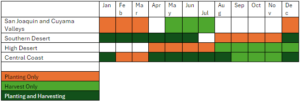
In California, carrot planting and harvesting vary by region.
- In the southern San Joaquin and Cuyama Valleys, planting from December to March yields harvests from May to July, while planting from July to September is harvested from November to February.
- In the southern desert, planting from August to February results in harvests from December to June.
- The high desert sees planting from April to July and harvests from August to December.
- On the central coast, planting from December to August produces harvests from April to January.
Table 1. California Planting and Harvest of Carrots (UC Vegetable Research and Information Center)
What have been the food safety issues associated with carrots?
Food safety issues associated with carrots in the United States have been relatively uncommon, below are recent events.
- 2024 E. coli Outbreak: In November 2024, an outbreak of E. coli O121 was linked to organic whole and baby carrots. The outbreak has reported 39 cases across 18 states. The Centers for Disease Control and Prevention (CDC) and the Food and Drug Administration (FDA) issued warnings and recall of the contaminated products took place.
- 2012 Salmonella Recall: Carrot chips (sliced carrots) were recalled due to Salmonella contamination.
- 2019 Listeria Recall: In 2019, various minimally processed vegetables, including carrot sticks, due to potential Listeria monocytogenes contamination. The recall was a preventive measure, and no illnesses were reported. The FDA provided guidance to consumers regarding the recall.
What are the growing conditions for carrots?
Carrots are grown in well-drained, sandy soil at optimal temperatures of 60 to 70°F. High temperature can cause bolting, pale color and texture issues. Carrots are generally ready to harvest approximately 70-80 days after planting, however, this depends on weather conditions and regionality.
What are some best practices to consider before planting carrots?
Ensuring food safety begins before carrot planting by addressing potential risks in the growing environment. Key practices include assessing land for contamination risks, using safe inputs and preparing soil and water sources to minimize pathogen introduction.
- Previous Land Use: Evaluate the historical use of the land for potential contamination risks, such as livestock grazing, use of biosolids or untreated manures.
- Adjacent Land: Assess nearby land uses, such as livestock operations, composting sites or drainage areas, to identify risks of water or soil contamination.
- Inputs and Amendments: Food safety risks regarding soil amendments mostly involve raw manure or other untreated animal-based soil amendments. Document the use only properly treated compost or manure to minimize pathogen risks.
What irrigation methods are used for carrots?
A consistent water supply is essential for optimal carrot color and root development. Irregular wet-dry cycles can cause root splitting, while overwatering can hinder color formation and increase the risk of disease. Carrots are typically irrigated using sprinkler irrigation during the entire season. In the California Imperial Valley, growers often switch to furrow irrigation after emergence (more here). The use of surface water without an assessment or treatment is not recommended as surface water may be contaminated and harbor pathogenic bacteria (more here).
It is important for carrot growers to comply with the updated FSMA Produce Safety Rule (Subpart E), carrot growers should follow these practices for agricultural water management:
- Conduct Annual Assessments: Growers must evaluate water sources and distribution systems annually to identify hazards that could contaminate carrots. Consider factors like water application methods (e.g., drip, furrow or sprinkler) and environmental conditions.
- Implement Corrective Measures based on Assessment Outcomes: If risks are identified, growers must take action, such as discontinuing use and performing corrective measures before resuming use such as treating water using alternative water sources.
- Keep Records: Documentation of water tests, assessments and corrective actions is required for compliance with FSMA and to ensure traceability.
How are carrots harvested?
Commercially grown carrots are harvested using self-propelled multirow harvesters. These machines lift the roots, shear off the tops and deposit the carrots into trucks for transport to sheds for washing, grading, sizing and packing. In the California Central Valley, transport distances are short, often to Bakersfield, while desert-grown carrots may be hauled over 300 miles (UC Vegetable Research and Information Center). The University of Colorado Extension highlights that hand harvest of carrots could increase the risk of cross-contamination from field workers to the crop.
What are water management practices in packing operations?
Before storage, carrots are typically washed and hydrocooled in clean water with 100 ppm chlorine (pH 6.5–7.5) (UC Vegetable Research and Information Center). The University of Georgia reports that cleaning and cooling water for carrots should be chlorinated at 75–100 ppm of free chlorine, achieved via gas injection systems, bleach or calcium hypochlorite tablets. Chlorination levels should be frequently monitored using chlorine test kits or litmus paper. Maintaining water pH between 6.5 and 7.5 is critical to optimize chlorine effectiveness and prevent excessive chlorine use (UGA Extension).
What are good practices for managing packinghouse equipment?
The University of Georgia shares that packinghouse equipment must be kept clean to prevent microbial growth. Residual products on belts, tables and conveyors should be removed by thorough scrubbing during cleaning procedures. When necessary, sanitizing with a chlorine solution can be applied, especially on belt conveyors and other equipment, using hand sprayers for spot treatment. Tools and apparel, such as knives, saws, blades, boots, gloves, smocks and aprons should be cleaned or replaced as required to maintain hygiene standards.
What are the ideal storage conditions for carrots?
Ideal storage conditions are 32°F (0°C) with 99% relative humidity, allowing carrots to be stored for over seven months with minimal losses. At slightly warmer conditions (33.8°F, 98% RH), storage duration reduces to five months.
What are some additional resources related to carrots?