



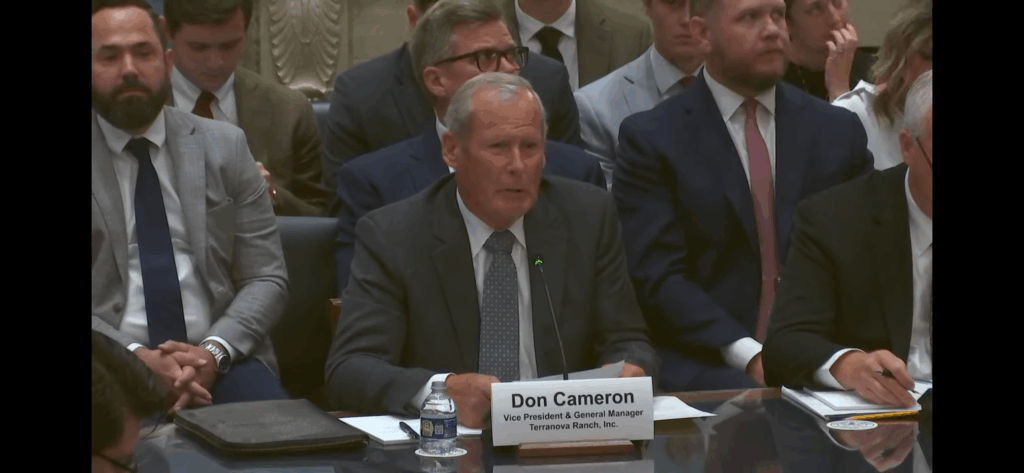
At Tuesday’s House Agriculture Committee hearing titled “Past Breakthroughs and Future Innovations in Crop Production,” Don Cameron, Vice President and General Manager of Terranova Ranch Inc. and Western Growers Board Member, delivered testimony highlighting the challenges and opportunities facing agriculture on the front lines of food production.
Cameron was introduced by Rep. Jim Costa (D-CA), a senior member of the Committee, who described him as “the full package” when it comes to agriculture. In his remarks, Cameron outlined the mounting economic pressures on growers and called for greater federal investment in crop protection tools and research, including biologicals and integrated pest management strategies. He also voiced support for the IR-4 Project, and stressed the need for science-based, streamlined regulatory processes at both the U.S. Department of Agriculture (USDA) and Environmental Protection Agency (EPA) to help accelerate the adoption of safe, effective innovations.
Chairman Glenn “GT” Thompson (PA-15) echoed that call for science-driven progress during his opening statement, noting that “American agriculture has become the envy of the world because we have embraced science, technology and a commitment to progress.” He warned that overly burdensome regulations could stifle innovation. “When innovators face confusion about which agency has jurisdiction, or when reviews take years with no clear rationale, we risk falling behind global competitors who are moving faster to deploy the tools of tomorrow,” Thompson said.
You can read Don Cameron’s full testimony below.
Testimony of Mr. Don Cameron
VP and General Manager of Terranova Ranch, Inc.
House Committee on Agriculture
Past Breakthroughs and Future Innovations in Crop Production
July 22, 2025, 10:30 a.m. ET
Introduction
Chairman Thompson, Ranking Member Craig, and members of the committee, it is an honor to be invited here today to help inform the important decisions you have been elected to make on behalf of U.S. agriculture for the food security of this nation.
My name is Don Cameron. I am Vice President and General Manager of Terranova Ranch in Helm, in the Central Valley of California. We farm over 25 different crops with 6,000 acres of our own production and 1,500 custom farmed for other clients. We grow a mix of conventional and organic crops including processing tomatoes, peppers, onions, corn, walnuts, wine grapes, almonds and pistachios. I have served in various agricultural leadership capacities throughout my career as a farmer including President of the California State Board of Food and Agriculture which advises the California Secretary of Agriculture and the Governor on agricultural issues and am also a board member of Western Growers Association.
State of Play
Today, we are here to talk about innovations in crop production including crop protection tools, so I’d like to spend just a moment talking about the current state of play.
Farmers are in the business of providing healthy, nutritious food. The ever-increasing cost of inputs; seed, water, energy and labor make for thin margins without room for error. To ensure my livelihood and that food arrives at your grocery store, restaurants, and schools, I must protect my crops from pests and disease. I can assure you, with all the costs of doing business and its associated regulatory burdens, farmers don’t have slush funds to waste on crop inputs that are not necessary. We look for ways to minimize what we use, which is how we have always handled the issue of crop protection. As a farmer, I’m aware of consumer apprehension about the use of pesticides and in turn retail grocery stores and restaurants who have been sensitized to the issue. As a father and grandfather, I am sympathetic to consumer concerns when hearing about pesticides in the media. I would like to note that the most extreme version of stories often gets the most attention, so I appreciate the opportunity to discuss this issue and how we can best support farmers and provide consumers with access to fresh, affordable, and safe food.
Sometimes we look past the fact that pesticides are regulated by the EPA with support from USDA, FDA, and state agencies to ensure that they are safe for human health and the environment under their intended use using scientific data. The Federal Insecticide, Fungicide and Rodenticide Act (FIFRA) mandates rigorous risk assessments to determine any associated risks and the necessary mitigation measures that must be taken before a product can be registered and applied. EPA also establishes residue limits or tolerances and tests for them regularly to ensure the safety of the food supply and has a “reasonable certainty” of no resulting harm from any pesticide residue.
Pesticides play a vital role in our food system, helping farmers protect their crops from destructive pests that threaten both yield and quality. An economics study by the California Department of Food and Agriculture’s Office of Pesticide Consultation and Analysis (CDFA OPCA) highlighted the real-world consequences of limited pest control options, revealing that in 2023 California cotton farmers lost $40.9 million due to an outbreak of Lygus bugs on Pima cotton—a loss directly linked to the lack of any effective tools to manage just one pest.
This example underscores the broader challenge faced by fruit and vegetable growers who must meet a high standard of quality demanded by consumers. In today’s culture, where shoppers often bypass slightly blemished produce in favor of perfect-looking fruits and vegetables, the pressure on farmers to deliver flawless crops is immense. To support both consumer expectations and public health goals centered around nutritious diets, a full range of innovative crop protection tools, including pesticides, is essential to ensure the reliable production of appealing, high-quality fresh produce.
Grower Innovation
Growers have been investing in crop innovations for a long time and are making great strides to reduce reliance on traditional pesticides, increase crop resilience, and diversify with innovative technologies. Farmers are utilizing integrated pest management (IPM) methods to manage pests while minimizing risks to people, property, and the environment, introducing predatory insects, precision agriculture, leveraging crop breeding and genetics to develop plants resistant to pest and disease pressures, laser weeding, autonomous equipment and more. As you know, farmers are pragmatic and continually adapt and improve to survive, but much more can be done to support the industry in these efforts including research and support for novel technologies.
It should come as no surprise that growers must ascertain very quickly which crop protection tools work and which don’t. With razor-thin margins, we can be reluctant to make a switch from something that we know works, to a new product or technology that is unproven. Efficacy concerns, costs associated with retrofitting equipment or unique handling requirements such as refrigeration, and the need for increased applications are all things to be considered. Biologicals are new technologies and growers are less familiar with them and will need additional technical guidance and incentives to take the leap. Proving something in a research lab is far different than in an open field, so we need to get more biologicals in the hands of growers to test it themselves and see what works best. We also see a strong need for resources to help evaluate and trial these products for efficacy on farm, getting the necessary data for broader grower buy-in.
The Trump Administration’s recently released the Make America Healthy Again (MAHA) report which in part seeks to address consumer apprehension to potential exposure to some pesticides. We see this spotlight on healthy food as an opportunity to spur collaborations toward innovative tools to address concerns while cultivating a viable future of domestically produced fruits and vegetables safeguarded from pests and diseases. With the committee’s leadership and oversight on the issue, innovations in crop production can help growers continue to provide healthy, nutritious foods for Americans.
USDA Opportunities
The US Department of Agriculture has the opportunity to lead the acceleration of developing novel crop protection tools. Biological products are one of the fastest growing segments of the pest control market and America should be seen as a leader of research and development for crop protection. This committee recognizes the IR-4 Project as a key resource for the specialty crop industry and we support increased funding to enable its continued work with novel crop protection technologies for specialty crops, including biological products. Relatedly, the IR-4 Project used to partner with the US Environmental Protection Agency (EPA) on a Biopesticide Demonstration Grant Program to coordinate the trials and promotion of the use of biopesticides; this program should be reinvigorated. I also encourage an increase in research grants specific to next generation crop protection tools specifically targeted at pests that are the greatest threat to our food supply. USDA’s Office of Pest Management Policy also stands to be a leader in new technologies, and we encourage increased funding for this vital team.
US EPA Opportunities
While the scope of the committee’s jurisdiction over EPA is limited, I think we can agree that EPA’s impact on agriculture cannot be overlooked, and we appreciate the committee’s attention to this issue. Given the complicated balancing act of agricultural pesticide use, I encourage EPA’s increased engagement with biological registrants to facilitate knowledge sharing in two ways: EPA educating smaller innovative biological companies with an understanding of the registration process, and EPA providing opportunities for innovators to share the latest tools and techniques for their ongoing awareness- both are necessary to shorten the lengthy timeline for innovative tools.
EPA staffing issues also impact the ability to move applications through the registration process in a timely fashion. First, there simply aren’t enough EPA staff to keep up with the workload, a key reason EPA has described as the hurdle to finalizing registrations. Second, the staff being hired are not as familiar with biotechnology as they are often grounded in conventional products. Growers appreciate recent announcements from the EPA related to staffing priorities and we support increasing staff who can focus on biological registrations.
The EPA has a unique opportunity to lead beyond its own federal agency. US growers are impacted by multiple levels of pesticide regulations and pest pressures, and we look to the EPA to engage both domestically and globally. For those of us in California, where about half of the US production of nutritious fruits and vegetables are grown, an additional registration and reporting process is required by California’s Department of Pesticide Regulation (DPR). DPR has a shared interest with the EPA in advancing biological crop protection technology. The dual registration requirement processes, however, run counter to a swift development of next generation products such as biologicals and provide a concurrent registration process. I encourage EPA to dialogue with DPR to collaborate on this shared goal and develop an MOU to guide sustainable crop protection tools in the hands of growers at a rapid pace.
Closing
As I close, it is my hope that through conversations like this and through your leadership, we can pave the way for America to lead in these innovations and by so doing, continue to produce healthy food long into the future.
Thank you again for the opportunity, I look forward to your questions and to this important discussion today.
Tuesday’s full witness list included:
Mr. Don Cameron, Vice President and General Manager, Terranova Ranch, Inc., Helm, Calif.
Mr. Terry Abbott, Chairman, Council of Producers and Distributors of Agrotechnology (CPDA), Lakewood, Colo.
Dr. Karl Wyant, Director of Agronomy, Nutrien, Tempe, Ariz.
Mr. Bryan Witherbee, Chief Executive Officer, Agragene, Inc., St. Louis