



Something occurred to me while participating in a metagenomics panel at the International Association of Food Protection (IAFP) this past summer in Cleveland, Ohio. I was attentively listening to the other panelists and how they have found value and promise in this emerging discipline, sharing insights into how they incorporate screening ingredients and processing facilities to understand their unique microbial and genomic profile. As I listened to their remarkable use cases, I couldn’t help but feel that the discussion about the entire genetic community of food and processing sounded remarkably static when referring to a microbial world that is not static at all.
Thus began a long series of thoughts on my part – spanning months, not weeks. I’ve always approached food production through a microbiologist’s lens. Everywhere we produce food, whether in a field or in a facility, we should expect that shifts in conditions will cause microorganisms to quickly respond and evolve. Whether in an agricultural field or in a facility, microorganisms live in constant flux, filling adaptive roles in the ecosystem. Simply put, to assume static populations in these environments is a scientific mismatch. Without constant change, they perish.
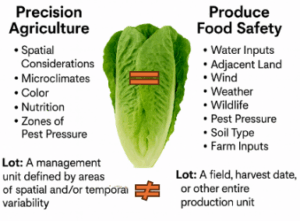 This point of view gives me a slightly different vantage point than most, but it isn’t unique to microbiologists. Agronomists, horticulturists, plant geneticists, soil scientists, plant pathologists, and the like, all hold a similar viewpoint. For these experts, they would never consider every plant in a field the same. They would never assume uniformity in soil characteristics, a field of production, or assume that all inputs, agronomic practices, and climatic shifts lead to equal and uniform outcomes for crops planted within a field. Their tools—stratified sampling, site-specific management, and targeted treatment—are built around acknowledging that fields are heterogeneous by nature.
The disconnect between these two approaches on the same topic is disconcerting. One discipline (agronomic) would never assume homogeneity for plants within the same field – they would design treatments and needs based on stratified sampling and assessments to make sure they only treated plants with the need. The other (food safety) often considers the exact same plant as a homogeneous product when produced with the same inputs, during the same time frame, and on the same ranch/farm.
Here’s the key question: At what point does an inherently variable plant become a food, and its unique lived exposure and state reduced to one lot code of operational production?
Lotting is a challenging activity and generally comes down to functional operational units like those mentioned above (field, harvest day, single irrigation system, pack day). For produce food safety, we must balance these operational units with the known scientific variability (and potential risk) of the lot – like we do for precision agriculture, aligning food safety strategies with practices of agronomists, soil scientists, plant scientists, etc. What doesn’t make sense to food safety is to consider these highly variable factors within a field (adjacent land, microclimates, soil composition, crop treatments, pest pressure) and then lump all the plants in that field into one single production lot. Doing this, we lose (1) the ability to truly identify root cause by creating too broad a lot, (2) we assume guilt of a whole field, production day, or season when only a fraction of crop may carry risk, (3) we lose resolution in traceback and cause overly broad, non-risk-based recalls.
Given the inherent variability in biological systems, environmental conditions within a field, and production practices, the burden should be on demonstrating that they are sufficiently alike to be considered one lot, and that the food safety risk they carry is truly uniform. Functionally, this means we need to find a more representative way to lot, likely more similar to that of Precision Agriculture. Precision Agriculture treats lots within fields as microzones, incorporating spatial variability and scientific differences to delineate lots for cultivation. Produce food safety must evolve to do the same. Given what we know about agronomic science, microbial ecology, remote sensing showing inter-field variability, and types of food safety risks – broad uniform food safety risks within fields are less likely to exist, and higher resolution is needed to pinpoint where risks are.
With more granular lotting, we can approach food safety risk much like that of precision agriculture– managing where the needs are, and not by an arbitrary operational lot that ignores known variability. With higher resolution lotting, we (1) shift the burden of proof – no longer assuming uniformity, but needing to prove it, (2) use agronomic data to define microzones that can improve our ability to resolve where and when risks are present (3) align agronomic strategies along with produce food safety practices to optimize both outcomes.
Designing higher resolution lotting for food safety in produce is a necessary evolution, just like precision agriculture and targeted agronomic treatments are necessary to improve sustainability and yield.
Granular lotting for food safety offers us the opportunity for:
- Better resolution during root cause investigations
- More targeted risk mitigation and corrective actions
- Fewer unnecessary product losses
- Incorporates the variability that what we already know is inherent for plants, agricultural environments, and microbial ecology.
Just as Precision Agriculture is offering better yields, resource allocation, and pest control, precision food safety can offer smarter prevention strategies, quicker and more accurate responses, and ultimately lead to better public health and economic outcomes for growers.