



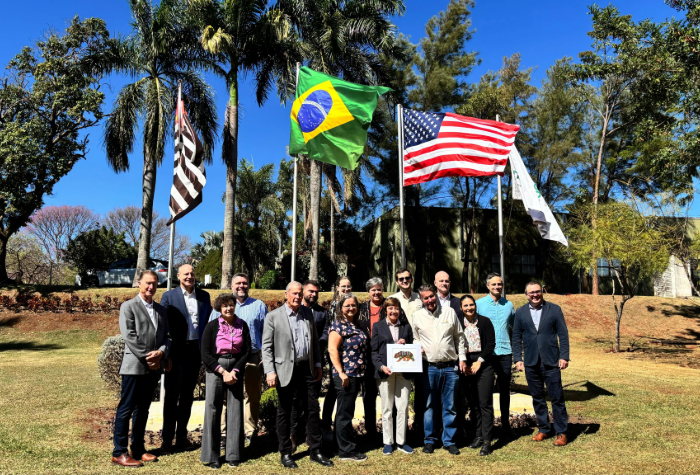
As we stood in the shade of the wind-rustled trees, overlooking the largest Hass Avocado farm in Brazil, only the intermittent cool breeze reminded us that were in fact, far from home. At Jaguacy, a multi-generational family farm in the state of São Paulo, a retrofitted storage shed contained a “Matryoshka dolls” style beneficial-wasp-parasitized-egg production and drone release program, deployed to control the avocado seed moth.
Teeteringly tall sprinklers danced overhead, which we were told cooled the trees in the dry summer months, an idea adapted from the frost control measures of California vineyards.
On this California Department of Food and Agriculture (CDFA) supported delegation made up of California agricultural organizations strengthening ties with Brazil, we witnessed firsthand the adaptive and innovative strategies advancing Brazilian agriculture.
Our visits highlighted the rapid development and wide-spread adoption of biological products as well as the acceleration of precision agriculture for Brazil’s farmers. With a thriving start-up scene and expanding rural connectivity, AI tools and data analytics are providing insights to improve yield, as well as water and nutrient use efficiency.
Highlights of the visits included the start-up companies Symbionics Brazil and IDEE Lab, both using AI and genomic sequencing to discover and commercialize new biological products, as well as Koppert Brazil tackling pest pressure with drone-deployed biologicals, and AgNest validating new technologies for farmers in real-world farming systems.
At Fundecitrus, an association of citrus growers, we toured the Applied Research Center, a model institution for international collaboration and solutions-focused transparency. Their efforts to stop the spread and address the impacts of Huanglongbing (HLB), a bacterial infection of citrus plants, has engaged more than 19 scientific institutions in seven countries, including our own UC Riverside. The pest monitoring and management lab provides free PCR testing for farmers for HLB and other pathogens as well as support for farmers to rogue and replace infected trees.
Key research projects are investigating psyllid repellents, attractants and lethal trap plants to include biotech development projects as well as research to better understand the spread of the disease via the vector.
Researchers have observed a high correlation with climate and disease spread, particularly in the central region of Brazil. Warmer climates accelerate the quick life cycles and pesticide resistance can develop quickly, so new offensive tools are needed. Although the Fundecitrus researchers believe that HLB is currently “the worst problem that citrus will face in its lifetime,” their team is committed to supporting their growers to fight to maintain and build resilience for this important industry.
This unforgettable experience was an incredible opportunity to learn from our fellow farmers and ag industry members and build upon diplomacy underway long before our time. I was reminded and proud of the incredible innovation and resilience of California’s agriculture industry, and I return home deeply inspired by the shared passion for sustainability and collaboration. I am incredibly grateful for the opportunity to be part of this delegation to Brazil and look forward to building on relationships and learnings to further support and elevate California agriculture.