

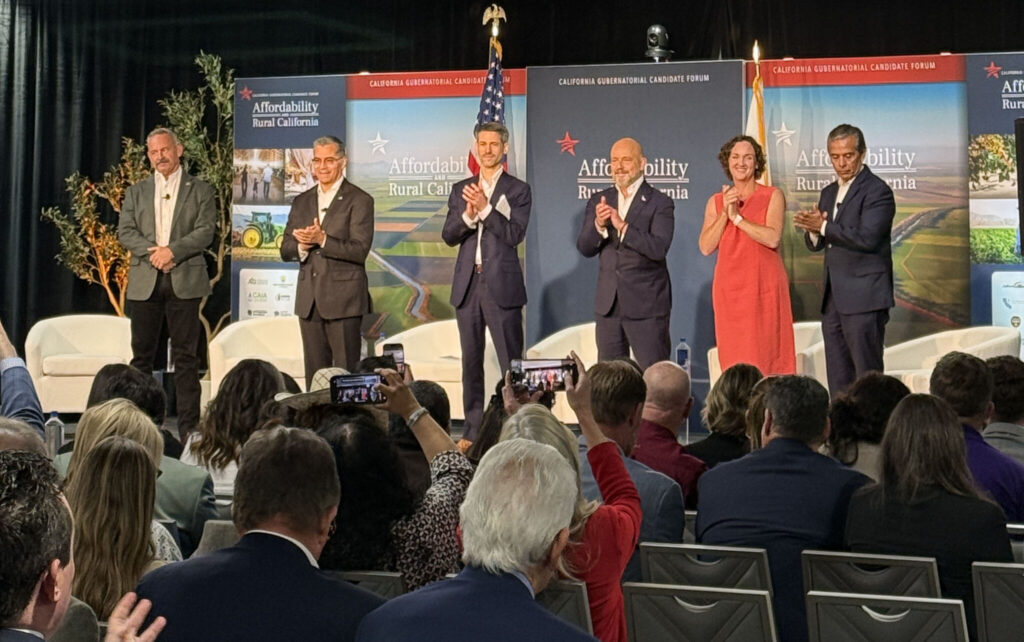
An estimated 525 attendees gathered at Fresno State University for the California Gubernatorial Candidate Forum, “Affordability and Rural California,” for a wide-ranging discussion that highlighted the economic pressures facing the state’s rural communities and agricultural industry.
Hosted at the Ruiz Event Space in the Lynda and Stewart Resnick Student Union, the event brought together six leading candidates—Xavier Becerra, Chad Bianco, Steve Hilton, Matt Mahan, Katie Porter and Antonio Villaraigosa—for a conversation centered on affordability, agriculture, water and energy policy. The Forum was moderated by Kristin Olsen-Cate, Partner at California Strategies & Advocacy, and Fresno County Supervisor Buddy Mendes.
A Unifying Issue: California is Too Expensive
Despite their ideological differences, the candidates aligned on one central issue: California’s cost of living has reached unsustainable levels. From housing and energy to groceries and healthcare, each candidate acknowledged that affordability is placing increasing strain on both families and the agricultural sector.
But, they disagreed on how to address it.
Republican candidates Chad Bianco and Steve Hilton pointed to taxes and regulation as the primary drivers, calling for broad rollbacks. Bianco pledged sweeping regulatory reductions, while Hilton proposed lowering vehicle fees, expanding in-state energy production and reducing the size of government.
Democratic candidates, while acknowledging regulatory burdens, emphasized more targeted reforms. Katie Porter and Matt Mahan highlighted housing as the largest cost pressure, with Porter proposing tax relief for lower-income earners and Mahan advocating for comprehensive environmental review reform to accelerate development.
Antonio Villaraigosa and Xavier Becerra framed affordability as a broader, systemic challenge requiring coordinated policy changes across multiple sectors.
Agriculture at the Center of the Debate
Given the Central Valley setting, agriculture remained a focal point throughout the forum. Candidates repeatedly noted that California has lost tens of thousands of farms over the past few decades, raising concerns about the long-term viability of the state’s agricultural economy. There was broad agreement that regulatory costs have increased dramatically (some estimates more than tenfold over the past 20 years), placing significant strain on growers.
Porter emphasized the economic reality confronting growers: “Farmers are not leaving agriculture by choice… they’re losing their farms financially.”
Villaraigosa pointed to the rising cost burden: “We’ve gone from $160 an acre in regulatory costs to $1,600… that’s not sustainable.”
Bianco argued current policies are actively undermining the sector: “Everything being put in place is to make sure that farming doesn’t exist in the future in California.”
Hilton framed the issue as a policy failure: “The assault on this industry has to stop.”
Mahan focused on regulatory impact: “We have increased the cost of complying with regulations on farms by 13 times in just 20 years.”
Xavier Becerra called for a more targeted approach to oversight: “Let’s start to shave away all the other regs that have nothing to do with safety and production.”
Energy Costs and Climate Policy Tensions
Energy emerged as another major point of contention, with candidates debating the balance between climate goals and affordability. All candidates agreed that energy costs are too high, but they disagreed on why. The Republican candidates blamed climate policies and restrictions on fossil fuel production, while the Democratic candidates pointed to a need for better planning and investment in infrastructure.
Mahan and Villaraigosa advocated for a more “all-of-the-above” energy strategy, including maintaining existing energy sources while transitioning to cleaner alternatives. Porter emphasized the need to expand renewable energy and storage capacity, noting that demand is expected to rise sharply in the coming years.
Notably, when asked whether California needs to rethink the balance between climate mandates and affordability, every candidate raised their hand in agreement, underscoring a rare moment of consensus.
United on Water but Split on Strategy
Water policy, one of the most critical issues for the Central Valley, generated both agreement and debate. Candidates widely supported expanding water storage, improving conveyance systems and investing in infrastructure. However, disagreements emerged over specific projects and regulatory frameworks.
Republican candidates pushed for large-scale reservoir construction and fewer environmental restrictions, while Democratic candidates emphasized a mix of solutions, including groundwater management, recycling and conservation.
The state’s Sustainable Groundwater Management Act (SGMA) drew mixed reactions. Some candidates called for major reforms or repeal, while others defended its intent but criticized its implementation as overly complex and burdensome. Across the board, candidates stressed the need for more predictable water supplies to support long-term agricultural investment.
Candidates Split on Role of Government
Beyond specific policies, the forum revealed a deeper divide over how California is governed. Several candidates criticized the growing power of regulatory agencies, arguing that unelected bodies wield too much influence over industries like agriculture. Porter and Villaraigosa called for stronger legislative oversight, while Hilton and Bianco advocated for dramatically shrinking the regulatory state. Mahan framed the issue as one of accountability, emphasizing the need to measure outcomes rather than simply adding new rules.
The Road Ahead in the Gubernatorial Race
While the candidates disagreed on solutions, the forum made clear that affordability and the future of rural California will be central issues in the gubernatorial race. From housing and energy to water and agriculture, the challenges discussed in Fresno reflect broader tensions across the state: how to balance economic growth, environmental priorities and the cost of living for everyday Californians.
As moderator Kristin Olsen noted in her opening remarks, the question facing voters is ultimately simple: What can the next governor do to make California more affordable while sustaining the industries and communities that keep it running?
Did you miss the live stream?
You can watch the forum in its entirety on YouTube here.
_____
A special thanks to the 30-plus agriculture industry associations and the Maddy Institute for joining together to sponsor this event:
Almond Alliance
Ag Association Management Services Inc.
Agricultural Council of California
California Agricultural Irrigation Association
California Alfalfa and Forage Association
California Apple Commission
California Association of Wheat Growers
California Association of Winegrape Growers
California Blueberry Commission
California Cherry Growers and Industry Association
California Citrus Mutual
California Cotton Ginners and Growers Association
California Farm Bureau
California Fresh Fruit Association
California Grain and Feed Association
California Pear Growers Association
California Poultry Federation
California Seed Association
California State Beekeepers Association
California State Floral Association
California Sweet Potato Council
California Tomato Growers Association
California Walnut Board
California Warehouse Association
California Wild Rice Advisory Board
The Maddy Institute
Olive Growers Council of California
Olive Oil Commission of California
Pacific Coast Renderers Association
Walnut Alliance
Western Growers
Western Tree Nut Association