



Under federal law, all commercial motor vehicle (CMV) drivers must be able to “read and speak the English language sufficiently to converse with the general public, understand highway traffic signs and signals, respond to official inquiries, and make entries on reports and records.” In 2023, the U.S. Department of Transportation (DOT) estimated that 3.8 percent of the U.S. interstate commercial driver population (approximately 3.5 million people) lack proficiency in English.
This year the Trump Administration has taken action to strengthen English language proficiency (ELP) enforcement. Effective June 25, roadside inspectors can now place interstate CMV drivers out of service immediately if they are unable to meet the ELP standards. Previously, violations would result in citation only.
Enforcement is largely conducted by states, so Western Growers members should expect timing and scope to vary state by state. Awareness and proactive planning will be crucial during the transition seasons that take many drivers back and forth between California and Arizona.
The WG federal and state government affairs teams are actively in contact with the relevant authorities to ensure we have the best information available for members now and moving forward. Provided below is a list of frequently asked questions with information that is current as of September 19, 2025.
Who must meet English language proficiency standards?
These standards and enhanced enforcement apply to all interstate CMV operators, not just those with commercial driver licenses (CDLs). It is important to note these standards also apply to H-2A and other work visa holders, as well as Mexican and Canadian-domiciled drivers, if they operate a CMV across state borders or borders with the United States.
According to the American Trucking Association, employers responsible for driver compliance (including those employing visa holders) must ensure all drivers meet ELP standards. They are also responsible for ensuring a violation by their driver is corrected before they hit the highway again.
Members should consider including a new section on English proficiency in their hiring, training, and retention policies. Companies should also consider investing in language training to retain drivers and minimize turnover.
Further actions to consider:
- Update onboarding and qualification: Evaluate English comprehension as part of your road test, in-person interviews or orientation training. Document it.
- Reassess current drivers: If you suspect someone may struggle with ELP under the new standard, now is the time to coach or reevaluate roles.
- Plan for accommodations: If you employ drivers with hearing impairments or waivers, work with legal counsel and document that these drivers meet federal exemption standards. Educate your team on how to handle these edge cases at scale.
- Invest in training tools: Use language improvement programs/apps, or in-house driver coaching, to reinforce English proficiency, road terminology and situational safety. Keep record of training materials, events, or any other action that was taken to prepare drivers.
- Stay up to date: The executive order and DOT guidance leave room for evolving policies. Bookmark the FMCSA ELD & Safety page and monitor updates to ELP enforcement criteria.
What is a commercial motor vehicle?
A CMV is any self-propelled or towed motor vehicle used on a highway in interstate commerce to transport passengers or property when the vehicle—
(1) Has a gross vehicle weight rating or gross combination weight rating, or gross vehicle weight or gross combination weight, of 4,536 kg (10,001lbs.) or more, whichever is greater; or
(2) Is designed or used to transport more than eight passengers (including the driver) for compensation; or
(3) Is designed or used to transport more than 15 passengers, including the driver, and is not used to transport passengers for compensation; or
This vehicle universe includes reefer trucks, semi-trucks, tank trucks, flatbeds, box trucks, buses, large passenger vans, and generally large combination or pivot joint vehicles.
Who can test drivers for ELP compliance?
Official ELP inquiries can be made by federal and state traffic safety officers (e.g. highway patrol), border patrol, agricultural checkpoints and cargo weight-limit station personnel. Inspectors should be certified by the Commercial Vehicle Safety Alliance, which maintains the North American Standard Inspection Program.
It should be noted that, while the federal order applies only to interstate commerce, there is nothing in the order that bars individual states from broadening their own enforcement to include intrastate transit (i.e. trips within state lines).
How will an ELP test be administered?
Inspectors are to begin all roadside inspections in English, and if they suspect a driver doesn’t understand them, they must then administer a test that includes:
- An oral interview. Drivers must be able to understand and answer questions to the best of their ability about shipping documents, load type, the origin and destination, how long they’ve been on duty, and the vehicle itself. They cannot use interpreters, smartphones/translation apps, cue cards or other aids during the interview. Hearing-impaired drivers that are capable of reading and writing in English can satisfy the requirement. There should be no questions that are unrelated to the job or driver standards, including questions about immigration status.
- A highway traffic sign recognition component (both static and electronic). This portion only occurs if the oral interview is sufficient. A driver may explain the meaning of prompted road signs in a language other than English, provided the assessing officer can also communicate in that language. This portion will draw from the Federal Highway Administration’s Manual on Uniform Traffic Control Devices (MUTCD).
If the inspector determines that the driver is proficient (i.e. functional but not fluent), the inspector may conduct the rest of the inspection using the communication methods and techniques best suited to facilitate the safe and effective completion of the inspection.
If the inspector determines that the driver is not proficient, they are to be immediately placed out of service and cannot continue their trip. The vehicle and any accompanying cargo may be towed to a nearby yard. Members should consider reviewing internal procedures, as well as any contracts with brokers and/or buyers, to confirm responsibility and process in the event a driver and/or cargo is stranded due to an out of service stoppage.
Are there exceptions for farming from these standards?
The executive order does not create any new ag specific exemption or exception from this enhanced enforcement.
There are existing ag exemptions for some federal driver qualification standards (including ELP). Any driver that already meets the existing exemptions’ criteria is not required to meet ELP standards. However, there are still ELP standards for farm drivers of certain CMV types, so it is still a gray area with case-by-case considerations. WG continues to seek clarity if such exceptions would be applicable to this new enforcement.
Are there exceptions for drivers near the U.S.-Mexico border?
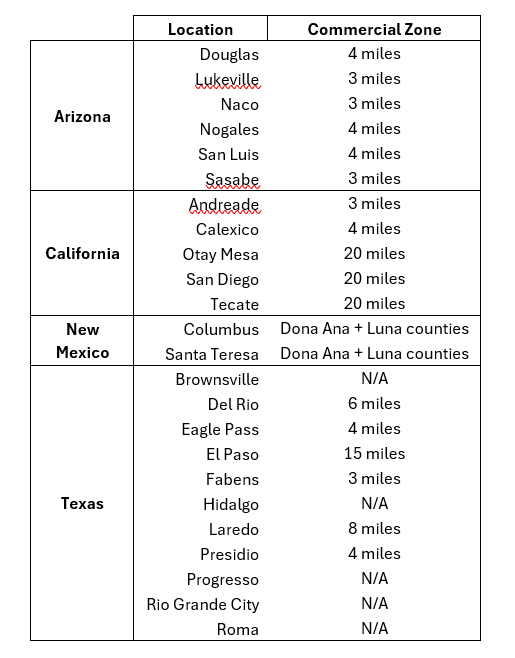
Mexican cross-border/interstate drivers with a valid CDL equivalent are subject to U.S. laws and regulations, including ELP requirements. There are exceptions for designated commercial zones along the U.S.-Mexico border that will be maintained. In these areas, drivers are subject to the ELP requirements and may still receive citations, but they will not be placed out-of-service solely for ELP noncompliance [see chart]. At this time there are no exceptions for areas surrounding the U.S.-Canada border.
Please contact Tracey Chow for additional information: [email protected] or 202-704-7312.
