



Last updated 11/1/2024
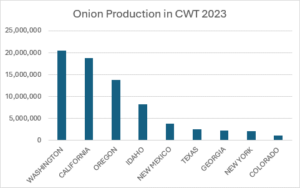
According to the 2022 Census of Agriculture, onions rank among the top-produced commodities in the U.S., with 166,000 acres harvested that year. In 2023, 28 percent of onions were produced in Washington State, 26 percent from California and 19 percent from Oregon. (USDA , NASS)
As reported in the Vegetables and Pulses Yearbook Tables, in 2023, 20.8 percent of the domestic availability of onions were imported, while 79.8 percent were from domestic origin. However, of Salmonella outbreaks linked to bulb onions in 2020 and 2021 from both Mexico and the U.S, no definitive root-cause was identified for these two outbreaks.
At Western Growers, food safety is extremely important, and in response, we have developed this FAQ and resource list to provide guidance and access to essential food safety information for onion production.
Frequently Asked Questions Related to Onion Food Safety (FAQs)
Onion Characteristics and Food Safety
Drier, thicker outer onion skins reduce the likelihood of pathogen growth, however pathogens may still survive in these outer layers. Despite natural antimicrobial compounds (like allicin and quercetin) in onions, these are insufficient alone for pathogen control.
While human pathogens can still survive on cut onions, infection by plant pathogens can make onions more prone to contamination. Maintaining the physical integrity of onions is essential, as decay can create conditions that favor pathogen persistence.
What are the pathogens that most commonly affect onions?
Salmonella has been linked to foodborne outbreaks associated with onions, particularly when onions are contaminated during growth or processing. However, contamination from other pathogens such as pathogenic E.coli can occur if onions are exposed to unsafe water sources during irrigation, or contaminated soil amendments. While not frequently associated with onions, Listeria monocytogenes can contaminate and grow on diced or processed onions, especially under improper refrigeration, making it a concern in ready-to-eat onion products.
Have onions been commonly linked to food safety outbreaks historically?
From 2009 to 2022, the NORS BEAM Dashboard reports seven multistate outbreak related to onions. Below is a list of those relevant outbreaks. In terms of etiology, one is related to E. coli and the other six are related to Salmonella. Below is a list of these relevant outbreaks.
- 2015: An E. coli O157 outbreak was linked to a pre-cut celery and onion blend used in rotisserie chicken salad sold at Costco stores. This outbreak affected 19 people across seven U.S. states. The CDC, in coordination with local health authorities, traced the contamination to celery and onion products supplied by Taylor Farms Pacific.
- 2016-2019: From 2016–2019, dry bulb onions were the suspected cause of three multistate outbreaks in the U.S.. These outbreaks varied in size from 29 to 149 ill people and were all identified between August and September of their respective years. No CDC or FDA reports were found regarding these outbreaks.
- 2021: A widespread outbreak of Salmonella Oranienburg was associated with whole red, white and yellow onions imported from Chihuahua, Mexico. This outbreak led to over 1,040 cases across 39 states with around 260 hospitalizations.
- 2020: Another significant Salmonella Newport outbreak linked to red, yellow and white onions from Thomson International, Inc. affected over 1,000 people in the U.S. and Canada. Tracebacks identified multiple illness clusters at restaurants where red onions were served, prompting a large-scale recall to mitigate risk.
- 2023: A Salmonella Thompson outbreak was traced to diced onions from Gills Onions, affecting 80 people across 23 U.S. states, with 18 hospitalizations and one death. Affected products were distributed to both foodservice and retail markets, with a recall issued in October 2023 to prevent further cases.
What are the recommended practices for handling irrigation water?
Water used in onion production can be a source of contamination, carrying various microorganisms of public health concern, including Salmonella, pathogenic E. coli and human viruses like hepatitis A. Prior produce-related outbreaks have identified water as a likely vehicle for contamination due to factors like wildlife activity upstream, storm runoff or canal dredging.
Irrigation water aspects that need to be considered include:
- Source of water (Surface, Ground, Municipal)
- Timing for irrigation (extended time before harvest allows time for pathogen die-off)
- Application (overhead, flood and furrow, or sub-surface)
Conducting a water assessment for (1) the type of each water source (e.g., ground, surface, or municipal), (2) the grower’s control over the water source, (3) the level of protection around the water source, (4) the uses of nearby and adjacent land, and (5) the chances that upstream water users may introduce hazards.
Should I be testing my agricultural water?
Water should be tested to understand the potential for contamination posed by the water source. Commodity Specific Food Safety Guidelines for the Dry Bulb Onion Supply Chain suggests testing for generic E. coli three times, at the start of the season, mid-season and near harvest, with more frequent testing for higher-risk sources like surface water.
Testing water quality throughout the season helps identify and manage any emerging risk.
Do whole, unprocessed onions undergo any pathogenic testing prior to harvest, at harvest or during storage?
Whole, unprocessed onions do not typically undergo routine pathogen testing before or during harvest or storage, as is common with leafy greens. However, some customers or buyers may require testing. Before establishing a testing program for onions evaluate (i) the purpose of the testing, (ii) the ability of current assays/lab method for testing and detecting contamination in onions, (iii) the power of the sampling based on contamination scenarios, (iv) how will the data generated by the testing program will be used and evaluated to maximize learning.
Does onion farming follow the same risk assessment protocols as leafy greens?
Onion farming is subject to the FSMA Produce Safety Rule (PSR), like leafy greens. However, most leafy greens, green grown in the U.S. are subject to the LGMA standard. Onion growers can adopt voluntary practices established in the (Commodity Specific Food Safety Guidelines for the Dry Bulb Onion Supply Chain). These guidelines provide recommended food safety practices that are intended to minimize the microbiological hazards associated with dry bulb onions.
What should I consider for the lifting, toping and curing activities?
The curing process helps protect onions by drying the neck, which minimizes entry points for pathogens. Proper curing in dry conditions aids in reducing potential contamination and supports safe storage by enhancing the protective outer layers.
Before starting lifting, topping or curing activities, growing areas should be checked for contamination risks, including signs of wildlife, domesticated animals, fecal contamination, flooding or crop damage. Decisions on whether to proceed should consider whether contamination could spread through equipment or worker movement.
- Agricultural water must be safe and adequate for all uses, including irrigation, drip tape removal, chemical applications or dust control.
- All tools and equipment involved in onion production, like knives and clippers, must be cleaned and sanitized when appropriate.
- Inspect harvest totes, bins, bags and transportation equipment to ensure they are clean, debris-free and in good condition before loading onions.
- Workers should adhere to health and hygiene policies, such as handwashing, using toilets, avoiding contact with onions when ill and having designated break areas.
- Onion storage facilities used for curing and drying must remain clean, dry and well-maintained, with measures in place to prevent and control pest activity.
Can weather affect the curing process of onions?
- Heat: Extremely hot temperatures can cause onion layers to collapse and lead to decay if onions are left exposed for too long.
- Cold: Frost can affect onions, causing translucent layers. Frost-affected onions should be stored separately for close monitoring to assess any postharvest deterioration.
- Moisture/Drought: Excessive rain near harvest time increases the risk of plant disease and postharvest deterioration. Using drying rooms and improving air circulation in storage and curing areas helps reduce moisture-related losses. If the edible crop portion contacts floodwater, it is deemed adulterated and unsuitable for harvest.
- Unusual Weather or Environmental Events: After significant events, growers should assess risks to the crop and water sources. Wildfire smoke, for example, may reduce UV exposure, affecting curing, while severe weather may disrupt septic systems, leading to water contamination. In cases of nearby wildfires, producers should consult local emergency agencies regarding any possible chemical contamination from firefighting efforts.
What is the risk related to diced/slithered onions?
While pathogens may not grow yet survive on onion skins, diced or slithered onions present risks, due to the potential contamination, and more favorable conditions for microbial growth:
- Fresh-cut onions, including diced forms, provide ideal conditions for pathogens like Listeria monocytogenes and Salmonella Typhimurium, and E coli growth, especially when stored improperly. Temperature control is critical to prevent microbial growth in diced onions (Jayeola, Lieberman)
- Cross-Contamination: During slicing, pathogens can transfer between onion slices, creating a risk for contamination of all pieces in bulk processing. This risk underscores the need for strict sanitation protocols during processing
How do environmental factors, such as weather events, affect onion safety?
Weather events like flooding or drought can impact onion safety by introducing contaminants from external sources. Floodwaters introduce various pathogens, including Escherichia coli, Salmonella and Listeria monocytogenes, which persist for weeks after flooding, suggesting that produce exposed to floodwater poses a significant health risk. Onions exposed to weather impacts may require adjustments to management practices.
What do we know about the Outbreak Investigation of E. coli O157:H7-related to Onions (October 2024)?
The FDA is investigating an E. coli O157 outbreak linked to slivered onions previously served on McDonald’s Quarter Pounder burgers. This outbreak involves 90 cases across 13 states, with illnesses reported from September 27 to October 16, 2024.
Are there concerns about the safety of onions due to the recent McDonald’s outbreak?
As of October 30, 2024, the FDA reports that “The current risk of illness from E. coli contamination is low because onions have been recalled and should no longer be available.” Importantly, the FDA noted on its website that according to available information, it is unlikely that recalled yellow onions were sold to grocery stores or directly to consumers. McDonald’s also has ceased using slivered onions in affected states, including Colorado, Kansas and Wyoming, as well as parts of Iowa, Idaho, Missouri, Montana, Nebraska, New Mexico, Nevada, Oklahoma and Utah. FDA’s investigation is ongoing.
Resources
Commodity Specific Food Safety Guidelines for the Dry Bulb Onion Supply Chain.
These guidelines provide recommended food safety practices that are intended to minimize the microbiological hazards associated with dry bulb onions.
FDA’s Strategy to Help Prevent Salmonellosis Outbreaks Associated with Bulb Onions
The FDA’s strategy to prevent salmonellosis from bulb onions involves enhancing safety inspections, testing and industry collaboration to mitigate contamination risks, especially for imported onions.
Studies/Articles of Interest
This study highlights the significant risk of preharvest contamination of subterranean crops, specifically carrots and onions, by enterohemorrhagic Escherichia coli O157 due to the application of contaminated manure compost and irrigation water. E. coli O157 was found to survive in the soil for 154–196 days and on the vegetables for up to 168 days, indicating that improper manure management and irrigation practices can lead to prolonged contamination of crops. It also emphasized the need for careful handling and monitoring of organic fertilizers.
Strategic approaches to mitigate Salmonella contamination of bulb onions
The study highlights the activation of onion innate immunity against Salmonella, revealing that while outer layers inhibit pathogen growth, internal layers allow proliferation, emphasizing the need for improved sanitation practices in the onion supply chain.
Cross-contamination risks in dry environments
This study found that Salmonella enterica and Enterococcus faecium can survive on food contact surfaces for up to three months in dry conditions, underscoring the need for improved cleaning strategies to prevent cross-contamination in fresh produce handling.
Assessing the potential for production practices to impact dry bulb onion safety
This study on the 2020 Salmonella Newport outbreak linked to onions revealed significant contamination risks from poor-quality agricultural water used for crop protection sprays and irrigation, particularly from overhead irrigation.
Survival of generic E. coli and Salmonella during the growth, curing, and storage of dry bulb onions produced with contaminated irrigation water
The study aimed to assess the survival of E. coli and Salmonella on dry bulb onions in Oregon and Idaho, using contaminated irrigation water. Due to high desert conditions, water reuse in irrigation leads to elevated microbial loads. Despite a contamination level of up to 3.5 log CFU/g on onions, the study found that two weeks without irrigation plus a curing process reduced E. coli and Salmonella levels significantly, remaining stable and below 1 CFU/g through curing and storage.
This study demonstrated that conventional curing practices effectively mitigate microbial risks from non-compliant irrigation water in Treasure Valley’s dry bulb onion production, reducing levels of generic E. coli and Salmonella spp. to less than 1 CFU/g, while also suggesting that generic E. coli can be a reliable indicator for Salmonella behavior in future research.
Questions
If you have any questions about onion food safety, please contact us at [email protected].