



As interest in reusable packaging grows across the fresh produce industry, reusable plastic containers (RPCs) are an important part of the conversation. While RPCs offer several benefits, such as reducing plastic waste and protecting product quality, their adoption also presents unique logistical and operational challenges. To learn more about how reusable packaging systems work in practice, I spoke with Sean Judkins-Boeri, Vice President of Sales and Account Management at Dispatch Goods, a company that specializes in reusable packaging logistics and washing services.
Q: Can you tell us about Dispatch Goods and how your work intersects with RPCs?

Sean: Dispatch Goods operates two primary business lines. One focuses on reusable packaging for direct-to-consumer meal and grocery delivery, while the other supports foodservice operators with reusable packaging systems. In the RPC space, Dispatch works as a logistics and washing partner for companies such as Misfits Market and Imperfect Foods. The company collects used RPCs from distribution centers, washes, repalletizes them, and returns them to circulation.
“We pick up truckloads of dirty RPCs, they go through our wash process, they’re repalletized and we redistribute them,” Sean explained.
Photo: Dispatch Goods
Q: What advantages do RPCs offer for fresh produce supply chains?
Sean: One of the clearest benefits is waste reduction. By replacing single-use packaging with containers that can be reused many times, companies can significantly reduce packaging waste.
Sean also noted that rigid reusable packaging may help reduce product damage during transportation. While this could vary by product, more durable packaging can offer better protection for delicate items.
“When you transition from certain types of packaging toward reusables, loss due to damaged product in transit tends to be reduced with rigid packaging,” he said.
Q: What are the biggest challenges limiting wider RPC adoption?
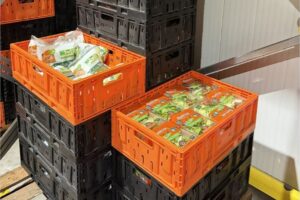
Sean: The major challenges are cost and asset management. Unlike single-use packaging, RPC systems require significant upfront investment and ongoing management.
“Who’s going to front the money to create the pooled inventory and track it?” Sean asked.
Another challenge is that RPCs are valuable assets that can be misplaced throughout the supply chain. Containers may be repurposed for storage or simply fail to return to the system.
“They tend to wander,” Sean said. “Without really strong tracking systems, things can get messy.”
Many established RPC providers address this challenge by serially tracking each container and charging fees when containers remain in circulation beyond expected return periods.
Photo: FreshPlaza
Q: How do regional reusable packaging networks differ from larger national systems?
Sean: Regional systems may offer advantages because they can leverage existing logistics networks.
Dispatch Goods already operates delivery and collection routes for reusable foodservice packaging. Because trucks are already traveling to customer locations, used packaging can often be collected during return trips, reducing transportation costs.
“The costs to recapture that product are fairly low because we’re utilizing routes and trucks that are already going to those places,” he explained.
This approach helps maximize truck utilization by ensuring vehicles travel full in both directions whenever possible.
Q: How important are reverse logistics for RPC systems to work?
Sean: Reverse logistics are critical. Unlike single-use packaging, reusable systems require containers to be collected, cleaned, and returned for future use.
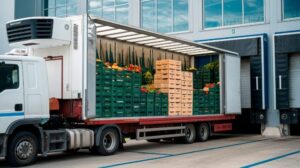
“The RPCs are expensive already,” Sean noted. “Any sort of extra logistics costs become an added cost.”
The economic and environmental success of reusable packaging often depends on how efficiently containers can be recovered and returned to service. When there are empty trucks and inefficient transportation, these reuse systems are not as beneficial.
Photo: Evo Logistics
Q: What role could reusable packaging play in the future of fresh produce?
Sean: Looking ahead, Sean expects extended producer responsibility (EPR) policies and other packaging regulations to influence packaging decisions across the industry.
As the costs associated with single-use packaging increase, reusable systems may become more attractive.
“I think it’s wise to explore [reusable packaging] so when and if you do have to make that tradeoff and decision, you’re informed,” he said.
While the future pace of adoption remains uncertain, Sean believes companies that begin evaluating reusable packaging systems now will be better positioned to respond to evolving regulatory and market pressures.
I took a lot away from this discussion, but one clear takeaway is this: while RPCs are not a great fit for fresh-cut and vulnerable fresh produce commodities, they are a highly effective tool in systems where the logistics and economics make sense. Their value depends not only on the package itself, but on the strength of the system built to support it. These are important considerations as we continue to evaluate the sustainability, practicality, and long-term viability of reusable packaging systems in the fresh produce industry.