



The U.S. Department of Labor’s Employment and Training Administration has published updated Adverse Effect Wage Rates for H-2A non-range occupations. The new rates take effect August 3, 2026, in most states.
The rates reflect updated Occupational Employment and Wage Statistics data for the July 2026 through June 2027 wage year. Under the wage methodology adopted by DOL last year, each occupation is assigned separate rates for Skill Level I, covering entry-level positions, and Skill Level II, covering positions requiring experience or other qualifications. H-2A workers who receive employer-provided housing without charge are generally subject to a downward compensation adjustment that does not apply to U.S. workers.
Employers must still pay the highest wage rate applicable to the work performed. Depending on the job and location, that may be the AEWR, a prevailing wage, a collectively bargained rate, or the applicable federal, state, or local minimum wage. The wage rate in effect when the work is performed controls, even if the employer’s job order lists a lower rate. This means that employers are required to pay a higher rate if the AEWR has increased, but cannot lower wages once a job order is certified-if wages decrease.
Different Effective Date in 17 States
The updated rates will not take effect until August 17, 2026, in the following states:
Arkansas, Florida, Georgia, Idaho, Indiana, Iowa, Kansas, Louisiana, Missouri, Montana, Nebraska, North Dakota, Oklahoma, South Carolina, Tennessee, Texas, and Virginia.
These states remain covered by the preliminary injunction issued in Kansas v. U.S. Department of Labor, which prevents DOL from enforcing portions of its 2024 Farmworker Protection Rule in those jurisdictions. Because the injunction preserves the prior AEWR regulation in the covered states, the new rates remain subject to the former two-week lead-time requirement.
Below are examples of the new wage rates and how they impact California, Arizona and Colorado H-2A employers.
California
For California’s five principal field and livestock worker occupations, the newly published rates are:
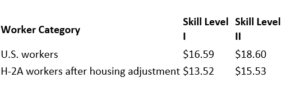
California’s statewide minimum wage is $16.90 per hour in 2026. As a result, the applicable statewide wage floors are:
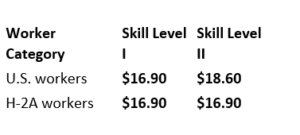
The new AEWR therefore does not reduce the wage rate for California H-2A workers in the field and livestock category below $16.90. For U.S. workers in corresponding employment, Skill Level I is also governed by the $16.90 minimum wage, while the Skill Level II AEWR increases to $18.60.
Employers must also determine whether a higher city or county minimum wage applies at the place of employment.
Arizona
For Arizona’s five principal field and livestock worker occupations, the newly published rates are:
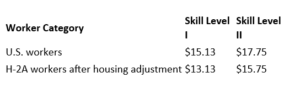
Arizona’s 2026 minimum wage is $15.15 per hour. The applicable statewide wage floors are therefore:
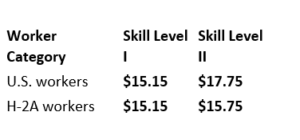
The state minimum wage raises the Skill Level I rate for both U.S. and H-2A workers to $15.15. The published AEWR controls for Skill Level II workers because it exceeds the state minimum wage.
Colorado
For Colorado’s five principal field and livestock worker occupations, the newly published rates are:
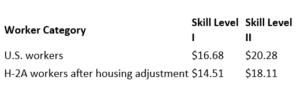
Colorado’s statewide minimum wage is $15.16 per hour in 2026. The applicable statewide wage floors are therefore:
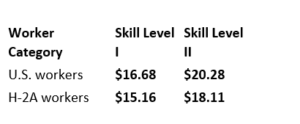
The state minimum wage raises the H-2A Skill Level I rate from $14.51 to $15.16. The published AEWRs remain controlling for the other categories. Employers should also check for higher local minimum wages, including those applicable in Denver, Boulder, Edgewater, and unincorporated Boulder County.
Lower National Average Reduces H-2ALC Bond Amounts
DOL has also recalculated the national average AEWR used to determine surety-bond amounts for H-2A labor contractors. The national average will decrease from $17.74 to $15.96 per hour.
The new calculation combines the Skill Level I and Skill Level II rates for SOC 45-2092, Farmworkers and Laborers, Crop, Nursery, and Greenhouse, without applying the housing adjustment. Because H-2ALC bond amounts are tied to this national average, the reduction should lower required bond amounts by approximately 10 percent.
What H-2A Employers Should Do Now
Employers of H-2A workers should immediately review the updated rates for every state and occupation listed on their current job orders. The “Big 5” field and livestock rates apply only when the majority of the workdays involve duties falling within those occupational classifications. Jobs involving other occupations, including agricultural equipment operators, truck drivers, construction workers, mechanics, supervisors, or cooks, are governed by a different occupation-specific AEWR which can be found on the second tab of the DOL-OFLC_2026-2027_AEWRs_FINAL spreadsheet found on DOL’s FLAG portal under “Current Adverse Effect Wage Rates (AEWRs) -> ii. ALL Non-Range Occupations -> View the statewide 2026-2027 IFR AEWRs.”
Employers should also review whether their job orders contain Skill Level II qualifications, such as prior experience, licenses, certifications, or other specialized requirements. The wage analysis must account for the AEWR assigned to the occupation and skill level and any higher federal, state, local, prevailing, or collectively bargained wage. Note that the H-2A housing adjustment is already factored into the AEWRs for H-2A workers.
For questions about the new AEWRs, bond amounts or the H-2A program in general, please contact the Western Growers H-2A Services Team at [email protected].