



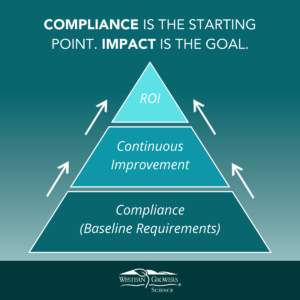
 A few weeks back, I wrote an article about the value that food safety data should have in driving our operations. It can be found here and is titled Compliance to Impact – Making Continuous Improvement Count. It came with this nice-looking pyramid image that was posted on our social media accounts (thank you WGA Marketing).
Since then, I have had a few conversations on the matter – discussions with experts, industry, stakeholders, etc. on the topic and a few things just kept resonating and lingering in my thoughts. Hence, a second article to build upon the first round – a little ascension on my own hierarchal continuous improvement thought pyramid.
All discussions on this topic of Food Safety Data and continuous improvement centered around what should be and, more realistically, what food safety data currently is. As you might imagine, these should be/is states are quite different. Not surprising, that feels about on point for most things in life these days. This presents a problem though, if we continue to want improved food safety metrics and look for improvements in overall public health and food safety outcomes, we need to call out (productively) that we might need to reimagine what and how we approach it. Compliance information will always be important, but I have little hope (open to debate here) that compliance information, data, and hierarchy is suddenly going to become predictive or efficient at reducing residual risk in the system. We didn’t design it that way, and my guess is that it won’t remarkably surprise us. As a result, conversations about food safety systems that rely on data or their findings have an inherent and glaring weakness – they won’t be successful unless we get honest about the type of data we need to collect. This is not novel. When thinking about operational key performance metrics (KPIs), we know how to look at KPIs critically, to design six sigma systems as an example (i.e., ~3.4 defects per million opportunities) – a disciplined way to reduce variation, prevent defects, and make performance predictable using data. The challenge is to make the leap from operational production data into food safety data – first accepting that food safety “defect” rates aren’t zero, and that we can improve them. If this were tied to top-line sales or bottom-line profits directly, the incentive and motivation would be clearer. Are we failing? No, we’re just missing the opportunity to revision food safety programs into a system that passively drives improvement based on operational and financial metrics. I am all for “hopes and prayers”, but this is not, and will never be, a successful food safety strategy.
The next thing most conversations touched upon – there is some latent frustration that the industry, and/or individual companies depending on how you look at it, don’t self-promote to the next level on the pyramid (continuous improvement).
I am also frustrated and disappointed with this point. As someone who has worn many hats in my career (food safety, auditor, laboratory leader, business unit leader/general manager), I have seen firsthand the decision-making process at food companies. It often (not always) leaves us wanting, with budgets and resource constraints taking precedence over “nice to have” food safety improvements. If we are compliant and successful (i.e., no outbreaks, recalls) why then would we allocate limited resources to improving the process. Thinking back to my school days, why put in the extra effort for the “A” when a “C” gets you to the same endpoint (i.e., graduation). It’s a good thought, and one I have wrestled with my whole life given the overachiever that I am. What have I really gotten for always getting the “A”? My joke is generally that I am just more stressed and tired, but I suppose that I also developed a keen sense of determination and grit too. I refuse to accept the “C”, and I refuse to stay at the lower level of the food safety program pyramid too.
As such, what do we need to do to move up the pyramid? How can we enable the system to naturally select for the “continuous improvement” and “ROI” level? My hypothesis is to stop talking about it, and instead show how it works, highlighting other benefits along the way. We need to build a different data ecosystem for food safety – one that supports the outcomes we want and the business successes that we need. Just like operational KPIs that deliver financial incentives and productivity gains, so must our food safety systems. They’re not separate, and they are not distinct types of data.
Getting to a new system of operation won’t be easy. It will require that we discern what type of information will improve us, what will make us more resilient, and what will generate more proactive programs. The first step is to build the bridge, not just to show what can be done, but to ultimately create the pull and destination that others move to. Once the old system is no longer acceptable, a new system will have to naturally emerge…hopeful? Yes – most definitely. Hopeless? Hardly.
I didn’t move into food safety to accept the status quo and hope you won’t accept it either. Join us on working to design data systems that drive measurements on what matters, that incentivizes the system to invest in solutions and improvements. Food safety data needs to look different. Help us create it. GreenLink® and our data efforts are far more than a data-sharing program, it’s the chance to reimagine what compliance and food safety improvement(s) can look like.