



Data, Data, Data…
Over the past decade, almost every conversation I’ve had as it relates to food safety seems to revolve around data. The promise is always the same: if we just collect enough of it, we’ll uncover the answers to all our problems.
And honestly, data can solve many challenges. But it’s equally important to recognize what data cannot do, and even more critical, to understand what it can do when given the right context, quality, and purpose. Data on its own is just numbers, many times without context; it’s the meaning we attach to it that creates insight.
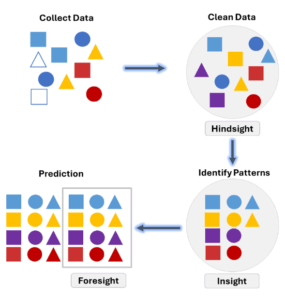
That’s where predictive modeling enters the picture. Predictive models take what we already know, the history that is in our data, and use it to estimate what might come next. They transform information into foresight, turning static records into living systems of learning and anticipation. Figure 1 below shows the progression from data to hindsight, insight, and ultimately foresight reflects how predictive modeling transforms our understanding. We begin with raw data, individual observations that, once analyzed, offer hindsight about what has occurred. From these reflections emerge insights that reveal underlying patterns and relationships of what already exist. Predictive models then build on these insights to generate foresight, allowing us to anticipate future conditions and make more proactive, data-driven decisions rather than reactive ones.
What Predictive Models Really Do
Predictive models do exactly what their name implies: they use patterns in historical data to make predictions about new situations (foresight).
Think back to the simple equation y = mx + b. That’s the foundation of a linear model. Here, m represents the effect of one variable, and b is your baseline, the starting point of your prediction.
Imagine this in action:
- y = price of a house
- x = number of rooms
- m = how much price changes per extra room
- b = the price of a one-room home
Even if you’ve never seen a seven-room house, you can still predict its price using that model. That’s the power of patterns in data.
But wait…rooms aren’t the only thing that affects home prices. School districts, square footage, neighborhood, even the year built may matter more. If your model only knows about rooms, is it wrong? Not entirely. But could it be better? Absolutely.
Predictive power depends on the story your data tells, and what pieces of that story are missing.
The Data You Feed the Model Matters
A predictive model can only work with what it’s given. Feed it limited or overly broad data, and it will give you limited answers.
If you train a model with data from an entire city and then ask it to predict neighborhood-specific prices, it will fail, not because it’s bad, but because it doesn’t know what you’re asking. The same is true in produce safety. If your dataset only captures general weather patterns and not field-level differences, you can’t expect it to predict which specific field might face higher risk next week.
The lesson: models reflect our interests and hypothesis. The better our questions and the more intentional our data collection, the more meaningful the insights.
So, Start with a Hypothesis
Before we start collecting data or building models, we need a why.
- What are we trying to solve?
- Where might contamination occurs within a field?
- What time of year is riskiest for a certain crop?
- Which environmental factors influence outcomes most?
A clear hypothesis guides what data to collect or reveals what’s missing. If you don’t have the data yet, that’s not failure. It’s a signal to start collecting today so you can predict tomorrow.
Once ready, make sense of the results
Predictive models generate probabilities, not certainties. They measure outcomes with accurate metrics like sensitivity, specificity, or RMSE (Root Mean Squared Error). But beyond accuracy, they offer insight.
- Prescriptive Power: Predictions can guide action. If the model shows that risk is higher in early spring, you can adjust your sampling strategy accordingly.
- Diagnostic Power: By examining coefficients (the m in y = mx + b), you learn which variables have the most influence. That knowledge can refine future models or direct further research.
Predictive models aren’t just black boxes, they’re learning tools. Each iteration teaches us something about the system we’re studying, we ask more questions and keep learning and improving them.
Can Models Be Trusted?
That’s a fair question. Trust in predictive models comes from validation and transparency. Validation: We test the model with new data, data it hasn’t been seen before, and compare predictions against real outcomes. Performance: The goal isn’t perfect; it’s reliability. Weather forecasts, Zillow home estimates, and even your car’s GPS predictions are never exact, but they’re useful enough to guide decisions.
In produce safety, it’s the same. A model may not predict every event, but it can help you know when and with enough granular information where to pay closer attention. Models are wrong most of the time in the literal sense, but incredibly useful in practice. They don’t replace human judgment; they amplify it. So yes, when performed correctly, and used in the right context, models can be trusted as a tool to amplify our knowledge and understanding.
Where do we go as an industry. We need data with purpose.
If we want to make predictive models truly work for us, especially in fields like producing safety, here’s the roadmap:
- We need to be intentional in data collection. Collect with purpose, not convenience or compliance.
- Start with a clear hypothesis. Knowing the question before chasing the answer, most likely is that to answer your questions, new data must be collected.
- Recognize imperfection. Models won’t be perfect, but they can be consistently helpful, and they will improve with more high-quality data.
- Trust the models and amplify your knowledge: The goal isn’t about replacing our judgment with algorithms, but about empowering smarter, faster, more informed decisions.
So, we keep building larger, more diverse datasets.
We test what the models tell us, learn from those insights, and refine our approach.
We let data challenge our assumptions. The real power of predictive modeling isn’t in prediction itself; it’s in how it changes the way we think. It pushes us to move from reactive to proactive, from guessing to reasoning, from data collection to data understanding. The models give us direction.