


We’ve been talking about how important risk management is in our food safety standards and regulations. It’s usually contrasted with hazard-based management, focusing on what is there versus if what is there will cause an illness or negative outcome. A good example to contrast the difference is a shark swimming off the beach in the ocean – that is a hazard. If no one enters the water, the probability of that shark harming a swimmer becomes extremely low. The hazard hasn’t disappeared; the risk has changed.
Conceptually, this is easy to understand. We all can understand that the risk from the shark is mitigated because we don’t go into the water. The hazard is present, but the risk is not. Theoretically, the shark could lunge out of the water and get you…but probabilities of that occurring are practically non-existent.
For food safety, risk is harder to talk about, and often harder to visualize. It’s critically important though that we do. Why? Fresh produce is produced in open agricultural systems where there are many important variables like weather, wildlife, adjacent activities, shared water systems, etc. that cannot be completely controlled. By embracing risk management systems that are optimized to reduce risk (aka, probabilities), we can reduce the likelihood that any one serving will be unsafe.
Food safety is an outcome that we want, and risk management is how we improve the odds of getting it.
We often talk about food safety as binary: a serving is safe or it isn’t. But the system that produces that serving is much more complex than that.
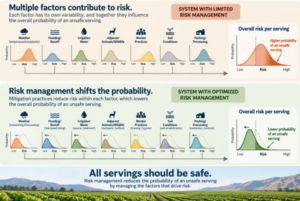
Weather has variability. Water quality has variability. Wildlife activity, flooding, adjacent land use, worker practices, soil conditions, processing. The risks associated with each change across time and space.
Think of each factor as having its own probability distribution.
Good risk management doesn’t pretend we can eliminate variability. It asks: What can we do to shift those distributions?
Better monitoring. Better information. Strategic buffers. Water treatment. Sanitation. Training. Process controls. Earlier detection of changing conditions.
Risk management changes the distribution of possible outcomes. And when those changes are integrated across the production system, they can reduce the overall probability of producing an unsafe serving. That is a critically important distinction.
Two servings of fresh produce can both be perfectly safe today, while having been produced by systems with very different probabilities of producing an unsafe serving tomorrow.
All servings should be safe. Optimized risk management increases the probability that they will be.