



Image created from: thewordsearchmaker.com
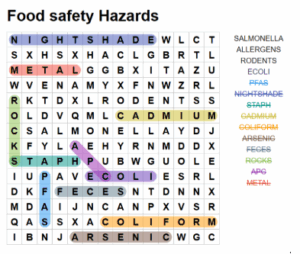
Hazards are easy to identify. They sometimes take a bit of looking, but generally and with time, you begin to see them – much like looking at the word search game shown above. At first glance, there are just letters. Soon, however, your eyes recognize the patterns, and you become more adept at finding the specified word targets.
Similarly, with practice and focus, food safety practitioners become particularly proficient at finding hazards (chemical, microbial, physical) within the products and systems they manage. We get remarkably efficient at listing them within our food safety plans – cross-referencing them to the preventive controls and perquisite programs we have in place. A well-thought-through plan makes all the difference in risk analysis, and hazard identification is a critical first step. But it is only a step – a foundation for what we build risk characterization, management and communication upon.
But, with hazards identified and no complete means to eliminate it (i.e., common occurrences within fresh produce), how do we manage the risk?
This is where things get tricky. Too often, the simplest approach of “get rid of the hazard” isn’t scientifically or practically possible. Here is where the science and art of risk assessment and management come in. The problem is, who teaches us how to manage and communicate a risk that we know isn’t/won’t be zero? Subjectivity and objectivity are poised to collide. The bad news is that learning to manage risks in real-world conditions (variable, fast, complex) doesn’t come with an instruction manual. The good news is that we can practice and learn from each other.
Where can we learn this? WG Science is launching an educational and professional development program to advance the practice of food safety risk management in fresh produce through collaboration, innovation and scientific learning. This cohort-based program will focus on building produce food safety leaders and teaching applied food safety approaches – leveraging both scientific and social science curricula, all the while enforcing hands-on learning that will immediately be useful in real-world scenarios.
Applications are required, and enrollment is free for WG members – all levels of food safety professionals are encouraged to apply.