



On March 27th, 2026, The Interagency Food Safety Analytics Collaboration (IFSAC), released its latest annual source attribution report. These reports are designed to estimate which broad food categories are most commonly associated with foodborne illness caused by pathogens, including Salmonella, E. coli O157, and Listeria monocytogenes. The data in this 2023-year report uses 49,848 illnesses linked to 1,390 foodborne disease outbreaks that occurred from 1998 through 2023. Another new aspect of this year’s report is a new modeling approach that applies a weighted modeling approach that emphasizes more recent years while still incorporating longer-term historical data.
Overall Takeaways
Across the study period, IFSAC identified 4,156 foodborne disease outbreaks that occurred between 1998 and 2023. Of those, 1,390 outbreaks involved a confirmed or suspected implicated food that could be assigned to a single food category and included in the attribution analysis.
Among these attributed outbreaks:
- 1,037 outbreaks (74%) were associated with Salmonella
- 285 outbreaks (21%) were associated with E. coli O157
- 68 outbreaks (5%) were associated with Listeria monocytogenes
The report also highlights the strong influence of recent data outbreaks on the updated model. Outbreaks occurring from 2019 through 2023 accounted for:
- 57% of the model-estimated illnesses used to calculate attribution for Salmonella
- 59% for E. coli O157
- 31% for Listeria monocytogenes
This shift toward weighing more recent years is important, as it allows attribution estimates to better reflect current patterns in foodborne illness rather than relying too heavily on older outbreak data.
Produce Estimates per organism
Salmonella: The report notes that more than 75% of Salmonella illnesses were attributed to six categories overall: chicken (19.1%), fruit (14.2%), seeded vegetables (13.0%), pork (11.7%), other produce (10.0%), and beef (7.8%). In terms of production the estimates are spread across multiple categories rather than concentrated in just one. The produce-related categories reported were:
- Fruits: 14.2%
- Seeded vegetables: 13.0%
- Other produce: 10.0%
- Vegetable row crops: 3.4%
E. coli O157: Over 85% of E. coli O157 illnesses were attributed to vegetable row crops (such as leafy greens) and beef. Vegetable row crops had a significantly higher estimated attribution percentage than all other categories.
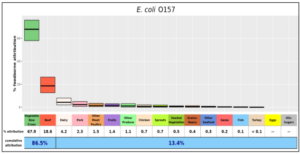
Listeria monocytogenes: For Listeria monocytogenes, produce also represented a meaningful share of attributed illnesses. The report estimates:
- Vegetable row crops: 27.4%
- Fruits: 15.9%
The leading non-produce category was:
- Diary: 31.9%
Why It Matters
Reports like this are important because they provide a broad, national-level perspective on where foodborne illnesses have historically been linked across the food system. While source attribution estimates should not be interpreted as a direct measure of contamination risk for any one commodity or operation, they can help identify where public health burden has been concentrated and where prevention efforts may have the greatest impact
For our industry, one of the most relevant takeaways is that fresh produce continues to remain part of the national food safety conversation, particularly for pathogens such as E. coli O157 and Listeria monocytogenes. At the same time, the report also reinforces that attribution is often distributed across multiple food categories and should be interpreted carefully. These findings are best viewed as not as a measure of blame, but as a directional tool.
It is also important to recognize what reports like this can and cannot tell us. IFSAC estimates are based on outbreak data, which are one of the strongest available tools for linking illnesses to foods, but they still represent only part of the broader food safety picture. Many illnesses are never linked to a specific source, and outbreak detection itself depends on surveillance, traceback, and investigation capacity. As a result, source attribution estimates are best used as a directional public health tool rather than a definitive measure of contamination.