


Ever since he can remember, Larry Jacobs has been captivated by the quiet magic of nature. One of his earliest memories is conducting a science experiment in his kindergarten class, where he had to grow a corn seed in a milk carton, “When milk cartons were still around,” Jacobs joked. He recalled the process of planting the seed, caring for it—until finally experiencing the gratifying moment when it sprouted.
“I just couldn’t understand how from this little seed, this plant grew,” Jacobs reflected. “It’s something very special that’s happening there.”
This fascination stuck with Jacobs into young adulthood, despite going off to college to study electrical engineering. However, at just 19 years old, he quickly realized that being stuck inside a fluorescent-lit laboratory was not the life for him, and ultimately, this desire to work in nature led Jacobs down the path of becoming the owner and manager of a wholesale nursery in the San Fernando Valley.
At one point, Jacobs got sick after applying a pesticide to treat an aphid infestation at the nursery, and that’s when he began searching for safer, chemical-free alternatives. He said he wanted to find “a way to grow crops without using the toxic materials that everybody was recommending, despite being told that that was pretty crazy.”
While regenerative and sustainable agriculture are buzzwords for the industry that often don’t have clear definitions, Jacobs has aimed to embody and define them through his life’s work.
At the encouragement of the county inspector, Jacobs went back to college and got a degree in Soil Science with an emphasis on Plant Pathology from California Polytechnic State University, San Luis Obispo.
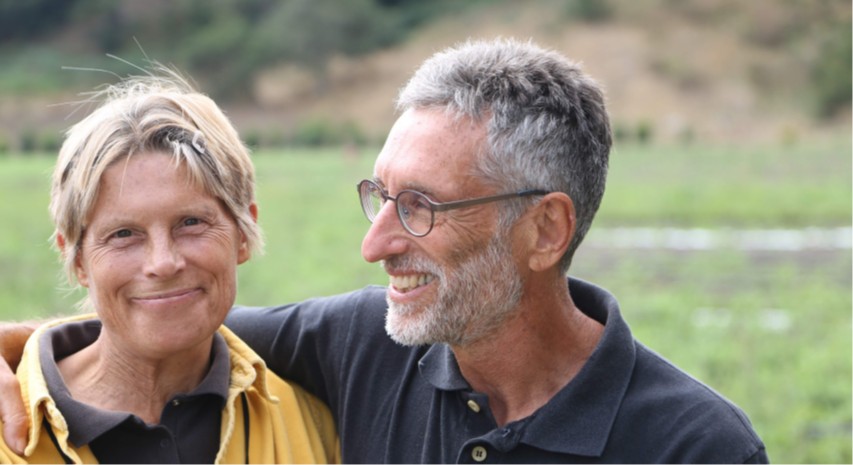
After graduation, Jacobs married his wife, Sandra, and together, the two went on to run a local nonprofit in the Western Highlands of Guatemala, where they set up a soil testing lab for small-scale farmers.
Fast forward three years later, the couple returned to the U.S. with plans to settle down on farmland. The two decided to move to San Mateo County, buying a piece of land in the small coastal town of Pescadero in 1980, officially establishing Jacobs Farm.
Although Jacobs now had years of soil testing experience under his belt, he admitted, “I always felt it was a little presumptuous to be doing all these soil tests, and recommendations based on the soil tests, without any experience actually growing these crops.”
Jacobs said he and his wife were initially focused on increasing the amount of organic matter in soil and growing cover crops, and this was “before it was popular.” After achieving some good-quality, healthy crops on their eight-acre field, they decided to expand and begin specializing in fresh, organic culinary herbs.
As the Jacobs family continued to grow their business, they were forced to get creative in some respects, saying at one point, “We didn’t have the capital to buy a big truck and refrigeration.” But they didn’t let this speed bump get in the way of deliveries.
“It was a funny story,” Jacobs recalled. “We stripped the seats out of a Honda Civic and loaded it up. We could get about $3,000 worth of boxes in there and still have room for the driver.”
That very Honda Civic later doubled as their getaway car for a vacation to Mexico. (Don’t worry, the seats were put back in.) While making their way up the Baja Peninsula, they spent a few days visiting local farms and talking to people.
“We learned that a lot of these little farms had really beautiful crops that were market gardens,” Larry said. But because of the town’s small population—about 10,000—it didn’t take long to fill up the local market. “It was pretty isolated to get product anyplace else.”
With a need to develop a source of organic fruit and vegetables during their off-season, this inspired the couple to attempt to bridge that gap by partnering with these growers. With the support of the locals and the Mexican government, a fruitful partnership was created and from there, the del Cabo collective was born.
“I think if we had known how challenging and risky it was, we probably wouldn’t have done it. But we were young and naive, so we did it,” Jacobs said.
Initially, their focus was to establish a system where these farmers could be self-sufficient and ultimately make a higher income to support their families. The collective started out with a group of 10 people, and from there, it continued to grow.
“Other communities up and down the Baja became interested as word began spreading,” Jacobs said. “It was hard for us to walk down the beach without somebody asking us how to become a part of this thing.”
Today, the del Cabo collective spans the full length of the Baja California Peninsula and into mainland Mexico, providing organic farming training and lasting quality of life to more than 1,250 farming families in 14 communities.
Beyond their philanthropic work, Larry and Sandra have remained committed to leading their company in sustainable and forward-thinking practices.
In 2020, Jacobs Farm del Cabo introduced its ClimateLab program, a comprehensive initiative to support farmers in adapting to the effects of climate change and reducing environmental impact. This includes efforts to cultivate climate-resilient soils, assess climate risks and cut down on plastic waste.
Through this program, they also recognized the importance of implementing gender-focused initiatives, noting that women have historically been disproportionately affected by the impacts of climate change.
The two were able to identify other challenges unique to their female employees, including some who were new moms and needed a place to breastfeed. The first thing Jacobs thought was “we could implement that.” Many of their farms now offer not just private lactation areas, but also provide a pump and a refrigerator for milk storage.
Reflecting on his decades of experience in the ag industry, Jacobs said with nostalgia, “Sometimes the things that we’re interested in as children stick, and sometimes they don’t.”
For Jacobs, it all goes back to that little seed in the milk carton, and that sense of awe and childlike wonder that stuck with him throughout his life.
“Whether it’s the hillsides along the coast in the spring after the first rains, when the first seeds are sprouting and you see this flush of green on the hillsides, or it’s a roll of parsley, it doesn’t matter. It just always seems magical to me.”
Although Jacobs has spent his life making a positive impact on the ag industry, he has no plans of slowing down. “I’m looking forward to another thousand years. Let’s keep going.”