



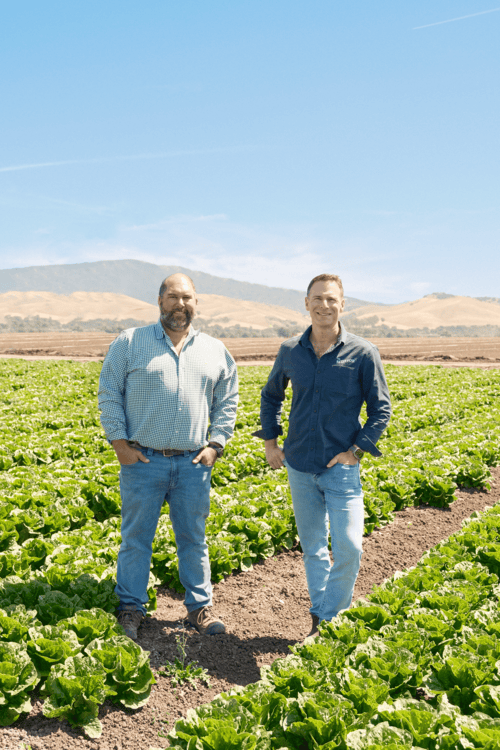
When Danny Bernstein steps outside every day, he launches into nonstop meetings, phone calls, emails, conversations with startups, investors, growers, partners, media and more. His view of this day-to-day bedlam—or symphony of innovation and California agriculture—is one of gratitude and purpose-driven satisfaction.
Just three years ago, Bernstein was deep inside Google at a nondescript fluorescent-lit desk. The terrible lighting in his office was less the problem than the real-world impact, or rather lack of impact, he found himself making. There was “an abundance of resources and a lack of real problems to solve,” he said. As CEO and Managing Partner of The Reservoir, where agtech innovation meets dedicated farmland in California, he is firmly planted in the inverse.
Though an accomplished tech operator from Silicon Valley with a pedigree that includes executive roles at Google and Microsoft, Bernstein is able to keep any initial skepticism from his new partners—farmers, growers and operators in Western agriculture—at bay. A San Francisco native, Bernstein graduated from the University of California, Davis. As a Political Science undergraduate student working “20 hours a week for three and a half years,” he recalls being mesmerized by his friends in the Agribusiness Economics major, one of the school’s most rigorous courses: a memorable “180 units.” The obvious import of this program, one of America’s finest in agricultural economics, formed the basis of Danny’s respect for, and interest in, rural concerns.
He never stopped searching for what he considered “the real California.” Now, his lifelong nascent interest in agriculture and rural California has bloomed into the Reservoir and its first-of-its-kind on-farm robotics incubator, Reservoir Farms, just seven minutes’ drive from downtown Salinas.
Reservoir Farms will be an intuitively designed, programmable and managed environment replete with world-class R&D facilities and land access.
Tanimura & Antle, an immensely respected Salinas Valley grower and Western Growers member, generously leased 40 acres of prime farmland for the original Reservoir Farms location.
Bernstein highlights this collaborative foundation as critical to Reservoir’s early momentum. “It was when Western Growers, Tanimura & Antle and other industry partners each leaned in— from their respective positions—that we knew this wasn’t a niche effort; it was a shared priority. Once startups saw this alignment, momentum quickly followed.”
His initial leap out of Silicon Valley a year and a half ago involved self-funding six months of feasibility research, and proudly and necessarily conducting more than 100 conversations with agricultural companies. His considerable research and boots-on-the-ground approach is evident in the language Bernstein uses today, having clearly listened, and listened some more, until he grasped growers’ concerns and views on things.
Bernstein learned that approximately 50 to 70 percent of high-value crop production costs are tied directly to labor, yet less than two percent of agricultural production tasks are automated. California’s regulatory complexities continue to stymie meaningful agtech advancement and its use in the fields. Western Growers’ Walt Duflock, Senior Vice President of Innovation, and Ben Palone, Senior Director of Commercialization, aligned themselves with Bernstein, and the Reservoir eventually earned the trust of Western Growers as a whole.
The future of California agtech, woefully underutilized and underfunded at present, will directly influence the future of California farming; the strength of rural economies like the Salinas Valley and the Central Valley; and Americans’ very access to fresh produce.
Make America Healthy Again? Not if we allow California fields to fallow.
That is not to say that hard-working startups and extraordinary new technologies in the agricultural sector do not exist. Companies across California, Washington, Arizona, the U.S. and global stage are actively aspiring to become expert agricultural system thinkers and are quite literally out in the field. However, their experience can be more akin to a farmer alone in a harvester with no one around for miles; their pathway relying upon independently sought and hard-earned partnerships without much institutional support behind them (unless one is lucky enough to be friends with Duflock).
As one can imagine, the startups scoring such meetings and winning partnerships with respected companies are overwhelmingly “top of the totem pole.” Creative and determined upstarts remain on the outside looking in for years, or worse, until the company and their gifted engineers move on in a different direction—to a sector with fewer barriers to entry and more opportunities to apply and scale their technology.
The Reservoir, and its nonprofit on-farm robotics incubator, Reservoir Farms, is working hard to become this missing R&D layer that growers trust. In building the partnership with Western Growers, the Reservoir wants to show members that it exists to serve their needs and bring them closer to the tools that matter.
Growers will have the opportunity to engage with and provide feedback to startups working hard to solve real problems facing California specialty crop producers. The Reservoir will facilitate interactions between startups and growers through field visits, showcases and introductions. Western Growers’ Palone envisions a “well-driven track around Reservoir Farms as growers visit and see what’s happening.”
Beginning with the Salinas location, there will be a rhythm of quarterly showcases that tie into natural crop and testing cycles, supplemented with monthly engagement opportunities, including small group site visits, in-field demos and roundtable discussions. The best way to follow what’s happening at the Reservoir is on LinkedIn, and there are plans to develop a member portal where growers can opt in, state an area of interest or pain point, and be matched with startups working on relevant technologies.
Although Western Growers members can expect a warm welcome from the Reservoir’s General Manager and staff, driving onto the well-driven path is not necessary. The Reservoir will maintain a dedicated online presence which will include startup profiles, field trial reports and video walkthroughs that give growers a sense of what’s working, what is still being figured out and what’s coming next. Growers well-versed in the agtech startup ecosystem will enjoy the regular community, programming and updates, and members who have not stepped into the universe will now find easy entry. WG members will learn not just what each company does, but how they learn, iterate and engage with the field.
In a nutshell, growers can trade the 8 a.m. meetings with startups at their company office for front-row seats to the show— with many acts and performers, and an extended residency in their backyard. The need to explore and commit to a single partnership is replaced by the opportunity to engage with a handful of companies working on various problems facing California farming, especially concerning labor-offsetting technologies, all in a low-pressure environment that will allow for an organic development of partnerships as trust builds.
In Bernstein’s words: “We want Western Growers members to feel like Reservoir is a living, breathing space they can drop into— not just an annual conference booth.”
In selecting their inaugural cohort, the Reservoir is evaluating companies based on technical due diligence, crop relevance (including the region’s core crops: lettuce, berries, broccoli and other specialty produce) and founder mindset. Priority areas include robotic harvesters adept at handling delicate produce; rugged mobility solutions for uneven terrain and open fields; machine vision tailored specifically to specialty crops; lightweight end effectors designed for produce handling; and more. Additionally, there is support for startups working on modular robotics components for flexible field use, edge AI facilitating real-time decisions without cloud reliance, and precision soil analytics.
Companies and participants must share a commitment to wanting to learn from growers and build with them—not just sell to them. A selection committee comprising growers, original equipment manufacturer (OEM) advisors and technical experts, helps balance these dimensions.
Bernstein notes the distinctiveness of this approach: “These startups operate in the real world, not a simulated one. That demands a different kind of toughness and humility. They’re systems thinkers, and they know they can’t build in a vacuum.”
Salinas is just about an hour from Silicon Valley. Most teams will relocate or maintain a strong local presence during their time at Reservoir Farms: some may choose to fully move, others may come down multiple times a week. The economic impact for Salinas is obvious, and a proud full-circle moment for Bernstein given his early interest in California’s rural economics with regard to investment.
“Founders stay in town, eat locally and spend time in the community. We see Reservoir as a long-term economic contributor, not an isolated tech campus. Over time, we believe dozens of new agtech companies will establish themselves in rural regions like Salinas, bringing hundreds of millions in investment and creating thousands of high-quality jobs. This is about startup success, as well as regional transformation, where innovation becomes a driver of economic vitality across the Central Coast and beyond,” Bernstein said.
With Reservoir Farms’ groundbreaking set for Aug. 27, 2025, excitement continues to grow.
Looking ahead, Reservoir Farms is laying the groundwork for expansion: plans are developing for locations in Merced County and Sonoma County. Bernstein gives great credit to his right-hand powerhouse COO Jillian Heisman, Marketing Manager Grace Wodecki, and mentions the invaluable contributions of Reservoir friends and advisors, including Jason Sedano and Josh Roberts, Joshua Ruiz, Nishan Moutafian and Dr. Matthew Hoffman, and Henry Guerrero and Dr. Hillary Q. Thomas-Sanchez of Taylor Farms, Duda, Driscoll’s and Naturipe Berry Growers, respectively. WG member Randy Pura was a critical early thought partner as well.
Of Western Growers’ Duflock, Bernstein likes to say, “No matter what, I always answer the phone for three people: my wife, my mom and Walt.”
There appears to be a strong element of civic mindedness with Bernstein, the one-time Political Science major, as he boldly and unhesitatingly moved his career away from the “Googleplex” to an area that really needs it—and needs it most desperately. Bernstein is grounded by the beauty of the “real California” he once quested for, and has in him the good instinct to slow down and observe the meaning inherent to agriculture: that which can be found in a single clamshell.
“I keep coming back to strawberries. When you see firsthand how skilled and fast that labor has to be—how much of it is done by feel and instinct—it becomes clear why automation here is both incredibly challenging and incredibly important. Watching the precision, pace and care of a harvest crew completely changed my understanding of what goes into a single clamshell. It’s humbling. And it makes the tech stakes feel very real.”
Amid his day-to-day obligations and leadership at the Reservoir, Danny Bernstein conducts himself with the humility of a grower; with significant appreciation for his partners and the support of the community, and a reverence for California agriculture—his office at the historic and iconic corner of Highway 68 and Hitchcock Road in Salinas now lit by the California sun.