



Last Sunday I presented at the 52nd CAPCA Annual Conference on a communication problem our industry keeps running into: finding a pesticide residue is not the same as finding risk. Here is what I shared, and why I believe data sharing is the way forward.
Presence is not risk
A detection answers one question: is something there, and at what level? Risk answers the question that matters: does it affect health? Risk requires both a hazard and an exposure. If either is absent, there is no adverse effect.
The distinction is easiest to see side by side:
| Hazard | Exposure | Risk | |
|---|---|---|---|
| What it is | An agent with the potential to cause harm | Contact with the hazard (route, frequency, dose) | Requires both a hazard and an exposure |
| Focus | Inherent properties of the agent | How and how much contact occurs | The likelihood of harm under realistic conditions |
| If absent | No potential for harm | No risk | No adverse effect |
A residue detection is a hazard-side input. It is an ingredient of a risk assessment, not a conclusion about safety. Risk is also dynamic: it depends on multiple factors and varies with them, so no single factor, presence included, equals risk.
Regulators already work this way. Dietary exposure estimates combine what people eat (NHANES/WWEIA) with how much residue is in it (USDA PDP). The result is compared with a health-based reference value (RfD/PAD) and expressed as % of PAD and Margin of Exposure.
Public messaging often skips all of this. “Dirty Dozen”-style lists rank by detection frequency, with no toxicology and no dose. Growers then absorb reputational and market consequences that are disconnected from the underlying science.
Even good assessments rest on limited data
The national datasets are valuable, but each tells only part of the story, and none includes actual grower data.
- Scale: USDA PDP tested 9,872 samples across 19 commodities in 2024.
- Rotating coverage: not every crop is tested every year.
- “As tested,” not “as consumed”: potatoes, for example, are washed but not cooked before analysis.
- Dietary data: two-day recalls can miss variability in episodic foods, and self-reported intake carries recall and portion-size bias.
- Uneven geography: monitoring is not a designed census of every region, season, or combination.
If these are the inputs, how representative are the resulting assessments?
What GreenLink® already does
GreenLink® is Western Growers’ private, industry-built data-sharing platform. It is designed to move data up a value ladder: collect raw data, clean and aggregate it, see patterns, learn and recommend, and finally take risk-based action in the field.
Trust is built into the design:
- Company name, exact location are anonymized.
- Data is aggregated, and when visualized results appear only when a minimum group size is met (for example, three or more participants).
- Role-based access keeps individual data individual.
- A Data Governance Committee lets participants shape platform development and use cases.
Today GreenLink® links food safety data with weather, season and time, EPA nearby operations, USDA Cropland Data Layer land cover, and hydrology, all to build predictive models that forecast signals from industry data enriched with public datasets. However, the focus has been mostly on preharvest testing microbiological testing data.
The opportunity: pesticide data
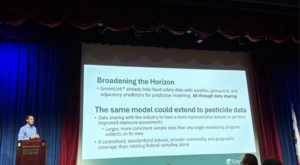
The same model could extend to pesticide data. Sharing residue data across the industry would give us:
- A more representative dataset for improved exposure assessments.
- Larger, more consistent sample sizes than any single monitoring program collects on its own.
- A centralized, standardized dataset with broader commodity and geographic coverage than rotating federal sampling alone.
What this could enable:
- A stronger industry voice. Data-driven participation in cumulative risk and MRL discussions, and better-grounded communication with the public.
- Better exposure assessments. More representative residue inputs to the models regulators and researchers already use.
- Earlier signal detection. Emerging residue patterns and shifts spotted before they become compliance issues.
To be clear, this complements regulatory monitoring and never replaces it. PDP, FDA, and EPA remain the system of record. Industry data adds depth and context to what those assessments already show.
Where the industry fits in
Growers, shippers, processors, and industry partners all hold pieces of this picture. Defining what useful, trustworthy pesticide data sharing looks like will take input from across the supply chain.
The data we already collect, the models we can already build, and the governance we have already tested give us a foundation. The next step is deciding, together, whether pesticide data belongs on it.
If you would be interested in developing this further, please reach out to me at [email protected].