OSHA Announces Public Comment Period for Rule to Protect Indoor, Outdoor Workers from Dangers of Extreme Heat

September 5th, 2024

On August 30, 2024, the U.S. Department of Labor (DOL) announced the opening of the public comment period for its proposed Heat Injury and Illness Prevention in Outdoor and Indoor Work Settings rule and its publication in the Federal Register 

The rule was announced in July 2024 by the department’s Occupational Safety and Health Administration (OSHA), in an effort to substantially reduce workplace heat injuries, illnesses and fatalities. OSHA encourages public participation in the rulemaking process to assist the agency in developing a final rule that adequately protects workers, is feasible for employers and is based on the best available evidence. 

Submit comments to Docket Number OSHA-2021-0009. Directions on how to submit comments are included in the Federal Register notice. OSHA anticipates holding a public hearing after the close of the written comment period, with details to be announced. 

Social Media and Harassment: Ninth Circuit Ruling Expands Employer Liability 

September 5th, 2024

A recent decision by the 9th U.S. Circuit Court of Appeals offers crucial guidance for employers on the intersection of social media conduct and workplace harassment. In Okonowsky v. Garland, the Court reversed a district court’s dismissal of a sex discrimination claim under Title VII of the Civil Rights Act of 1964, allowing the case to move forward to trial. 

The plaintiff, a female employee of the Bureau of Prisons, brought the action based on a male supervisor’s Instagram posts. These posts depicted graphic content, including images and statements suggestive of violence and sexual acts against women, some of which appeared to target the plaintiff specifically. The content was not only offensive but also implied threats of rape and physical abuse, creating an atmosphere of fear and intimidation. 

Initially, the lower court granted summary judgment in favor of the employer, determining that the Instagram activity occurred outside of the workplace and that the employer had responded promptly to the issue. However, the 9th Circuit disagreed, finding that the district court overlooked key evidence and applied an overly narrow view of what constitutes a hostile work environment under Title VII. 

Key Rulings from the 9th Circuit 

The Court emphasized that in hostile work environment claims, the totality of circumstances must be considered. This includes both sexually harassing behavior not directly aimed at the plaintiff, as well as non-sexual conduct that may be retaliatory or intimidating. The 9th Circuit also rejected the argument that only conduct within the physical workplace can be actionable under Title VII. With the increasing use of social media to harass or bully, the Court recognized that harassment can easily cross the boundaries of a traditional workplace. 

The Court found that the plaintiff raised legitimate issues regarding whether she experienced a hostile work environment and whether her employer, the Bureau of Prisons, failed to take effective remedial action. The case was remanded for further proceedings, allowing it to proceed to trial. 

What This Means for Employers 

This ruling underscores several critical points for employers navigating employee conduct on social media: 

  1. Broadening Scope of Employment: Employers may be held accountable for employee actions on social media that affect the workplace, even if those actions occur outside of work hours or the physical workspace. 
  2. The Role of Management: Supervisors and managers play a key role in how harassment is handled. If they condone or fail to properly address misconduct, they increase the employer’s exposure to liability. 
  3. Prompt and Effective Action: Employers must act swiftly and effectively when harassment complaints arise, ensuring a workplace free from hostility or retaliation. 
  4. Redefining the Workplace: The workplace now includes both physical and virtual environments. Employers must be aware of how online behavior can impact workplace dynamics, potentially leading to legal risks. 

Employers should review their harassment policies to ensure they cover social media conduct and provide clear guidance on how to report and respond to inappropriate behavior, whether it happens on or off the premises. 

California Certifies Minimum Wage Increase for 2025

September 5th, 2024

The California Labor Code mandates the state’s Director of Finance annually determine and certify whether an adjustment for inflation should be applied to the minimum wage once it reaches $15.00 per hour. California’s minimum wage is currently $16.00 per hour.  

This year, the Department of Finance calculates that the average U.S. Consumer Price Index for Urban Wage Earners and Clerical Workers (U.S. CPI-W) increased by 3.18% from July 1, 2023, to June 30, 2024. Consequently, the minimum wage will rise by 3.18% to $16.50 per hour, effective January 1, 2025. 

Employers should also keep in mind that this increase will also affect the minimum salary requirements for full-time exempt employees (currently $66,560 per year or $5,546.67 per month).  Effective January 1, 2025, the minimum salary for a full-time exempt employee will increase to $68,640 per year or $5,720 per month. 

To prepare for the upcoming increase employers should: 

  • Update Payroll Systems: Ensure that payroll systems are adjusted to reflect the new minimum wage rate beginning January 1, 2025. 
  • Budget Adjustments: Review and adjust budgets to accommodate the increased labor costs. 
  • Employee Communication: Be prepared to inform employees about the wage increase and how it will affect their pay by posting updated mandatory notices.  
  • Compliance Check: Verify that all wage-related policies and practices comply with the new minimum wage requirements. 

CDFA Unveils New PSP Portal Website 

September 3rd, 2024

The California Department of Food and Agriculture (CDFA) Produce Safety Program (PSP) has officially launched its new Farm Data Repository website, known as the PSP Portal. This digital platform is designed to help California produce growers manage their farm inspections and comply with the Food Safety Modernization Act (FSMA) Produce Safety Rule more effectively. 

Key Benefits of the PSP Portal: 

  • Access Inspection Reports: View your own farm’s inspection reports online at any time. 
  • Digital Engagement: Respond to inspection-related action items and upload necessary documents electronically. 
  • Streamlined Communication: Easily connect with CDFA PSP staff through the portal. 

Getting Started: 

  • Welcome Emails: PSP Portal login emails have been sent to California farms throughout 2024. If you haven’t received yours, you can request it on the PSP Portal login page or email [email protected]. 
  • Old Reports: Inspection reports dated before Aug. 26, 2024, are being added gradually.  

For more information, visit the PSP Portal website at www.cdfa.ca.gov/producesafety/pspportal. 

Farming, Monarch Butterflies, and the New EPA Workplan: What Does this Mean for Farmers? Webinar

September 3rd, 2024

What do growers need to know about the federal Endangered Species Act (ESA) listing of the monarch butterfly and how the Environmental Protection Agency (EPA) workplan will change pesticide use?

Join our webinar on October 8th from 9 a.m.-10 a.m. PT to gain crucial insights into the anticipated federal listing of the monarch butterfly, how this will impact farming operations and how the EPA workplan will change pesticide use.

Federal Listing of the Monarch Butterfly under the Endangered Species Act

The monarch butterfly is one of the most recognizable species in North America. Despite this, monarch numbers in North America have declined in the last two decades. This has prompted the U.S. Fish and Wildlife Service to review candidacy for listing the monarch under the federal Endangered Species Act by December 2024.

What This Means for California Growers

California has significant potential to support monarch butterfly conservation efforts, being a key region within the monarch’s migratory route. Critical overwintering habitat along the coast and essential breeding habitat dispersed throughout the state support the monarch’s life cycle. Farming operations play a key role in the conservation of the monarch butterfly and farmers will likely encounter this candidate species, putting growers at risk for Take, or violations resulting in civil and criminal penalties.
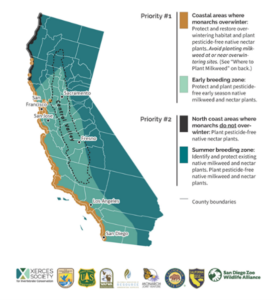
As a result of the EPA workplan and impending listing of the monarch, growers will likely be impacted by changes to pesticide regulations. As the EPA continues to release its Strategies for Identifying and Incorporating Early ESA Mitigation Measures Across Groups of Chemicals, farmers will need to comply with the broadened approach to minimize pesticide exposure to listed species.

Join guest speakers Dr. Chip Taylor from Monarch Watch and Brigit Rollins from the National Agricultural Law Center to hear about the conservation of and history of this important species, crucial insights on the anticipated federal listing of the monarch butterfly and how this will impact growers, and what to expect in pesticide use from the EPA workplan.

Dr. Chip Taylor is the Founding Director at Monarch Watch, an outreach program focused on education, research and conservation relative to monarch butterflies. Monarch Watch has enlisted the help of volunteers to tag monarchs during the fall migration. In recognition that habitats for monarchs are declining at a rate of 6000 acres a day in the U.S., Monarch Watch created the Monarch Waystation program with the goal of inspiring the public, schools and others to create habitats for monarch butterflies and to assist Monarch Watch in educating the public about the decline in resources for monarchs, pollinators and all wildlife that share the same habitats.

Brigit Rollins B.A., J.D. is a staff attorney at The National Agricultural Law Center. Her work focuses on environmental law as it intersects with ag, covering issues such as the Endangered Species Act (ESA), pesticide law and waters of the United States (WOTUS). At the Center, her primary area of research and scholarship is environmental law as it intersects with agriculture. She maintains an interest in promoting sustainability and environmental health through agriculture and resource use.

Register here for the webinar on October 8 from 9 a.m. -10 a.m. PT (12-1 p.m. ET) on Farming, Monarch Butterflies, and the New ESA: What Does this Mean for Farmers?

Registration Now Open for the Organic Grower Summit on Dec. 4-5

September 3rd, 2024

Registration is now open for the 2024 Organic Grower Summit, taking place Dec. 4-5, 2024, at the Hyatt Regency Monterey Hotel & Spa in Monterey, Calif.

Co-hosted by Western Growers and Farm Progress, the Organic Grower Summit brings together producers and suppliers to explore the latest advancements and trends in organic farming. This annual event provides a valuable opportunity for industry experts to exchange insights, share best practices and discuss success stories in sustainable agriculture. 

The two-day summit will feature agtech presentations, a supplier showcase, a tradeshow and more! Attendees will also hear from speakers representing organizations such as the CDFA, Taylor Farms and Braga Fresh.

Tickets: Western Growers members have an opportunity to secure their tickets at a discounted rate of $199.

This is an event you won’t want to miss. Secure your spot today by visiting:

https://ogs.swoogo.com/2024OGS/begin?code=WGAMEMBER24