Prepare Now for Year End Harassment Prevention Training

December 26th, 2024

Harassment, discrimination, and retaliatory conduct remain a concern and source of potential risk for employers. Sexual harassment also continues to be a serious area of liability with impacted employers seeing record settlements and damages awards. 

The California employer’s duty to prevent harassment includes training all employees on preventing sexual harassment and abusive conduct in the workplace. Employers with five or more employees must provide: 

  • One hour of interactive training and education on sexual harassment to all non-supervisory personnel. 
  • Two hours of interactive training and education on sexual harassment to all supervisory personnel. 

Other factors important to fulfilling mandated training obligations include: 

  • Providing training once every two years and within six months of assuming a supervisor or non-supervisory role. 
  • Providing training on preventing abusive conduct and practical examples of harassment based on gender identity, gender expression, and sexual orientation. 

Training may be virtual or in-person but must be conducted by qualified instructors. Online training is offered through the California Civil Rights Department  as well as through Western Growers University 

IRS Updates Mileage Reimbursement Rate for 2025

December 26th, 2024

The Internal Revenue Service (IRS) has announced an increase in the standard mileage rate for business use of a vehicle for the 2025 tax year. Effective January 1, 2025, the rate will rise by 3 cents, from 67 cents to 70 cents per mile. 

This adjustment reflects the IRS’s annual assessment of the fixed and variable costs associated with operating an automobile, including factors such as fuel prices, maintenance expenses, and depreciation. Taxpayers have the option to use this standard mileage rate to calculate deductible vehicle expenses for business purposes, or they can choose to itemize actual expenses if that method provides a greater deduction. 

It’s important to note that under the Tax Cuts and Jobs Act, taxpayers cannot claim a miscellaneous itemized deduction for unreimbursed employee travel expenses. Additionally, deductions for moving expenses are limited to active-duty members of the Armed Forces moving under orders to a permanent change of station. 

For agricultural professionals and businesses, this increase may impact budgeting and expense reporting for the upcoming year. Employers who reimburse employees for business travel using personal vehicles should adjust their reimbursement policies to align with the new IRS rate to ensure compliance and to provide fair compensation for travel-related expenses. 

For more detailed information, refer to the official IRS announcement. 

WG Legal Insights Top 10 Articles of 2024: A Year in Review 

December 26th, 2024

Minimum Wage Increases for 2025

December 19th, 2024

As we look forward to the New Year, employers in all Member states should be aware of applicable minimum wage increases, as well as the final phase-in of California agriculture overtime provisions.  

Unless an exemption applies, most employers are subject to both state and federal minimum wage laws. However, local city and county minimum wage ordinances may require an employer to pay a higher minimum wage for employees working within their local jurisdiction. As such, employers should keep this rule in mind: When faced with conflicting employment law standards, an employer must follow the standard that is most beneficial to the employee. 

Arizona 

Effective January 1, 2025, Arizona’s minimum wage will increase to $14.70 per hour. Generally, unless an exemption applies, an employer may not pay less than the minimum wage for all hours worked, regardless of the frequency or basis of payment (e.g., hourly, salaried, commissioned, piece rate, or any other basis). This increase is in accordance with the state’s Fair Wages and Healthy Families Act which requires Arizona’s minimum wage to increase yearly based on the cost of living. Cities in Arizona are also empowered to establish local minimum wage rates. However, only Tucson ($15.00 per hour for 2025) and Flagstaff ($17.85 per hour for 2025) have established their own minimum wage rates. 

The Fair Wages and Healthy Families Act and 2025 increase does not apply in certain circumstances such as where an individual is employed by a parent or a sibling; or to individuals employed in a small business that grosses less than $500,000 in annual revenue, if that small business is exempt from having to pay a minimum wage under section 206(a) of Title 29 of the United States Code. 

Wage rate posters must be displayed prominently in a place accessible to employees. Updated wage and hour notice posters (Spanish and English) can be found on the Industrial Commission’s Labor website.  

California 

Effective January 1, 2025, California’s minimum wage will increase to $16.50 per hour. Unless an exemption or higher minimum wage applies, all employers must pay employees the state minimum wage. California has several local city and county minimum wage requirements. Review the UC Berkeley Labor Center’s detailed list of local minimum wage ordinances for additional guidance.  

January 1, 2025, also marks the state’s final phase-in of agricultural overtime provisions. In 2016 California initiated a plan to phase-in agricultural overtime to the same basis used in most other California industries. The multi-year phase-in schedule ends in 2025 for employers with 25 or fewer employees.  

As of January 1, 2025, employers with 25 or fewer employees must pay overtime of 1.5 times the employees’ regular rate of pay for any hours worked over 8 hours per day or 40 hours per week. Double the regular rate of pay is required after 12 hours in a workday. This is the last phase-in for all employers. Updated wage and hour notice posters (Spanish and English) can be found on the Department of Labor Standards and Enforcement website. 

Colorado 

Effective January 1, 2025, Colorado’s state minimum wage will increase to $14.81 per hour. Cities in Colorado are empowered to establish local minimum wage rates. Several cities including Denver and the City of Boulder have established their own minimum wage rates. Review the Colorado Division of Labor Standards and Statistics website for a list of local minimum wage ordinances.  

Also, effective January 1, 2025, overtime must be paid after 48 hours worked per week, or 56 hours worked per week for up to 22 “peak weeks” for highly seasonal employers. 

Employers covered by COMPS Order #37 are required to post the applicable wage and hour notice poster. An updated poster can be found on the Department of Labor and Employment’s website.   

New Mexico 

New Mexico’s state minimum wage will not increase in 2025. The state’s last increase was effective January 1, 2023, at $12.00 per hour. Generally, unless an exemption applies, an employer may not pay less than the minimum wage for all hours worked. New Mexico has several local city and county minimum wage requirements.i Review the Department of Workforce Solutions website for a detailed list of local minimum wage ordinances. Employers in the state must also display wage and hour notice posters. Updated posters can be found on the Department’s website.  

Members with questions about pending minimum wage increases should contact Western Growers. 

Managing Holiday Cheer

December 19th, 2024

With the holiday season in full swing and many companies looking forward to once again hosting their employees for in-person holiday parties, it’s a good time to begin managing the holiday cheer. Whether your company will be hosting a formal or casual holiday get together these tips and reminders should help keep things merry and bright! 

Policy Reminders: It is always a good practice to remind employees ahead of any company get together that company sanctioned events are an extension of workplace norms, policies and procedures. It is important that employees understand that this is the case regardless of whether the event takes place on or off company property. Reminders should include the company’s policies on drug and alcohol use, anti-harassment and social media. 

Avoid Compulsory Attendance: Employers must be mindful that not all employees celebrate the same holidays or celebrate the holidays at all. Compulsory attendance at holiday events may trigger social anxiety and place undue pressure on employees who feel they must ‘go along’ to ‘get along.’ To avoid any missteps a best practice in this regard is to make attendance truly voluntary; don’t over-do the ‘we haven’t heard from you yet’ email reminders.  

Be As Inclusive As Possible: Avoid risk associated with discriminatory conduct by making the extra effort to ensure event facilities can accommodate disabled employees and their guest(s). If alcohol is to be served, make sure there are non-alcoholic options and if you are asking employees to RSVP consider including space for employees to list any special dietary restrictions or allergies. 

Holiday get togethers can be a great moral booster and a welcome opportunity to celebrate company “wins” over the past year. With a bit of planning and forethought they can also be a professional and fun group event.  

SCFBA Seeks Expansion of MASC Program After Specialty Crops Excluded from Year-End Economic Aid Package

December 18th, 2024

Group requests Congressional support for a $3 billion additional investment in USDA’s Marketing Assistance for Specialty Crops program


WASHINGTON, D.C. (Dec. 18, 2024) – In a letter issued to the leaders of the U.S. House and U.S. Senate Agriculture Committees, the Co-Chairs of the Specialty Crop Farm Bill Alliance (SCFBA) expressed their disappointment that specialty crop production – which represents nearly half the farm gate value of American agriculture – is left out of the final year-end economic assistance package negotiated by Congressional leaders.  


In the letter, the group writes: 


“Shortly after the FARM Act was introduced in the House of Representatives in October, the Specialty Crop Farm Bill Alliance put together a proposed structure for economic aid for our industry. We shared this proposal with the agriculture and appropriations committees in the House and Senate and requested that if Congress were to advance an economic assistance package for agriculture that it be inclusive of specialty crops.  


Subsequently, in recognition of the severe and unique challenges confronting specialty crop growers in the United States, the Department of Agriculture announced the new Marketing Assistance for Specialty Crops (MASC) program. This $2 billion in economic assistance that is being provided through MASC is an important downpayment for our growers, and except for the structure of the payment limits, it is substantially similar to what the Alliance proposed in October. We are grateful to the Department for recognizing this immediate need and for taking this important first step, however, more is required. 


The Alliance has been communicating with your staffs throughout the year-end negotiations, advocating that Congress include economic assistance for specialty crops in the form of additional funding for MASC along with adjustments to the program’s payment limits. It is now clear that this request has been left out of the final package negotiated by Congressional leaders.” 


The group proposes a path forward to assist specialty crop growers by requesting support for an additional $3 billion in funding for MASC and changes to the program’s payment limitations.  


“Specialty crops include nutrient dense fruits, vegetables and tree nuts, which should make up more than half of an American’s diet according to the Dietary Guidelines for Americans. It is imperative that specialty crop growers in the United States receive economic aid similar to that which Congress is providing to row crops, which include payment limits twice the level of those announced for specialty crops in MASC. Accordingly, we are requesting that each of you support our request to the Department of Agriculture for an additional $3 billion in funding from the Commodity Credit Corporation for the MASC program and that it adopt the payment limits used for CFAP-2, including the three-entity multiplier.”      


The Alliance concludes by reiterating the need for Congress to provide certainty to specialty crop growers by passing a bipartisan five-year Farm Bill, rather than an extension, which delays much-needed investments for the industry.  


“The Specialty Crop Farm Bill Alliance has been advocating for new and innovative long-term investments in the Farm Bill to help our growers compete in an increasingly challenging marketplace. These proposals, which include innovative new programs for research, risk management, technological advancement, and trade, have been receiving widespread bipartisan support from both Houses of Congress. Another extension of the 2018 Farm Bill disproportionately affects specialty crop growers by further delaying these investments in an industry that is vital to the health and wellbeing of all Americans.”  


The full letter is available here 


SCFBA is a national coalition of more than 200 specialty crop organizations representing growers of fruits, vegetables, dried fruit, tree nuts, nursery plants and other products. In early 2023, the alliance released a set of key policy priorities as part of its Farm Bill recommendations. Specialty crop production, including fruits, vegetables, tree nuts, nursery and greenhouse commodities, contributes significantly to the U.S economy, accounting for $64.7 billion in farm gate value and 30 percent of farm cash receipts for crops. 


The SCFBA is co-chaired by Cathy Burns, CEO of the International Fresh Produce Association; Mike Joyner, President of the Florida Fruit & Vegetable Association; Dave Puglia, President and CEO of Western Growers; and Kam Quarles, CEO of the National Potato Council. 


# SCFBA # 


The Specialty Crop Farm Bill Alliance is a national coalition of more than 200 organizations representing growers of fruits, vegetables, dried fruit, tree nuts, nursery plants and other products. The Alliance was established to enhance the competitiveness of specialty crop agriculture and improve the health of Americans by broadening the scope of U.S. agricultural public policy. For more information, visit farmbillalliance.com.   


MEDIA CONTACTS: 

Christina Morton, Florida Fruit & Vegetable Association, [email protected]  

Siobhan May, International Fresh Produce Association, [email protected]  

Mark Szymanski, National Potato Council, [email protected]  

Ann Donahue, Western Growers, [email protected]  

DHS Publishes Final Rule Enhancing Protections for H-2A Workers

December 19th, 2024

The Department of Homeland Security (DHS) has issued a final rule, “Modernizing H–2 Program Requirements, Oversight, and Worker Protections,” which introduces significant updates to the H-2A and H-2B visa programs. Effective January 17, 2025, the rule aims to bolster program integrity and strengthen worker protections while introducing greater flexibility for both workers and employers. 

Key Enhancements to Worker Protections 

  • Fee Prohibitions: 
    • Employers, recruiters, and agents are expressly prohibited from charging fees to workers for H-2 employment. This includes penalties for contract breaches. 
    • Workers may only incur costs that are personal and voluntary, such as passport fees, while employers are responsible for reimbursing required expenses like visa fees. 
  • Whistleblower Safeguards:
    • The rule extends protections to workers who report program violations, guarding them against retaliation and aligning H-2 protections with those already established for H-1B workers. 
  • Increased Oversight: 
    • Employers must now comply with enhanced compliance reviews, including on-site inspections. Non-cooperation or failure to provide requested information can result in petition denial or revocation. 

New Worker Flexibilities 

  • Extended Grace Periods: 
    • Workers are granted up to 10 days before the start and 30 days after the end of their employment authorization. Additionally, terminated workers have a new 60-day grace period to find new employment or prepare for departure. 
  • Job Portability: 
    • Workers may begin new employment upon filing of a petition by a new employer, streamlining workforce transitions and minimizing disruption. 
  • Employment Termination Protections: 
    • The rule removes language around “abscondment,” clarifying that worker departure from employment alone does not imply wrongdoing. 
  • Clarifying “Dual Intent” for Green Card Applicants: 
    • The rule provides assurance that H-2A workers seeking to adjust their immigration status through the PERM, EB-3, or other “green card” pathways will not be penalized for steps taken to obtain lawful permanent residency. Workers will not be deemed to have violated their H-2A status solely for initiating or pursuing these processes. 

Employer Compliance and Integrity Measures 

  • Stricter Petition Denials: 
    • Employers with a history of labor law violations or fraudulent practices may face mandatory denials of petitions for up to three years. 
    • Discretionary denials are also permitted for employers failing to demonstrate intent or ability to comply with program requirements. 
  • Streamlined Rules: 
    • The rule simplifies procedures, such as reducing the time workers must spend outside the U.S. to reset the three-year H-2 status clock from three months to 60 days.  

New Form I-9

Due to the changes, there will be a new I-129 in effect 30 days after publication, January 17, 2025. Current forms will not be accepted after that date. A new form will be published soon on uscis.gov. WG will circulate updated information once available. 

What This Means for Agricultural Employers 

Some of these changes are expressions of existing law. Other changes signify increased accountability and enhanced protections within the H-2A program.  As always, employers using the H-2A program must maintain rigorous compliance standards. 

Western Growers is here to assist its members in understanding and implementing these changes. Members seeking to gain access to a reliable and legally compliant workforce are eligible to use the expert H-2A application filing assistance offered by Western Growers H-2A Services. If you have questions or need support, please contact our team. 

IFSAC Release Annual Report for 2022 Sources of Foodborne Illness 

December 18th, 2024

The Interagency Food Safety Analytics Collaboration (IFSAC) has released its newest annual report, titled Foodborne Illness Source Attribution Estimates for Salmonella, Escherichia coli O157, and Listeria monocytogenes – United States, 2022. 

IFSAC, a partnership between the CDC, FDA and USDA FSIS, was established to enhance coordination across federal agencies in food safety analysis. The report provides important insights into the sources of foodborne illnesses, focusing on priority pathogens such as Salmonella, E. coli O157 and Listeria monocytogenes. 

More information and the full report can be found here. 

Cover Crops and Sustainability Initiatives Field Day at Dole Farms 

December 18th, 2024

Join us on January 16th for an afternoon field day at Dole Farms to discover how integrating cover crops can boost sustainability outcomes in vegetable production systems.

Learn how to integrate cover crops into farming to boost soil health, improve yield, cycle nitrogen and control erosion at this side-by-side fallow winter/cover crop trial. Discover how cover crops reduce pesticide use, suppress fallow-period weeds and create habitats for beneficial insects. Don’t miss this opportunity to gain insights and practical tips.

Event Details:

Date: January 16, 2025
Time: 1:00PM PT
Location: Dole Farms (Directions sent before the event)
Register Here: Sign up now
Credit: 1 CCA Credit in Soil & Water Management

Speakers Include:

Zach Barnes (Dole), Eric Brennan (USDA), Gina Colfer (Wilbur Ellis) and Rebecca Roberts (CMSF).

Walt Duflock Talks the Future of California Ag with The Modern Acre Podcast

December 18th, 2024

Walt Duflock, Senior Vice President of Innovation at Western Growers, joined The Modern Acre podcast (Episode 382) to discuss California’s pressing labor challenges.

“We’re forecast to lose 32% of our state acreage—nine million acres—between 1997 and 2052. And we’re forecast to lose 51% of our farms,” Duflock shared during the podcast.

Duflock brings a wealth of experience to the conversation. As a fifth-generation California farmer (cattle, wine grapes, leafy greens), a 30-year Silicon Valley startup veteran (including eBay and three successful acquisitions) and an agtech innovation leader for the past seven years at SVG-THRIVE and Western Growers, he’s deeply focused on solving challenges around labor, water and food safety.

The Modern Acre is a weekly podcast that dives into the latest trends in business, investing, technology and sustainability within agriculture.

The episode was released on Tuesday, Dec. 17. You can listen to the podcast on Spotify here.

Join Today: WG Data Cultivation Workgroup  

December 18th, 2024

Are you ready to learn about data, collaborate on projects and meet other data enthusiasts? Join the data cultivation workgroup (DCW) this new year.  

The DCW is more than a group – it’s a community of forward-thinkers, problem-solvers and collaborators. By joining, you will: 

  • Build Knowledge: Improve your data literacy and skills through expert presentations and peer discussions. 
  • Foster Collaboration: Connect with professionals across the value chain to share insights, tackle challenges and drive collective progress. 
  • Drive Innovation: Help design and execute data-driven projects that advance agriculture and education, shaping the future of our industry. 

January Meeting 

Our first meeting of the year is expected to be held in January. Please stay tuned for more details. 

Join Interactive Discussions: Help us shape the DCW’s vision and goals for 2025. Our agenda and talking point can be found in our interactive Miro board. 

Project Planning: Collaborate and help us scope our two initiatives and deliverables: 

  1. Building expertise within the group: Develop and grow the data literacy of those who are part of the working group.  
  2. Data resource hub: Lay the groundwork for a platform that empowers growers, researchers and scientists with trusted agricultural datasets and educational materials. 

Who Should Attend? 

Whether you’re a data expert, agricultural professional, researcher, or someone passionate about using data for smarter decision-making, this is your opportunity to contribute. 

Time Commitment and Benefits 

  • 1-2 hours per month 
  • Grow your network, build skills and contribute to projects with tangible industry impact. 

Want to join? Fill out this form: https://forms.monday.com/forms/c8cbb28136bc34af67664b5df7964750?r=use1  

USFWS Announces Proposed ‘Threatened’ ESA Listing of Monarch Butterfly

December 17th, 2024

The U.S. Fish and Wildlife Service (USFWS) proposed to list the monarch butterfly (Danaus plexippus), the iconic orange and black butterfly, as a threatened species and designate approximately 4,395 acres of critical habitat under the Endangered Species Act (ESA).

Citing the ongoing impacts from loss and degradation of breeding, migratory, and overwintering habitat, exposure to insecticides and effects of climate change, the threatened listing is proposed with protective regulations under section 4(d) of the Act. A ‘threatened species’ is a species likely to become an endangered species within the foreseeable future throughout all or a significant portion of its range.

Western Population in High Decline

Western monarch population is facing greater decline and environmental threats

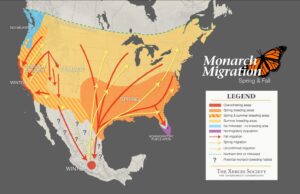
Monarch Populations and Habitat. Source: Xerces Society https://journeynorth.org/monarchs/featured/monarch-butterfly-distribution-map

Compared to the Eastern monarch population, the Western monarch population is facing greater decline and environmental threats. The draft states: “In its current condition, the Western migratory population has a probability of extinction of less than 10 percent over the next 10 years. The Western migratory population has a higher risk of extinction due to current threats, with a probability of extinction of 60‒68 percent over the next 10 years…Looking across the range of future conditions for which we can make reasonably reliable predictions, the probability of extinction for the Eastern migratory population is estimated to be 24‒46 percent in 30 years and 56‒74 percent in 60 years. The probability of extinction for the Western migratory population is estimated to be 92‒95 percent in 30 years and reaches 99 percent in 60 years.”

The decline and threats to the Western population can be highly attributed to climate change. The draft states, “the Western population is vulnerable to catastrophic losses due to both widespread drought events and the co-occurrence of poor environmental conditions [such as extreme weather events or temperature] and low population abundance.”

East vs West, the Population Divide

Distinctions are made by USFWS between the Eastern monarch populations and the Western monarch population. Although not distinguished genetically, the population’s morphology, habitat and threats are the primary differentiators. A third subset, “non-migratory” monarchs are also identified by USFWS.

Nonmigratory monarchs are not likely to go extinct due to their widespread nature and ubiquity around the globe. However, likelihood of nonmigratory population growth to support migratory populations is low, due to nonmigratory populations of monarch butterflies building up high levels of a protozoan parasite, Ophryocystis elektroscirrha (OE). “In California, about 8 percent of migratory monarch butterflies are infected with OE, compared to about 75 percent of residents [nonmigratory] (Satterfield et al. 2016, p. 346). Similarly, for the eastern North American population, less than 10 percent of migratory monarch butterflies are infected with OE, compared to 75–100 percent of nonmigratory monarchs in Florida (Altizer and de Roode 2015, p. 91).”


Climate change is identified as a significant driver for the decline in monarch populations.

Monarch Butterfly (Danaus plexippus) Source: USFWS https://www.fws.gov/species/monarch-danaus-plexippus

Climate Change as a Driver

Climate change is identified as a significant driver for the decline in monarch populations. The draft notes, “the Western population is vulnerable to catastrophic losses due to both widespread drought events and the co-occurrence of poor environmental conditions [such as extreme weather events or temperature] and low population abundance.”

New geographies shifted due to climate change that have potential to sustain monarch habitat are not expected to host monarch populations. The draft reads, “in western North America, climate change is predicted to cause a significant change in the distribution of overwintering monarchs in coastal California (Fisher et al. 2018, p. 10). While modeling projections suggest an inland and upslope displacement of suitable overwintering conditions by the year 2050, the best available evidence does not indicate that monarchs would move to or use these upslope areas (Fisher et al. 2018, pp. 10, 13–14).”

Critical nectar resources and access to milkweed are also expected to decline due to climate change. The draft notes that, “with a warming climate, drought impacts may affect the availability of nectar sources, especially in the western population and in the migratory bottleneck through Mexico… The reduced amount of breeding and migratory habitat continues to negatively impact the viability of the migratory North American monarchs. Monarch conservation needs an approach that encourages and incentivizes landowners to add milkweeds and nectar resources and implement actions to maintain this habitat.”

Farming Critical to Support

Farmers have demonstrated that agriculture and pollinator conservation work hand in hand. USFWS acknowledges that, “private landowner and general public support are crucial because the species is wide-ranging and needs broad conservation action, from small- to large-scale efforts, throughout its range.”

To improve future conditions that would allow monarch migratory populations to stabilize and grow, USFWS suggests that there is a need to “(1) achieve a significant increase in the availability of milkweed and nectar plants in monarch breeding and migratory areas; (2) protect and enhance overwintering habitat; (3) avoid and minimize impacts to monarchs and their habitat from insecticides and herbicides; and (4) maintain public support for the conservation of monarch butterflies.”

Next Steps

USFWS will hold two public informational meetings followed by public hearings. The first meeting and hearing will be from 6:00 p.m. to 8:30 p.m., eastern time, on January 14, 2025. To accommodate those in western time zones, the second meeting and hearing will be from 8:00 p.m. to 10:30 p.m., eastern time, on January 15, 2025

Register Today: 2025 H-2A Stakeholder Meeting in Yuma, Arizona

December 16th, 2024

Secure your spot today for the H-2A Stakeholder Meeting taking place on Jan. 15, 2025 in Yuma, Arizona. This one-day event brings together key players in the H-2A community. Hear directly from government officials and industry experts, including WG Sr. Vice President and General Counsel, Jason Resnick, as they share essential updates and insights on the latest developments regarding H-2A programs and compliance.

Event Details

Location:
Paradise Event Center, 450 Quechan Drive, Yuma, Arizona

Date and Time:
Wednesday, Jan. 15, 2025
7:30 a.m. –  3:00 p.m. MST

The cost of the event is $75 per person and includes breakfast, lunch and an electronic certificate of attendance.

To reserve your spot for the event, click here.

Fresh Produce Alliance Welcomes Passage of Bill C-280 into Law

December 16th, 2024

You can read the full release here.

December 10, 2024 (Ottawa, ON) – Yesterday evening, the Canadian Produce Marketing Association (CPMA), the Fruit and Vegetable Growers of Canada (FVGC), and the Fruit and Vegetable Dispute Resolution Corporation (DRC) were thrilled to see Bill C-280, the Financial Protection for Fresh Fruit and Vegetable Farmers Act, pass at third reading in the Canadian Senate.

Bill C-280, introduced in the House of Commons by Member of Parliament Scot Davidson and sponsored in the Senate by the Honourable Michael MacDonald, establishes a deemed trust financial protection mechanism for fresh produce sellers in Canada. This deemed trust will help secure payment in the event of buyer bankruptcy, providing stability and support to the industry while safeguarding Canadian food security.

“The passage of Bill C-280 has been the result of decades of advocacy by organizations and industry members across the fresh produce supply chain and in the broader agriculture sector,” said CPMA President Ron Lemaire. “We are grateful to all who have supported this work over the years, and greatly appreciative of the efforts of Bill C-280’s sponsors and Parliamentary champions in moving this important legislation forward.”

“From the farm to the dinner plate, fresh produce sellers make significant contributions to local economies across the country, and provide Canadians with safe, nutritious fruit and vegetable products,” said FVGC Executive Director Massimo Bergamini. “The establishment of a deemed trust for all fresh produce sellers will strengthen food security in Canada and help ensure that that our sector can continue to fulfill its important roles.”

In addition to its impact on domestic produce sales, the lack of a financial protection mechanism for fresh produce sellers in Canada has meant that Canadian sellers have been unable to utilize the preferential treatment they previously enjoyed under the United States Perishable Agricultural Commodities Act (PACA). Instead, Canadians selling fresh produce to our biggest trading partner must currently pay double the bond on the shipment to access the PACA dispute resolution mechanism – a cost that is simply untenable for many Canadian businesses. The establishment of financial protection under Bill C-280 now paves the way for the U.S. Department of Agriculture to restore Canadian produce sellers’ preferential access under PACA.

“The positive impact of Bill C-280 on the highly integrated fresh produce industry cannot be overstated,” said DRC President and CEO, Luc Mougeot. “The lack of a financial protection mechanism in Canada has been a pain point in our trading relationship with the United States for many years. We look forward to working with our U.S. counterparts to put in place reciprocal protection and provide stability for produce sellers on both sides of the border.”

CPMA, FVGC, and DRC thank all Senators for their work in considering this important legislation and express their appreciation to both Chambers of Parliament for their recognition of the positive impact that Bill C-280 will have on the fruit and vegetable supply chain in Canada.

For more information, please contact:

Candace Knights
Manager Communications and Market Research
Canadian Produce Marketing Association
Cell: 613-878-3312
Email: [email protected]

Ashley Peyrard
Communications Manager Fruit and Vegetable Growers of Canada
Telephone: 613-621-2195
Email: [email protected]

Luc Mougeot
President and CEO Fruit and Vegetable Dispute Resolution Corporation (DRC)
Email: [email protected]

About the Canadian Produce Marketing Association Based in Ottawa, Ontario, The Canadian Produce Marketing Association (CPMA) is a not-for-profit organization that represents a diverse membership made up of every segment of the produce industry supply chain who are responsible for 90% of the fresh fruit and vegetable sales in Canada. CPMA is fortunate to represent a sector that is both a significant economic driver for communities and that also improves the health and productivity of Canadians. About the Fruit and Vegetable Growers of Canada The Fruit and Vegetable Growers of Canada (FVGC) represent growers across the country involved in the production of over 120 different types of crops on over 14,000 farms, with farm cash receipts of $5.9 billion in 2021. They are an Ottawa-based voluntary, not-for-profit, national association, and, since 1922, have advocated on important issues that impact Canada’s fresh produce sector, promoting healthy, safe, and sustainable food, ensuring the continued success and growth of their industry. About the Fruit and Vegetable Dispute Resolution Corporation (DRC) The Fruit and Vegetable Dispute Resolution Corporation (DRC) is a non-profit, membership-based organization serving the produce trade. DRC provides harmonized standards, procedures and services to help members avoid commercial disputes, as well as consultation, mediation and arbitration services when disputes arise. The DRC can help with disputes that arise between members domestically or internationally and deals with all types of disputes, including condition, contract and payment issues. We work closely with industry associations and governments on behalf of our members to reform legislation, make federal inspections more accessible, develop best practices, and level the playing field for participants.

Updated H-2A AEWR Now in Effect in Most States

December 16th, 2024

The Department of Labor (DOL) has released updated Adverse Effect Wage Rates (AEWRs) for “non-range” H-2A occupations, now published in the Federal Register. These rates are effective as of Dec. 16, 2024, for employers not covered by the Kansas v. U.S. Department of Labor injunction. For employers in the 17 states affected by the injunction, the updated rates will take effect on Dec. 30, 2024. The rates are the same as those published in the Farm Labor Survey and previewed here.

The Kansas injunction impacts states including Arkansas, Florida, Georgia, Idaho, Indiana, Iowa, Kansas, Louisiana, Missouri, Montana, Nebraska, North Dakota, Oklahoma, South Carolina, Tennessee, Texas and Virginia.

The AEWRs apply to six Standard Occupational Classification (SOC) codes commonly used for H-2A labor, such as Farmworkers and Laborers (Crop, Nursery, and Greenhouse – SOC 45-2092) and Agricultural Equipment Operators (SOC 45-2091). AEWRs are the minimum wages employers must pay H-2A workers and corresponding U.S. employees to avoid adverse effects on domestic labor conditions.

The DOL has clarified that when job duties span multiple SOC codes, the highest applicable AEWR will apply.

Employers with H-2A employees currently on payroll should ensure compliance with these updated wage requirements to meet regulatory standards.

WG 2024 Annual Meeting Memories: Browse the Photo Album

December 16th, 2024

Relive the highlights, memorable moments and connections from the Western Growers 98th Annual Meeting. Didn’t get to go this year? These photos will make you feel like you didn’t miss a beat.

Visit www.wga.com/AM24photos to view the gallery. Thank you to everyone who helped make this gathering unforgettable.

Looking forward to the next one? Save the date! The Western Growers 99th Annual Meeting is set for Nov. 9-12, 2025, at the iconic Hotel Del Coronado in Coronado, Calif. Stay tuned for more details!

New Protections for Victims of Violence Under AB 2499: What Employers Need to Know 

December 12th, 2024

California employers must prepare for significant changes under AB 2499, effective January 1, 2025. This law expands employee protections for victims of “qualifying acts of violence” (QAV) and their family members, aligning these rights with the Fair Employment and Housing Act (FEHA). Here’s a summary of key changes: 

Expanded Definition of “Qualifying Acts of Violence” 

AB 2499 introduces the term QAV, which encompasses domestic violence, sexual assault, stalking, or other harmful acts such as: 

  • Causing bodily injury or death. 
  • Brandishing or using a weapon. 
  • Threatening force to cause injury or death. 

These acts qualify regardless of criminal charges or convictions. 

Broadened Employee Protections 

The law prohibits employers of any size from retaliating against or discriminating against employees who: 

  • Serve on a jury or appear as witnesses in court. 
  • Seek legal relief, such as restraining orders, for themselves or family members. 
  • Take time off to address safety, health, or recovery needs stemming from a QAV. 

Protections now extend to employees caring for family members who are victims, defined broadly to include children, parents, spouses, domestic partners, and even designated individuals. 

Reasonable Accommodations for Safety 

Employers must reasonably accommodate employees who are victims—or have family members who are victims—of QAV. Accommodations may include: 

  • Modified work schedules or locations. 
  • Safety measures, such as changes to workstations or access controls. 
  • Assistance with relocation. 

Interactive processes must be timely and in good faith, considering any immediate dangers to the employee or their family. 

Leave and Paid Sick Time 

Employees may use paid sick leave and take protected leave for various purposes, such as medical care, counseling, legal proceedings, or securing new housing. Employers may limit leave to 12 weeks for employee victims and 10 days for family-related leave, though exceptions apply in cases of death due to QAV. Leave must run concurrently with Family and Medical Leave Act (FMLA) or California Family Rights Act (CFRA) leave if applicable. 

Notice Requirements 

Employers must notify employees of their rights under AB 2499 upon hire, annually, and when an employee identifies as a victim. By July 1, 2025, the Civil Rights Department (CRD) will publish a model notice that employers can use. 

Certification Requests 

Employers may require documentation, such as police reports or statements from licensed professionals, to verify the occurrence of a QAV. 

Action Steps for Employers 

To comply with AB 2499, employers should: 

  1. Update policies to reflect the expanded protections. 
  2. Train HR personnel and managers on the interactive process and accommodation requirements. 
  3. Prepare to distribute notices once the CRD publishes the official form. 

Western Growers’ 2025 California Employment Law Update Webinar

December 12th, 2024

Join WG for our annual Employment Law Update Webinar on January 8, 2025, at 10 a.m. PSTWestern Growers’ legal team will bring you up to speed on important California and federal 2025 legislative changes, including updates to California’s anti-discrimination laws, the latest on the captive audience ban, and reframing of the state’s Victim-of-Violence leave. Best practices guidance and important tips for HR professionals will have you set and ready for a compliant 2025! Register to reserve your spot today. HRCI credits are pending 

Register Here


ALRB Approves AB 113 (Card Check) Regulations

December 12th, 2024

On December 11, 2024, the Agricultural Labor Relations Board (ALRB) voted to approve regulations implementing AB 113, often referred to as the “card check” law. This action marks a significant step in the development of labor relations in California’s agricultural industry. The approved regulations now head to the Office of Administrative Law (OAL) for final approval, a process that must be completed within 30 working days. 

Throughout 2024, the ALRB reviewed public comments, including those submitted by Western Growers, and modified the proposed regulatory text to address concerns raised by stakeholders. The version approved by the Board mirrors the Proposed Modified Regulatory Text, adopted without further changes. 

Key Features of the Regulations 

Majority Support Petitions: 

  • Submission and Validation: Labor organizations seeking to represent agricultural employees must file majority support petitions with the ALRB, accompanied by evidence such as authorization cards or petitions. These documents must clearly indicate that signing constitutes a vote for representation. 
  • Employer Responsibilities: Employers must respond to petitions within 48 hours (excluding weekends and holidays) by providing a list of current employees, including contact information (including cell phone numbers and emails), to facilitate the validation process. 
  • Employee Notification: Regional directors are required to notify employees of petition filings and provide opportunities for questions about the process. 
  • Challenged Eligibility: Provisions allow for the resolution of disputes regarding the eligibility of employees included in or excluded from the bargaining unit. 

Unfair Labor Practice Compliance: 

  • Monetary Remedies: The regulations outline detailed procedures for calculating and enforcing backpay or bargaining make-whole remedies for unfair labor practices. Employers must provide accurate documentation or risk default judgments. 
  • Non-Monetary Compliance: The regulations establish formal proceedings for ensuring compliance with non-monetary orders, such as bargaining obligations or cease-and-desist directives. 

Appellate Bonds: 

  • Employers seeking to appeal an ALRB decision involving monetary remedies must post a bond or cash deposit equal to the amount owed. Bonds must meet specific legal standards, and deposits are held in interest-bearing accounts to protect employee rights during judicial review. 

Next Steps 

The OAL will review the approved regulations for consistency with state law. If approved, the regulations will become effective, solidifying the procedural framework for AB 113 implementation.  

For employers, compliance requires careful attention to documentation and procedural timelines, particularly in timely and thoroughly responding to petitions and addressing compliance orders.  

CA Civil Rights Department Continues Fair Chance Act Enforcement Efforts

December 12th, 2024

The California Civil Rights Department (CRD) recently settled with several California employers – Amazon, Ikea, Kohl’s, the Los Angeles Dodgers, The Citizen Hotel, and MPIJet – over alleged violations of the state’s Fair Chance Act.  

Individual complaints filed with the CRD in 2023 allege each of the companies unlawfully rejected otherwise qualified job applicants and failed to comply with the requirements of the Fair Chance Act. Specifically, the companies either failed to follow legally required hiring processes — such as obtaining criminal history information unlawfully through a criminal history questionnaire — or denied employment opportunities over unrelated or even decades-old criminal history information. In each instance, the companies also allegedly failed to consider the gravity of the offense, the time that had passed, and how the offense related to the actual job being sought.  

The purpose of the Fair Chance Act is to reduce barriers to employment that can prevent people with past arrests or convictions from successfully reintegrating into their communities. More broadly, the Fair Chance Act bars most employers from asking about a job applicant’s criminal history before making a job offer and limits convictions that employers can use to disqualify someone to those that have a direct and harmful relationship with the job. For instance, advertisements with statements like ‘No Felons’ or ‘Must Have Clean Record’ violate the law’s protections. In passing the Fair Chance Act, the Legislature recognized that nearly one in three adults in the state has an arrest or conviction that can significantly undermine their efforts to get a job.  

CRD’s Ongoing Fair Chance Act Focus 

This latest round of settlements evidences the CRD’s ongoing commitment to challenging employer hiring practices that run afoul of Fair Chance Act prohibitions. The CRD is also taking proactive steps to challenge unlawful online job advertisements that violate the Fair Chance Act.  

Employers can gain valuable insight into the CRD’s compliance focus by noting the corrective actions included in the settlement agreements between CRD and the various companies. Depending on the specific harms alleged, the following corrective actions were imposed: 

  • Conducting individualized assessments of job applicants’ criminal history information prior to an adverse employment action. 
  • Esuring convictions that have been sealed, dismissed, or expunged are not considered in connection with any application for employment. 
  • Providing written notice to applicants with specific information indicating if an offense is considered disqualifying and how to respond with evidence of rehabilitation.i 

A few additional key points to consider: 

  • Audit current onboarding practices. As noted here, changes to the Fair Chance Act in 2023 concerning notice, individualized assessment, reassessment, and revocation notice practices make it imperative that qualified employers audit current hiring practices to assure compliance. 
  • Create a checklist to ensure compliance with updated processes, timeframes and notice requirements. Provide a copy of the checklist to all hiring managers along with additional training to ensure understanding.