Risk does not care where fresh produce comes from.

May 28th, 2026

By Joelle Mosso, AVP, Science Programs and Sonia Salas, AVP, Food Safety and Regulatory Affairs

The U.S. fresh produce supply is now deeply dependent on imports: The USDA ERS estimates that in 2024 imports supply 59.4% of fresh fruit availability and 36.3% of fresh vegetable availability. Yet FDA oversight, inspection resources, and operational focus still disproportionately center around the domestic supply chain because it is easier to directly regulate and access. 

Instead, we continue increasing costs, compliance burdens, and operational pressures on domestic growers. The same growers that are already operating under some of the strictest food safety expectations in the world.  

Western Growers has recently completed Cantaloupe & Netted Melons Best Practice documents written by subject matter experts and the industry aimed at just that – increasing focus and further reducing risk. Meanwhile, the same growers that are electively working towards improved practices watch as the economic pressure increasingly shifts sourcing toward regions with less visibility, less oversight, and fewer consequences. 

If FDA truly expects domestic suppliers to implement “risk-based” food safety management, then FDA’s own oversight and resource allocation should also become risk-based. Right now, they are not aligned with where increasing supply, and increasing outbreak risk, is coming from. 

But we also understand reality: federal systems move slowly. 

Retail and foodservice buyers decide every day which suppliers survive and their decisions impact consumers . Too often, the deciding factor remains the cheapest delivered price, with no transparency about the tradeoffs behind those decisions. 

Consumers are never told that the lower-cost product may come from systems with less food safety oversight, less verification, or less accountability. 

That needs to change. 

It’s not just food industry CEOs who need to learn that illness is more expensive than a clean packing floor. Retailers, foodservice companies, and their buyers also need to become accountable for the sourcing decisions they make. It is time for the system to reward producers investing in reducing consumer risk and not overlook them in favor of the cheapest bidder.

USDA Details Payment Rates and Signup Timeline for Specialty Crop Assistance

May 29th, 2026

(Washington, D.C., May 29, 2026) – U.S. Secretary of Agriculture Brooke L. Rollins today announced payment rates and the enrollment period for the Assistance for Specialty Crops Farmers (ASCF) program. The U.S. Department of Agriculture (USDA) will issue $1.625 billion in payments to eligible specialty crop producers in response to elevated input costs and market disruptions resulting from foreign competitors engaging in unfair trade practices that impeded specialty crop exports. Producers who have a Login.gov account can access and submit their pre-filled application starting June 1, 2026. Producers who do not have a Login.gov account or prefer to enroll in person at their local Farm Service Agency (FSA) office can request their prefilled application beginning June 8, 2026. The ASCF enrollment period closes on Aug. 7, 2026.

“The Trump administration continues to put Farmers First and is committed to ensuring the economic strength of our specialty crop operations as we continue opening new markets abroad and strengthening demand domestically for American produce,” said Secretary Rollins. “Building on the success of the Farmer Bridge Assistance program, we are using an expedited program application and payment process through the One Farmer, One File system to ensure specialty crop producers also receive the necessary financial assistance as quickly as possible, while we work to build a more robust market with lower input costs and more opportunities.

These payments are authorized under the Commodity Credit Corporation Charter Act and are administered by the Farm Service Agency (FSA). Specialty crop payments are intended to provide financial support to allow producers to pay for production and marketing inputs in the face of significant market disruptions during the 2025 growing season.

How to Apply

Pre-filled applications will be available online to producers with a Login.gov account who timely filed their 2025 crop acreage report for eligible specialty crops. Starting on June 1, 2026, producers who have a Login.gov account can access and submit their pre-filled application from fsa.usda.gov/ascf. Beginning June 8, 2026, producers can request their pre-filled ASCF application from their FSA county office.

The deadline to submit completed ASCF applications is Aug. 7, 2026. Producers can complete their applications online or submit them to their FSA county office.

Payments will be issued as applications are submitted and approved, beginning as early as the first week of signup.

Login.gov

Login.gov is the public’s one account for government. Producers can use one account and password for secure, private access to participating government agencies, including FSA.

To apply for ASCF online, producers can start by visiting fsa.usda.gov/ascf to create their Login.gov account. Producers who have an existing Login.gov account can work with FSA using their existing account.

With a secure Login.gov account, producers can be amongst the first to apply for ASCF, allowing them to view, complete, certify, and submit their application as well as track their application and payment status.

For assistance creating a Login.gov account, visit login.gov/help.

Eligibility

Specialty crop acres of eligible crops reported to FSA as an initial, double crop, repeat crop, or subsequent crop by April 24, 2026, will be used to determine ASCF program payments. Acreage that is reported as a cover crop, prevented planted, or with an intended use of grazing, left standing, green manure, silage, forage, volunteer, or experimental will not be used to determine ASCF program payments.

For a list of eligible specialty crops visit fsa.usda.gov/ascf. Specialty crops grown in a controlled environment are not eligible, except for mushrooms.

Crop insurance linkage is not required; however, USDA strongly urges producers to take advantage of the new risk management tools provided in the Working Families Tax Cuts Act, also known as the One Big Beautiful Bill Act, to best protect against future price risk and volatility.

Payment Calculation

FSA used national average revenue per crop as a metric for developing the ASCF program payment categories and payment rates listed below. For a full list of eligible crops under each category, visit fsa.usda.gov/ascf.

  • Tier 1 – $650 per acre
    Includes eligible specialty crops with an average annual revenue of more than $10,000 per acre.
  • Tier 2 – $225 per acre
    Includes eligible specialty crops with an average annual revenue of more than $2,300 per acre and up to $10,000 per acre.
  • Tier 3 – $65 per acre
    Includes eligible specialty crops with an average annual revenue of up to $2,300 per acre.
  • Beans and Peas – $25 per acre
    Includes all types of beans and peas that were not eligible for the FBA program.

For more information on how revenue per acre was calculated, visit fsa.usda.gov/ascf.

The ASCF payment limitation is $250,000.

More Information

More information on ASCF is available online at fsa.usda.gov/ascf. Producers can also contact their local FSA county office.

Best Practices: Attendance Policies Still Matter

May 29th, 2026

A recent federal court decision highlights an important takeaway for employers: consistently enforced attendance policies and well-documented decision-making can be a strong defense against discrimination and retaliation claims. At issue in the case was whether the employee’s termination was based on consistently documented attendance policy violations as opposed to allegedly discriminatory “stray-remarks” made in the workplace. Ultimately siding with the employer, the court held that the termination was lawful because it was sufficiently based on documented attendance policy violations. 

For California employers, however, the lesson learned is more nuanced. California courts and agencies often scrutinize attendance policies closely, especially when protected leave, paid sick time, disability accommodations, or retaliation concerns are involved. In California, even comments considered “stray remarks” elsewhere may still be admissible as evidence when combined with other facts.  

What Does it Mean? 

This recent decision serves as a reminder that well-documented and consistently enforced attendance policies remain one of the strongest defenses against employment claims, especially when employers can clearly demonstrate that disciplinary decisions were based on legitimate policy violations rather than discriminatory motives. Consider the following: 

  • Neutral Policies Must Still Account for Protected Leave. Attendance policies should clearly exclude legally protected absences from disciplinary calculations. This includes California paid sick leave, Kin Care leave, CFRA/FMLA leave, jury duty, and other protected time off. Employers should review point-based attendance systems to ensure protected leave is carved out and supervisors understand which absences cannot be counted against employees. 
  • Documentation Often Determines the Outcome. The employer in the recent case prevailed largely because records showed the termination decision was based on attendance policy violations that were consistently applied. Consistent documentation and application of policies helps demonstrate that employment decisions are policy-driven rather than retaliatory or discriminatory. Maintain detailed records of: 
    • Attendance violations 
    • Employee notifications and acknowledgements 
    • Progressive discipline steps 
    • Leave requests and approvals 
    • Decision-making rationale 
  • California Courts Do Not Ignore “Stray Remarks.”  Unlike some federal courts, California courts may consider inappropriate comments or workplace remarks as part of the overall evidence in a discrimination case. Even isolated comments can become problematic when paired with inconsistent enforcement or weak documentation. Manager comments that seem informal at the time can later become evidence in litigation. Train supervisors to avoid speculative, personal, or insensitive comments related to: 
    • Medical conditions 
    • Age 
    • Leave usage 
    • Disabilities 
    • Family obligations 
    • Protected complaints 
  • Consistency Across Supervisors Is Critical. Courts frequently examine whether similarly situated employees were treated differently under the same policy. Inconsistent application can undermine otherwise lawful attendance standards. Centralize HR review for high-risk attendance terminations and conduct periodic audits to confirm consistent enforcement across departments and multiple worksites. 

Attendance policies remain an important operational and legal tool. But in California, policy enforcement alone is rarely enough. When attendance decisions are supported by strong records and compliant practices, employers are in a far stronger position to defend against discrimination and retaliation claims. 


California Executive Order Signals Increased Scrutiny of AI’s Impact on the Workforce

May 29th, 2026

California Governor Gavin Newsom recently issued Executive Order N-6-26 (EO), directing state agencies to evaluate how Artificial Intelligence (AI) may affect workers, businesses, and communities across the state. While the order does not impose any immediate legal obligations on private employers, it signals California’s growing focus on the workplace impacts of AI and could shape future legislation affecting the agricultural industry. 

The EO primarily directs state agencies to study potential workforce disruption caused by AI and develop policy recommendations related to worker protections, workforce training, and economic transition support. The EO specifically states that it does not create enforceable rights or immediate compliance obligations for private employers. It does, however, task state agencies with evaluating potential changes to: 

  • Cal/WARN Act requirements and layoff notification rules 
  • Severance and worker transition programs 
  • Workforce retraining initiatives 
  • Collective bargaining issues involving AI 
  • Tracking and reporting of workforce disruption trends 

Why the Agricultural Industry Should Be Watching 

Agriculture is increasingly adopting AI-powered technologies, including automated harvesting systems, precision agriculture tools, workforce management platforms, predictive analytics, and autonomous equipment. While these technologies can improve efficiency and address labor shortages, they may also raise questions about workforce displacement, training needs, and the use of AI in employment decisions. 

Specifically, the EO directs state agencies to identify sectors that may experience significant workforce impacts and to monitor hiring and payroll trends for signs of disruption. Industries with growing automation investments, including agriculture, could receive increased regulatory attention as these reviews progress. 

AI Employment Decisions May Face Increased Scrutiny 

Although the EO focuses primarily on future policy development, employers should recognize the broader trend toward increased oversight of AI-related workplace practices. California regulators continue to show interest in how AI tools are used in hiring, workforce management, performance evaluation, scheduling, and other employment decisions. Employers utilizing AI-assisted technologies should consider: 

  • Reviewing how AI tools are used in employment-related decisions 
  • Maintaining human oversight of key personnel actions 
  • Documenting decision-making processes 
  • Evaluating whether AI systems could create unintended bias or disparate impact 

What Does it Mean? 

While the EO does not create new compliance obligations today, it represents another step toward greater regulation of AI’s role in the workplace. Agricultural employers investing in automation and AI technologies should continue monitoring AI-focused developments, as the mandated review process may ultimately lead to new requirements affecting private sector workforce planning, employee protections, and AI-related employment practices. 


SB 54 Plastic Packaging Resources and Updates

May 20th, 2026

AB 2646: Proposed H-2A Wage Mandate Advances to Senate

May 29th, 2026

AB 2646 would establish a new California minimum hourly wage of $19.75 for certain agricultural employees, including H-2A workers and domestic workers in corresponding employment, beginning January 1, 2027. Each year thereafter, the wage would increase by the same cost-of-living adjustment applied to Social Security benefits.  

This proposed wage mandate would be layered on top of existing H-2A program obligations, including employer-paid housing, inbound and outbound transportation, and either three meals per day or free kitchen and cooking facilities. The practical effect would be to further increase the cost of using the H-2A program in California. 

Where the Bill Stands 

AB 2646 passed off the Assembly floor on a 58-16 vote and is now in the Senate, where it has been referred to the Senate Rules Committee for assignment.  

WG remains strongly opposed to the bill. If enacted, AB 2646 would likely increase production costs, contribute to higher food prices, and make California-grown products less competitive against imports produced at lower cost. 

The bill may also invite litigation. Because the H-2A program is governed by a comprehensive federal statutory and regulatory scheme, there is a strong federal preemption argument if California attempts to impose a separate state wage mandate targeting H-2A employment. 

What Employers Should Do Now 

Agricultural employers should monitor AB 2646 closely as it moves through the Senate. Employers using, or considering using, the H-2A program should begin evaluating the potential cost impact of a $19.75 wage floor beginning in 2027, including the effect of annual COLA increases in future years. 

Employers should also continue documenting H-2A compliance practices, including housing, transportation, meals or kitchen facilities, wage records, and job order obligations. While AB 2646 is not yet law, the bill reflects continued legislative scrutiny of the H-2A program. 

For more information about AB 2646 or the H-2A program generally, WG members should contact the Western Growers H-2A Services Team.

FDA Shares Update on FY26 Cucumber Sampling

May 28th, 2026

Microbiological Surveillance Sampling

The FDA has initiated a new surveillance sampling assignment for both domestic and imported raw fresh whole cucumbers for Salmonella.

A history of Salmonella outbreaks linked to cucumbers precipitated this assignment. Between 2012 and 2025, both domestic and imported cucumbers were linked to multiple Salmonella outbreaks. The FDA has carefully considered recent public health data, prior sampling assignment results, and historical outbreak patterns in developing this assignment, reflecting the agency’s commitment to adaptive surveillance that responds to food safety challenges.

Questions and Answers

What is the projected timeline for this assignment?

The FDA is conducting a surveillance sampling assignment for raw fresh whole cucumbers from May 4 – September 30, 2026.

What are the objectives of this assignment? 

The assignment aims to:

  • Prevent the introduction of contaminated food into U.S. commerce
  • Remove contaminated food from the U.S. food supply
  • Identify trends and strategies for prevention and risk mitigation.

What is the scope of this assignment? 

Both domestic and import samples of raw fresh whole cucumbers will be collected and analyzed for Salmonella.

Where will samples be collected? 

Samples will be collected at retail locations, distribution centers, and ports of entry. Note that sampling will not take place on farms.

How are domestic samples collected?

Domestic samples are collected at retail locations and distribution centers throughout the United States. Samples are taken from unopened boxes/containers in backroom or stockroom areas — not from customer-facing display cases. The focus is on field-grown, raw fresh, whole cucumbers.

How are import samples collected? 

Import samples are collected at ports of entry in the United States.

Why are cucumbers being sampled? 

Between 2012–2025, cucumbers were linked  to multiple Salmonella outbreaks, underscoring the need for continued surveillance.

How did the FDA develop this assignment? 

The FDA carefully considered recent public health data, prior sampling assignment results, and historical outbreak patterns in its decision to continue cucumber sampling. The agency previously conducted a cucumber sampling assignment in FY 2016–2017, covering both domestically produced and imported cucumbers. Since then, cucumbers have been linked to several additional outbreaks, underscoring the need for continued surveillance. As a result, the FDA is continuing to sample this commodity to better understand contamination routes and inform future food safety efforts—reflecting the agency’s commitment to adaptive, data-driven responses to food safety challenges.

What actions will the FDA take if a sample tests positive?  

The specific actions taken will depend on the specific factors, including: the firm’s voluntary corrective actions, historical information related to the firm and product, and WGS genetic information related to the isolates.

Specific additional actions may include:

  • Preventing future entry of contaminated product into U.S. commerce
  • Helping to ensure that contaminated product does not reach consumers
  • Considering additional enforcement strategies to ensure food products do not present a risk to consumers.

If a positive sample is found in domestic samples, in addition to other actions, the FDA will notify relevant commissioned state partners.

Will the FDA share findings from this assignment? 

Yes, the FDA plans to share the assignment findings on FDA.gov upon completion of the assignment.

Who is the FDA contact for more information on this assignment? 

Please send questions about this assignment to [email protected].

Reminder: Upcoming Deadlines for SB 54

May 27th, 2026

This is an important reminder regarding upcoming SB 54 deadlines and available resources for growers, packers, shippers, and brand owners using plastic packaging in California.


Important Deadline

June 1, 2026 – Deadline to register as a Producer under SB 54.

If you are going to file for an Exclusion or an Exemption, we recommend you still register as a Producer in the event an Exclusion is ultimately denied avoiding any penalties for late registration. The Exclusion Notice can be submitted at any time.


Producer Reminder

You generally do NOT have to register as a Producer for covered material used during harvest and field packing.

Western Growers strongly encourages members to add a statement on invoices to customers such as:

“This produce was harvested and packaged in the field” to document the product has been field packed.

However, if covered material is added later in the warehouse before shipment, you MAY be considered the Producer for that packaging material and may need to register.


Exclusion Notices to CalRecycle

An Exclusion Notice may be submitted to CalRecycle at any time for packaging necessary to comply with federal food safety rules, regulations, and guidelines where no feasible recyclable or compostable alternative currently exists.


Important Guidance Documents to Be Submitted with Exclusion

Western Growers has developed guidance documents, templates, and supporting citations specifically for fresh-cut produce packaging to help members complete and support an SB 54 Exclusion Notice submission to CalRecycle.

Western Growers strongly recommends that members upload the WG guidance documents and supporting materials as supplemental information with their Exclusion Notice submission.

View Guidance Documents Here

CalRecycle has confirmed that supporting guidance documents, best practices, industry recommendations, academic research, and technical information are relevant to the exclusion process because they help demonstrate:

  • Why the packaging is necessary for food safety;
  • How the packaging complies with federal food safety standards; and
  • Why feasible recyclable or compostable alternatives may not currently exist.


Resources Available on the Western Growers Website

All SB 54 resources are available at the top of the Western Growers homepage under:

“SB 54 Plastic Packaging Resources and Updates”

Resources include:

  • Producer guidance
  • Supporting food safety justifications
  • Federal rules, regulations and guidelines
  • Filing instructions
  • CalRecycle guidance documents
  • Exemption information
  • Regulatory updates

View Resources Here


Please contact Gail Delihant [email protected] or Jeana Cadby [email protected] with any questions regarding Producer status, Exclusion Notices, or Exemption applications.

DISCLAIMER: This email does not provide legal advice. Although this message may contain information and advice that may affect possible legal matters, it cannot and should not constitute or substitute legal advice. If you have further questions or need legal advice, please contact a lawyer.

FDA’s Traceability Rule Pilots to Support Readiness are Announced

May 27th, 2026

The Partnership for Food Traceability (PFT) has announced the launch of three industry pilot programs developed to help food businesses assess and strengthen their readiness for FDA’s Food Traceability Rule, which takes full effect on July 20, 2028. 

As a public-private partnership bridging industry and the FDA, PFT advanced the design these pilot frameworks to give organizations a standardized, structured, low-stakes environment to test their traceability capabilities, identify gaps, collaborate with peers, and compare learnings — well before the compliance deadline arrives. 

PFT will formally introduce all three pilot programs during a free, one-hour webinar on Tuesday, June 9th, from 2:00 to 3:00 PM EDT.  Space in each pilot program is limited. We encourage interested Western Growers members to confirm participation early. Click here to register for the upcoming webinar.

About the Three Pilot Programs 

Pilot 1 — TLC Flexibility: Traceability Lot Code Flexibility 

This pilot explores additional flexibilities for satisfying the Food Traceability Rule’s lot-level tracking requirements. Participating organizations will document their current traceability lot code approaches — whether from completed pilots, active implementations, or planned testing — and share findings with PFT. The goal is to surface and validate workable compliance solutions for supply chain segments where lot code capture and transmission represent new operational requirements. 

Pilot 2 — Data Sharing to FDA: Electronic Sortable Spreadsheet Sharing 

This pilot initiates a series of hypothetical data intake exercises designed to further inform the capabilities of FDA’s Product Tracing System. Participants will practice completing and submitting an Electronic Sortable Spreadsheet (ESS) that captures Critical Tracking Events (CTEs) and Key Data Elements (KDEs) across the supply chain — building familiarity and confidence with the submission process before it is required. 

Pilot 3 — Industry Interoperability 

This pilot enables organizations to test cross-industry data sharing and identify any technical difficulties prior to full implementation. By working directly with supply chain partners to send and receive traceability data using existing systems, participants can surface integration challenges, evaluate current capabilities, and develop solutions in a collaborative, non-enforcement environment. 

What Participants Gain 

Organizations that enroll in a PFT pilot program will receive: 

  • Access to a structured forum for sharing real-world implementation results 
  • Feedback from industry peers and stakeholders on compliance approaches 
  • Greater clarity on where flexibility exists within the Food Traceability Rule 
  • Collaborative peer strategies for achieving compliance ahead of the 2028 deadline 
  • A demonstrated track record of proactive readiness with FDA 

Register for the June 23 Webinar 

PFT’s free one-hour webinar will walk through each pilot program in detail, explain the enrollment process, and answer questions from attendees. It is open to all to participate!  

Tuesday, June 23 | 2:00–3:00 PM EDT | Free to Attend 

Register Here

For any questions on these pilots, reach out to Sonia Salas at [email protected].

Food Traceability Rule Updates: FDA Discussion Paper Released and Stakeholder Engagement Opportunities

May 27th, 2026

On May 27, 2026, the U.S. Food and Drug Administration (FDA) released a discussion paper to encourage more detailed stakeholder engagement on potential flexibilities related to the lot-level tracking requirements under the final Food Traceability Rule, “Requirements for Additional Traceability Records for Certain Foods.” The paper outlines key topics and questions intended to guide discussions ahead of the FDA-led virtual public meeting on June 15, where participants are encouraged to provide input. As a reminder, registration is required to attend the upcoming FDA’s virtual public meeting on June 15, 2026, and those wishing to speak during this meeting must register by June 5.  

The discussion paper entitled “Identifying Additional Flexibilities for Satisfying the FTR’s Lot-Level Tracking Requirement” can be found here. FDA encourages those attending and speaking at the public meeting to consider the topics in this discussion paper. Written comments on the FDA public meeting or discussion paper must be submitted by July 15, 2026, through Docket No. FDA-2014-N-0053 on Regulations.gov. A public notice regarding this comment opportunity will be published in the Federal Register on May 28, 2026, and will be made available here. 

Lastly, Western Growers submitted comments on the FDA’s traceability rule draft guidance due May 21, 2026. The final comments can be found hereWestern Growers is also actively engaging in the development of pilots to support supply chain readiness and coordination across the supply chain. For more information on upcoming pilots and other opportunities to engage, click here. 

To access FDA’s Constituent Update, click here. 

Packaging as a Waste-Reduction Tool Across the Supply Chain

May 27th, 2026

When people talk about food waste, the image that usually comes to mind is what ends up in the trash at the end of the day: unsold produce, bruised fruit, a box pulled from the shelf. What we don’t often talk about is everything that came before that moment: the water, fuel, fertilizer, labor, land and time invested long before the product was ever packed. 

That’s where packaging and its associated functionality enters the conversation. Not loudly. Not dramatically. But consistently. 

Packaging functionality is one of the quieter tools in the supply chain, yet it plays a role at nearly every step. It’s used in harvest and cooling, through transportation and distribution, onto the retail shelf and finally into a consumer’s refrigerator. And the way it’s designed and used in the supply chain can be the difference between product that moves through it and product that never gets a chance. 

Take shelf life as an example. Functionality technologies like modified atmosphere packaging (MAP) can extend freshness by 50–200%, often translating to one to three additional weeks depending on the commodity. That extra time matters. It can absorb delays from weather, labor shortages or transportation issues. It can reduce shrink, improve fill rates and give partners more flexibility when things don’t go perfectly, which, in real life, they often don’t. 

And shelf life is just the beginning. 

Think about how much product is lost simply due to physical damage. Bruising from compression, punctures during handling, or cartons that weren’t quite right for the journey. The right structures, like clamshells, pads, corner posts and well-designed master cartons act as quiet insurance policies. Fewer defects mean fewer claims, fewer downgrades and less product pushed into secondary or salvage channels. 

Then there’s the consumer side of the equation. How often does food waste happen not because the product was bad, but because the package wasn’t usable? Examples include portion sizes that don’t match household needs, packaging that can’t be resealed or products that dehydrate once opened. When packages are designed with real use in mind, more of what’s bought actually gets consumed.  

Information matters too. Having clear lot codes, readable date labels and tools like 2D barcodes not only support compliance, but they also support better decisions. Faster receiving. More accurate rotation. Earlier identification of quality or food safety issues. The sooner a problem is seen, the smaller it tends to be. Better information flow helps prevent the kind of slow bleed that quietly turns into major loss. 

Even visibility plays a role. What’s the first thing a consumer does when they pick up a pack of berries? They inspect it for freshness. The design of the packaging being see-through allows them to do this easily. It’s an important feature that is commonly overlooked. Well-designed retail packaging and packs that don’t require excessive handling can help product move more quickly and consistently. When displays stay intact and fruit looks fresh, shoppers are more likely to buy the products and shrink tends to fall. 

So, what does all of this mean for growers, packers, shippers? 

It starts with acknowledging that packaging isn’t one-size-fits-all. Distance, seasonality, handling conditions, destination and transportation mode all matter. A pack that works beautifully on a short haul might struggle on a longer or more volatile route. Cost per unit is important, but it’s rarely the full story. 

Packaging can also act as a buffer for the cold chain. Even the best cooling programs face variability in the real world. If a package is well-designed to help protect quality through temperature swings, it can reduce rejection rates and claims, keeping products moving instead of stuck in dispute. 

Consistency also improves traceability. When labels are standardized and easy to scan, partners down the supply chain can rotate product correctly and respond faster if a problem comes up. Tracking shrink by specific pack types, rather than lumping everything together, can also help identify small packaging changes that lead to big reductions in waste. 

The bottom line is simple: packaging decisions are waste decisions. 

This isn’t about using more packaging. It’s about using the right packaging which is packaging that is functional, meaning it protects quality, supports food safety, improves information flow and allows every link in the chain to do its job more effectively. When that happens, less food is lost, fewer resources are wasted and the system works the way it’s supposed to. 

For those interested in exploring the research and best practices behind these ideas, resources are listed below. 


Resources 

Advancing sustainability through modified atmosphere packaging (MAP) for fresh food preservation: A critical review 

Food Loss and Waste – SPPA 

Food wastage along the global food supply chain and the impact of food packaging 

A Review on the Modified Atmosphere Preservation of Fruits and Vegetables with Cutting-Edge Technologies 

Strategies to Extend the Shelf Life of Fresh and Minimally Processed Fruit and Vegetables with Edible Coatings and Modified Atmosphere Packaging 

A Simple Guide to Clamshell Protective Packaging for Food Products. 

The impact of transparent packaging: how transparent packaging for organic foods affects tourists’ green purchasing behavior 

Western Growers Discusses Fresh Produce Packaging Through a Supply Chain Lens with Insights from G.L. Robertson 

Bridging the Gaps in Traceability Systems for Fresh Produce Supply Chains: Overview and Development of an Integrated IoT-Based System 

Modified Atmosphere Packaging for Fresh-Cut Produce 

Modelling approaches for designing and evaluating the performance of modified atmosphere packaging (MAP) systems for fresh produce: A review 

Mourning the Loss of Vicki Scott

May 27th, 2026

On May 20, 2026, the fresh produce industry lost a truly influential leader whose impact extended far beyond Arizona and touched many across the industry. Vicki Scott played a leadership role in advancing solutions to address food safety and regulatory issues impacting the fresh produce industry, helping shape a more collaborative approach grounded in both science and practical implementation. 

Vicki was a dedicated food safety professional, President of the Yuma Safe Produce Council, member of the Leafy Green Marketing Agreement serving in different capacities, as well as a key contributor to the work of Western Growers Association, Yuma Fresh Vegetable Association, and other entities. She had a unique ability to recognize emerging challenges early and advance meaningful progress. Her legacy will live on through the work she helped build and the many lives she influenced.  

Her passing was unexpected, and she left us far too soon. She will be remembered not only for her professional contributions but also for the lasting influence she has had on the people and work around her. Our thoughts are with The Scott Family and all of those who had the privilege to get to know her. For those who would like additional information, send condolences, or reach out to the family, please click here for additional information.

Are You Prepared for Upcoming Packaging Fees and Reporting?

May 27th, 2026

Extended Producer Responsibility (EPR) for Fresh Produce Packaging 

For more information about EPR and fresh produce, register for the Town Hall: Navigating EPR in California: Source Reduction Plans & SB 54 Reporting Requirements

What is EPR?

Extended Producer Responsibility (EPR) is a policy approach that shifts the financial and operational responsibility of packaging waste management from municipalities to producers. These policies aim to address growing concerns about plastic pollution and strained recycling streams. 

Under EPR, producers are required to fund and support the collection, recycling, and disposal of packaging materials. In most cases, this is done through participation in a Producer Responsibility Organization (PRO), which manages compliance on behalf of its members. 

The definition of “producer” varies by state or region but generally refers to the entity responsible for introducing packaged products into the marketplace. This can include brands, licensees, importers, distributors, growers, packers, or shippers. Because definitions differ across jurisdictions, companies operating in multiple states may face varying compliance obligations. 

Where is EPR Active in the U.S.? 

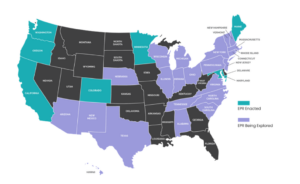
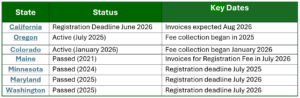
While there are currently no federal EPR policies, at least seven states have enacted EPR laws for packaging, including California, Oregon, Colorado, Maine, Minnesota, Maryland, and Washington. Each of these states requires producers to join a PRO, report materials data, and begin paying fees that fund recycling infrastructure and waste management. 

In addition, more than a dozen other states have proposed or are actively considering similar legislation, signaling continued expansion in the near future.

Figure 1. EPR adoption in the United States. Source: OPLN EPR Readiness Circle 

While all EPR programs share a similar framework, implementation timelines and requirements vary significantly. 

Table 1. State-by-state snapshot of packaging EPR programs in the United States, illustrating differences in legislative status, rollout timing, and program requirements. 

Important Deadline 

June 1, 2026 – Deadline to register as a Producer under SB 54. 

Additional Guidance & Resources 

Guidance for EPR policy in California  

For more information about EPR and fresh produce, register for the Town Hall: Navigating EPR in California: Source Reduction Plans & SB 54 Reporting Requirements

Reminder: Upcoming Deadlines for SB 54

May 27th, 2026

This is an important reminder regarding upcoming SB 54 deadlines and available resources for growers, packers, shippers, and brand owners using plastic packaging in California.

Important Deadline

June 1, 2026 – Deadline to register as a Producer under SB 54.

If you are going to file for an Exclusion or an Exemption, we recommend you still register as a Producer in the event an Exclusion is ultimately denied avoiding any penalties for late registration. The Exclusion Notice can be submitted at any time.

Producer Reminder

You generally do NOT have to register as a Producer for covered material used during harvest and field packing.

Western Growers strongly encourages members to add a statement on invoices to customers such as:

“This produce was harvested and packaged in the field” to document the product has been field packed.

However, if covered material is added later in the warehouse before shipment, you MAY be considered the Producer for that packaging material and may need to register.

Exclusion Notices to CalRecycle

An Exclusion Notice may be submitted to CalRecycle at any time for packaging necessary to comply with federal food safety rules, regulations, and guidelines where no feasible recyclable or compostable alternative currently exists.

Important Guidance Documents To Be Submitted with Exclusion

Western Growers has developed guidance documents, templates, and supporting citations specifically for fresh-cut produce packaging to help members complete and support an SB 54 Exclusion Notice submission to CalRecycle.

Western Growers strongly recommends that members upload the WG guidance documents and supporting materials as supplemental information with their Exclusion Notice submission.  

Growers who are going to submit an exclusion should also submit the Best Practices documents with their notice as supporting documentation.

Guidance Documents

CalRecycle has confirmed that supporting guidance documents, best practices, industry recommendations, academic research, and technical information are relevant to the exclusion process because they help demonstrate:

• Why the packaging is necessary for food safety;
• How the packaging complies with federal food safety standards; and
• Why feasible recyclable or compostable alternatives may not currently exist.

Resources Available on the Western Growers Website (link to website)

All SB 54 resources are available at the top of the Western Growers homepage under:

“SB 54 Plastic Packaging Resources and Updates”

Resources include:

• Producer guidance
• Exclusion Notice templates
• Supporting food safety justifications
• Federal rules, regulations and guidelines
• Filing instructions
• CalRecycle guidance documents
• Exemption information
• Regulatory updates

View Resources

Please contact Gail Delihant [email protected] or Jeana Cadby [email protected]  with any questions regarding Producer status, Exclusion Notices, or Exemption applications.

DISCLAIMER: This email does not provide legal advice. Although this message may contain information and advice that may affect possible legal matters, it cannot and should not constitute or substitute legal advice. If you have further questions or need legal advice, please contact a lawyer.

Big Thank You to My Friend and Former WG Colleague Mayor Dennis Donohue

May 27th, 2026

We held a retirement party for Mayor Dennis Donohue at the Taylor Farms Courtyard next to the Western Growers Center for Innovation and Technology on Monday, May 18. It was a very appropriate in the perfect setting because the CIT was part of the series of events that helped establish Salinas as the epicenter of specialty crop AgTech. There were three key elements that came together to make that happen.

1)          The Forbes AgTech event on Main Street in Salinas in the big tent. This event established west coast agriculture as a separate entity worthy of coverage all on its own. Prior to this, specialty crop agriculture was one of the areas you could see in Tulare at World Ag Expo, but there weren’t many events dedicated to general specialty crop AgTech, particularly with thought leadership content. Forbes changed that with the Salinas Forbes AgTech show. As usual, Dennis was right in the middle of the show, connecting Forbes and Paul Noglows with John Hartnett at SVG-THRIVE and Bruce Taylor from Taylor Farms to bring investors, growers, and startups together in one place for two days to cover everything specialty crop AgTech. It was noticeably different from other AgTech, and the press started to notice. The Forbes AgTech was a big part of the reason that specialty crop AgTech (and later AgFunderNews would extend it to AgriFoodTech to include both the behind and in front of the farm gate tech segments as one to make it appear larger than it was).

2)          The Western Growers CIT was a great visual for AgTech. It created the image of shared workspace and the notion of market access for startups all in one place. It was especially convenient for startups that were located outside of Salinas Valley but knew they needed a presence in the valley. For many, the CIT became that presence, particularly if they were international. They had a place to call home when they visited. As always, Dennis was right in the middle of this, working with Hank Giclas and Emily Lyons to help launch and support the CIT. Equally important, Dennis was the connector that made sure everyone knew that the CIT was there and was available to help with conference rooms for meetings, open air space for large group gatherings, and the courtyard for events that fit better outside or were larger than CIT could support. Because the CIT was the first shared AgTech work spaces, it created a visual image around being first and being a great place to hang out. Big and ongoing thanks to Bruce Taylor and the Taylor Farms team for making it so easy to work with them on the CIT for over a decade.

3)          The launch of the SVG-THRIVE fund with Western Growers and Bruce Taylor as key early Limited Partners (LPs) in the SVG-THRIVE fund. What Western Growers and Bruce told the market was that the ag industry was going to be supportive of AgTech by investing industry dollars into early funds. This is a key signal that horizontal LPs who are not from the ag industry are looking for when they are making decisions about where to put their money. Western Growers represented the 2,000+ specialty crop grower members and a check from Western Growers to SVG-THRIVE said those members supported a direct investment into the companies, not just the use of capital to buy the equipment and solutions after they have been developed. It’s a different level of commitment and confidence in the space. Similarly, when Bruce Taylor invests as an LP, it sends a powerful signal from one of the most influential growers and operators in the food industry. As founder and CEO of Taylor Farms — one of the world’s largest vertically integrated food producers — his involvement signals strong confidence in the opportunity. It should come as no surprise that these early checks were part of the momentum that took AgriFoodTech from $2B in 2011 to $54B in 2021. Industry-led signals led to LPs finding and entering the space with VC General Partners at several funds. And as you may have guessed by now, Dennis was right in the middle of this as well, introducing Bruce Taylor and John Hartnett (Founder and CEO at SVG-THRIVE). From there, the larger picture emerged with Western Growers stepping in alongside Bruce as LPs with Dennis playing the classic tech and capital connective role that all segments need to emerge and scale.

To me, those three events are the key pillars in the emergence of Salinas Valley as the specialty crop capital of AgTech. They provided a catalytic event that lasted for years with capital commitments from key strategic LPs that put cash into influential VCs back when it was really needed and then added a physical visual manifestation of what market access to the key players in the equation really looked like – the growers, because it’s always the growers who write the most important check. That is the check to the AgTech startup that built the thing that they convinced the grower could help improve their economics because they worked with their team to do the before and after math.

Dennis’s retirement party was such a perfect way to put a bow on Dennis’s efforts at Western Growers and as the Mayor because of the speakers who made a few remarks and what they represent. Naturally, I was happy to take the microphone as the MC to try and connect the dots for those that were able to join us. My time with Dennis has been through multiple phases – as a partner at SVG-THRIVE, as a Western Growers member through my 5th generation family farm that supported the Mayor in his first three terms, as a Western Growers colleague, and now as a Western Growers Executive who will continue working with Dennis as the Mayor (now for a 4th term!) We have been in complete alignment through all of our conversations – the growers are the key player in AgTech and they (and they alone) will be making the decisions about which AgTech solutions are ready for prime time and which are not. Having that as our true north star has made it easy to stay on task and on mission no matter what our respective roles have been. It helped SVG-THRIVE cohort startups understand the importance of talking to growers early and often. It helped all startups understand the need for things like the CIT and more recently Reservoir Farms. It helped the growers understand that if we (Western Growers and partners) could provide a vetting experience for startups that helped them earn the right to talk to growers, it made sense for growers to push them our way before they engaged because it was the most efficient way for 2,000+ growers to gain the benefit of the AgTech solutions without needing to talk to 2,000+ startups (just in the automation and chemical alternatives categories).

So, who provided some remarks for Dennis on Monday?

1)          Bruce Taylor – this one was easy. We are in Bruce’s courtyard just outside the CIT that Bruce and Dennis helped build in the Taylor Farms headquarters. No one has been with Dennis on the journey of specialty crop AgTech more than Bruce Taylor from all angles. It was fitting that Bruce shared a few thoughts on the early days of AgTech in Salinas, the relationship with Forbes and John Hartnett, and had a few thoughts for Dennis.

2)          Rob Yraceburu (President of Wonderful Orchards at Wonderful Co.) was next. Rob is the current Chair of the Western Growers Board of Directors and has been very involved in AgTech activities while managing an increasingly large set of operations and activities at Wonderful. As the Chair of the Western Growers Board, Rob stays close to all of the activities going on inside Western Growers, including the WG Innovation team. Rob gave an overview of the importance of innovation to the Western Growers Membership and Wonderful and acknowledged the progress made to date while stressing the need to continue moving forward for the good of the entire WG membership.

3)          Danny Bernstein (Founder and CEO of Reservoir Farms) was the third speaker. Danny has been focused on AgTech for a few years after a very successful career in Silicon Valley. For the last two and a half years, Danny has been working with Ben Palone and me from Western Growers and Sean Sundberg and Greg Christensen from John Deere to develop the strategy, programs, and partners that can turn Reservoir Farms into a world-class on-farm robotics incubator. These activities have led to two huge milestones recently. The first was the official grand opening of the Reservoir Farms location in Salinas off highway 68 with 12 (and counting) Reservoir Farms members using the shared R&D space, shared commercially grown acreage, and shared John Deere equipment to build their products faster and cheaper. The second was the three-year commitment Western Growers made that was a clear indication of long-term strategic alignment and an investment of $1.5M from Western Growers to Reservoir. John Deere has already committed $3M in equipment, support and capital and are evaluating future options for deepening the relationship. And again, how did this get started? Well Danny got introduced to – you guessed it – Mayor Dennis. After they talked, Dennis called me and said you should have lunch with this guy from Silicon Valley. He’s very interesting. As usual, Dennis was right, and Danny and I were off and running the following week.

There you have it. The thre speakers that help symbolize the three key pillars of AgTech innovation in Salinas and in specialty crops. Bruce Taylor as the Founder and CEO of Taylor Farms who was with Dennis from the beginning to help chart the way. Rob Yraceburu as the current WG Board of Directors Chair and a key AgTech player- at Wonderful clearly supporting the work that has been done and the work that remains to be done. And Danny Bernstein, who represents the best path forward in the WG-John Deere partnership to help startups get the last mile connectivity they need to growers with real world field demonstrations just feet away from where they can now complete R&D and iterate on it in real time. We’ve come a long way from the parking lot demos on asphalt with green chalk that some of the early robot startups used before they had Reservoir Farms or real acreage as an option.

Congratulations to Dennis and thank you for all that he did to help make Salinas the specialty crop AgTech capital. It came at a time when Salinas really needed a new economic lever, and the impact on Western Growers members and all specialty crop growers really has been massive. Two things are true at the same time. We have made so much progress in the last 10 years, and we have so much still to do.

Now Dennis turns out to be very bad at retirement. His main purpose in retiring was to be able to be both the current full-time Mayor of Salinas and to run (I would argue an even more full-time job!) for Mayor again. So Dennis and I and many of the folks that were at the retirement party will continue to work together because no industry is more crucial to the success of Salinas than the combination play of agriculture and AgTech. Good luck with the rest of your 4th term, Mayor Dennis, and good luck on securing your 5th term this year! I look forward to continuing to work together.

New Voices of the Valley: Inside the Hidden World of Insects in Ag

May 22nd, 2026

In this episode of Voices of the Valley, Western Growers’ Jeana Cadby sits down with USDA research entomologist Dr. Daniel Hasegawa to explore the surprising role insects play in agriculture. From beneficial pollinators and parasitoid wasps to destructive pests and insect-borne crop diseases, Dr. Hasegawa breaks down how insects shape the food we grow and eat every day, and the cutting-edge research helping farmers protect crops while supporting healthy ecosystems.

Listen to the episode here.

Best Practices for CA and AZ Employers: Donning and Doffing

May 21st, 2026

“Donning and doffing” refers to the time employees spend putting on and removing required clothing, protective equipment, safety gear, or other work-related items. Whether this time must be paid can present significant compliance challenges for employers under both federal and state wage and hour laws. 

Because compensability depends heavily on the specific facts and circumstances of the work being performed, employers should carefully evaluate their practices and consult legal counsel when necessary. 

Arizona: Focus on the “Integral and Indispensable” Analysis 

Under the Fair Labor Standards Act (FLSA), courts generally apply the “integral and indispensable” test when determining whether donning and doffing time is compensable. This analysis looks at whether the activities are a necessary and essential part of the employee’s principal job duties. 

Given the fact-specific and multi-factor nature of this standard, Arizona employers should exercise caution before excluding donning and doffing time from compensable hours worked. A few key best practices include:  

  1. Evaluate Required Gear and Equipment. Review whether employees are required to wear specialized protective equipment, uniforms, or tools that are essential to performing their primary job duties. 
  1. Assess Pre-Shift and Post-Shift Activities.Examine whether employees are performing required activities before or after their scheduled shifts that may qualify ascompensable work time under the FLSA. 
  2. MaintainClear Timekeeping Policies.Ensure policies and timekeeping procedures accurately capture all potentially compensable work activities, including required preparatory or concluding tasks. 

California: Apply a Broader Standard 

California law generally requires employers to compensate employees for time spent changing clothes or washing on the employer’s premises when those activities are required by the nature of the employer’s business. California courts often apply a broader interpretation of compensable work time than federal law. 

As a result, California employers should carefully assess whether employees are effectively under the employer’s control while performing donning and doffing activities. A few key best practices include: 

  1. Determine Whether On-Site Changing Is Required. Evaluate whether employees are required to change into uniforms, protective gear, or specialized clothing at the worksite due to business or safety requirements. 
  2. Review Wage and Hour Policies Regularly. Conduct periodic reviews of payroll and timekeeping practices to ensure all required pre-shift and post-shift activities are being properly compensated. 
  3. Train Supervisors on Compensable Time Issues. Ensure managers and supervisors understand when preparatory and concluding activities may constitute compensable work time under California law. 

Because donning and doffing issues are highly fact-specific and subject to evolving legal and state specific standards, employers should consult experienced employment counsel before implementing policies that exclude preliminary or postliminary activities from paid time. 

EEOC Requests Recission Review of EEO-1 Reporting Requirements

May 21st, 2026

The Equal Employment Opportunity Commission (EEOC) has submitted a regulatory review request to the Office of Information and Regulatory Affairs (OIRA) that could eventually lead to the rescission of certain long-standing EEO data collection requirements, including EEO-1 reporting obligations. EEO-1 reports are currently required from private employers with 100 or more employees and certain federal contractors meeting applicable employee thresholds. Although the request has generated significant attention, it remains under review and does not change employers’ current reporting obligations.

Employers that are currently subject to EEO-1 reporting requirements must continue preparing to comply with existing reporting obligations. According to the EEOC’s official EEO Data Collections page, the 2024 EEO-1 Component 1 data collection is closed, and updates regarding the 2025 EEO-1 Component 1 data collection will be posted as they become available. Notably, last year’s collection period opened on May 20, 2025. The delay, coupled with the pending regulatory review request, is creating uncertainty regarding the timing and potential scope of ongoing EEO reporting requirements. 

What Does it Mean? 

In the short term, until the EEOC formally changes the regulations, employers should assume existing EEO-1 reporting requirements remain in effect and continue preparing accordingly. 

In the long term, if the EEOC ultimately rescinds EEO-1 reporting obligations, the change could significantly affect how workforce demographic data is collected and used by federal agencies and employers. EEO-1 data has historically been used by the EEOC to support enforcement of federal anti-discrimination laws and to analyze workforce demographics across industries. Many employers rely on EEO-1 data for internal pay equity reviews, diversity analytics, government contracting compliance, and broader workforce planning initiatives.  

While waiting for the opening of the 2025 data collection period, employers should continue focusing on several key compliance steps: 

  • Confirm reporting eligibility to determine whether the organization meets current EEO-1 filing thresholds. 
  • Review workforce demographic data to ensure employee race/ethnicity, sex, and job category information is accurate and up to date. 
  • Audit HRIS and payroll systems to verify that required workforce data can be properly extracted and reported if the portal opens on short notice. 
  • Continue monitoring EEOC announcements for updates regarding the 2025 EEO-1 Component 1 collection schedule and any changes to reporting requirements. 

DOL Formally Rescinds the 2024 Federal Overtime Rule

May 21st, 2026

The U.S. Department of Labor (DOL) has formally rescinded the 2024 federal overtime rule. In a final rule published May 15, 2026, the DOL removed the 2024 changes from the federal overtime regulations and restored the prior exemption standards established under the 2019 rule. The recission is a technical correction accounting for changes in the law that have already occurred.  

The 2024 rule was intended to increase minimum salary thresholds needed for certain employees to qualify for overtime exemptions. Increases were to be rolled out in two phases, with the first increase occurring July 1, 2024, and a second on January 1, 2025. However, in late November 2024, after numerous lawsuits challenged the rule, a federal district court judge in Texas held that the DOL had exceeded its authority in issuing the rule, resulting in the rule being vacated nationwide. 

What Does it Mean? 

With the DOL’s latest action, the federal overtime exemption standards formally revert to the 2019 rule.  

Employers evaluating exempt classifications under federal law should continue using: 

  • The standard salary threshold of $684 per week ($35,568 annually); and 
  • The highly compensated employee threshold of $107,432 annually. 

Employers that delayed planned salary increases tied to the 2024 rule will no longer need to implement those increases under federal law. However, employers should continue reviewing employee classifications to ensure employees satisfy both the salary basis test and the applicable duties tests under the FLSA. 

California employers are reminded that, although the DOL’s action affects federal overtime exemption standards under the FLSA, California wage and hour laws continue to apply and impose their own exempt salary thresholds and overtime requirements. Because California’s exemption standards are generally more stringent than federal law, the withdrawal of the federal rule does not change employers’ obligations under California law. 

SB 54: Plastic Packaging Exclusion Resources

May 21st, 2026

CalRecycle recently released additional guidance documents related to SB 54, California’s Plastic Pollution Prevention and Packaging Producer Responsibility Act.

We know there is still significant confusion regarding who is considered a “Producer,” what packaging must be reported, what an “Exclusion” means and how “Exemptions” work. We hope the summary below helps simplify the latest developments.

Regarding California’s SB 54 packaging requirements and a potential exclusion pathway that may apply to your fresh produce packaging: Packaging may qualify for an exclusion if the packaging used is necessary to comply with federal food safety laws and no reasonably feasible recyclable or compostable alternative exists (Section 18980.2 – Categorically Excluded Materials).  This exclusion process is generally intended for packaging used for minimally processed ready-to-eat produce processed and packaged in a warehouse.

Western Growers has developed draft templates to help members prepare. Members submitting a notice for an exclusion must submit it through CalRecycle’s website (see CalRecycle’s email notice below).

  1. Exclusions Worksheetincludes the intake questions that will need to be submitted through the Cal Recycle portal. This document is for organizing purposes and does not need to be included in the submission.
  2. Categorical Exclusion Supporting Materialsincludes language that can be used to support your application. Copy-paste applicable content, considering the materials used in your operation.

Please note:

  • These documents are for informational purposes only and not legal advice
  • Updates will be provided as additional guidance becomes available from CalRecycle
  • You may need to reach out to you packaging supplier/manufacturer for detailed information

Field Packed Produce
If you produce, harvest and package your commodity on the same site where it is grown, the law states (Public Resources Code §42041(a)(4)) you are NOT a Producer for the covered material. Growers who only field pack do not need to register as a Producer.  Growers may consider adding a statement on invoices or indicating other transactional documents to inform entities down the supply chain that the product was harvested and packaged in the field.

However, that does not exempt the packaging material in which those commodities are packaged from the definition of “covered material” within the meaning of section 42041(e)(1). The definition of covered material includes, “Single-use packaging that is routinely recycled, disposed of, or discarded after its contents have been used or unpackaged, and typically not refilled or otherwise reused by the producer.”  This would capture packaging used in the field. The exclusion from the covered producer definition would mean that the those who produce, harvest and package the commodity in the field are not subject to SB 54. However, other parties in the supply chain could be considered the producer for these materials under the law.

Warehouse Packaging
If additional covered material is added in the warehouse before shipment, you MAY be considered the Producer for that covered material. Western Growers is continuing to seek clarification from CalRecycle regarding these situations.

Exemption (limited timeframe) – Application is on Circular Action Alliance (CAA) website: https://circularactionalliance.org/
An “Exemption” is different from an “Exclusion.”

An exemption is temporary and generally lasts between 2–5 years.

This process applies when:
• You use covered material that does not currently meet recycling requirements; and
• You need additional time to transition to compliant packaging.

Please note that exemptions are expected to carry the highest producer fee obligations.

Where to Find Official Guidance

CalRecycle will post additional instructions and submission details here:
https://calrecycle.ca.gov/packaging/packaging-epr/

Where to Register (If You Are a Producer)

If you determine you are a producer, registration is required through:
https://secure.calrecycle.ca.gov/PEPRS/Account/SignIn

Important Deadlines

  1. Within 30 days of final regulations – Submit Exclusion or Exemption notices to
    Circular Action Alliance
  2. June 1, 2026 – Producer registration deadline (to avoid penalties)
  3. August 1, 2026 – Source Reduction Plan due

Not Sure If You’re a Producer?

Use our decision tool here:
https://wga.mediavalet.com/portals/epr

Learn More

Please stay tuned for additional details on our upcoming webinar, Navigating EPR in California: Source Reduction Plans & SB 54 Reporting Requirements.

Other Resources

If you have questions or would like help determining whether your packaging may qualify for an exclusion, please contact:

Gail Delihant – [email protected]
Jeana Cadby – [email protected]

We encourage all members to begin reviewing their packaging and gathering documentation now to determine whether an exclusion may apply.

This email is for informational purposes only and does not constitute legal advice.  We encourage you to consult qualified legal counsel regarding your specific circumstances.