State Water Board Releases Draft Report of Recommendations of the Second Statewide Agricultural Expert Panel

March 30th, 2026

The State Water Resources Control Board (State Water Board) has released the draft report of recommendations of the Second Statewide Agricultural Expert Panel (Panel).

The draft encompasses Panel recommendations on issues relevant to the Panel charge questions, which ask the Panel to consider the approaches in State Water Board Order WQ 2018-0002, In the Matter of Review of Waste Discharge Requirements General Order No. R5-2012-0116 for Growers Within the Eastern San Joaquin River Watershed that are Members of the Third-Party Group (Eastern San Joaquin Water Quality Order) and State Water Board Order WQ 2023-0081, In the Matter of Review of General Waste Discharge Requirements for Discharges from Irrigated Lands Order No. R3-2021-0040 (Central Coast Ag Water Quality Order).

For more information, please refer to the Notice. If you have additional questions, please email [email protected].

The FDA Office of CORE+EP Recently Released the Core 2024 Annual Report

March 30th, 2026

Previously known as CORE Network, CORE+EP was established in 2024 as part of a government reorganization to protect public health and oversee food defense, traceability, and supply chain initiatives. CORE+EP offers weekly updates on foodborne illnesses and adverse events across the United States and works in coordination with agencies like the Centers for Disease Control and Prevention (CDC) and state health departments. Their most recent report summarizes incidents investigated within the FDA Human Foods Program involving FDA-regulated food. 

 As part of their investigation process, the Signals Team first investigates incidents that could lead to outbreaks by monitoring emerging outbreaks and disease surveillance. These investigations involve reviewing data from food firms, including past inspections, sampling results, and other records. If an outbreak is linked to FDA-regulated food, the CORE Response Team takes over to determine the FDA’s response efforts, including identifying a specific ingredient associated with illnesses. Once the ingredient/product is identified, the CORE team takes public health action, issuing public health advisories or recommending voluntary recalls to companies associated with an outbreak. These public health actions could result in warning letters, seizures, and the addition of firms to import alerts. For products that are not FDA-regulated, the investigation is designed for other pertinent agencies (e.g., USDA). 

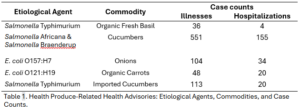
In 2024, the Signals Team evaluated 72 incidents, of which 26 responses were initiated (FDA-Regulated Food), and 10 advisories were issued. Half of the advisories involved fresh produce (Table 1), all of which resulted in outbreak advisories and recall announcements.  


Notably, cucumbers were associated with multiple regulatory actions across different firms. In one case, the FDA issued a warning letter. For imported cucumbers, a nationwide import alert (99-35) was issued, under which foreign firms are subject to detention without physical examination (DWPE). 

Advisories are issued when the food vehicle is identified either during the outbreak or afterward. Sometimes, a product linked to illnesses is identified, but no advisory is issued because there is no specific actionable advice for consumers, such as if the product is no longer available. For example, in 2024, produce-related items on that list included leafy greens like romaine lettuce, imported parsley, and spinach. Additional items included jalapeno peppers and sprouts.  

Reference: 

  1. U.S. Food and Drug Administration. (2026). CORE 2024 annual report. https://www.fda.gov/food/outbreaks-foodborne-illness/core-2024-annual-report 


What the Latest IFSAC Report Tells Us About Foodborne Illness and Why It Matters

March 30th, 2026

On March 27th, 2026, The Interagency Food Safety Analytics Collaboration (IFSAC), released its latest annual source attribution report. These reports are designed to estimate which broad food categories are most commonly associated with foodborne illness caused by pathogens, including Salmonella, E. coli O157, and Listeria monocytogenes. The data in this 2023-year report uses 49,848 illnesses linked to 1,390 foodborne disease outbreaks that occurred from 1998 through 2023. Another new aspect of this year’s report is a new modeling approach that applies a weighted modeling approach that emphasizes more recent years while still incorporating longer-term historical data. 

Overall Takeaways 

Across the study period, IFSAC identified 4,156 foodborne disease outbreaks that occurred between 1998 and 2023. Of those, 1,390 outbreaks involved a confirmed or suspected implicated food that could be assigned to a single food category and included in the attribution analysis. 

Among these attributed outbreaks: 

  • 1,037 outbreaks (74%) were associated with Salmonella  
  • 285 outbreaks (21%) were associated with E. coli O157  
  • 68 outbreaks (5%) were associated with Listeria monocytogenes  

The report also highlights the strong influence of recent data outbreaks on the updated model. Outbreaks occurring from 2019 through 2023 accounted for: 

  • 57% of the model-estimated illnesses used to calculate attribution for Salmonella  
  • 59% for E. coli O157  
  • 31% for Listeria monocytogenes  

This shift toward weighing more recent years is important, as it allows attribution estimates to better reflect current patterns in foodborne illness rather than relying too heavily on older outbreak data. 

Produce Estimates per organism 

SalmonellaThe report notes that more than 75% of Salmonella illnesses were attributed to six categories overall: chicken (19.1%), fruit (14.2%), seeded vegetables (13.0%), pork (11.7%), other produce (10.0%), and beef (7.8%). In terms of production the estimates are spread across multiple categories rather than concentrated in just one. The produce-related categories reported were: 

  • Fruits: 14.2%  
  • Seeded vegetables: 13.0%  
  • Other produce: 10.0%  
  • Vegetable row crops: 3.4% 

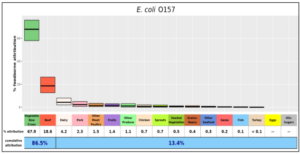
E. coli O157: Over 85% of  E. coli  O157 illnesses were attributed to vegetable row crops (such as leafy greens) and beef. Vegetable row crops had a significantly higher estimated attribution percentage than all other categories. 


Listeria monocytogenesFor Listeria monocytogenes, produce also represented a meaningful share of attributed illnesses. The report estimates: 

  • Vegetable row crops: 27.4%  
  • Fruits: 15.9%  

The leading non-produce category was: 

  • Diary: 31.9% 

Why It Matters 

Reports like this are important because they provide a broad, national-level perspective on where foodborne illnesses have historically been linked across the food system. While source attribution estimates should not be interpreted as a direct measure of contamination risk for any one commodity or operation, they can help identify where public health burden has been concentrated and where prevention efforts may have the greatest impact 

For our industry, one of the most relevant takeaways is that fresh produce continues to remain part of the national food safety conversation, particularly for pathogens such as E. coli O157 and Listeria monocytogenes. At the same time, the report also reinforces that attribution is often distributed across multiple food categories and should be interpreted carefully. These findings are best viewed as not as a measure of blame, but as a directional tool. 

It is also important to recognize what reports like this can and cannot tell us. IFSAC estimates are based on outbreak data, which are one of the strongest available tools for linking illnesses to foods, but they still represent only part of the broader food safety picture. Many illnesses are never linked to a specific source, and outbreak detection itself depends on surveillance, traceback, and investigation capacity. As a result, source attribution estimates are best used as a directional public health tool rather than a definitive measure of contamination.  

New Cemex Ruling Challenges NLRB Authority

March 27th, 2026

As discussed here, the 2023 National Labor Relations Board (NLRB or Board) ruling in Cemex Construction Materials Pacific, LLC (Cemex) deviated significantly from decades-long precedent regarding the voluntary nature of card check recognition. 

In Cemex, the Board found that the employer’s anti-union activity so tainted the election that its only remedy was to set aside the election results. As a result, the standard set by the NLRB made it an unfair labor practice to refuse to recognize, upon request, a union designated as a representative by the majority of employees in an appropriate unit unless the employer promptly files a Representation Management (RM) petition to test the union’s majority status or the appropriateness of the unit. 

One challenge to this controversial ruling has resulted in a decision by the Sixth Circuit Court of Appeals invalidating the NLRB ruling and calling into question its decision-making authority. Finding that Cemex established “a general rule of broad applicability” through Board adjudication rather than a formal rulemaking process, the Court’s decision challenges the Board’s authority in creating governing precedent through adjudication as opposed to establishing rules in alignment with its overarching purpose as a regulatory body. 

What Does It Mean? 

Even though the Sixth Circuit’s ruling is binding only in cases appealed to that jurisdiction, it has broad implications for existing and future challenges. For example, Cemex remains under review by the Ninth Circuit Court of Appeals. It is unclear if—or to what extent—the Ninth Circuit will consider or adopt the Sixth Circuit’s ruling. Conflicting rulings among the circuit courts, or a controversial ruling by the Ninth Circuit, could result in a further appeal to the U.S. Supreme Court, thereby extending any final decision into the unforeseeable future. 

Until the Cemex case has run its course through the courts, employers are left navigating the defense of bargaining orders through a mix of traditional standards and the still-existing Cemex framework. 

As for any lasting impact on the NLRB, it remains to be seen how this may affect other similar cases in which the Board could be challenged for establishing rules through an adjudicative process, as opposed to using its formal rulemaking authority.

 Broad Arbitration Agreements Upheld

March 27th, 2026

A recent California Court of Appeal decision confirms that broadly worded arbitration agreements, even those covering “all claims,” can be enforceable when drafted and implemented properly. The case provides useful guidance for employers navigating the line between expansive coverage and unconscionability challenges. 

The Case 

In Ayala-Ventura v. Superior Court ( Fresno County), the court considered an arbitration agreement that required employees to arbitrate essentially all claims arising from the employment relationship. The employee challenged the agreement as overly broad and unconscionable, arguing that its sweeping scope made it unfair and unenforceable. 

The court disagreed and enforced the agreement. 

Key Takeaways 

  1. “All claims” language is not inherently fatal
    The court rejected the notion that broad arbitration provisions are automatically invalid. While prior decisions have raised concerns about agreements that appear to extend indefinitely or cover unrelated future disputes, the court emphasized that context matters. Where the employer’s operations and the employment relationshipreasonably limit the scope of potential claims, broad language alone will not render an agreement unconscionable. 
  2. Courts will assess real-world scope, not hypothetical extremes
    Rather than focusing on theoreticalpossibilities, the court evaluated whether the agreement realistically swept in unrelated or unforeseeable claims. It concluded that the agreement did not create the type of “infinite” exposure that would support a finding of substantive unconscionability.  
  3. Traditional contract principles still control
    The decision reinforces that arbitration agreements are treated like any other contract. Under the Federal Arbitration Act, they are enforceable unless invalid undergenerally applicable contract defenses such as unconscionability. This means employers must still ensure fairness in both procedure and substance. 
  4. Drafting and presentation remain critical
    The court pointed to several factors supporting enforceability:
  • Clear, standalone agreement 
  • Mutual obligations between employer and employee 
  • Balanced procedures 
  • Meaningful opportunity for the employee to review terms 

These factors continue to be central in defending arbitration agreements against challenge. 

What it Means for Employers 

This decision is a helpful reminder that employers can still use broad arbitration agreements to manage litigation risk, including wage and hour and class action claims. But breadth alone is not enough. 

Employers should focus on: 

  • Clarity and readability 
  • Mutuality of obligations 
  • Avoiding one-sided carveouts 
  • Providing a fair review process at onboarding 

Courts remain receptive to arbitration, but they are equally willing to scrutinize agreements that appear overreaching or procedurally unfair. 

Bottom Line 

A well-drafted arbitration agreement is highly recommended as it can cover a wide range of claims without running afoul of California law. The key is not how broad the language appears on paper, but whether the agreement operates fairly in practice and reflects a balanced employment relationship. 

CA Compliance Deadline: Emergency Contact Notification Required by March 30, 2026

March 27th, 2026

As discussed here, California’s SB 294—officially titled the Workplace Know Your Rights Act (the Act) and signed into law on October 12, 2025—aims to ensure that California employees are fully informed of their rights in the workplace, particularly in areas involving labor protections, immigration-related inspections, union activity, and constitutional rights during law enforcement interactions. 

Pursuant to the Act, employers are required to provide all employees with an Emergency Contact Notification option, enabling them to designate an individual who will be notified in the event of an arrest or detention at the workplace or during work hours. This notice requirement must be implemented no later than March 30, 2026. 

This notification opportunity must be made available to all existing employees as well as offered during the onboarding process for new hires. 

Penalties for noncompliance are significant: $500 per employee, per day, for each day the violation occurs, up to a maximum of $10,000 per employee. 


The 2026 Western Food Safety Conference Comes to Salinas on May 6–7

March 25th, 2026

The Western Food Safety Conference will take place May 6–7 in Salinas, CA. Now in its 21st year, the conference has become a cornerstone event for advancing food safety education, research and collaboration across the fresh produce industry.

Bringing together leaders from industry, academia and regulatory agencies, the conference creates a unique forum to share critical insights, explore emerging risks and discuss practical solutions that strengthen food safety from farm to fork. Attendees will hear directly from renowned researchers, government officials, and industry experts on the latest science, regulatory developments and real-world implementation challenges shaping the future of food safety.

This year’s program highlights timely and impactful topics, including the evolving regulatory frameworks such as SB 54.

Beyond the sessions, the conference offers valuable opportunities to connect with peers, build relationships and engage in meaningful conversations that drive progress across the industry. Hosted in the heart of the Salinas Valley, the event also reflects the region’s critical role in feeding the nation and supporting the future of agriculture.

Whether you are a grower, shipper, processor, retailer or food safety professional, the Western Food Safety Conference provides a space to learn, collaborate and be part of shaping a safer, more resilient food system.

Learn more here.

What You Need to Know About PFAS and Pesticides in California

March 25th, 2026

The Department of Pesticide Regulation (DPR) conducts one of the nation’s most comprehensive produce residue monitoring programs, collecting and testing thousands of domestic and imported fruits and vegetables each year. The term PFAS can vary widely and DPR independently evaluates each chemical individually to evaluate the impact of that chemical on human health and the environment.

Read the full statement from DPR on what you need to know about PFAS and pesticides in California here.

New Report: Guidelines for Biopesticide Validation and Adoption

March 25th, 2026

Western Growers and the Bioeconomy Science Institute have published Guidelines for commercial field trials, grower assessment and industry adoption.

Through a global collaborative effort involving industry and research experts, this framework was drafted at the International Biopesticides Research Workshop, sponsored by Western Growers, held in June 2025 at the University of California, Davis. The guidelines consolidate insights from international researchers, product registrants, growers, and commodity groups to create a scientifically sound path for evaluating biopesticides.

The agricultural landscape is shifting due increasing pest resistance and a changing policy and social landscape for pest control tools, among other pressures. While the biological products market is projected to reach nearly $28 billion by 2028, growers often find it difficult to navigate the diverse array of new biopesticides. The guidelines address the complexity of trialing biopesticides, which often differ from traditional synthetics in terms of knockdown speed and environmental sensitivity as well as provide a transparent framework for validation. Growers are in need of further resources to navigate the process of identification for high-performing products and those in need of further development. This practical framework to help growers overcome barriers to integration, can support biopesticide adoption as a reliable tool for sustainable agriculture.

Key takeaways include:

  • Rigorous Field Validation: Successful adoption will rely on trials that reflect real-world commercial conditions, including variations in climate, soil, and water quality.
  • Economic Viability (ROI): Trials must demonstrate a clear Return on Investment (ROI) for growers, measuring benefits like yield improvements, input cost savings, and labor efficiency.
  • Standardized Reporting: The industry is encouraged to use standard reporting templates to ensure consistency, transparency, and comparability across different regions.
  • IPM Integration: Biopesticides should be evaluated for their fit within existing Integrated Pest Management (IPM) programs, focusing on how they can reduce resistance and protect beneficial species.
  • Food Safety and Compliance: Rigorous adherence to regulatory standards, including microbial purity and pre-harvest intervals, remains a top priority for products used on fresh produce.

For detailed protocols on commercial trials, grower assessment checklists, and the full biopesticide development pipeline, please refer to the complete document here:

View Biological Assessment Guidelines (March 2026)

“Dirty Dozen” List Again Smears Safe, Healthy Produce

March 24th, 2026

(Washington, DC) – The Environmental Working Group’s (EWG) “Dirty Dozen” report once again villainizes safe, healthy, and affordable fruits and vegetables by misrepresenting U.S. Department of Agriculture (USDA) pesticide data. In its usual approach, EWG overstates the risk of consumer pesticide exposure by leaving out a key detail: more than 99% of the commodities sampled by the U.S. Department of Agriculture in its annual Pesticide Data Program (PDP) report (the source material for the EWG report) have residues well below the stringent safety standards set by the Environmental Protection Agency (EPA).

As USDA reports have consistently shown over the years, the latest report demonstrates that the vast majority of the commodities sampled had residues well below the established EPA safety standards, and more than 42% had no detectable residues. The PDP tests a wide variety of both domestic and imported foods with a strong focus on those commonly fed to infants and children. Fresh and processed fruit and vegetables made up 92.8 percent of the 9.872 tested samples, including: apples, avocados, blackberries (fresh and frozen), cherry tomatoes, cucumbers, head lettuce, leaf lettuce, onions, oranges, pineapples (fresh and frozen), potatoes, canned pumpkin, sweet corn (fresh and frozen), and tomatillos. These data are further supported by FDA’s latest Pesticide Residue Monitoring Program Report and its new Pesticide Report Data Dashboard.

The USDA and FDA reports clearly demonstrate that, when farmers use pesticides, they follow the stringent laws and regulations governing pesticide use to provide safe and healthy fruits and vegetables for America’s families, including their own. The Alliance for Food and Farming (AFF) has previously pointed out that peer-reviewed research published in the Journal of Toxicology found that the recommendation in the “Dirty Dozen” list to substitute organic forms of produce for conventional does not result in any decrease in risk for consumers because residues on conventionally grown produce are so low, if present at all.

The EWG openly states that one goal of its Dirty Dozen report is to drive consumers toward organic produce, which costs significantly more than conventionally grown produce, and offers equal health benefits. It is well known and widely accepted that a diet rich in fruits and vegetables is a keystone of healthy nutrition. Studies have shown, however, that lower-income and cost-conscious consumers do not respond to the EWG report by purchasing only organic products: instead, they are increasingly likely to avoid fruits and vegetables altogether.

In a report released by the Centers for Disease Control and Prevention (CDC), only 1 in 10 Americans consumes enough fruits and vegetables each day, unchanged from previous survey levels reported almost a decade ago. The report states that those living below or near the poverty level were the least likely to meet produce recommendations. EWG attempted to justify the methodology used in its latest report by comparing pesticide levels in various foods with those in the urine of people who ate those foods. However, this new approach is riddled with errors and data manipulation. Instead, AFF recommends that consumers use the pesticide residue calculator to get an accurate count of how many servings can be eaten without health effects.

Consumers who are still concerned about pesticide residues can follow FDA advice to wash fruits and vegetables under running tap water, which often removes or eliminates any low levels of residues that may be present. (FDA advises never using soaps or detergents to wash produce.) Learn more about the safety of all produce at www.safefruitsandveggies.com.

###
The Alliance for Food and Farming is a nonprofit organization founded in 1989 that represents both organic and conventional farmers. Alliance contributors are limited to farmers of fruits and vegetables, companies that sell, market or ship fruits and vegetables or organizations that represent produce farmers. Our mission is to deliver credible information about the safety of fruits and vegetables. Visit www.safefruitsandveggies.com or contact us at [email protected].

State Water Board Seeks Input on Agricultural Expert Panel Draft Report

March 23rd, 2026

The State Water Resources Control Board (State Water Board) is accepting public comments on the Recommendations of the Second Statewide Agricultural Expert Panel (Panel) Draft Report (Draft Panel Report), offering stakeholders an opportunity to help shape future water quality and agricultural policies.

The Draft Panel Report will be available on or before March 30, 2026, on the Water Board Agriculture Second Statewide Agricultural Expert Panel website here.

Comments must be submitted by 12 p.m. on April 30, 2026.

In addition to written comments, the State Water Board staff will host a public workshop on Friday, April 10, 2026, from 2 p.m. to 6 p.m. The workshop will include a presentation, followed by the opportunity for verbal comments on the Draft Panel Report. Please refer to this notice for additional details.

If you have additional questions, please email [email protected].

Do You Know WGCIT Startup KipTraq?

March 30th, 2026

KipTraq Introduces “Brandi,” a Powerful New AI Assistant

KipTraq is excited to announce the launch of Brandi, our new AI assistant built directly into the KipTraq platform. Designed to simplify complex workflows, Brandi can instantly summarize thousands of inspections—data, comments, and observations—and deliver a concise, easy‑to‑read briefing in English or Spanish. These summaries can also be automatically emailed to your team on a customized schedule.

Users can guide Brandi with specific prompts, rules, priorities, and goals to ensure each summary highlights the issues that matter most to their operation. The result is clear, actionable insight with no extra effort.

Automated Workflows That Keep Your Operation Moving

KipTraq customers are also seeing major efficiency gains with our new Workflow system, which automates follow‑up tasks based on your defined rules. When an issue is identified—whether it’s in the field, on equipment, or inside a facility—KipTraq automatically assigns the task to the appropriate team members, includes all relevant details, sets a deadline, and sends reminders as needed.

Best of all, this functionality is 100% user‑configurable and works seamlessly both in-field and in‑plant, giving teams flexibility without added complexity.

Learn more at KipTraq.com.

What Customers Are Saying

Nick Martin, Director of Supply Chain for Pacific Trellis Fruit, shared:

“KipTraq gives us the visibility we need to forecast labor, materials, and quality, without adding complexity. We’ve built tools that fit our operation, integrate with our systems, and actually save time and labor. There’s really no limitation to what we can do with it.”

More customer testimonials can be found here.

The New AgFunderNews AgriFoodTech Report is Here

March 30th, 2026

It’s here! Yes, folks, last week was World Agri-Tech in San Francisco, and so once again that means that the team at AgFunderNews released their annual report Global AgriFoodTech Investment Report 2026, which goes in-depth (as always!) into the funding highlights and analysis of why things changed in 2025 and are likely to continue changing in 2026. I have had the chance to read the report for the first time this week. I will give it a couple more reads in the next few weeks, and I often like to compare the content and context to prior years to see where there are some lessons to be learned across multiple years that you don’t always get from a single year analysis. The AgFunderNews is one of the key pieces of analysis for AgriFoodTech. It’s the AgriFoodTech version of Mary Meeker’s Internet Report, and it’s absolutely must-see TV (or must-read print!).

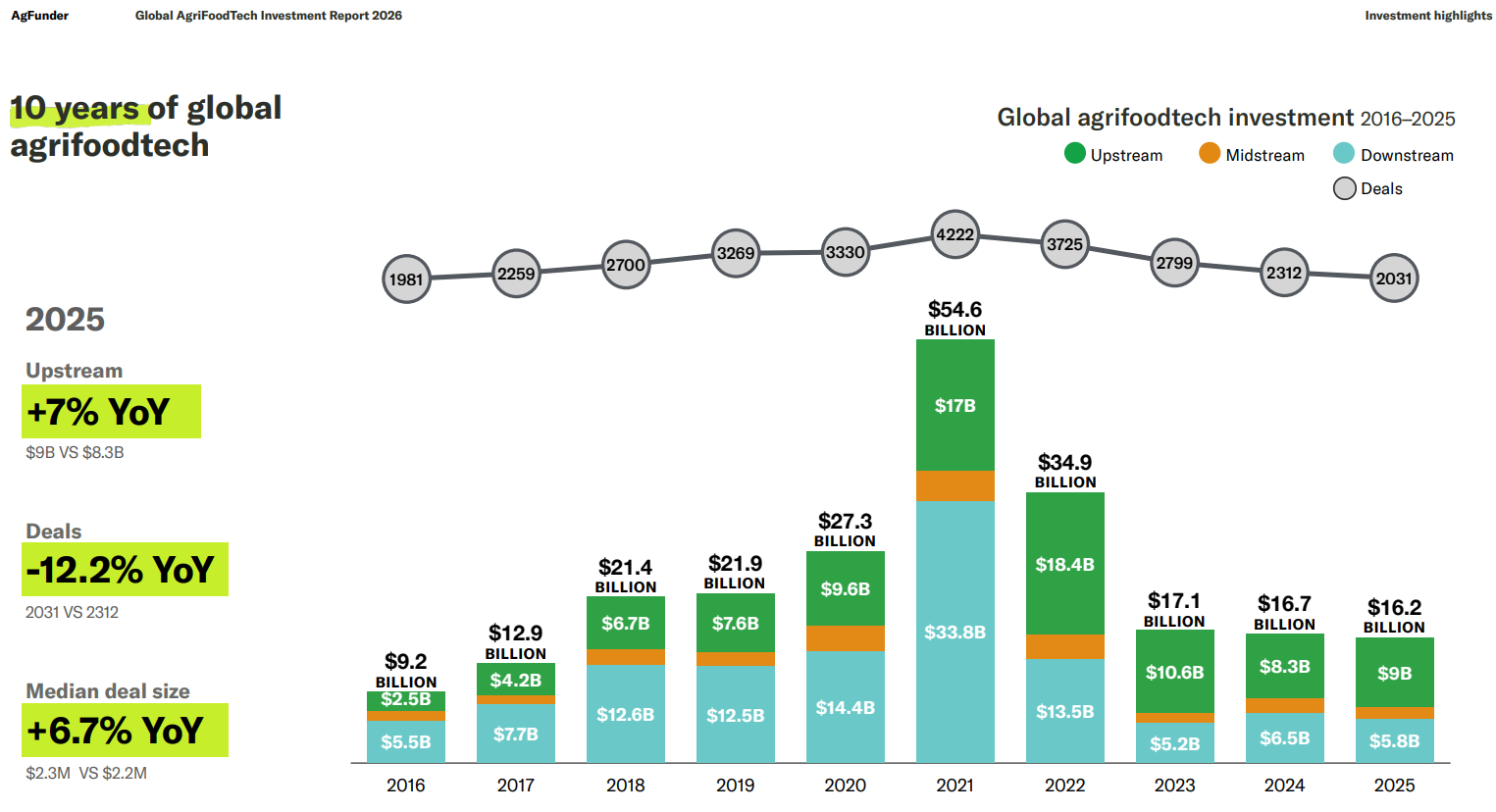
For today’s article, I wanted to highlight what I believe is the most significant graphic. It’s the classic 10 years of Global Agrifoodtech that now goes from 2016-2025. That graphic is here, and there’s a lot to discuss.

Let’s get right to the most important number: $16.2 billion. That is the total amount of AgriFoodTech VC for 2025. This number tells us a lot about 2025. First, it tells us that while the first half of 2025 was horrendously low in investment capital at $5.1 billion (always worth reminding everyone that the annual number for 2021 was $53B, so $26.5 would be a half year estimate for comparison shopping purposes. Clearly that’s a much different baseline than the $5.1B we saw in the first half of last year), the second half of 2025 got significantly better at $11.1, thus the $16.2B total.

While it is true that in many tech segments the second half (or back half) of the year can be heavier than the front, the first half of 2025 was troubling because coming off the drop from $54.6B in 2021 to $34.9B in 2022 to $17.1B in 2023 to $16.7B in 2024, many of us were of the belief that the small drop from 2023 to 2024 suggested that we had reached the bottom of the trough and things would stabilize. After all, $54.6B to $16.7B represents a 69% drop in three short years, and many of us were hoping to find the bottom sooner than later. But we found no support at all for the alleged new baseline in the 1H2025 number ($5.1B). In fact, you can argue that this is why many were hesitant to put much confidence in a second half resurgence. Things looked pretty grim in July and August of 2025, and $10B seemed like a very real possibility for the 2025 total. So many of us described the forecast for 2025 after the first-half number as $10-12B (to capture a little upside) or $8-12B (to put the $10B as the midpoint of a reasonably large range).

Even worse, to many of us who watch the space closely, as we talked to startups and investors and watched transaction announcements and activity, it did not seem like the second half of 2025 was likely to generate much beyond the first half. On this count, I am very happy to be proven wrong. On all fronts, the $16.2B total for 2025 is actually a big win. Being able to use a $15-17B or $16-18B range as your total AgriFoodTech VC funding amount for 2025 (depending on how conservative you want to be) is a lot better than $8-12B or even $10-12B.

The other point to remember for AgriFoodTech VC at a high level is that we’ve gotten rid of a lot of capital from two of the dumpster fires of 2021 (vertical farming/CEA and alternative proteins – 42% of that $54B number and none of it ended well) and now (for the moment) stabilized in the $15-17B range. Every dollar that those two categories have been reduced by de-risks the AgriFoodTech VC segment as a whole and thankfully there have been billions of dollars in reductions. I see much less risk in vertical farming today than I did even two years ago.

I still have some concerns about the alt-protein category, but that’s a topic for another day. For now, it’s worth noting that of those two dumpster fires, alt-protein is by far the one with the most smoke still lingering around and therefore the higher risk factor of the two, but it’s a lot less risk than just a few short years ago.

So, we have a much healthier baseline for AgriFoodTech VC than we did just six months ago ($16.2B v $10B), and we have de-risked two of the riskiest segments and 42% of the whole category from five years ago. Time will tell if we can maintain the new range of $15-17B (to be conservative). Our first two data points will be the Q1 and H1 checkpoints at the end of Q1 and Q2 this year.

With the significance of the overall total discussed, let’s take a look at the main category related to California grower economic challenges: labor. Second, when we dive into the automation segment specifically, recall that earlier I posted that automation is averaging 4-7% of total AgriFoodTech investing and trending up (currently at about 6%). If you take 6% of $10B (the estimate I was using for 2025 until actual numbers landed), you get $600M as the annual investment in automation. That was the number I’ve been using, and obviously if you baseline five years of investment and don’t see much cause for big increases (because growth in AgriFoodTech VC is unlikely to happen until exits, either IPOs or M&A, picks up in a meaningful way), you can straight-line the numbers to $50B in AgriFoodTech VC over five years and $3B (6%) as the target for automation/robotics. That was the number I’ve been using as a five-year automation investment target for a few months.

Now that the real number has landed at $16.2B and the real number (which will be in a graphic further down) for automation for 2025 was $900 million, you see two things. We are well above the $10B target (as above – 62% above) I’ve been using for AgriFoodTech and (as importantly, particularly for robotics startups) well above the $600M target for automation (in fact we are 50% above it). As importantly, if you take $900M as the automation spend out of $16.2B, you see that last year automation was at 5.6% of total. This provides support for the 6% baseline I used for the five-year projection.

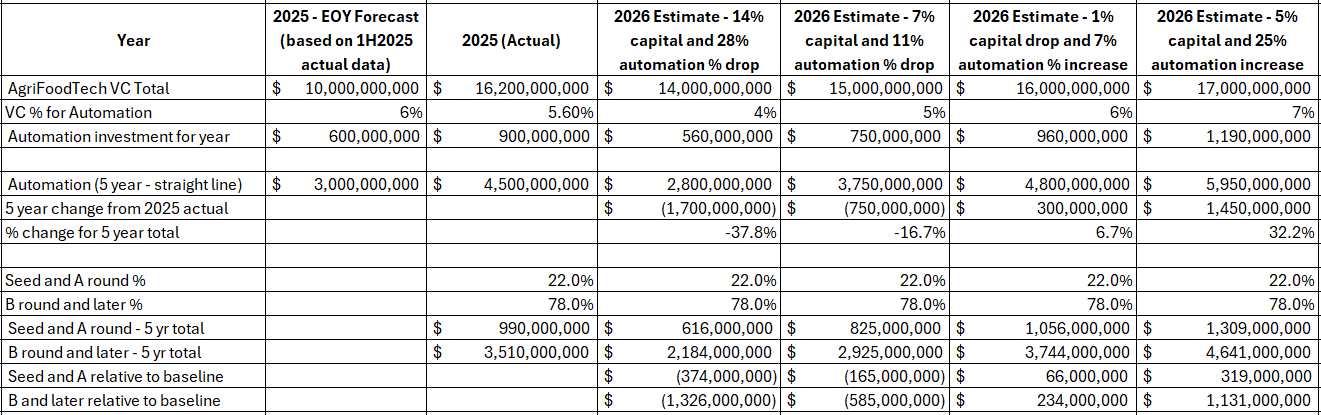
And here we get to the fun with spreadsheets portion of the article, and who doesn’t like to see some fun with spreadsheets in an AgTech article? I went through a couple of modeling exercises and played them all the way out. In the spreadsheet below, you can see that I took the old 2025 forecast (when all we had was first half of 2025 data) and compared it to actual in the first two columns, then ran the numbers out straight-line as a baseline for a five-year projected total. Then I took four different scenarios that used different amounts of overall AgriFoodTech VC funding and the percentage of that funding that was in the automation category. The four scenarios I used for total AgriFoodTech VC were $14B, $15B, $16B, and $17B. The four scenarios I used for automation were 4%, 5%, 6%, and 7%. You can see the details here.

Based on the actual data we now have from 2025, I believe the most likely baseline (i.e. which one of the four is most likely to be closest to both numbers) is the third column, which uses $16B and 6%. Recall that the actual numbers for 2025 turned out to be $16.2B and 5.6%. I think the $16B number represents a fair annual baseline because a lot of the poorly performing segment capital has gone away and is not likely to suffer an additional large drop. I think the 6% number represents a fair automation percentage baseline because automation is the category that is most closely aligned to solving specialty crop grower’s primary challenge – labor and the cost and availability of it. I think it will continue to grab share from categories that are less clear about the grower problems they are solving or even less clear about the grower economics they need to reach to become a solution growers purchase. You can see the range of outcomes in the four models when you focus on the five-year forecast numbers for each of the models. There is a range of $1.7B lower in the first model to $1.5B higher in the last model.

Recall that I posted a couple weeks back on the shifting investment landscape as we went from 78% funding for seed to A round investments 10 years ago and 22% funding for B round and later to an exact flip today. Today, we have 78% going to B round and later and 22% going to seed to A round. There are multiple reasons for this, the primary one being that a lot of VCs are choosing portfolio protection over new investments and choosing to double down on existing investments with new rounds at a much higher rate (78%), which leaves much less capital for early stage first time investments (22%).

I outlined in that piece that we now have a $1B shortfall in funding needed for a healthy automation innovation funnel because of this shift. The reason to continue watching the capital shift by stage is to provide further support and more data for the argument. One of the more likely sources of capital that can help close the $1B shortfall is federal or state funding from DC and Sacramento based on an economic development thesis because of all the jobs agriculture and AgTech create and support in rural economies. The economic development skews heavily toward rural job creation and minority job creation and job up-skilling.

We will continue watching the overall AgriFoodTech VC number, the automation number, and the shift-mix from seed to A to B and later with an eye on helping both DC and Sacramento remember that ag and AgTech work closely together to support ag GDP and jobs, AgTech GDP and jobs – particularly in automation. The ag and AgTech then create additional opportunities for things like automation integration (integrating the robots into farming operations after they are sold and need to be supported) and data/analytics solutions, as well as circular economy GDP and jobs created from the opportunity that hundreds of thousands of acres of permanent crops (trees and vines) and 6,000 ag and food processing facilities creates around reuse and recycle of both of those product sets into things like new ingredients and new jobs and GDP.

For today, the key points from the most important graphic of the AgFunderNews annual report are these:

1)          $16.2B is a great total for 2025 AgriFoodTech total VC investments given the risk factors and concerns many of us had just six months ago. Ideally, this total represents a new baseline range that AgriFoodTech VC can maintain. We will know as the quarterly actual numbers land each quarter of 2026.

2)          $900M is a solid total for automation and keeps its percentage of AgriFoodTech VC spending at 5.6%. I expect automation to continue to gain share of investment because it’s solving real problems related to labor availability and cost.

3)          The four scenarios I modeled with AgriFoodTech annual investment at $14B, $15B, $16B, and $17B, and the % on automation at 4%, 5%, 6%, and 7% create a wide range of 5-year automation investment totals (from $1.7B below baseline to $1.5B above baseline). These scenarios are important because they allow us to adjust in real time as new data arrives and as we make fundraising requests and measure the economic development impact of capital from all sources.

4)          At this point, the most likely baseline scenario for 2026-2030 for automation VC investment is $4.8B, which models AgriFoodTech VC at $16B a year (up from $10B a year previously) and models automation investment at $960M a year (up from $600M a year previously). In the most likely scenario, the model suggests $1.1B for seed to A round investments over five years and $3.7B for B round and later investments over five years. All of these numbers are well above the former model, which is good news for startup founders. Now we watch and see how 2026 plays out and if we need to make additional model adjustments.

Best Practices: Empathy As A Leadership Tool

March 20th, 2026

Empathy: “the action of understanding, being aware of, being sensitive to, and vicariously experiencing the feels, thoughts, and experience of another….” The ability to take on the role of someone who says: “I may not know how you feel, but I’m here to listen.” A time consuming and potentially messy workplace skill set, but one that is infinitely useful if you are someone who manages people.

This is especially true in the workplace of today where our front-line company leaders take on such an important role in preserving company culture and providing stewardship of internal policies and procedures. Legal mandates at the state and federal level require employers to protect employees from discriminatory, harassing and retaliatory behaviors based on protected classifications (e.g., race, sex, religion, age). A job duty that falls largely on the shoulders of front-line leaders. Below are a few tips for embracing empathy as a useful tool for front-line leaders to use in their efforts to provide innovative support and increase engagement of all company employees.

Face each situational challenge with a fresh perspective. Embrace the fact that you may not know what the other person is feeling – or even see where they are coming from – and let go of any preconceived notions you may have about the situation. Many feel that leadership is about finding common ground with those around us; best achieved by shared (or sharing) experiences. However, empathy challenges us to recognize that we may in fact not know what the other person is feeling or thinking even if we may have experienced something identical or similar. Step back, open your mind and listen with an unbiased perspective. Show those around you that you are willing to learn and accept a new or different take on an old familiar scenario.

Commit yourself to addressing the problem or situation head-on. Empathy does not guarantee ‘smooth sailing.’ Empathy challenges leaders to accept the situation at hand – adversarial or not – and commit to working toward resolution. Taking the time to listen and understand (to the best of your ability) the problem at issue and then committing to take the steps necessary to put the individual on the road to resolution is an impressive way to show empathy.

Observe and learn. Company leaders are an employers first line of defense against erosion of company culture and the negative impacts that occur when company policies are not actively monitored and enforced. Observation is a critical component when it comes to leading with empathy. Observation is also critical to risk management – leaders must be able to observe and recognize red-flag behaviors that could lead to all sorts of workplace issues (e.g., allegations of abusive conduct, harassment, discrimination or retaliatory conduct).

Reservoir Farms Opens in Salinas: A New Era for AgTech Commercialization

March 25th, 2026

Last Monday marked a milestone moment for the Western fresh produce ecosystem with the grand opening of Reservoir Farms in Salinas. This new commercial-scale site isn’t just another operation breaking ground; it’s an inflection point for the future of agricultural innovation. For years, both innovators and growers have pointed to the gap between early stage development and real‑world commercial testing. Reservoir Farms is designed to close that gap, and its opening signals a major acceleration point for AgTech across the Western U.S.

Why This Matters for Innovators

For AgTech startups and established innovators alike, Reservoir Farms creates something the industry has been missing for far too long:
A true commercial farm environment where technology can be tested, iterated, refined, and validated on real crops, in real conditions, on real timelines.

Historically, innovators have been forced into a slow and often uncertain process: waiting months to run a single trial, relying on fragmented access to fields, or depending on grower goodwill and sporadic availability. Reservoir Farms solves this problem by providing consistent access to commercial acreage, the farm enables companies to:

  • Test ideas earlier and more often
  • Identify failure points quickly
  • Perfect their products before approaching growers
  • Cut down burn rate and reduce costly delays
  • Accelerate time to market

It’s the kind of testbed Silicon Valley startups take for granted—but until now, the fresh produce sector lacked.

Why This Matters for Growers

Growers have carried an enormous burden in the AgTech journey. Every new technology requires time, attention, and operational disruption. With dozens of startups knocking each season, trial fatigue has become a real and growing challenge.

Reservoir Farms gives growers something new:
A place to see, evaluate, and compare emerging technologies without committing labor, land, or downtime on their own operations.

Instead of hosting ten different companies, growers can visit one centralized location and

  • See technology running in real conditions
  • Compare solutions side‑by‑side
  • Evaluate performance objectively
  • Decide what fits their operation before engaging

This isn’t just more efficient, it protects valuable time and ensures growers only adopt the tools that truly deliver.

Why I’m Personally Excited

My excitement for Reservoir Farms is deeply tied to my own experience. When I was part of developing what ultimately became the Stout Smart Cultivator, I had access to internal farms that accelerated our progress dramatically. We could test constantly, iterate rapidly, and generate real-world data at a pace that simply wouldn’t have been possible otherwise.

When I left Stout in 2021, it became immediately clear how rare that kind of access was. Most AgTech companies were operating without it, and the consequences showed. Slower iteration. Higher burn. Longer time to market. Less successful commercialization.

Reservoir Farms changes that. Now, any agtech company—large or small—can access the same advantages I once had. And ultimately, that’s the biggest win for growers: stronger companies, better products, and solutions that reach the field faster and more reliably.

Western Growers’ Commitment

To demonstrate how critical we believe this initiative is, Western Growers is committing a seven‑figure sponsorship to Reservoir Farms. Our board has been clear: “This technology needs to happen faster.” This financial commitment sends a strong signal to our membership—we are fully invested in helping solve their biggest challenges, and we’re putting real resources behind that commitment.

Reservoir Farms is more than a new facility. It’s a catalyst for the next generation of agricultural technology and a major step toward a faster, more collaborative, more effective commercialization pipeline.

And this is only the beginning.

Welcome to the New Front Door for AgTech Startups – Thanks Plug and Play!

March 25th, 2026

The WG Innovation team would like to offer a new front door for AgTech startups that want to talk to Western Growers members. I am excited to share the release of the new page that our partners at Plug and Play have put together:

Western Growers Association | Startup Intake Form

The Startup Intake Form is easy to complete. When you click through to the page, you press Start and it’s very similar to what you fill out when submitting an Accelerator or Incubator application process. This should not be a surprise because Plug and Play is one of the world’s largest Accelerators, and this is far from their first rodeo – just their most recent.

You enter your company name, your company URL, the region you are operating in, the year you launched your startup, how many full-time and part-time team members you have, total funding to date, annual revenue, the role of the main point of contact, your name, and your latest Pitch Deck or one-pager. Then you fill in your traction data – what segment you are in (automation, etc), what crop you are strongest in, what stage you are in (prototype, pilot, commercial or scaling), type of product you are selling (hardware, software, both, service), top value propositions for growers to consider your solution (labor solution, compliance solution, water efficiency solution), where you can deploy within 90 days (what region), what you need from Western Growers (introduction, pilot partner, or channel partner), and your biggest pilot dependency.

Next, you provide some data on your solution: how growers will justify buying your technology, your ROI / payback time (with data from growers), what stops adoption on farms (even with tech that works), how you approach commercialization, number of grower/shipper interviews you’ve done in the last 6 months, and you’re done. The whole process should take 5-10 minutes. The page says five. That might be optimistic, but I completed it twice and didn’t rush, and ten minutes is definitely a fair expectation. This is particularly true if you’re a founder who knows your startup and your metrics (which are certainly most or all of you).

So why did we launch this process with Plug and Play? It’s simple. We needed a way to scale the front door to grower conversations for startups in our two key areas – labor challenges (and automation provides the best and most scalable solutions) and chemical input challenges (and the portfolio of bio-controls, genetics, and regenerative agriculture practices provide the best alternatives to pesticides that are increasingly under pressure of having usage limits or outright bans from both state and federal regulators as well as retail buyers). Our friends at Mixing Bowl identified over 700 automation startups two years ago, and there have been additional startups funded since then. In biologicals alone, they have identified 1,300 funded startups with over 400 in the bio-controls segment in 2025 (and as with automation more have received funding since the Landscape was published). To be clear, these are the ones that earned a spot on the Crop Robotics Landscape, Biologicals Landscape, and Bio-Controls Landscape after some vetting work by Mixing Bowl. There are more startups. This is just the relative short list to focus on.

We have 2,000 startups, and increasingly they are all over the globe. Well, Ben Palone and I are only two people, and we have some budget and time constraints that prevent us from going all over the world to do scouting activity. In fact, we have plenty to do right here in California and the western region of the US. So how do you take the 700 automation startups plus the additional ones that got funding and the 1,300 biological startups (and additional ones that got funding) and manage the 2,000+ startups into an innovation funnel that winnows itself down to a manageable count of “commercial ready” or more importantly “grower economics ready” prospects?

First, you look at the potential players that could help with global scouting activity. There are several Accelerators that get hundreds of applicants for AgTech and AgriFoodTech programs. There are Accelerators that focus on early stage technology efforts in key tech segments like AI, fintech, and mobile apps. Then we looked at a Venn diagram of the overlap between those two groups, and things thinned out pretty quickly (just like you would expect with a quality thinning robot – see what I did there?) We were looking for a partner with a global footprint that could help us scout startups all over the world and interact with the WG team and WG members regularly about what and who they’re seeing with a good understanding of grower needs and how well they are being met as related to the quality of solutions they are evaluating.

Once we reviewed the choices, it was pretty clear that Plug and Play provided a unique combination of global capabilities and a solid understanding of grower challenges and evaluating potential solutions. With that in mind, we signed a three-year partnership with them last year focused on automation scouting globally as a key deliverable. The first step was opening up communications between Plug and Play and WG membership. This effort began in earnest at the WG Annual Meeting last November, which four members of the Plug and Play team were able to attend. The next step was to build the landing page at the URL above and begin promoting it. Startups should see this as the first step in a multi-step funnel toward engaging with WG members.

We (the WG Innovation team) think this is a big step forward for startups, for Plug and Play, and for Western Growers. Startups now have a clear starting point because Ben and I were getting somewhat overwhelmed by the volume of in-bound conversations, and it forced us to do less travel and scouting. Every early stage startup conversation we had took time away from one of our big focus areas: helping startups that are already at midfield get into the red zone and ideally into the end zone (i.e. commercial success at a scale that achieves cash flow positive status. At this point, the startup’s future is much more secure and they do not need to raise additional capital). In a capital constrained environment, helping later stage companies get to commercial scale needs to be a priority to maximize the chances of developing more automation solutions. But early stage startups need help too – in many cases even more than later stage startups until they are able to achieve the highly desirable product-market fit where the value proposition hits the grower right where they are and at grower economics that allow the grower to buy the solution and deliver an ROI timeframe of less than two years. Ben and I were barely bringing a knife to a gun fight.

So back to the form – submit your information via the form and the Plug and Play team will review the information, and in many cases, will confirm key data points during their evaluation. Then the rest of the funnel starts to take shape. And before we go any further, we want to recommend and highly encourage the founder (or co-founder) or CEO (and ideally and often those are the same person) complete the data because you should have the most comprehensive picture of the information needed to complete the form. Don’t leave that to someone else. Once you are vetted, Plug and Play will work with Ben and me to determine the right set of scouted startups to put in front of WG membership in a webinar (i.e. yep, another Zoom call for growers!).

The webinars will likely be quarterly, and the first few will focus heavily on automation solutions. The Plug and Play team will present an overview of each solution in terms of the product (the tech), the team (with particular focus on ownership of the revenue target and the product roadmap – the two functions that matter the most for AgTech startups), and the go-to market strategy (which markets are they in, what are the plans for US market entry for international startups). The evaluation is about a lot more than just the R&D work to get to a first version of the product. Technology Readiness Level (TRL) is a common metric cited as a measurement of product capabilities, but it is only part of the entire package that needs to work with grower organizations. And for AgTech, it is always worth mentioning that the all-important last mile is the actual integration of the solution into the grower operations team and the integration of a new robot into a farming operation team is one of the more complex integrations out there because it requires both the tech and the teams to get integrated in a way that delivers the targeted economic results and ROI.

I’ve worked in startups in e-commerce, search marketing, and enterprise data centers. AgTech has by a fairly wide margin the most complex requirements for successful and sustainable integration because it has the largest set of (literally) outside-the-building risks relative to the ones I mentioned above. Startups need to invest in it to be successful, and Plug and Play will be looking to evaluate the integration capabilities.

Those are the first couple of steps startups should take. Submit the form to get into Plug and Play’s evaluation list. Then once you are evaluated by Plug and Play, the vetted solutions will get presented to WG members via multiple channels (in addition to the webinar, we will promote the vetted startups in both WG Member publications and emails to raise awareness of them among WG members). Our goal is to put vetted startups in front of members on a regular basis through channels they already use to create as many opportunities as possible for grower-startup conversations with vetted startups. It is important to remember that the WG Innovation team does not own your startup’s revenue number, but we are happy to help tee up funnel opportunities when it makes sense. Usually, one time where it makes a lot of sense is after the vetting process. We are doing things this way to really provide an incentive for every startup to complete the form. That puts everyone on a level playing field and lets Plug and Play review all of them during vetting.

We will provide more details of the rest of the engagement points on the way to a very happy day for some startups. That day is when you’ve gone through a Reservoir Farms membership (or something like it) and technology evaluation (which is different than Plug and Plays evaluation for reasons that will become obvious once we define it in a future article) or something comparable, completed numerous field demonstrations and field trials, and finally earned the right to be published in a Western Growers Case Study with detailed grower economics and an Economic Template so other growers can do their own math of how the solution economics work for them (different farmers use different equipment ownership/leasing processes, different labor types – H-2A v domestic, and different employment options – through a farm labor contractor (FLC) or direct hire; together all of these factors can make the ROI math very different for two growers of similar crop sets). But all of that is a topic and an article for a different day. For now, we would like to invite folks to share the form widely and make sure the startups they are working with, investing in, and supporting all know that there is a new front door to WG members, and it’s available for everyone!

Cal/OSHA Reminds Employers To Protect Workers From Heat Illness During Heat Wave

March 19th, 2026

Cal/OSHA is reminding all employers to protect workers from heat illness at outdoor and indoor workplaces as heat waves are forecast across California this week. 

As California experiences more frequent and severe weather patterns, heat events are extending earlier into the year. Employers must remain vigilant in protecting workers and be prepared for any increase in temperatures. 

The National Weather Service has issued multiple heat advisories across the state through Friday evening. Temperatures ranging from the mid-80s and mid-to-high 90s are forecast in the Bay Area and Central Coast, and in coastal areas and foothill locations of Southwest California including Ventura, Los Angeles, Santa Barbara and San Luis Obispo; while temperatures of 90 to 100 degrees Fahrenheit are forecast in the San Diego area; and temperatures up to 102 degrees are expected in San Bernardino, Riverside and the Inland Empire. 

Heat illness is a serious and potentially deadly hazard. Under Cal/OSHA’s Heat Illness Prevention Standards, employers are legally required to implement protective measures for outdoor and indoor workers. Employers may be covered under both the indoor and outdoor regulations if they have workers in each setting. See the Comparison Chart of Indoor and Outdoor Heat Illness Prevention Standards for more information. 

Cal/OSHA’s Heat Illness Prevention in Indoor Places of Employment regulation applies to most indoor workplaces, such as restaurants, warehouses, and manufacturing facilities. For indoor workplaces where the temperature reaches 82 degrees, employers must take steps to protect workers from heat illness. Some of the requirements include providing water, rest, cool-down areas, and training. 

To prevent heat illness at outdoor worksites, the law requires employers to provide outdoor workers fresh water, access to shade (which must be in place when temperatures are 80 degrees or higher) and, whenever requested by a worker, cool-down rest breaks in addition to regular breaks. In certain industries, when the temperature at outdoor worksites reaches or exceeds 95 degrees, Cal/OSHA’s standard requires additional protections. The industries with additional high-heat requirements include agriculture and transportation of agricultural products. High-heat procedures include ensuring employees are observed regularly for signs of heat illness and establishing effective communication methods. 

Employers in both settings must also maintain a written prevention plan with effective training for supervisors to recognize the common signs and symptoms of heat illness, and what to do in case of an emergency. 

Western Growers, SCFBA Among 54 Groups Calling on Administration for Farmer Support

March 19th, 2026

Severe weather, high expenses and global uncertainty are hitting farmers from all sides, squeezing them to the breaking point. Fifty-four agriculture groups laid out the challenges facing rural America in a letter to President Trump today.

The letter recognizes progress made last year in enhancing farm risk management tools and securing much-needed tax relief for farmers, but says additional resources are needed during these turbulent times, “As the administration considers a defense supplemental package in the coming weeks, we urge you to include much-needed market relief for America’s farmers.”

That relief should build on recent efforts to deliver Farmer Bridge Assistance Program payments, and should include meaningful support for all specialty crop, sugar and alfalfa growers, assistance for farmers and ranchers dealing with catastrophic weather events, and build longer-term demand stability for U.S. agriculture through year-round sales of E15 and tax incentives to increase use of domestic agricultural products, such as the Buying American Cotton Act and the Grown in America Act. The letter mentions administration actions, such as finalizing strong Renewable Volume Obligations in the Renewable Fuel Standard and supporting value-added opportunities for farmers in the 45Z Clean Fuel Production Credit, that will also help support longer-term demand stability for U.S. agriculture.

The recent closure of the Strait of Hormuz and its impact on fertilizer and fuel prices only worsened the financial strain farmers face and poses significant consequences for the food supply chain in America and around the world.

“We appreciate your longstanding commitment to rural America. Now is the time to ensure that American agriculture can weather this period of extraordinary strain. Without timely assistance, continued losses risk accelerating farm closures, reducing domestic production capacity and weakening the ability of farmers and ranchers across this great nation to provide food, clothes and fuel for the American people.”

Read the full letter here.

Reservoir Farms Grand Opening Monday March 16!

March 18th, 2026

We are excited to share that Monday was the Grand Opening for Reservoir Farms first location in Salinas. There were over 300 RSVPs as of last Friday and I am writing this before driving down for the Grand Opening, so we expect several hundred people to come by and support the launch. Salinas Mayor Dennis Donohue and Western Growers President and CEO Dave Puglia will be joining the event for keynote remarks.

The Grand Opening is a big milestone for Salinas Valley agriculture and AgTech. Growers will now have a place that provides startups with commercially grown acreage across the key crops that make Salinas Valley, including leafy greens, strawberries, and many others that the growers and startups will specify. Reservoir Farms has been working closely with my Western Growers colleague Ben Palone and I for over two years to help make the Grand Opening a reality. What WG members want more than anything is successful startups who can prove their products work and that they work in a way that improves grower economics, often around labor costs. Reservoir Farms helps by providing both the acreage and the technology validation stages needed to make sure products work as advertised. Big thanks to Naturipe and Tanimura & Antle for providing the growing work to make sure the acreage is built right so that growers and startups can trust it.

Startups also get several huge benefits. At launch, there will be 12 paying members startups at Reservoir Farms. They will get shared R&D space, shared acreage (as mentioned, commercially grown), shared equipment (huge thanks to our friends at John Deere for providing some nice looking green tractors!), and shared office space at both the Reservoir Farms location and the WG Center for Innovation and Technology downtown. This will save the startups significant amounts of time and money as they build and get ready to commercialize their technology solutions. Many of the original solutions are for automation, so you can expect to see a lot of robots and drones in the ground and in the air just west of Salinas off highway 68. They will be testing regularly. There will be regular field demonstrations. There will be meetings to get feedback from growers on what’s working and what needs some more work. Ideally, Reservoir Farms helps some startups save enough time and money that they are able to get to commercialization faster and with less capital required. If more startups are making it through to commercialization, that is a win for the startups, WG members, and Reservoir Farms.

Monday was two years in the making but represents a huge step forward for Salinas. In addition to Salinas, Reservoir Farms is hard at work on two additional locations – Merced and Sonoma. By the end of 2026, all three locations will be open and serving Reservoir Farms startup members with support from WG members. Startups will be able to choose the right location for their solution based on the crops and growers they are building their solutions for, so look for more news to come. It has taken a great mix of public and private funding to get Reservoir Farms to this point, and Western Growers is in active discussions on the right way to increase our commitment and deepen the partnership.

Broad Coalition of Farmers, Dairy Product Makers, Packaging Manufacturers, Restaurants, and Grocers Sue California Over “Speech Ban” Law That Undermines Recycling and Violates the First Amendment

March 18th, 2026

A broad coalition of farmers, food producers, restaurants, packaging manufacturers, and grocers today filed a federal lawsuit challenging California’s SB 343 (2021), calling the law an unconstitutional restriction on free speech that will reduce recycling, confuse consumers, and increase cost pressures for California families. The lawsuit, filed in the U.S. District Court for the Southern District of California, argues that SB 343 operates as government-imposed censorship, prohibiting product makers from informing consumers when their packaging is recyclable unless the material satisfies rigid and arbitrary regulatory criteria set by the state. Plaintiffs are seeking a preliminary injunction to block enforcement of the law, which goes into effect on October 4, 2026 but is already causing businesses to change their labels.

Developing a circular economy depends on consumers knowing what and how to recycle. When a dairy farmer ships milk to a grocery store, when a restaurant sends food home in a container, when a food producer packages berries, nuts, or proteins, that packaging needs a clear path back into the recycling stream. SB 343 cuts off that communication. If companies cannot label recyclable packaging as recyclable, that packaging is far more likely to end up in a landfill.

“California is about to make it harder, not easier, for families to go green,” said Dairy Institute of California Executive Director Katie Davey. “SB 343 forces dairy product manufacturers to remove vital recycling guidance from the very cartons Californians rely on every day. This law ignores the reality of our recycling infrastructure and unconstitutionally restricts our right to provide transparent recycling instructions to consumers. We are seeking to stop this policy before it leads to more waste and disrupts our ability to deliver milk to California families and schools.”

At its core, the lawsuit challenges what plaintiffs describe as a sweeping content-based restriction on speech. SB 343 bars producers from using widely recognized recycling symbols and statements, even when factually accurate, unless the packaging meets state-imposed recyclability criteria that do not reflect real-world recycling capabilities or local program variation. What’s more, those criteria are vague and difficult to apply in practice, with the legality of a recyclable claim dependent on decisions of a multitude of recycling program operators that are outside the control and knowledge of producers. Fundamentally, SB 343 makes it risky for businesses to label their products recyclable.

The complaint further alleges that SB 343 will not further its intent to increase recycling. Recycling systems depend on consumer participation, and consumer participation depends on clear guidance on the packaging. When recycling guidance disappears from the packaging, consumers lose the information they need about what belongs in recycling bins, creating confusion and reducing recycling participation. The plaintiffs also allege the law discourages investment in new recyclable materials, penalizing any innovation for even more sustainable packaging.

The plaintiffs are seeking a preliminary injunction to block enforcement of the law while the constitutional challenge proceeds. Companies are already facing penalties and enforcement risk for providing recycling guidance that does not comply with the statute, and the law is already chilling speech and increasing costs as companies alter or remove recycling labels to avoid liability.

Plaintiffs include the California Restaurant Association, Dairy Institute of California, California Grocers Association, Pet Food Institute, SNAC International, Californians for Affordable Packaging, California League of Food Producers, Flexible Packaging Association, the Print Creative Alliance, Grower-Shipper Association of Central California, California Table Grape Commission, California Strawberry Commission, California Apple Commission, California Blueberry Commission, Olive Oil Commission of California, California Walnut Commission, American Forest & Paper Association and the Western Growers Association.