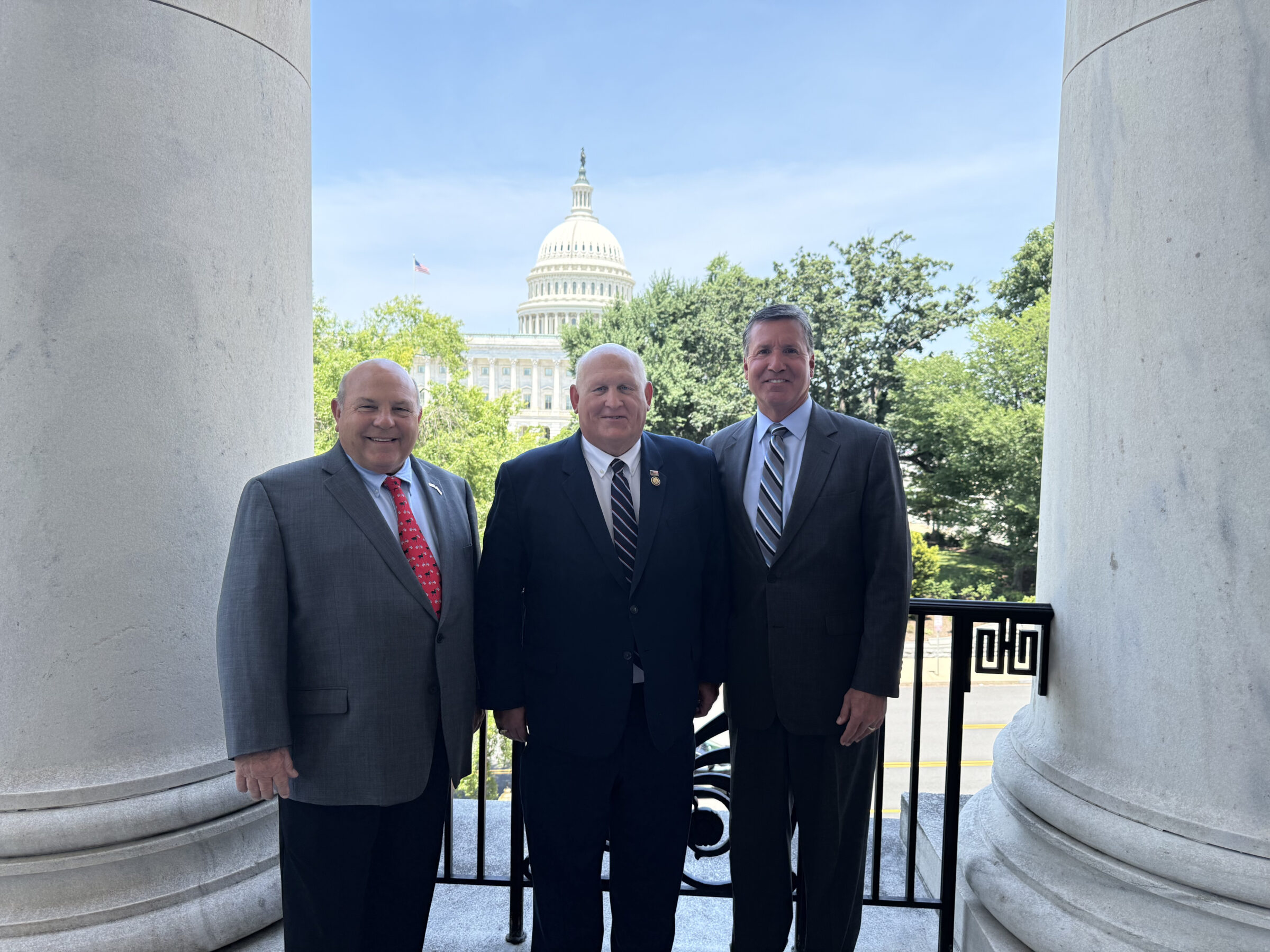
Western Growers Applauds Introduction of the Securing Agriculture’s Workforce Act

June 30th, 2026

From left: American Farm Bureau Federation President Zippy Duvall; House Ag Committee Chairman GT Thompson and Western Growers President and CEO Dave Puglia

IRVINE, CALIF. (June 30, 2026) – Western Growers President and CEO Dave Puglia issued the following statement in support of House Agriculture Committee Chairman GT Thompson’s introduction of the Securing Agriculture’s Workforce Act:

“Western Growers strongly supports Chairman Thompson’s Securing Agriculture’s Workforce Act (SAWA) and commends his leadership in advancing long-overdue reforms to stabilize America’s agricultural workforce.

“Fresh produce growers in California, Arizona, Colorado and New Mexico have relied on the H-2A program out of necessity, but the program has not kept pace with the realities of modern agriculture. It remains too difficult and expensive for many farmers who depend on it for access to a legal and reliable workforce.

“More predictable wages are essential to keeping American agriculture strong and fresh produce affordable for consumers. Between 2018 and 2025, the national average Adverse Effect Wage Rate increased more than $5.50, from $12.20 to $17.74. That 45 percent surge far outpaced a historically high inflation rate of 28 percent during the same period. This bill offers a meaningful solution to volatile wage increases that put farmers out of business.

“SAWA would take important steps to streamline the program, reduce administrative burdens and provide greater certainty around wage rules. This legislation is a commonsense step toward protecting domestic food production, supporting family farms and ensuring American families continue to have access to a safe, healthy and affordable food supply.

“Western Growers appreciates Chairman Thompson’s leadership and urges Congress to move this legislation forward.”

For more information, please contact:
Ann Donahue
(949) 302-7600
[email protected]

About Western Growers: Founded in 1926, Western Growers represents local and regional family farmers growing fresh produce in California, Arizona, Colorado and New Mexico. Western Growers’ members and their workers provide over half the nation’s fresh fruits, vegetables and tree nuts, including half of America’s fresh organic produce.

Click here to read the full press release from the office of GT Thompson.

Western Growers Annual Meeting Early Bird Registration Now Open

June 30th, 2026

It’s time! Early bird registration is now open for the Western Growers 100th Annual Meeting, and we invite you to join us for a celebration a century in the making.

From Nov. 8 – 11, 2026, gather with the fresh produce industry’s most influential growers, shippers, processors and suppliers at the breathtaking Grand Wailea Maui for an unforgettable centennial celebration.

This milestone event will feature inspiring keynote speakers, meaningful networking and special celebrations honoring our legacy while looking ahead to the next century.

The last day to register with Early Bird rates is July 31.

Reserve your spot today before it’s too late!

Hotel availability is limited, and our room block is expected to sell out quickly.
Register today at WG Annual Meeting 2026 to secure your spot.

We hope to see you there!

Sponsorship Opportunities Available

Celebrate this historic milestone while showcasing your brand to the industry’s most prominent leaders. Sponsoring the Annual Meeting places your company at the center of the celebration, creates new business opportunities and positions your company at the center of the conversations shaping the next 100 years of agriculture.

To learn more about sponsoring Annual Meeting or the Growers Cup Golf Tournament, please contact Rob Steinmann at [email protected].


At Heritage Growers, Native Seeds Are Helping Restore California at Scale

June 30th, 2026

It’s not every day you see perfectly neat rows of native plants, prime and waiting for harvest as an old 1980s combine rattles by. Stretched across the Heritage Growers farm in Colusa, Calif., fields have been planted with hand collected seeds for production at scale, a painstaking trial and error process, one step in the mission to restore native habitat in California.

Heritage Growers is a Northern California-based nonprofit native seed and plant supplier founded by restoration experts connected to River Partners, the nonprofit known for restoring river corridors and rebuilding wildlife habitat across the state. The team grows source-identified native seed, or seed collected from known locations and grown out for the purpose of restoring native California landscapes.

The effort is led by Pat Reynolds, General Manager of Heritage Growers and a restoration ecologist with more than 30 years of experience designing, implementing and monitoring habitat restoration projects. Reynolds has spent his career helping restoration professionals use native seed effectively, and at Heritage Growers that expertise is being applied to one of the biggest barriers facing the field: supply.

“Currently the seed is not available in the quantities that we need to be able to restore things at scale,” Reynolds said. “So, what we are doing here is to break that bottleneck, get this material grown and available, so that at the end of the day we can create high value, resilient habitats throughout California.”

That bottleneck is significant. California’s ambitious conservation and restoration goals depend on native plants that can support pollinators, stabilize soils, improve habitat and build climate resilience. Unlike most agricultural crops, these native plants are not bred for uniformity or easy harvest. Some germinate unpredictably, and others mature unevenly or require specialized timing, irrigation, equipment and seed-cleaning methods. “We are one of only three native seed farms in all of California that is growing native seeds at scale,” Reynolds said.

The playbook is still being written, and much of the team’s work involves experimentation. Staff test how different species grow, when they flower, agronomic needs, how seeds are maturing and harvesting methods that provide the highest yields. In some cases, a crop may yield a tiny volume of seeds due to poor initial seed quality, environmental factors that don’t match the needs of the plants or even an unexpected flock of birds coming through the area. The process requires the collaboration and knowledge of restoration ecologists, seed collectors, farm managers and warehouse specialists working together from collection through cleaning and storage.


New Publication:  A Review on Reclaimed Water and Produce Safety

June 30th, 2026

Western Growers Science is pleased to share a new peer-reviewed article published in the Journal of Food Protection: A Review of Reclaimed Water Use for Irrigation of Produce Crops and Food Safety Aspects in the United States.” 

The review was led by the Western Growers Science team in collaboration with Dr. Trevor Suslow of the University of California, Davis; Dr. Daniel Gerrity of the Southern Nevada Water Authority and the University of Nevada, Las Vegas; and Susan Leaman of iDecisionSciences.  

As water availability continues to challenge agriculture, reclaimed or recycled water is receiving increased attention as a potential supplemental irrigation source. The article reviews the current regulatory and scientific landscape for using reclaimed water in fruit and vegetable production, including treatment approaches, microbial water-quality criteria, monitoring practices and irrigation considerations. 

The review highlights that safe use of reclaimed water depends on more than treatment at the water reclamation facility. Storage and distribution systems, irrigation methods, potential contact with the edible portion of crops, harvest timing and on-farm water-management practices are all important considerations. 

The article also identifies areas where continued research is needed, including treatment effectiveness against more resistant pathogens and the evaluation of emerging chemical constituents. This work provides a resource for growers, water providers, regulators, buyers and researchers as the industry continues to evaluate sustainable water-use options while maintaining confidence in produce safety. 

What is reclaimed water? 

Reclaimed water is treated as wastewater that is reused for a beneficial purpose. Depending on the intended use and applicable state requirements, treatment can include secondary treatment, filtration and disinfection. Requirements are generally more stringent when water may contact the edible portion of a crop. 

Reclaimed water and produce irrigation 

The review shows that reclaimed water may be used for food crop irrigation in some states, but allowable uses depend on state-specific requirements. Arizona, California, Colorado and Florida all have frameworks that distinguish allowable irrigation uses based on treatment level and crop-contact conditions. 

For example, California allows its highest reclaimed-water category, disinfected tertiary recycled water, to irrigate food crops when water is expected to contact the edible portion of the crop. Other categories may be limited to crops where the edible portion is not contacted by the reclaimed water. 

What does the research say about safety? 

The article reports that secondary and tertiary wastewater treatment processes can achieve substantial reductions in microbial hazards, including bacteria, enteric viruses and protozoa. The review also notes that available quantitative microbial risk assessments have found that reclaimed water use does not appreciably increase public-health risk from enteric pathogens and , in some situations, may be safer than more traditional irrigation-water sources. 

At the same time, the authors identify important areas where more research is needed. These include the effectiveness of treatment processes against more resistant pathogens, particularly Cyclospora cayetanensis, as well as continued evaluation of chemical constituents of emerging concerns, such as pharmaceuticals and industrial chemicals. 

The review provides a resource for growers, water providers, regulators, buyers and researchers seeking to better understand the opportunities and considerations associated with reclaimed water use in production. As water challenges continue to evolve, the publication underscores the importance of treatment, monitoring, system management and science-based decision-making in protecting both agricultural water resilience and producing safety. 

New Voices of the Valley: The Water It Takes to Grow Your Food

June 30th, 2026

In this episode of Voices of the Valley, Western Growers’ Taylor Lauson sits down with Michelle Paul, Executive Director of the California Farm Water Coalition, to break down one of the most important and misunderstood topics in agriculture: water.

From where California’s water comes from and how it reaches farms to the technologies helping growers use it more efficiently, Michelle explains the complex systems that keep fresh food on our tables. Together, they discuss common misconceptions about agricultural water use, the challenges of managing water in the West and why reliable water infrastructure is essential to the future of farming and our food supply.

As Michelle reminds listeners throughout the episode, “Food grows where water flows.”

Listen to the full episode here.

Supreme Court Limits Glyphosate Warning Claims

June 26th, 2026

The U.S. Supreme Court issued a significant pesticide-labeling decision this week in Monsanto Co. v. Durnell, holding that the Federal Insecticide, Fungicide, and Rodenticide Act (FIFRA) expressly preempts state-law failure-to-warn claims seeking to require a cancer warning on EPA-approved Roundup labels. In a 7-2 decision authored by Justice Brett Kavanaugh, the Court reversed a Missouri appellate ruling that had allowed a $1 million-plus verdict against Monsanto to stand. 

The case centered on whether a state tort claim could impose liability on Monsanto for not including a cancer warning on Roundup, even though EPA has repeatedly concluded that glyphosate is “not likely to cause cancer” and has not required such a warning on glyphosate-based pesticide labels. The Court held that it could not.  

Background 

John Durnell sued Monsanto in Missouri state court, alleging that he used Roundup products for approximately 20 years and developed non-Hodgkin’s lymphoma as a result. His failure-to-warn claim asserted that Monsanto should have included a cancer warning on Roundup’s label. A jury agreed, and the Missouri Court of Appeals affirmed the verdict. 

Monsanto argued that FIFRA preempted the claim because pesticide labels are reviewed and approved by EPA, and federal law prohibits states from imposing pesticide labeling requirements “in addition to or different from” those required under FIFRA. The Supreme Court agreed.  

The Court’s Holding 

The Court emphasized that FIFRA gives EPA comprehensive authority over pesticide registration and labeling. Before registering a pesticide, EPA must determine that the product will not generally cause unreasonable adverse effects and that its label complies with FIFRA’s requirements, including necessary warnings. Once EPA approves a label, the manufacturer generally must use that label unless EPA approves or requires a change.  

Because EPA had approved Roundup labels without a cancer warning, the Court concluded that a state-law verdict premised on the absence of that warning would effectively require Monsanto to use a label different from the EPA-approved label. That, the Court held, is exactly what FIFRA’s express preemption provision forbids. 

Justice Kavanaugh wrote that Durnell’s claim would impose a pesticide-labeling requirement “in addition to or different from” federal labeling requirements, and therefore was expressly preempted. Justice Jackson dissented, joined by Justice Gorsuch. 

Why This Matters for Agriculture 

For agricultural employers, applicators, and pesticide users, the decision reinforces the central role of EPA-approved labels in pesticide regulation. The ruling provides important clarity that states may not use tort law to require additional or different label warnings where EPA has not required them under FIFRA. 

However, the decision should not be read as a broad exemption from pesticide compliance obligations. Growers and applicators must still follow all EPA-approved label instructions, including use restrictions, application rates, personal protective equipment requirements, restricted-entry intervals, worker protection requirements, storage and disposal directions, and any applicable state and local pesticide-use rules. 

The decision also does not eliminate other potential claims or enforcement theories. It addresses a specific category of claim: state-law failure-to-warn claims based on the absence of a label warning that EPA has not required. Claims based on alleged misuse, off-label application, drift, exposure, negligence, workplace safety violations, or failure to comply with the label may still present legal risk depending on the facts. 

Practical Takeaways for WG Members 

Employers and agricultural businesses should continue to treat pesticide-label compliance as a core risk-management practice. The ruling makes EPA-approved labels more central, not less. Members should: 

  • Review pesticide labels before use and ensure employees and supervisors understand all application restrictions and safety requirements. 
  • Maintain records showing that products were used consistently with label instructions and applicable state pesticide regulations. 
  • Train handlers and field employees under applicable Worker Protection Standard requirements and state-specific pesticide-safety rules. 
  • Avoid modifying, supplementing, or disregarding label directions based on informal guidance or assumptions. 
  • Monitor EPA and state regulatory developments, particularly where pesticide registrations, use restrictions, or label language may change. 

Bottom Line 

Monsanto v. Durnell is a major pesticide-preemption decision. For agriculture, it provides greater certainty that EPA-approved pesticide labels cannot be displaced by state-law failure-to-warn verdicts requiring different warnings. But it also underscores the importance of strict label compliance: the EPA-approved label remains the controlling document for lawful pesticide use.

Recommended Reading: Putting Pesticide Residues into Risk Context

June 24th, 2026

A recent Food Safety Magazine article, “Beyond Detection: Putting Dietary Pesticide Residues Into Risk Context,” discusses why pesticide-residue findings should be interpreted through a dietary risk-assessment framework rather than through detection alone. 

The article reviews a 2024 an assessment of commonly discussed fruits and vegetables and emphasizes that estimated dietary exposures were below health-based benchmarks, including under intentionally conservative assumptions for adults and children. It also highlights the importance of considering consumption, toxicological potency, body weight and established health-protective reference values when discussing residue data. 

Key Questions and Answers 

Does finding a pesticide residue mean food is unsafe?
Not necessarily. Modern testing methods can detect residues at extremely low concentrations. A detected residue must be considered alongside the amount present, expected food consumption and the health-based benchmark to determine whether there is a meaningful health concern. 

How is dietary pesticide risk evaluated?
Dietary risk assessments combine residue-monitoring data with food-consumption information, body-weight assumptions and pesticide-specific toxicological reference values. Estimated exposure is then compared with health-based guidance values, such as EPA population-adjusted doses. 

What did the assessment discussed in the article find?
Across the produce–pesticide combinations evaluated, estimated dietary exposures were well below health-based guidance values. The assessment used conservative assumptions, including assigning residues at the analytical detection limit to non-detect samples, which intentionally overestimates potential exposure. 

Why can detection-based produce rankings be misleading?
Rankings based primarily on the number or frequency of residues do not necessarily account for toxicological potency, dose or realistic consumption. As a result, a commodity with more detectable residues may not have a higher dietary risk than one with fewer detections. 

What is the main takeaway?
Pesticide residues should be monitored and regulated carefully, but a detection by itself does not establish health risk. Clear communication should distinguish between the presence of a residue and whether exposure approaches a level of toxicological concern. 

Read the full article: Beyond Detection: Putting Dietary Pesticide Residues Into Risk Context.” 

Do You Wear the AgTech Uniform?

June 24th, 2026

In Salinas, the unofficial “farming uniform” is consistent: jeans, a collared shirt, boots, and a logoed trucker hat and Carhartt puffy vest. It is functional, practical, and it means you’re ready to walk a field.

When Silicon Valley met the “Salad Bowl of the World,” the agtech crowd quickly realized that showing up in nice shoes or perfectly hemmed jeans made them stand out. So, naturally, they adopted our uniform.

Ben and Walt just returned from farm visits in Australia. Their field photos featured farmers in laced-up hiking boots, short-sleeve shirts, and, most shocking of all, shorts. My native Salinas brain could barely process it. Different climates, different crops, and different dress codes. And it made me appreciate our uniform even more.

The WG Innovation team recently added the company’s 100th Anniversary logo to our work vests because our gear must manage both a field walk and a meeting right after. At the Western Growers Center for Innovation & Technology, the wardrobe must work with ag and tech.

Suzanne Devereaux-McKinstrie Named CPS’s Chief Executive Officer

June 24th, 2026

The appointment of Suzanne Devereaux-McKinstrie as Chief Executive Officer for the Center for Produce Safety (CPS) was announced at the recent CPS Symposium hosted in Nashville, Tennessee. After leading international market development efforts and working extensively with growers, industry leaders and agricultural stakeholders to advance the mission of American Pistachio Growers, Devereaux-McKinstrie now assumes a new role. 

Her appointment comes at a time when the produce industry faces increasing challenges related to food safety, evolving regulations, sustainability and consumer expectations. Organizations such as CPS play a critical role by funding applied research that helps the fresh produce industry, researchers and regulators advance science-based decisions. As she begins her new role, Western Growers will work alongside her to advance CPS’s future priorities, partnerships and overall direction. 

Her appointment represents not only a leadership transition for CPS but also an opportunity to further connect scientific research with the broader agricultural community and the practical challenges facing specialty crop producers. 

Click here to access the CPS website.

Eating the Food Safety Elephant One Bite at a Time.

June 24th, 2026

In my last article, I wrote about the food safety elephant in the room – that somewhere along the way, we as food safety and risk managers “…became more comfortable discussing the dangers of finding problems than the dangers of not finding them. When the conversation shifts from using science to solve the problem, to conversations on how that same data and learning is a risk in terms of legal exposure – it’s far past time to change. It’s now the time to turn our well-honed root cause skills into something more productive – correcting the system to stop failing.  

The past article (and this one) was not about avoiding data and learning. It was about admitting that our current food system can make knowledge feel dangerous. But naming the elephant is not enough. At some point, we have to eat it. One small bite at a time. 

Efforts need to shift to work towards a framework that builds the outcomes we seek. Prevention systems and trust don’t just happen naturally. They are invested in little bits over time. Figuring out what works, iterating, using the data to fine-tune and hone the next approach. Watching that those data are not used against you. That can’t happen in a vacuum given the legal and enforcement liabilities. We also need the legal and policy evolution to change expectations of compliance and build practical enforcement and legal systems that enforce them.  

Let’s stop weaponizing the act of looking and learning. Let’s design food safety data governance and safe harbor policies. There must be a legal mechanism that protects those who do more to understand and manage their system. This is not a plea to remove accountability. In fact, it’s the exact opposite. It’s about raising the bar on what accountability looks like. Accountability is established and built through intentional, well-designed systems of knowledge, science-driven actions and that data and learnings should have safe-harbor from those using it in the wrong way. When used the wrong way and out of context, it’s scientific and data malpractice.  

Knowing and looking for pathogens (or other hazards), discovering that they could be in a food or production environment, performing root cause analysis that shows there are uncontrollable steps in processes is not evidence of negligence, failure or neglect. In some cases, that is just the realities of food production in environments shared with microorganisms, including those of foodborne pathogens. If there is wrong-doing, cover-ups, manipulation of data – then all the information should be fully accessible and useable in a court of law. No bad actors welcome.  Good actors and better outcomes? More please. 

Not all risks are equal. Nor do they have the same risk pathway (internally-owned risk vs. externally-introduced risk).  

Risk-based management is something we need to embrace, not just because science requires it (it’s a little thing called reality), but also because our existing food safety regulations (FSMA) already explicitly require it. However, sometimes risk management strategies may look counterintuitive to our older hazard-based framework. And generally, they are structured to focus on expectations of the producer only, not considering the responsibility of the downstream and upstream risk-owners. That doesn’t make sense. Risk doesn’t know our laws, legal boundaries and fence lines. It will make you sick either way, and it’s time to place responsibility and accountability where it is warranted along the entire supply chain. Some risks are internally-owned, coming from the practices and inputs chosen and managed by the producer. However, some risks are not under the producer’s control. These could be risks originating from adjacent land and operations, or risks from weather and climatic events, or risks when transporters fail to handle products appropriately, or risks when restaurants, food handlers and consumers don’t hold up their end of the food safety and preparation bargain. 

Regulation and policy should reflect this holistic system and distribute legal accountability appropriately. Adjacent land neighbors, trucking companies, coolers, food service operators and retailers are part of the process regardless of whether they want to be. It makes little sense that a grower of fresh produce item can do everything in the greatest of their abilities to reduce the risk to the crop, only to have neighbors and/or downstream supply chains fail to also minimize risks from airborne and runoff, use inappropriate temperature control, introduce cross-contamination and lose traceability leading to broad recalls and market impacts. It is categorically flawed to immediately assume that a root cause for a food safety event always leads you to the responsibility of the original producer in tracebacks- what about externally introduced contamination either during production or later in the supply chain? There is some accountability and responsibility required there as well – it’s a food system, dependent upon all steps in the process.    

Food safety liability should not be based on the fantasy that all risks are preventable. It should be based on whether risk was reasonably managed, and whether the supporting data establishes that case. That packet of information on production records, monitoring results, root cause analysis, corrective actions and risk-management decisions, etc. should be protected under a safe harbor policy similar to the protections we recognize for sensitive health information and medical quality-improvement systems. 

We need to stop allowing information collected to prevent food safety events and to achieve continuous improvement from being used to punish the growers and producers that are doing the hard work of reducing the risks within their control. Their efforts on managing to the best of their ability the risks introduced from outside their control should be viewed realistically, recognizing that not all risks are preventable. 

When prevention data becomes a weapon instead of a tool, we have not made food safer. We have only made people more afraid to learn. And a food safety system afraid to learn is a food safety system designed to fail.

New H-2A Dairy Guidance Clarifies Existing Rules

June 24th, 2026

New federal guidance has been published by U.S. Citizenship and Immigration Services (USCIS) addressing when dairy operations may qualify for the H-2A temporary agricultural worker program. While the announcement has generated interest across agriculture, the practical impact appears limited: the guidance clarifies that dairy-related work may qualify for H-2A only when the employer can demonstrate a temporary or seasonal need under existing law. It does not create a new pathway for year-round dairy labor.

USCIS’ June 17, 2026, policy memorandum states that H-2A petitions for dairying should be evaluated on a case-by-case basis, considering the totality of the facts presented, and in the same manner as other H-2A petitions. The memorandum also states that it does not impose new obligations on employers submitting H-2A petitions.

For Western Growers members, the key point is that dairy operations already had very limited access to H-2A where the job opportunity was temporary or seasonal in nature. Examples could include labor needs tied to a defined calving season or short-term construction, repair or barn/structure work connected to a limited-duration need. The new guidance appears to reaffirm that such petitions may be considered where the employer can document the temporary or seasonal nature of the work.

However, the guidance does not appear to resolve the larger issue facing dairy and other year-round agricultural employers: H-2A remains limited to temporary or seasonal agricultural labor. USCIS continues to describe H-2A as a program for employers seeking to fill temporary agricultural jobs, and the employer must still establish that the work is temporary or seasonal.

For the guidance to become more significant, additional regulatory or definitional changes would likely be needed—particularly from the Department of Labor—to address the temporary or seasonal need requirement in a way that better reflects the realities of year-round agricultural operations. Western Growers has continued to advocate for reforms in this area.

Western Growers will continue monitoring implementation of the USCIS memorandum and any related agency guidance to determine whether the clarification results in any meaningful change in how dairy-related H-2A petitions are adjudicated.

For questions about H-2A eligibility for dairy-related work or about the H-2A program in general, please contact the Western Growers H-2A Services Team.

Western Growers Urges DOL to Clarify Joint Employer Rule for Agriculture

June 24th, 2026

Western Growers recently submitted comments to the U.S. Department of Labor’s (DOL) Wage and Hour Division in response to its proposed rulemaking on joint employer status under the Fair Labor Standards Act, Family and Medical Leave Act and Migrant and Seasonal Agricultural Worker Protection Act. As discussed here, the Notice of Proposed Rule Making (NPRM) proposes the adoption of a single joint-employer standard under all three statutes. In its comment letter, Western Growers expressed support for a clearer and more predictable joint employer framework, while urging DOL to recognize the unique operational realities of modern agricultural production.

Western Growers’ comments emphasized that agricultural employers, farm labor contractors, agricultural associations, housing providers, transportation providers and other service partners must routinely coordinate on matters such as harvest timing, crop maturity, weather interruptions, food-safety requirements, transportation logistics, worker arrivals, housing administration and regulatory compliance. Western Growers urged DOL to clarify that these ordinary business communications and compliance-related activities should not, standing alone, be treated as evidence of joint employer status.

The comment letter specifically asks DOL to distinguish between legitimate agricultural coordination and actual authority over essential terms and conditions of employment. Western Growers explained that a grower’s decisions about which field should be harvested, when harvest should begin or stop due to weather, or what food-safety protocols must be followed are agricultural production and compliance decisions—not necessarily employment decisions involving hiring, firing, discipline, compensation, payroll or supervision.

Western Growers also highlighted the increasingly specialized role of farm labor contractors, particularly within the H-2A program. Many modern FLCs provide significant workforce-administration and compliance services, including recruitment, visa processing, transportation coordination, housing administration, payroll, recordkeeping, worker onboarding and regulatory reporting. Western Growers cautioned that the use of licensed FLCs should not create any presumption of joint employment and that reliance on specialized compliance providers often promotes, rather than undermines, legal compliance.

The letter further urged DOL to incorporate agriculture-specific examples into the final rule or preamble. Western Growers requested clarification that harvest coordination, food-safety oversight, field-entry restrictions, weather-related work stoppages, housing inspection logistics, transportation coordination, resource-sharing arrangements and agricultural association support services do not, by themselves, make joint employer status more or less likely absent evidence of control over essential employment terms.

Regulatory certainty is especially important for agricultural employers because labor, housing, transportation and production decisions are often made months before work is performed. Western Growers warned that uncertainty surrounding joint employer standards could discourage growers from using specialized compliance resources, participating in cooperative arrangements or seeking assistance from agricultural associations, even when those arrangements support worker protections and regulatory compliance.

Western Growers urged DOL to adopt a final rule that preserves the ability of growers, agricultural associations and workforce providers to cooperate in ways that support agricultural productivity, food safety, workforce stability and worker protections, while maintaining the proper focus on whether an entity actually exercises or meaningfully reserves authority over essential employment terms.

Some Thoughts on AI’s Impact on Tech Segments and AgTech

June 24th, 2026

AI is changing how we (and for this article I mean we to specifically be AgTech startups) should think about engineering talent. I have been listening to and reading a lot of content about AI and its impact on businesses. One of the under-recognized aspects is the multiple impacts it is likely going to have on organization-wide engineering for startups. Based on what I’m hearing and reading, I believe the following are some of the key areas for change:

  1. Improved coding efficiencies are available – you have to figure out what that means for you development team. Yes, the key first point (as it has been for months to now almost years for many organizations) is the obvious truth­—the AI coding tools can do a lot more coding a lot more efficiently. So, the success metrics around output for engineers needs to change. What one engineer could do from a product roadmap perspective for software needs to be looked at. Can you reduce your product roadmap in terms of cost or time and by how much? In some cases, you’re not going to know which variables are impacted and you’re just going to have to work on the product roadmap revisions in real time.

But there’s no doubt based on the successful revenue growth in the coding segment by the key players that software efficiency gains are available, and the key for most startups is to figure out what your gains are likely to look like. There are multiple podcast episodes across the tech segment talking about 10-20% efficiency gains in weeks for coding, quality control (QC)/quality assurance/testing functions, and others and in some cases continuing to lower by another 10-20%. You start to scale that across even a small engineering team and you can really have an impact on the product roadmap.

2. The cost of engineering talent is going up. We’ve all seen the Steph Curry-like contract figures for some of the true AI unicorns. Those aren’t the people I’m talking about. They are the ultimate outliers and they are hunted like NBA free agents that can shoot the 3 and have enough defensive skills to guard the 3 point line as well (the “3 and D” crowd, if you will) and they are surprisingly rare and therefore increasing in value (come on, Trae Young just signed for $212M in DC and I’m not even sure he plays defense, so you’re not getting the same value for $212M you got just a few years ago). No, I’m talking about the journeyman players out there that have nice leisurely all-star weekends but can find their way onto NBA rosters for 8-10 years or more by maxing out their skillset and hoops IQ. In this case, think the 5-10 year coding veteran that has a year or two of AI coding tools and knows his or her way around all the cool kid toys, knows what each model does, and can implement them at scale with very limited managerial support. A coding veteran with some skills in that arena that can leverage AI coding tools effectively is commanding premium value in the marketplace today. So what used to be a $200-300k developer is now in many cases a $350-$450k developer or more. So figure out where market is before getting that job description together and be brutally honest about what you can get for your money out there today. Recruiting AI talent is only getting harder and more costly.

3. And that engineering talent is going to need some care and feeding – and by care and feeding I mean AI tokens, lots and lots of AI tokens. So now you’ve hired that rock star $500,000 AI developer that knows all the latest tools and you’re just hoping they’re not a high maintenance prima donna (but you’re almost ok with that – they’re that good – or might be). But that’s not the end of the story. To quote the late great John Pinette, “I say nay nay!”

Jensen Huang (yes, that Jensen, Nvidia CEO) was on one of the tech podcasts recently and he said (paraphrasing slightly) “if I’ve got a $500,000 engineer and he’s not using at least $500,000 of AI tokens a year, we’re going to need to have a chat.” His point is why would you bring on A-grade talent and pay them A-grade talent money and then give them the coding equivalent of a Chevy Malibu. The key insight behind that point is you want to give that $500k developer another $500k+ in tokens because if they’re that good they should turn that into 3-5x performance gains and get the product available to sell faster to create incremental revenue opportunities all over the place.

From most of the CEOs, founder, and funders I’ve been listening to, it seems like most of the early action around AI coding was working hard to reduce engineering expenses through the use of coding tools. Once that was achieved, the focus for some of the more aggressive CEOs started to focus on leveraging AI further to create even more of a competitive advantage. Code that wasn’t even on the roadmap or was low priority can now get developed and released or re-prioritized.

It’s a little more nuanced for AgTech startups, but the principle remains the same. You need to balance out the level of talent you’re recruiting with the level of support (tokens) you want to give them to create the multiplier or flywheel effect for the engineering team. Maybe $500,000 each isn’t the right capital model for your engineering team, but figure out what it is and then hire and support to that level. And as with general tech, AgTech startups will have the choice to go for coding cost savings or be more aggressive with roadmap changes and quicker release time frames.

4. Retention is getting tougher as well. I already know of multiple startups that have lost candidates in recruiting mode to AI startups because of a much higher cash compensation and some AI equity that, if we’re being honest, is probably a bit to a lot more likely to turn into something meaningful on the AI side of the world then many AgTech startup equity grants. So you have two choices during the recruitment phase: (1) take the A player that is a 5-tool athlete but a known flight risk if they look or sometimes get an interesting in-bound from a recruiter after a rough day or week; or (2) take the A-minor play that is a 4.5-tool athlete but less of a flight risk (and maybe more of a team player because he realizes that can almost nudge you up to an A in a lot of situations). I’m not suggesting either is right for every startup. Your risk tolerance and self-awareness about how hard the A-talent is to replace will have a lot to say about where you come down on this one.

So that’s a few of my thoughts on the impact AI is having on tech and AgTech. I’ll be putting some additional posts out on the impact of AI in both horizontal tech segments and AgTech as a key vertical.

17 States Challenge California’s SB 54 Plastics Packaging Law

June 24th, 2026

A coalition of 17 states, led by Nebraska Attorney General Mike Hilgers and joined by the National Association of Wholesaler-Distributors, filed a federal lawsuit this week challenging California’s Plastic Pollution Prevention and Packaging Producer Responsibility Act, commonly known as SB 54. The lawsuit seeks to block enforcement of the law, arguing that California has exceeded its constitutional authority by imposing packaging-related mandates with nationwide economic and operational effects.

SB 54, enacted in 2022, creates an extended producer responsibility program for packaging and single-use plastic food service ware sold in California. The law shifts end-of-life management costs for covered materials to producers and requires participation in a Producer Responsibility Organization. CalRecycle’s final implementing regulations were approved and became effective May 1, 2026.

The lawsuit alleges that SB 54 violates the U.S. Constitution’s Commerce Clause, principles of federalism, and due process by effectively regulating conduct beyond California’s borders. Plaintiffs argue that because many companies use uniform packaging and distribution systems nationwide, California’s requirements may force businesses operating outside the state to alter packaging practices or absorb higher compliance costs.

While the lawsuit does not immediately eliminate SB 54 compliance obligations, it adds another layer of uncertainty to California’s rapidly evolving packaging regulatory framework. Businesses that sell, ship, or distribute packaged products into California should continue evaluating whether they qualify as “producers” or otherwise fall within SB 54’s scope, while monitoring the litigation for any stay, injunction, or change in enforcement timing.

Western Growers members are encouraged to refer to Western Growers’ SB 54 Resources and Updates page for additional compliance resources and ongoing updates.

Specialty Crop Farm Bill Alliance Welcomes Senate Farm Bill Discussion Draft

June 24th, 2026

WASHINGTON, June 23, 2026 — The Specialty Crop Farm Bill Alliance (SCFBA) issued the following statement after the public release of legislative text for Farm Bill 2.0 by U.S. Senate Committee on Agriculture, Nutrition, and Forestry Chairman John Boozman.

“The Specialty Crop Farm Bill Alliance commends Chairman John Boozman and his staff for advancing the farm bill process. The discussion draft released today includes important provisions to strengthen the competitiveness of the family farms producing specialty crops across the United States. We look forward to working with members of the U.S. Senate Agriculture Committee as the legislative process moves forward.

At a time when growers are facing unprecedented economic challenges, enacting a full five-year farm bill is critical to the long-term sustainability of American agriculture and the communities specialty crop producers support.”

The SCFBA is co-chaired by Cathy Burns, CEO of the International Fresh Produce Association; Mike Joyner, President of the Florida Fruit & Vegetable Association; Dave Puglia, President and CEO of Western Growers; and Kam Quarles, CEO of the National Potato Council.

# SCFBA #

The Specialty Crop Farm Bill Alliance is a national coalition of more than 150 organizations representing growers of fruits, vegetables, dried fruit, tree nuts, nursery plants and other products. The Alliance was established to enhance the competitiveness of specialty crop agriculture and improve the health of Americans by broadening the scope of U.S. agricultural public policy. For more information, visit farmbillalliance.com


Federal Drone Ban Webinar Highlights: Supporting Growers Through Uncertainty

June 24th, 2026

From crop scouting and aerial mapping to broadcast applications and field monitoring, drones are becoming an increasingly important tool in specialty crop agriculture. As adoption continues to accelerate, recent federal actions affecting foreign-manufactured drone platforms have raised important questions for growers regarding future equipment availability, fleet planning, and long-term investment decisions.

To help address those questions, the Western Growers Innovation team recently hosted a webinar focused on the Federal Drone Ban and its implications for specialty crop agriculture. The discussion featured Briana Layfield (Founder and President of Ag-Bee LLC), Kevin McDonald (Founder and CEO of Red Sparrow) and Walt Duflock (Sr. VP of Innovation for Western Growers), who provided expert perspectives on drone operations, regulatory developments, and the evolving landscape facing agricultural drone users.

One of the most important messages from the webinar was that existing authorized drone fleets remain legal to own and operate. While federal policy changes may impact the future importation, certification, and sale of certain foreign-manufactured drone systems, growers currently utilizing approved platforms can continue operating those systems. Separating facts from headlines was a key objective of the discussion and helped provide clarity around what these changes mean today versus what they could mean in the future.

The conversation also reinforced the growing importance of drones within specialty crop production. Growers continue to explore drone technology as a tool to improve operational efficiency, collect better field data, support crop protection activities, and address ongoing operational challenges. As these technologies become more integrated into farm operations, understanding the regulatory environment becomes just as important as understanding the technology itself.

While many questions remain regarding future equipment availability, replacement parts, domestic manufacturing capacity, and regulatory timelines, one thing is clear: growers need access to reliable information to make informed decisions. That is where Western Growers can provide value.

The role of the Western Growers Innovation team extends beyond identifying new technologies. We work to connect growers with trusted information, industry experts, technology developers, and policymakers so they can better understand both the opportunities and risks associated with emerging technologies. Whether the topic is drones, automation, robotics, artificial intelligence, or mechanization, our goal is to help members evaluate innovations through a practical, grower-focused lens.

The Federal Drone Ban webinar is an example of that commitment. As regulations evolve and technology adoption accelerates, Western Growers will continue bringing together experts and stakeholders to provide timely insights that help members navigate uncertainty and make confident business decisions.

Innovation is not simply about adopting the newest technology. It is about ensuring growers have the information, resources, and support necessary to determine what technologies make sense for their operations and when the time is right to adopt them. The Western Growers Innovation team remains committed to helping our members navigate that process and ensuring they have access to the knowledge and solutions needed to remain competitive in a rapidly changing agricultural landscape.

In case you missed the webinar, here’s the YouTube link.

What the Drone Ban Means for Growers

June 24th, 2026

As many of you know, drones are seeing increased use cases for grower operations, including spray drones, scouting drones, aerial surveillance drones, and high-tech aerial scarecrows with dog fighting included! Well, some changes made in December are having an impact on drones in ag.

These changes resulted in Western Growers hosting an online webinar that we recorded and are making available to all. Here is the YouTube link for the recorded webinar that Western Growers hosted on the Foreign Supplier Drone Ban (and what it means for specialty crop agriculture). Moderated by my WG colleague Ben Palone with Briana Layfield (Founder and President of Ag-Bee LLC) and Kevin McDonald (Founder and CEO of Red Sparrow) and I as panelists, we covered a lot of ground. It was a great combination of drone operator (Brianna), regulatory landscape (Kevin), and grower perspective (Ben and I). We all expect drones to continue to gain traction because they are capable of solving multiple real problems for growers, often with economics that are getting compelling to growers. Here were some of the key topics (thank you to Brianna for building the slides).

First, what is the drone ban? In December 2025 the FCC added foreign-produced drones and critical drone components to its Covered List, which prevents new FCC equipment authorizations for covered products and prevents them from being imported, marketed, or sold in the US. Commonly discussed manufacturers include DJI and Autel Robotics.

Second, what does it mean for growers? Existing authorized drones remain legal to own and operate, and previously approved models can continue to be used in commercial agriculture, research, and public safety operations. New foreign-produced drone models face significant barriers to entering the US market. Manufacturers requiring new FCC approvals may be unable to launch future products without an exemption or security determination.

Third, the agriculture has some concerns: (1) limited availability of new spray drone platforms; (2) supply chain uncertainty; (3) higher equipment costs; (4) limited domestic drone manufacturing capacity; and (4) questions about replacement parts, service and support, and long-term fleet planning.

Fourth, what is the future outlook? Likely outcomes include: (1) Blue UAS Cleared List and domestic end products with at least 65% US content are both likely to be FCC exempt through Jan 2027); (2) conditional approvals for 11 systems (including ag spray) will expire December 2026; and (3) FAA Part 108 (BVLOS) has final rule pending. Watch dates are December 31, 2026 (all conditional approvals expire); January 1, 2027 (Blue UAS and Buy American exemptions lapse absent further DoW action; and (3) January 1, 2029 (firmware and software updates for existing authorized fleets protected).

Bottom line – existing fleets remain operational, but the decisions made over the next several years will likely define the future of agriculture drone adoption in the US.

SB 54 Update for Members: Circular Action Alliance Seeks Producer Input on Fee Setting

June 22nd, 2026

Farmers, packers and shippers who may be impacted by Extended Producer Responsibility (EPR) programs should be aware of a new opportunity for producer engagement. Circular Action Alliance (CAA) has launched a Producer Fee-Setting Consultation process and is establishing a Steering Committee to help inform how producer fees are developed across states. The committee’s role is advisory and intended to provide input on proposed fee-setting methodologies and consultation topics. Final fee decisions will remain with CAA.

CAA says it is seeking participants with diverse industry perspectives, including companies with multi-state experience and technical or financial expertise related to fee-setting issues. Participation is intended to help increase transparency and provide earlier input into methodology discussions.

For more information, including details on the process and Steering Committee applications, visit Circular Action Alliance’s Producer Fee-Setting Consultation page.

Best Practices: Workplace Investigations

June 18th, 2026

Many state and federal laws require an employer to investigate employee complaints in a timely manner (e.g., California Fair Employment & Housing Act, Title VII, ADA/ADAAA). Prompt and thorough investigations ensure accurate recollections and give the employer the opportunity to quickly take all appropriate corrective actions.  

The first steps taken by an employer in any investigation are crucial. Securing information, maintaining confidentiality, and providing any necessary alleged victim protections are important first steps an employer should take after receiving any complaint. According to the California Department of Fair Employment and Housing (DFEH), to comply with the state’s legal mandate that to, “take reasonable steps to prevent and correct wrongful (harassing, discriminatory, retaliatory) behavior in the workplace, employers should take the following basic steps:  

  • Review all relevant company policies implicated by the alleged conduct.  
  • Provide ‘Due Process’ by striving to be fair to all parties during the investigation:  
  • Start the interview process by conducting a thorough interview with the complaining party. 
  • Provide the accused party with an equal opportunity to be heard and to tell their side of the story.  
  • Follow up these first two interviews with relevant witness interviews and a review of any important or related documents.  
  • Consider what other steps might be taken that would allow the employer to gather all the facts (e.g., visit the worksite, review video, take pictures).  
  • Reach a reasonable and fair conclusion, based on the information collected, reviewed, and analyzed during the investigation, as to whether a violation of company policy has occurred.  

Many state and federal laws require the employer to advise complainants of the outcome of any investigation. This does not necessarily require full disclosure of the exact disciplinary steps taken or not taken. A general statement indicating a full investigation was conducted and a conclusion reached (e.g., proof of misconduct or no proof of misconduct) and if applicable, that remedial measures have been taken should suffice. This is also an opportunity to follow up with the complaining party to be sure the problem has been resolved and they have not experienced any retaliatory conduct. 


Comment Period Closing Soon for DOL Joint Employer Proposal

June 18th, 2026

The public comment period for the U.S. Department of Labor’s proposed Joint Employer Status Under the Fair Labor Standards Act, Family and Medical Leave Act, and Migrant and Seasonal Agricultural Worker Protection Act is about to close.  

Published April 24, 2026, the public comment period for the DOL’s Notice of Proposed Rulemaking (NPRM) ends June 22, 2026.  As discussed here, the NPRM proposes the adoption of a single joint-employer standard under the Fair Labor Standards Act (FLSA), Family and Medical Leave Act (FMLA), and Migrant and Seasonal Agricultural Worker Protection Act (MSPA). The NPRM is more detailed than prior frameworks and would give employers greater clarity about what types of business arrangements would create “joint employer” liability. 

Comments may be submitted online until 11:59 p.m. EDT on June 22, 2026. Interested individuals can also call the Wage and Hour Division with questions and requests for compliance assistance at 866-4US-WAGE (487-9243). The full text of the proposed rule can be found here.