
One Small Trip to Yuma, One Small Step Forward for Specialty Crop Harvest Automation

January 28th, 2026

Rhishi Pethe and Ben Palone went to Yuma two weeks ago and it was the start of a new path for Western Growers on harvest automation. Ben put together a great agenda for Rhishi that included meetings with growers, farm workers and agtech automation experts with the goal of starting to develop a Product Requirements Document for an iceberg lettuce harvest automation solution. Solutions like this are badly needed for Western Growers members because labor is increasingly difficult to find (for a lot of domestic labor) and getting more costly. In California the current number is that 10% of farm workers are H-2A workers from international locations that cost $28-30/hour when housing, transportation and food are accounted for in the total cost. That kind of hourly rate continues putting pressure on acreage to relocate outside of California. In short, if we can’t automate it, the acreage will help itself to relocate. Nowhere is this more true than reading headlines in industry newsletters that announce weekly record-setting production and ag exports for specialty crops in countries like Mexico, Peru, Bolivia, Chile and Ecuador for key crops like avocadoes, blueberries and table grapes.

The automation progress being made is in non-harvest activities like weeding, planting, thinning, spraying and harvest assist. Western Growers estimates that 2-3% of these activities are automated and that they represent 1/3 of the total farm worker hours in aggregate. Harvest represents the other 2/3, and we are seeing very limited progress on fresh harvest automation. Combine that with the 85% reduction in venture capital ($53B to ~$10B from 2021 to 2025) and you realize that we need new capital strategies to get harvest automation moving forward that do not require venture capital. Rhishi and Ben’s trip was the first step in this direction. We will be reporting on the progress as it gets made, and we plan on building in plain sight. Can we come up with a grower-funded option for the R&D work that does not require any VC funding and provides a completely open-sourced solution available to all growers when complete? We are going to find that out starting with the 3:10 to Yuma trip. In the meantime, check out Rhishi’s great article to see where the journey begins.

One final update (which I’ll have more details on in next week’s Newsletter): since the Yuma trip, Rhishi has put the first draft of a Product Requirements Document (PRD) for iceberg harvest lettuce automation together. It’s a great start and probably a signal as to where Western Growers is going next on harvest automation.
Specialty Crop Leaders Express Disappointment with Latest House Spending Bills, Call for $5B in Aid

January 21st, 2026

WASHINGTON, Jan. 21, 2026 — Specialty crop leaders this week renewed their calls for urgent economic support for U.S. growers and shared their disappointment after the U.S. House released final spending bills yesterday that did not include aid for America’s specialty crop producers.

“At a time when producers face rising costs, domestic labor shortages, and severe market and weather challenges, this omission is deeply concerning,” said the co-chairs of the Specialty Crop Farm Bill Alliance (SCFBA).

“Specialty crops are vital to healthy diets and rural economies. Yet, producers continue to lack the economic support they need to withstand ongoing disruptions and remain competitive.”

“We urge Congress to address this gap as the appropriations process moves forward, and to include not less than $5 billion in dedicated aid for the specialty crop sector. This support is critical to the continued sustainability of American agriculture and the communities specialty crop growers serve.”

Specialty crops – including fruits, vegetables, tree nuts, nursery, greenhouse, and floriculture products – generate more than $75 billion annually in U.S. agricultural cash receipts, account for more than one-third of all U.S. crop sales, and support rural economies nationwide. Yet, under the current USDA Farmer Bridge Assistance (FBA) program, $11 billion is allocated to row crops while only $1 billion is reserved for specialty crops and other commodities, with key details on eligibility, payment formulas, and timing still unresolved.

In recent weeks, the Congressional Specialty Crop Caucus and American Farm Bureau Federation have echoed this call for assistance. Just last week, the SCFBA joined agricultural organizations from across the U.S. in calling on Congress for immediate financial assistance for America’s farmers and ranchers. Led by the American Farm Bureau Federation, the letter highlighted record-high input costs and historically low market prices in recent years have caused farmers to face negative margins and nearly $100 billion in losses nationwide. In December, the Congressional Specialty Crop Caucus sent a letter urging immediate, equitable and timely economic relief for specialty crop producers.

The SCFBA is co-chaired by Cathy Burns, CEO of the International Fresh Produce Association; Mike Joyner, President of the Florida Fruit & Vegetable Association; Dave Puglia, President and CEO of Western Growers; and Kam Quarles, CEO of the National Potato Council.

# SCFBA #

The Specialty Crop Farm Bill Alliance is a national coalition of more than 150 organizations representing growers of fruits, vegetables, dried fruit, tree nuts, nursery plants and other products. The Alliance was established to enhance the competitiveness of specialty crop agriculture and improve the health of Americans by broadening the scope of U.S. agricultural public policy. For more information, visit farmbillalliance.com

MEDIA CONTACTS:

Christina Morton, Florida Fruit & Vegetable Association, [email protected]

Sarah Gonzalez, International Fresh Produce Association, [email protected]

Mark Szymanski, National Potato Council, [email protected]

Ann Donahue, Western Growers, [email protected]


Do You Know WGCIT Company Inteligistics?

January 27th, 2026

For growers, packers and shippers, getting field heat out fast and monitoring temperature throughout is essential for preserving quality and reducing shrink. Inteligistics solutions makes that easier than ever with an affordable, automated pre‑cooling system that works with the equipment you already have.

Why Growers Choose Inteligistics

  • Better quality, longer shelf life
    Inteligistics rapidly removes field heat from berries, leafy greens, and tree fruit, helping slow respiration and microbial growth. Product arrives at market fresher and with longer shelf life.
  • Prevents over‑cooling and under‑cooling
    AI‑enhanced data coming from sensors continuously track core and air temperatures—even inside inner pallets—so every load reaches the ideal temperature without guesswork or manual checks.
  • Faster cooling and lower energy costs
    Typical operations see 15–20% shorter cooling cycles and up to 33% overall efficiency gains. That means more throughput, less power use, and lower operating costs.
  • Works with your current equipment
    The system installs easily on nearly any forced‑air tunnel, vacuum tube or MACS setup. No need for expensive capital upgrades, and most growers see ROI in as little as eight months.
  • Fully automated, consistent results
    Start, stop and every stage of pre‑cooling are automated, eliminating operator variation and ensuring every load is cooled correctly.

If you are interested in learning more, please reach out to VP of Digital Transformation, Lawrence Mallia, [email protected].

Forging New Paths: Why Specialty Crop Harvest Automation Requires Creative, Grower Led Solutions

January 27th, 2026

Harvesting specialty crops has always been an intensely labor‑dependent process, but in today’s environment, the challenges surrounding labor availability, cost and reliability have pushed growers into increasingly uncertain territory. Across much of the specialty crop sector—leafy greens, tree fruit, berries, and vegetables—harvest labor represents nearly two‑thirds of total production costs. For growers already operating on tight margins, this concentration of cost in a single production phase exposes them to financial and operational risks that are becoming harder to manage each year. Labor availability fluctuates, regulatory pressures continue to evolve and the pool of skilled workers able and willing to engage in physically demanding harvest work continues to shrink. The result: a system under strain and an industry actively searching for alternatives.

At the same time, the very sector hoping to drive technological breakthroughs—agri‑foodtech—has faced its own headwinds. Venture capital investment in the space has fallen dramatically, down approximately 68% since 2022, drying up a vital source of funding for early stage automation efforts. While broader market forces have played a role, the structural mismatch between specialty crop needs and traditional VC investment criteria is an equally important factor. Specialty crops are, by design, a niche industry. They require highly customized technologies capable of handling biological variability, tight harvest windows and complex field environments—not the kind of uniform, scalable platforms that venture investors typically prefer.

This creates a fundamental tension: growers need practical, incremental, field‑ready automation solutions, while venture capital often seeks rapid scaling, high margins and broad applicability across markets. As a result, even promising automation concepts struggle to secure funding if they cannot demonstrate the kind of growth trajectory investors expect. Many growers have experienced this firsthand. Companies with strong early prototypes stall out once investment becomes elusive or pivot away from agriculture entirely, leaving growers without long‑term partners or pathways to scale.

In this environment, specialty crop agriculture is left with few traditional options. Relying on large VC investment alone no longer supports the level of innovation required. Instead, the path forward increasingly depends on the industry coming together to drive solutions collectively—growers, technologists, researchers and organizations aligned not around venture returns, but around real grower value. Collaborative problem‑solving, shared risk and models that prioritize grower outcomes over investor expectations are becoming essential.

This is where Western Growers steps in.

The Western Growers Innovation Team is committed to building these new pathways—ones that advance automation not through traditional Silicon Valley expectations, but through a grower‑centric model focused on practical, field‑verified impact. Our work is grounded in listening to growers, understanding operational bottlenecks and ensuring that the technology pipeline solves real‑world problems. By connecting growers directly with engineers, robotics firms and startups, we help shape solutions earlier in the development cycle, increasing the odds that new tools will be usable, affordable and scalable.

We also recognize that innovation must be paired with creative funding models—strategic partnerships, industry consortia, targeted grants, pilots and shared‑investment structures that reduce risk for innovators and growers alike. Automation in specialty crops is too important, too urgent and too complex to rely solely on market forces. It will take a united industry effort, and Western Growers is committed to leading that collaboration.

As labor uncertainty grows and traditional funding declines, the message is clear: the future of specialty crop automation will be built not by chance, but through shared ingenuity, collective action, and solutions designed by and for growers. And Western Growers is here to make that future possible.

Damian Mason’s Top 10 Predictions Podcast!

January 21st, 2026

Damian Mason’s Business of Agriculture podcast has 10 great predictions for agriculture in 2026. I highly encourage everyone to check out the full episode on YouTube (link below). Here are some of the best predictions:

1) Michael Di Sabato predicts Tyson will divest its beef business from the rest of its portfolio. Tyson’s beef business has gone from a cash cow (sorry) to a $20 billion money losing boat anchor and a big drag on profitability with a $1.1 billion loss in 2025.

2) Chris Rawley predicts we will see humanoid robots in the fields in the next 5-10 years based in part on continued progress from emerging solutions like Tesla Optimus and 15 or more different companies globally making humanoid robots.

3) Ryan Moe had a two part China prediction: (1) China is not going to fulfill their commitment on soybean purchases, and the deal should have never been made. They will continue to buy from Brazil, and the only way to regain share from Brazil is with lower prices; (2) China is going to kill as many hogs as the US hog herd has in total to avoid paying for feed for hogs that do not have any margin.

4) David Mlostek Jr. predicts that management and operations win over agtech. He had a great equation: yield = genetics x environment x management. His prediction is that Management will look to new tools like regenerative practices and growing efficiencies because agtech is expensive and doesn’t always work.

5) Krista Swanson predicts corn-based ethanol can create two new 5% opportunities: (1) maritime fuels – we need 70-80B gallons per year and if US ethanol captured 5% of that it’s 4-5 billion gallons of annual ethanol demand and can go straight into the product (SAF requires extra steps); (2) plastics – if ethanol captures 5% of the plastics market that equates to 10 billion gallons of annual ethanol demand.

6) Martin Peterson predicts that rural real estate land values are not going to drop, they are going to hold up and maybe even increase in spite of the numerous challenges agriculture faces in all segments.

7) Walt Duflock predicts that Peru will have more ag exports than California in 2034, with a particular focus on specialty crops like avocadoes, blueberries and table grapes.

You can listen to the podcast here.

Do You Know Our WGCIT Resident, Adaviv?

January 20th, 2026

Adaviv, a resident of the Western Growers Center for Innovation & Technology, is developing mobile-based tools designed to help growers, packers and shippers monitor plant health, evaluate harvest quality and track labor performance. The system operates on standard smartphones, reducing the need for additional equipment.

Following work with partners including Driscoll’s and NatureSweet in Mexico, the company is expanding its deployments across the United States. Early users report that the platform supports earlier detection of crop issues, provides consistent quality assessment from field through packing, and helps decrease product rejections and related penalties.

To support organizations interested in testing the technology, Adaviv plans to offer free onboarding, training and 15‑day pilot programs during the first quarter of 2026. These pilots are open to growers, PCAs, shippers, packers and processors. For more information, contact: [email protected] or 857‑316‑9290.

2025: A Strong Year of Steady Innovation Meets Harsh Realities

January 20th, 2026

As we reflect on 2025, the agricultural robotics sector was a mixed bag of fluctuating signals. The year saw rapid advancements in automation, driven by AI, precision tech and strategic mergers. This serves as a stark reminder that compelling ROI and value propositions are primary factors for growers to adopt agtech. Autonomous navigation breakthroughs to non-traditional chemical inputs for pest control­­—laserweeding and precision application implements—2025 reinforced robotics’ role in boosting operational efficiency by providing real solutions for growers combating labor and input costs. Here’s a roundup of some key developments from 2025.

VC-Backed Startups Face Headwinds in Specialty Crops

While innovation maintained a steady course, VC-backed startups targeting specialty crops grappled with new market realities. 2025 saw another meager year in total investment dollars in agri-food-tech investment. FarmWise, known for its AI-powered weeding robots, had its assets acquired by Taylor Farms after struggling to secure further funding. Similarly, Advanced Farm Technologies, a pioneer in robotic apple harvesting, saw its assets and IP acquired by CNH Industrial. Tortuga AgTech, while initially focused on strawberry harvesting, then later pivoted to table grape harvesting, was acquired by Rishi, underscoring consolidation in the automated harvesting space. The acquisitions of Advanced Farm and Tortuga AgTech reinforced the demand for automated harvesting solutions but exposed misalignments between traditional VC models and the specialized, capital-intensive nature of ag markets. Startups often face long development cycles and slim margins, prompting a shift toward strategic buyouts as subsequent funding rounds could not be achieved.

2025 Marked Significant Strides in Autonomous Navigation

Arizona continues to pave the way for on-farm innovation, by passing SB 1320 (updating transportation codes to recognize autonomous farm equipment), while California farmers are currently restricted from using driverless tractors. Agtonomy and Kubota entered into a strategic licensing agreement, which integrates Agtonomy’s AI-driven autonomy software into Kubota’s M5N tractors for specialty crops like vineyards and orchards. This partnership focused on tasks like spraying and mowing, enhancing precision and reducing labor costs. Meanwhile, Bonsai Robotics acquired Farm NG, combining Bonsai’s vision-based AI with Farm NG’s modular electric robots to create “AI-first” machines for crop management. This move aimed to address efficiency gaps in specialty crops. John Deere further solidified its dominance by fully acquiring GUSS Automation, building on a 2022 joint venture to advance supervised autonomy in high-value crops like orchards and vineyards. These developments highlight a trend toward scalable, easy-to-use and retrofit-friendly autonomy, making advanced tech accessible to more growers.

UVC Light Emerges as a Commercial Solution for pest and Disease Control

One of the year’s brightest spots was the maturation of UVC light treatments as viable alternatives to chemical pesticides and fungicides. Proven effective against pathogens like powdery mildew, UVC tech reaches commercial viability in winegrapes and strawberries. Kubota’s investment in UV Boosting signaled strong industry confidence, with the French startup’s UV-flashing equipment reducing fungicide use in vineyards and orchards. Leaders like TRIC Robotics, Saga Robotics, and UV Boosting drove adoption: TRIC’s Luna robots treated strawberry fields with UV-C for chemical-free mite and mildew control, while Saga plans to expand its Thorvald machines in UK strawberries and California vineyards. This shift not only alleviates resistance issues but also opened doors for M&A, as UVC applications shift market direction from traditional agrochemical applicators to standalone automation solutions.

Department of Labor Clarifies Use of FMLA Leave for Travel to Medical Appointments

January 16th, 2026

The U.S. Department of Labor (DOL) has issued a significant opinion clarifying that employees are entitled to use leave under the Family and Medical Leave Act (FMLA) not only for the time spent at medical appointments but also for the time spent traveling to and from these appointments. This clarification applies both to medical appointments related to an employee’s own serious health condition and to those of a qualifying family member. 

This guidance from the DOL’s Wage and Hour Division stemmed from an inquiry regarding whether travel time associated with medical appointments could be counted as FMLA-protected leave, especially in cases where medical certification from a healthcare provider confirms the need for the appointment but does not specify travel time. In the scenario presented, the DOL opined that FMLA leave may indeed be used for travel time to and from a medical appointment when it relates to a serious health condition of the employee or a qualifying family member. Specifically, the DOL reasoned that, “in defining ‘serious health condition’ to incorporate immediate medical treatment of, as well as ongoing care for, said condition, the statute makes clear that FMLA leave is appropriately used for time spent in medical appointments to diagnose, monitor, address, or treat an employee’s serious health condition. Part and parcel of obtaining care and continuing treatment from a medical provider may require the employee to travel to the provider’s location.” 

The DOL further clarified that a healthcare provider is not required to estimate or certify the amount of travel time needed to reach or return from the medical appointment for the medical certification to be considered complete and sufficient under FMLA. This means that as long as the need for the medical appointment is properly certified, the time spent traveling to and from the appointment is also protected, even if the certification does not address travel time specifically. 

Below are a few key compliance best practices for employers to consider:  

  • Confirm employee eligibility for FMLA leave. 
  • Obtain medical certification from a health care provider for the serious health condition requiring appointments. 
  • Do not require medical certification to specify or estimate travel time; certification of the medical need is sufficient. 
  • Count time spent traveling to and from medical appointments as FMLA-protected leave. 
  • Maintain accurate records of FMLA leave used, including time used for travel to appointments. 
  • Communicate FMLA protections clearly to employees, including their right to use leave for travel associated with treatment. 

Overall, this opinion provides important guidance for ensuring that employees do not face obstacles in using FMLA leave for necessary medical care, particularly when appointments are at locations some distance from their homes or workplaces. The DOL’s position reinforces the core FMLA principle of job-protected leave for serious health conditions, extending that protection to the travel required for treatment. 

California Civil Rights Department Publishes Updated Pay Data Guidance/FAQs

January 16th, 2026

The California Civil Rights Department (CRD) has published preliminary versions of its pay data reporting templates for Reporting Year 2025 as a precursor to the wider collection of pay data reporting resources scheduled for release in February 2026 

The 2025 preliminary templates are a simplified version of the operative templates that will be required for the 2025 reporting cycle and are intended to help filers become familiar with the expected format and data fields for Reporting Year 2025. A companion FAQ document was also published to provide answers to frequently asked questions on 2025 preliminary templates.  

It is important to note that the 2025 preliminary templates are subject to change and are intended for planning purposes only. They should not be filed with CRD. 

Access the 2025 Preliminary Templates and FAQ documents by clicking the links below: 

California DMV Pauses Limited-Term CDLs, Cancellations Continue into March 2026

January 16th, 2026

California employers who rely on limited-term (non-domiciled) commercial driver’s licenses should plan for continued disruption through at least early March 2026. In response to federal compliance action, California DMV has stopped issuing non-domiciled commercial learner’s permits (CLPs) and CDLs, and it is moving forward with cancellations affecting thousands of existing licenses.  

What DMV is doing 

DMV’s public guidance states it has “ceased issuing nondomiciled CLPs/CDLs” at FMCSA’s direction. In a December 30, 2025 release, DMV said it extended the anticipated cancellation date for about 17,000 non-domiciled CDLs by 60 days, pushing the key date to March 6, 2026 

FMCSA’s November 13, 2025 Conditional Determination explains the federal view: California was required to take the “immediate corrective action” of pausing all non-domiciled CLP and CDL issuance, and to resume only after meeting federal standards.  

Why this matters for ag employers 

For many agriculture operations, “driver” can range from short-distance hauling to passenger transport to heavier vehicles that trigger CDL requirements. If any portion of the job truly requires a CDL, California’s current posture creates two practical risks: 

  1. A licensing dead end. Employers should not assume a worker can obtain, renew, upgrade, correct, or replace a California non-domiciled CDL in the near term. DMV is not issuing them right now.  
  2. Mexico- and Canada-domiciled drivers are a special concern. FMCSA guidance states that citizens of Mexico and Canada are generally not eligible for U.S. non-domiciled CDLs because their home-country commercial licenses are recognized as meeting U.S. standards, with limited exceptions.  
  3. DL-45 knock-on effects. If your operation needs drivers who can transport farm workers in vehicles that trigger California’s farm labor vehicle rules, remember that the DL-45 special driver certificate process often depends on a CDL foundation (for example, a CLP/CDL and passenger endorsement prerequisites). A disruption in CDL availability can therefore become a disruption in your ability to qualify drivers for DL-45, even if the underlying need is “just” crew transport. 

What employers should do now 

  • Inventory driving duties and identify any role that actually requires a CDL or CDL endorsement. 
  • Reassign CDL-required work to drivers whose licensing status is stable and not dependent on California’s non-domiciled CDL pipeline. 
  • Plan conservatively around March 6, 2026. Even though DMV extended the cancellation timeline for many, the regulatory and litigation landscape is still moving, and employers should not build a staffing plan that assumes easy fixes.  

For employers using H-2A workers in CDL-related roles, this California licensing issue is only one piece of the puzzle. See the Legal Insights companion article on new consular screening for H-2 visa applicants in CDL-type positions.  

Mission Mexico Imposes New Consular Screening for H-2 Visa Applicants in CDL-Type Positions 

January 16th, 2026

Separate from California’s CDL developments, Mission Mexico issued guidance dated January 8, 2026, imposing additional screening requirements for H-2 visa applicants seeking to operate commercial motor vehicles in the United States. 

What the guidance requires 

Effective immediately, Mission Mexico-registered H-2 agents processing cases for applicants who will operate commercial motor vehicles in the United States must ensure applicants bring the following to the consular interview: 

  • A police report from each Mexican state where the applicant worked or lived for more than three months in the prior 10 years 
  • Copies of all commercial driver’s licenses held 

The guidance lists job titles “including, but not limited to” a range of driver titles (CDL Driver, Tractor Trailer Driver, Truck Driver, etc.) and references DOL SOC 53-3032.00 (Heavy and Tractor-Trailer Truck Drivers). While the language is not perfectly clear, the intent appears to be that any H-2 job that requires a CDL-type role is within scope. 

The guidance also warns that failure to comply can delay visa processing and may adversely affect an agent’s access to group appointment scheduling. 

Why this matters to H-2A employers 

If you use H-2A workers in positions that require driving as a material duty, the risk is not theoretical. Missing documentation can push appointments into administrative processing or rescheduling. For seasonal agriculture, that can mean a worker arrives late, or not at all. 

Practical steps 

  • Treat “CDL-required” as the trigger, not the job title. If the duties require a CDL, assume the consulate will treat it as covered. 
  • Front-load document collection. Police reports from multiple Mexican states can take time, so build that lead time into recruitment and pre-interview preparation. 
  • Coordinate job descriptions and recruiting messaging. If the role is not truly CDL-required, avoid drafting the job order or recruiting materials in a way that implies it is. If it is CDL-required, plan for the added consular documentation from day one. 

For additional context on CDL-related operational risk inside California, see the Legal Insights companion article on California DMV’s current pause and cancellations. 

For questions about the new requirements or the H-2A program in general, please contact the Western Growers H-2A Services team. 

GAO’s FSMA Findings: What They Mean for the Fresh Produce Industry

January 14th, 2026

In January 2026, the U.S. Government Accountability Office (GAO) released a report to Congress evaluating how the U.S. Food and Drug Administration (FDA) is implementing the preventive framework under the Food Safety Modernization Act (FSMA) — the landmark law intended to shift the U.S. food safety system from reacting to foodborne illness to preventing it.

Recent media coverage has largely emphasized what the GAO report identifies as gaps and delays in FSMA implementation. While those findings point to real and ongoing challenges, they also reflect a broader reality facing the fresh produce industry: meaningful progress under FSMA requires more than issuing rules or increasing inspections. Continued effort is needed to move from enforcement-driven approaches toward regulatory models grounded in prevention, compliance support, education and continuous improvement. Achieving that shift will depend on sustained public-private collaboration and practical, on-the-ground engagement with growers, shippers and other stakeholders.

Key GAO Report Findings

Progress on Rules, but Not Complete:
Since FSMA’s enactment in 2011, FDA has issued nine foundational rules to prevent foodborne illness. These rules set standards industry must follow from produce safety to sanitary transportation. While these rules provide an essential prevention-focused framework, GAO noted that issuing regulations alone does not ensure consistent implementation or measurable public health outcomes, underscoring the need for continued compliance support, education and ongoing improvement.

Most, But Not All, Requirements Completed:
Out of 46 key statutory requirements GAO identified in FSMA, FDA has fully completed 41. However, five requirements remain unfinished, including critical guidance on hazard analysis and intentional adulteration, updated produce practices and systems for food tracking and traceability. FDA has cited competing priorities and a recent reorganization for the delay.

Limited Assessment of Outcomes:
While FDA has evaluated compliance for certain FSMA rules, GAO found that the agency has not yet implemented a comprehensive performance management framework to assess whether FSMA’s preventive controls are actually reducing foodborne illness. GAO noted that without outcome-focused metrics, it is difficult to fully assess FSMA’s public health impact.

Need for Better Performance Management:
GAO concluded that FDA lacks a consistent, agency-wide approach to setting goals, collecting data and evaluating results across all FSMA rules—an approach that would help better demonstrate the effectiveness of prevention-focused food safety efforts.

GAO Report Recommendations:
To strengthen implementation and oversight, GAO recommends that FDA complete the remaining FSMA statutory requirements—such as issuing missing guidance and establishing tracking systems—and develop and implement a robust performance management framework to more fully evaluate whether FSMA’s preventive rules are achieving their intended outcomes.

Conclusion:

The enactment of FSMA represented a significant shift in U.S. food safety oversight by establishing, for the first time, science-based federal standards and routine regulatory oversight for produce growing, harvesting, packing and holding activities, areas that historically were not subject to specific FDA food safety requirements. While current metrics regarding FSMA’s impact on reducing foodborne illness are not available, FSMA has undeniably elevated food safety awareness and expectations at the producer level and across harvesting and fresh produce handling operations. Continued public-private collaboration remains essential to building on this foundation, and Western Growers will continue working with the FDA and other stakeholders to identify challenges, share lessons learned and advance practical, science-based solutions that strengthen preventive food safety and support long-term compliance. If you have any questions on this topic, reach out to Sonia Salas at [email protected].

Fresh Produce Sampling: Questions and Resources for Members

January 14th, 2026

Ongoing fresh produce sampling conducted by government entities across some states has raised questions from fresh produce companies about what to expect and how to respond. To address common questions during these situations, we are releasing a Q&A resource that addresses commonly asked questions related to government-led sampling, including appropriate actions, documentation considerations and key dos and don’ts.

Recent discussions with companies involved in sampling events have reinforced the importance of chain of custody, accurate and accessible documentation and strong traceability systems. Having clear records readily available supports timely communication, accurate product tracing and, if needed, swift removal of produce from the market when necessary.

These situations also highlight the value of recall preparedness. Planning, including understanding internal procedures and relevant insurance considerations, helps companies respond more effectively if issues arise.

Here is a link to access this new Q&A resource meant to provide practical guidance and clarity when government sampling occurs. We welcome your feedback regarding any other questions or situations we could address. Reach out to Sonia Salas at [email protected] with any comments or questions.

Western Growers Mourns the Passing of Former Board Chair and Award of Honor Recipient Thomas D. Deardorff

January 13th, 2026

Thomas D. Deardorff, of Deardorff Family Farms, died Jan. 5, 2026, at the age of 88. Tom was the Chair of the Western Growers Board of Directors in 1979; in 2000, he received WG’s most prestigious award, the Award of Honor.

In 1960, Tom began working for the Deardorff-Jackson Company alongside his grandfather, father, uncle and brother. Founded in Los Angeles in 1937, the company operated farming businesses throughout Los Angeles, Orange, San Diego and later Ventura counties.

Today, Deardorff Family Farms in Oxnard, Calif., is led by his son Tom Deardorff II, President, and his cousin Scott Deardorff, Vice President and Treasurer. It is a fully integrated grower, packer and shipper of both conventional and organic row crop vegetables.

Besides serving on the WG Board, Tom was also a member of the California Commission on Agriculture, United Way and The Swift Foundation, among many other organizations.

Above all, Tom was grateful for the many blessings in his life, none greater than his wife of 63 years, Connie. He met Constance Malcomson of Grosse Pointe, Michigan, while she was working as a summer intern at the Los Angeles Times. They were married in 1962 and built a close-knit family with their three sons, daughters-in-law and grandchildren.

Tom will be remembered most for the deep bonds of family he and Connie instilled in their children and grandchildren, and for being a kind, loyal and trustworthy friend to so many.

“Tom loved Western Growers, not just because of what it did for our industry, but mostly for how it brought members together like a family. He met some of his best friends through WG—people he loved, respected and trusted to help him in both his career and personal life,” said his son Tom Deardorff II, President of Deardorff Family Farms.

“Tom and his contemporaries were the greatest generation of our industry and of Western Growers history. They not only created the foundation for our current success but also instilled a moral fabric within Western Growers that will guide us for generations with a strong focus on family values and making decisions with honesty, respect, compassion and integrity. I am proud of all Western Growers is doing to carry on this tradition.”

To send flowers to Tom’s family or plant a tree in his memory, click here.


CalRecycle Pulls Plastic Pollution Prevention and Packaging Producer Responsibility Act (SB 54) Regulations for Revisions

January 13th, 2026

On January 9, 2026, CalRecycle withdrew proposed regulations to implement the Plastic Pollution Prevention and Packaging Producer Responsibility Act (SB 54) from the Office of Administrative Law’s review to make changes to the regulations to improve clarity and support successful implementation of the law. CalRecycle’s focus for these revisions will primarily be applicable to food and agricultural commodities.

CalRecycle plans to open an additional 15-day public comment period once the revised regulations are released. Statutory deadlines for SB 54 remain unchanged.

The agency said it remains committed to reducing plastic waste and advancing a circular economy while minimizing costs for small businesses and working families.

Why Counts Cannot be Used for Comparisons. Why the Denominator Matters. 

January 12th, 2026

When looking at data, and data summaries, we tend to focus on count data. There were three (3) positive tests. There were ten (10) customer complaints. There were two (2) incidents last month. Counts feel concrete, intuitive and easy to compare, so they often become the first, and sometimes the only, numbers we look at. 

But counts alone rarely tell the full story… 

A count tells us that something happened, not 

  • how often it happens,  
  • how likely it is, or 
  • how meaningful it is relative to the system it came from.  

Without additional context, the same count can represent very different things. 

A count is not a comparison. A count is simply a tally. It answers the question “how many,” but not “out of how many.” Three positive tests may sound alarming, reassuring or irrelevant depending on whether they came from ten tests, a hundred tests or ten thousand tests. This is where the denominator becomes critical. The denominator defines the scale of the measurement and provides the context needed to interpret whether a count is large, small within range or unusual. 

So how do we make comparisons possible? Normalization! Normalization is the step that turns a count into something that can be meaningfully compared. It involves dividing the count by a denominator that reflects the scale that we are interested in.  

Common examples include: 

  • Positives per total tests (emphasizing detection likelihood) 
  • Incidents per month (emphasizes trends) 
  • Findings per unit area (emphasizes spatial intensity) 
  • Events per unit time (emphasizes trends) 

Once normalized, data from systems of different sizes can be compared. Differences are no longer driven by how big the system is, but by how it behaves. 

Counts Over Time Can Be Especially Misleading 

Counts are often tracked over time to assess changes (improvements or declines in performance). However, counting overtime can reflect many changes at once: growth, increased monitoring, seasonal activity or changes in reporting practices. 

An increase in total events does not necessarily indicate worsening conditions. It may simply indicate that the system has grown or that monitoring has become more intensive. 

Rates help separate true changes in behavior from changes in scale. A stable rate with rising counts often signals expansion rather than increased risk. Without normalization, time trends based on counts alone are difficult to interpret reliably. 

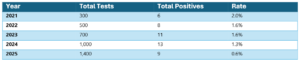
Example: Imagine the following example, where we track environmental monitoring results for a single facility over multiple years. The goal is to evaluate performance over time. 

At first glance, there are two obvious ways to make this comparison: 

  1. Compare the total number of positive results each year 
  2. Compare the positivity rate, defined as positives per total tests performed 

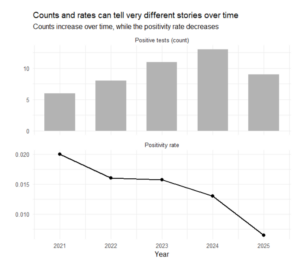
If we focus only on the first option, the conclusion seems straightforward. In 2024, the facility recorded the highest number of positive results. Based on counts alone, it would be tempting to conclude that 2024 was the worst-performing year. 

But this conclusion is incomplete. 

When we examine the second option, the context changes. The number of tests conducted increased substantially over time, particularly in 2024 and 2025. The increase in total positives coincided with a much larger increase in monitoring effort. 

Once results are normalized by the number of tests conducted, performance looks very different. The positivity rate steadily declines, indicating improved performance despite higher total counts.

Conclusion. Counts tell us that something happened. Denominators tell us what it means. Counts are essential for planning, resourcing and understanding operational demand. But when used for comparison without normalization, counts can mislead more than they inform. Larger systems, more transparent systems and systems that monitor more intensively will almost always appear worse when judged by counts alone. Meaningful comparisons require context. Context comes from the denominator. Understanding why counts cannot be used for comparisons, and why the denominator matters, is a foundational step toward responsible, fair and effective use of data. 

Digging into Details – EMPs in Fresh Produce Environments  

January 12th, 2026

In December 2025, there was a tragic shark attack in the Monterey Bay of California. An experienced open-water swimmer had a fatal interaction with a shark, leaving bystanders, friends and community traumatized. As someone who has been amazed by sharks my entire life, I think often about how these organisms have so eloquently evolved, fine-tuning function and necessity into every biological detail.  In the news coverage that followed, details have emerged at just how respectful this swimmer was when entering the space of these creatures – they knew they were the outlier and the object out-of-place in the ocean environment. The event is tragic, but it is a known (albeit small) risk for those who venture into the beauty and mystique of the ocean. 

This tragedy offers an important parallel for environmental monitoring in fresh produce food safety. Like the swimmer in the ocean, we are outliers in the environments where food is grown and processed. We insert our production systems (often simplified monocultures of the crops we grow) into ecosystems shared with other organisms, diverse food webs and both biotic and abiotic forces. Even when we control our operations, we remain dependent on and constrained by the broader systems in which we operate. 

So, in a world where we can expect no less than to cohabitate with other organisms, especially those that make their home in soil and plant systems, why would we ever expect encounters to be infrequent?  

I think about this a lot – in reading reports about how to design EMPs, in visiting producers who have questions or issues in their plants and fields, reviewing scientific journals on Listeria and Salmonella research, discussing companies’ EMP results and in hearing about recalls and outbreaks in mainstream media about the inherent risk (and described failures) of certain categories of food. Nothing from these activities implies that they are rare, nor that they solely originate from the failures of people managing them. Many companies go above and beyond in terms of seek and destroy, and they still seek and find quite often. Does this mean they are failing? Quite the contrary, they are exhibiting the exact behavior we wish to promote – proactive design and action to monitor their environment for optimized risk management. 

So why then do so many articles, conversations and legal cases frame EMPs findings as failures when observations are found? Doesn’t this reinforce the opposite behavior we seek? A well-designed EMP should have positives – in certain environments, many should be expected, and the lack of positive observations is suspect. The number of positive findings is not the important piece of a program. As with many things, it is the context around them, what they represent, what was done about them and the overall story that a cumulative data analysis can show.   

Too often, the story we speak about when discussing EMPs with many positive findings is that there are failures and inadequacies in the program – truants in manufacturing that knowingly or negligently are failing. Unfortunately, these failures do happen, just like encounters with rare sharks occur in the ocean. But just as we acknowledge sharks exist in the ocean, we should also expect and promote building EMP systems that find the targets, that applaud those who put the effort into really characterizing their environment or risk. A robust EMP program and the results it would find should not be viewed as failures or regulatory or legal liabilities. We should be promoting building EMPs that robustly identify when Listeria (or other pathogens) come into facilities and applaud those whose programs are able to keep the encounters as transient versus resident in the production environment.  

Western Growers Issues Statement in Response to 2025-2030 Dietary Guidelines for Americans

January 12th, 2026

IRVINE, CALIF. (Jan. 12, 2026) – Western Growers issued the following statement in response to the Dietary Guidelines for Americans:

“The 2025-2030 Dietary Guidelines unveiled by the U.S. Department of Health and Human Services and the U.S. Department of Agriculture reaffirm our own motto that Western Growers members ‘grow the best medicine in the world,’” said Western Growers Senior Vice President of Science De Ann Davis. “Our specialty crop growers are proud to put wholesome, nutritious food on American tables and provide better health for us all.”

For more information, please contact:

Ann Donahue

(949) 302-7600

[email protected]


About Western Growers:

Founded in 1926, Western Growers represents local and regional family farmers growing fresh produce in California, Arizona, Colorado and New Mexico. Western Growers’ members and their workers provide over half the nation’s fresh fruits, vegetables and tree nuts, including half of America’s fresh organic produce. Connect and learn more about Western Growers on Twitter and Facebook.

###

Court Grants Partial Injunction on California Law Authorizing PERB to Govern Private Sector Labor Relations, but Leaves Unfriendly Amendment to ALRB intact

January 9th, 2026

Signed into law September 20, 2025, AB 288 amends the Labor Code to expand the jurisdiction of California’s Public Employment Relations Board (PERB), a state agency with the authority to enforce federal labor law in the absence of action by the National Labor Relations Board (“NLRB” or “Agency”), and allow PERB to resolve private sector issues of federal labor law and grant appropriate relief if the NLRB has expressly or impliedly ceded jurisdiction.  

In addition to allowing PERB to order any appropriate remedy, including injunctive relief and penalties to resolve unfair labor practice charges, AB 288 grants PERB the authority to assess civil penalties in the amount of $1,000 per worker per violation to employers it finds have engaged in a pattern or practice of committing unfair labor practices. 

The legality of AB 288 was immediately challenged by the National Labor Relations Board (NLRB) which filed a lawsuit against the State of California and the PERB seeking to block enforcement of the new statute. The NLRB contended that AB 288 is preempted by the National Labor Relations Act (NLRA) and that it violates the Supremacy Clause of the U.S. Constitution. 

The Court’s Decision 

On December 26, 2025, a California district court issued a preliminary injunction blocking enforcement of those sections of AB 288 that allow PERB to intervene in cases impacted by NLRB delays or in situations where the Agency experiences a loss of independent governance. Finding that such situations are not indicative of an abdication of authority and that PERB intervention in such circumstances would create unnecessary conflicts and issues of uniformity in the application of federal law.  

Nonetheless, the court did agree with the state that AB 288 should remain enforceable under very limited circumstances, such as where the NLRB is legally enjoined from acting or the conflict at issue is no longer covered under the NLRA.  

A quiet ALRA change that is still moving forward 

One provision of AB 288 received far less attention, but could have real consequences for agricultural employers. Buried in the bill is an amendment to Labor Code section 1148 of the Agricultural Labor Relations Act (ALRA). 

Since the ALRA was adopted in 1975, section 1148 has required the Agricultural Labor Relations Board (ALRB) to follow applicable precedents under the National Labor Relations Act (NLRA). That statutory link has served an important function: it keeps California agricultural labor law generally aligned with federal labor doctrine and helps provide predictability for employers, unions, and employees alike. 

AB 288 changes that framework. As amended, section 1148 states that the ALRB may follow applicable NLRA precedents, treats those precedents as persuasive authority, and expressly provides that the Board is not obligated to follow federal precedent where it deems it inappropriate to do so. 

That discretion is not theoretical. Rob Roy, President and General Counsel of the Ventura County Agricultural Association, recently flagged that the ALRB has already cited amended section 1148 in a recent administrative decision (KEM Farms, Inc., Case No. 2024-CE 113, Order Denying Petition to Revoke), declining to follow NLRB precedent. 

Importantly, the December 26, 2025 federal injunction discussed above addressed AB 288’s new PERB jurisdiction provisions. It expressly did not enjoin the separate amend ent to the ALRA  In other words, even if much of AB 288 is tied up in federal court, this change to ALRB decision-making is still positioned to take effect. 

What Does it Mean 

At this point, outside of the ALRA context, the court’s ruling will likely have very little impact. Both sides could appeal the decision. Moreover, as of January 7, 2026, for the first time in a long time, the NLRB has a quorum, and a Senate confirmed General Counsel. James Murphy and Scott Mayer were sworn in as new Board members with Crystal S. Carey sworn in as General Counsel. As a result, the NLRB can now begin conducting Agency business and will hopefully work quickly to clear its existing backlog of pending cases.  

For now, California employers that are not subject to the ALRA should be aware that the labor-law landscape remains largely unchanged. Although California and some other states have sought to broaden local authority over general labor relations, those efforts have mostly been halted. 

California’s DLSE Updates its Healthy Workplaces/Healthy Families Act Notice 

January 9th, 2026

The California Department of Labor Standards Enforcement (DLSE) has updated its Healthy Workplaces/Healthy Families Act Paid Sick Leave Notice. The update reflects changes in the law that took place in 2024 (AB 2499) and 2025 (AB 406).  

AB 406 restores and recasts specific Labor Code sections that were deleted by last year’s AB 2499. These changes expanded employee protections for victims of “qualifying acts of violence” and their family members, aligning these rights with the Fair Employment and Housing Act. AB 406 clarifies jurisdiction between the DLSE and the CRD and aligns the restored Labor Code sections with FEHA provisions allowing crime victims to use paid sick leave for crime-related purposes.  

By expanding the Healthy Workplaces, Healthy Families Act, these legislative changes make clear that: 

  • Employees may now use paid sick leave for jury duty and court appearances as witnesses under a subpoena.  
  • Both paid and unpaid leave rights are broadened to support victims of serious crimes and their family members, including designated persons, allowing them to attend related judicial proceedings.  

Employers are required to provide written notice of these rights to employees and maintain confidentiality, while also offering reasonable accommodations for victim-employees and allowing accrued paid leave to be used for activities related to crime or abuse. 

The updated notice, dated January 2026, should be immediately downloaded and posted.