Why should I understand microbial hazards?
In food safety, the first important step in designing/revising a food safety program is to take time to do an in-depth analysis of the hazards that a process or product may have. When it comes to microbial hazards, that means taking time to understand the organisms, learning their characteristics and trying to understand and predict their capacity to adapt to the diverse produce environments. This reflection is so that optimal decisions can be made to manage them.
 Unlike chemicals, pesticides and heavy metals, microbial hazards add a unique element in that their risk may increase as a factor of time, hence, increasing the likelihood that a consumer receives an infectious dose (enough cells in a portion of food to make them sick). The capacity to increase in numbers (grow) introduces challenges for control but is also a useful trait when trying to test for them. Any time you search for any type of target (in our case bacterial cells), it is easiest to find when the prevalence and number is highest (Figure 1). If you can optimize where and when to look, food safety programs will identify where the least number of samples are needed to achieve the desired outcome (finding bacterial cells).
Figure 1: When searching for a target, the easiest option is to search when there is the greatest amount of the target. Finding the red marbles is much easier as they increase in concentration relative to the green marbles. For microbial testing – identify where in a process or product to test, focusing on time points and locations with the highest probability of detection to increase chances of finding the target with the fewest numbers of samples.
Masters of Survival
Bacteria rapidly evolve based on the environment they are placed in, constantly and effectively changing their processes and physical structure to adapt to this environment. They are, in short, masters in survival. This amazing capability is one reason they are formidable foes in the food industry – for every change we make to address/manage them, we may inadvertently provide a new opportunity for these organisms or strains to exploit a habitat/niche. This adept ability to adapt requires food producers to constantly monitor whether their measures to prevent, control or eliminate the organisms remain adequate and optimal. If monitoring activities identify results inconsistent with expected results, the applied systems may no longer control the risk, and/or new risks (e.g., other pathogens) may have been introduced. In these situations, quick action to characterize the new situation must be taken to ensure safe product for consumers.
Why Listeria?
One of the most discussed pathogens in microbial food safety, especially in recent years, is Listeria monocytogenes. L. monocytogenes is discussed frequently due to several notable outbreaks over the past decades, a high number of severe illnesses and deaths associated with those outbreaks, and the fact that L. monocytogenes contamination contributing to outbreaks has often come from poor processing and equipment design, inadequate cleaning/sanitation programs and insufficient environmental monitoring programs that failed to identify or eliminate the organism. In short, process failures led to insanitary conditions and adulterated food entering the marketplace.
L. monocytogenes colonization in processing plants is often controllable through robust cleaning, sanitation and monitoring programs. Fresh produce and fresh produce processing has unique considerations when it comes to Listeria management and risk. Unlike many other notable pathogens associated with fresh produce, Listeria’s natural habitat is the soil (hint: it is everywhere). As such, when growing, processing and packaging fresh produce grown in agricultural environments, Listeria should expect to be found. This contrasts with foodborne pathogens like Salmonella and pathogenic Escherichia coli where their presence in the environment is less frequent in the environment and their preferred and ideal habitat is the gastrointestinal tracts of animals. For these organisms, the produce environment is not their ideal ecological niche, and their presence is more often associated with contamination from inputs, wildlife, and adjacent land concerns. Listeria on the other hand resides and thrives in soil and the agricultural environment so growers and processors need to expect that it comes into the production area/product every day.
Provided here is a discussion on Listeria species and L. monocytogenes for fresh produce, focusing on key considerations about the organisms that are important to understand when designing programs to control the risk in fresh produce.
In fresh produce, it’s not a question of if Listeria will be present, but rather how much, how often and if it’s the same strain. Most importantly, is Listeria monocytogenes present in the environment, and are its numbers low enough to avoid presenting a health risk?
Who is Listeria?
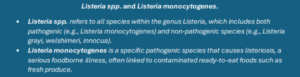
Listeria species fall in a genus of gram-positive bacteria containing 29 species, growing from six species since 2009. Despite the increasing number of species being discovered within the genus of Listeria, L. monocytogenes (1 of 29 species) remains the only species considered a human pathogen. L. monocytogenes is of high clinical relevance and has been observed to have high mortality rates of up to 20-30%, especially within immunocompromised groups (the elderly, infants and young children, pregnant woman). For this reason, food manufacturers are extremely cautious to ensure proper monitoring and control practices to keep L. monocytogenes risk low for consumers.
Listeria as a genus has several characteristics that provide the organism an advantage over other microorganisms within food processing plants.
- It is comfortable at a wide temperature range: First, Listeria has the capacity to grow at refrigeration temperatures (it is a psychrotrophic bacterium – meaning it can grow at ≤ 7°C or 44.6°F). Since temperature is a control measure used to combat other common foodborne pathogens, Listeria not only is able to grow at that temperature, but also grow with little competition from other microbes. Listeria can grow at cold temperatures but can also grow over a wide range of temperatures (-1.5°C up to 45°C). The speed of growth at those temperatures varies, with the slowest rate of growth being at cold temperatures, and optimal growth temperatures at 30-37°C (86-98.6°F).
- It is everywhere and it survives: Listeria species are ubiquitous (found everywhere) in the environment and are soilborne organisms that can be found all over the globe in both terrestrial environments and water sources. Listeria prefers moist environments over dry, however, it does have the capacity to survive low moisture environments by transitioning into a more resilient dormant state. This is an important characteristic since it can survive for long periods of time until reintroduced to more favorable conditions.
- Processing plants are a cozy home for listeria: Within processing plants and in natural habitats, Listeria is often found in complex microbial communities, or biofilms, that help the organism obtain nutrients and protection. Biofilm can be particularly challenging to remove in processing plants and often is invisible to the human eye. In produce processing plants biofilm is of high concern due to the challenges of removing it from the facilities, and the that these biofilms are commonly more resistant to cleaners due to the presence of other biofilm-forming species (e.g., Pseudomonas) commonly present on vegetable and plant matter and particularly resistant to cleaners/sanitizers.
Listeria in Fresh Produce
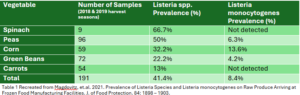
In fresh produce growing and processing, it is normal and expected to find Listeria since Listeria’s natural habitat is soil, water, and plant material. A recent publication in 2021 found varying levels of Listeria spp. prevalence rates for raw produce that were grown for frozen processing (Table 1). For the crops studied (spinach, peas, corn, green beans carrots), Listeria species prevalence rates ranged from 13%-66.7%, while L. monocytogenes prevalence rates ranged from not detected to 13.6%. Many factors such as geographic location, farming practices, harvest practices, input use, weather and adjacent land activities can contribute to varying degrees of Listeria prevalence, but the critical finding is that presence should be expected and planned for within a fresh produce food safety plan. This is especially important for fresh produce growers and fresh-cut produce processers where Listeria monitoring, cleaning and sanitation efforts should expect frequent introduction/reintroduction with inbound receipt of raw materials. This is divergent from other food categories where Listeria presence is less likely to be introduced, and presence is more directly related to cleaning and sanitation inadequacies.
With Listeria introduced every day in fresh produce processing and growing, what considerations should processors take to ensure that they are delivering safe food absent of Listeria monocytogenes risk?
Environmental Monitoring for Listeria
Fresh produce environmental monitoring programs should be finding Listeria frequently since they will be introduced almost daily by raw materials harboring vegetable/soil matter. This is especially true since recommended practices include taking microbial samples for Listeria during processing (hours after startup) is important to be able to identify potential harborage points, biofilm and aerosolization of Listeria-contaminated mist/water droplets. Given this expectation, give thought to corrective actions following a presumptive/confirmed sample or product, and design those actions to answer the question of whether that positive was an isolated event, or whether that positive is related to an established Listeria community in the processing or production area. Root cause analysis is particularly important since transient Listeria may be routine, coming in with raw material, soil debris, and field equipment.
A Note About Negative Test Results
If routine and investigation testing infrequently detect Listeria in conditions favorable for the organism (wet processing, plant, soil, vegetable matter), it is important to evaluate testing methods being used and speak to laboratory personnel about concerns. In some cases, on-site cleaners and sanitizers may interfere with the molecular detection platforms common for rapid Listeria detection, effectively returning false negative results. In these cases, there are often alternative swabbing devices and buffers that can be used to quench these compounds when the sample is being taken – these buffers can also have optimized ingredients to help resuscitate injured Listeria if it is present, providing an even clearer understanding of what may be happening in the environment. Additionally, while Listeria is adept at surviving in agricultural environments and processing plants, it is not always the most advantaged when in complex microbial communities like an enrichment culture. In these microbial enrichments, other bacteria can outgrow and outcompete Listeria rendering a negative result despite Listeria being present in your sample. Take time to understand the type of enrichment media, the amount of enrichment media used per sponge/swab and the enrichment time to be used. Listeria species are diverse, and new species are being discovered each year. This diversity can complicate detection and confirmation methods and may contribute to non-confirming presumptive test results (initial molecular detections that do not produce a culturable colony).
“Presence of Listeria species in fresh produce growing and processing is expected. The absence of Listeria detections is suspect. And, most importantly, does the operation have practices to ensure that the same strain hasn’t established residence in an operation, piece of equipment or water source.”
Conclusion
Listeria species and Listeria monocytogenes are important organisms to monitor for in produce growing environments and processing plants. However, unlike other pathogens where presence is more commonly associated with a contamination event, Listeria is ubiquitous and should expect to be introduced into fresh produce operations daily. As such, strategies and reactions to Listeria presence require a more realistic and appropriate action plan – one designed to clean, sanitize and ensure that the detections found do not represent an established biofilm or niche within a facility, area or piece of equipment. When/if Listeria monocytogenes is present in high concentrations, there can be frequent and routine contamination, and potentially at concentrations high enough to cause illness. This situation requires constant monitoring and management, and it is of critical importance for food safety operators to be on high alert to prevent.