USCIS Releases New Form I-9

April 10th, 2025

The U.S. Citizenship and Immigration Services (USCIS) has made minor changes to its Form I-9, Employment Eligibility Verification. The changes were made to better align Form I-9 with statutory language and to include a revised Department of Homeland Security (DHS) Privacy Notice.  

Key updates to the revised Form I-9 include:  

  • Renaming the fourth checkbox in Section 1 to “An alien authorized to work.”  
  • Revising the descriptions of two List B documents in the Lists of Acceptable Documents.  
  • Adding appropriate statutory language and a revised DHS Privacy Notice to the instructions. 

Changes were also made to the E-Verify and E-Verify+ systems to reflect the updated terminology. The selection “A noncitizen authorized to work” has now been updated to “An alien authorized to work.”  

The revised Form I-9 is available for download. Look for an edition date of 01/20/25 with an expiration date of 05/31/2027 

While employers may begin using the revised form immediately, multiple previous editions remain valid until their respective expiration dates:  

  • Form I-9 (08/01/23 edition) is valid until 05/31/2027 
  • Form I-9 (08/01/23 edition) is valid until 07/31/2026  
  • Employers using an electronic version of Form I-9 must update their systems with the version that has the expiration date of 05/31/2027 by 07/31/2026.  

Employers should note:  

  • If an employee attests on Form I-9 as “A noncitizen authorized to work,” the employer must select “An alien authorized to work” in E-Verify.  
  • E-Verify cases will display “An alien authorized to work,” while employees and employers may continue to see “A noncitizen authorized to work” on Form I-9, depending on the form edition being used.  
  • E-Verify+ participants will see the updated 01/20/25 edition date and 05/31/2027 expiration date reflected in Form I-9NG.  

Visit, USCIS for additional information and resources.  

New U.S. Tariffs Announced: Key Changes Taking Effect This Month

April 2nd, 2025

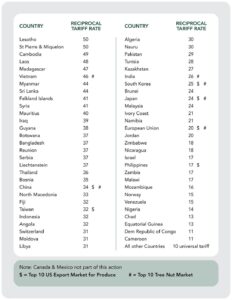
April 10 Update: President Donald J. Trump paused the country-specific tariffs for 90 days, except for China. The 10 percent universal baseline tariff on all imports remains in place. This pause until approximately July 9, 2025 allegedly gives the Administration time to negotiate with various countries that have expressed interest in addressing U.S. trade deficit and barrier concerns.

On April 2, Trump announced a 10 percent universal baseline tariff on all imports to the U.S., set to take effect April 5. In addition, the administration indicated that the U.S. will impose higher, country-specific tariffs on approximately 60 countries starting April 9. These tariffs will exceed 10 percent baseline and vary by country. Officials have emphasized that there will be no negotiations to avoid these tariffs outright, but will consider other countries’ proposals to address the Administration’s reciprocity concerns and consequently reduce or resolve the enhanced tariff.

The White House has released a list of goods that are not be subject to the recently announced tariff increases, which can be viewed here. Businesses are encouraged to review the list and talk with their input suppliers to determine if relevant products or ingredients are included, as well as potential cost and availability impact.

To view an official Fact Sheet on the President’s Action, click here.

Mexico and Canada will not face additional reciprocal tariffs under today’s action. Instead, existing tariffs related to fentanyl and illegal immigration will remain in place. Notably, USMCA-compliant goods, including produce, remain exempt from these tariffs. The President also confirmed that tariffs on steel, aluminum and auto imports—whether already in effect or previously announced—are unchanged and not part of this update.

Canada has already announced retaliatory tariffs in response to U.S. tariffs on its products related to fentanyl, steel and aluminum. As a reminder, exports of U.S. stone fruit, fresh tomatoes, citrus, melons and some tree nuts face a 25 percent tariff when entering Canada. Mexico has not announced any retaliatory measures. At this time, no changes are expected in the trade status between the U.S., Canada and Mexico. As of this update, foreign countries have not yet announced any retaliatory actions in response to the President’s decision. For the latest developments, please visit the Western Growers trade website here.

Western Growers and the California Women for Agriculture Coachella Valley Chapter Host Student Ag Careers Tour

April 8th, 2025

Eighty Coachella Valley High School and Indio High School students participated in an agricultural career tour on March 28 thanks to Western Growers and the CWA Coachella Valley Chapter.

Peter Rabbit Farms, Prime Time, Olson Engineering and West Coast Turf gave the students a hands-on look at the diversity of careers available in the ag industry via tour buses that took them to a farm equipment shop and carrot and turf grass fields. As part of the “Spring AgVenture Farm Tour” the students then met with farmers, ag engineers, mechanics, fabricators, accountants, sales and tech support professionals.

“This was a special day,” said Indio High School ag instructor Mamie Powell. “It really helped my students see what their futures can look like.”

The tour followed the March 27 Next Gen Ag X Ed event that occurred at College of the Desert’s Indio Campus.

Data 101: Understanding Summary Statistics: The Foundation of Data Analysis

April 8th, 2025

Data analysis is the process of collecting, cleaning, analyzing and interpreting data. Before we get too technical into the different areas of data analysis, I want to introduce the concept of summary statistics. In data analysis, raw numbers alone often do not provide a clear picture of the underlying patterns or insights. It is important to understand how to summarize the raw numbers to start making sense of our data.  

What are summary statistics?

Summary statistics provide a concise overview of a dataset by capturing key aspects such as central tendency, dispersion and distribution. They can help quickly understand data patterns without having to create visualizations.

Example Dataset: 

This dataset contains seven samples, each with recorded temperature (in Fahrenheit) and CFU/g (colony-forming units per gram), which measure microbial load, I am not specifying for what, as this is an example.  We will be using the following dataset for our discussion on summary statistics below.  
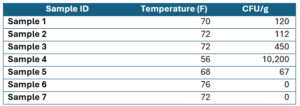
example data set for science post

Measures of central tendency:

Central tendency is concept that describes the center of a variable or multiple variables within a dataset. It represents a single value that summarizes the variable or variables as an indication of where most values fall. The three main measures of central tendency are: 

Mean (Average) 

This is the most common measure of central tendency, we are all very familiar with averages, as these are used. Some examples include and average rating for your favorite restaurant, the average points-per-game of an NBA super star and so on.  

Mathematically, the mean (average) is the sum of all values divided by the number of values. In the example above we can get the mean of the CFU/g column (variable). Where on the denominator we add all the results from each sample and divide it by the number of samples.  

mean formula for science post

Note: As you can see the average, we got is way higher than most numbers in the column. This is because the mean (average) is very sensitive to extreme values. See above (10,200) is a very large number, if you were to remove this number from the calculation, the new mean would be 124 CFU/g (10-fold lower). Showing that this value is extreme.  

mean formula for science post #2

Median  

The median is a little bit less common than the average, but it is used when we want to represent the middle of a distribution. For example, for income data, the median salary is often reported instead of the average because a few very high salaries can make the average misleading 

Mathematically, the median is the middle value when the data is arranged in ascending or descending order. If there is an even number of values, the median is the average of the two middle values.  Let’s calculate the median of the temperature column (variable). 

median formula for science post

Note: It is less affected by outliers than the mean. 

Mode (most common value) 

The mode is the frequently occurring value(s) in the dataset. In our Temperature example, we have the following numbers: 56, 68, 70, 72, 72, 72, 76. In this scenario, the mode would be 72, as it repeats itself three times.  

Central tendency when to use which?  

  • The mean is best when the data is symmetrically distributed without outliers.  
  •  The median is better for skewed distributions or datasets with outliers.  
  • The mode is useful for categorical data or identifying the most common occurrence. 

Below you will see the effect of the mean and median on asymmetrical distribution and a skewed distribution.
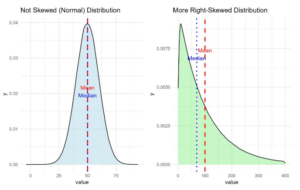
graph of mean and median on asymmetrical distribution and a skewed distribution

  • A normal distribution is symmetrical (mean ≈ median). 
  • A right-skewed distribution has a long tail to the right (mean > median). 
  • A left-skewed distribution has a long tail to the left (mean < median). 


Measures of Variability 

After identifying the center of the data using mean, median and mode, the next critical step is to understand how spread out the data is. This helps answer questions like: 

  • Are the values tightly clustered around the average? 
  • Is there a lot of variability in the data? 
  • Are there any unusually high or low values that might skew the analysis? 

Understanding variability is essential when comparing datasets or interpreting results, especially when making decisions based on consistency or uncertainty. 

The most common measures of variability include: 

Range 

Range is the simplest way to describe the spread. It is calculated as:  

range = maximum - minimum formula

In our Temperature example, our range would be 20°F. 20=7656. Meaning that the minimum and maximum temperatures are 20°F from each other.  

  • A small range suggests that all values are close to each other 
  • A larger range could indicate outliers or a wider spread.  

Note: the range is highly sensitive to outliers. Often good to be paired with the interquartile range (IQR).

Interquartile Range (IQR) 

The Interquartile Range (IQR) is a measure of variability that describes the spread of the middle 50% of your data. It’s especially helpful when you’re working with skewed data or datasets with outliers since it focuses on the center of the distribution and excludes extreme values. 

To find the IQR, you first break your sorted dataset into four equal parts (quartiles): 

  • Q1 (First Quartile): 25% of the data falls below this value.
  • Q2 (Second Quartile): the median, introduced in the central tendency section (50th percentile). 
  • Q3 (Third Quartile): 75% of the data falls below this value.
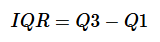
Interquartile Range (IQR) formula

For example, using our temperature data 56, 68, 70, 72, 72, 72, 76.
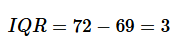
example Interquartile Range (IQR) formula

This means the middle 50% of temperatures fall within a 3°F range. 

Variance 

Variance measures the average squared difference between each data point and the mean. It gives us an idea of how much the values in a dataset differ from the mean, but because it’s based on squared differences, it’s not in the same units as the original data. For a measure in the units the same units of the data see the SD section.

A high variance means data points are spread out widely; a low variance means they are clustered closely around the mean. 

Step 1: calculate the mean 

Step 1: calculate the mean

Step 2: calculate the squared difference
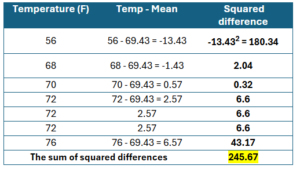
calculate the squared difference

Step 2: calculate the squared difference

 

Standard deviation

Standard deviation is simply the square root of the variance. It’s expressed in the same units as the original data, which makes it more interpretable.

Let’s continue the example above and let’s calculate the standard deviation.

Standard deviation

Generally: 

  • A small standard deviation means the data points are close to the mean—the values are pretty consistent. 
  • A large standard deviation means the data points are more spread out—there’s more variability in the values. 


In summary

Summary statistics are simple but powerful tools to start your data analysis and data cleaning. Remember to start with the basics, and then let the data tell its story. In our next post, we will talk about data visualization and their interpretation.
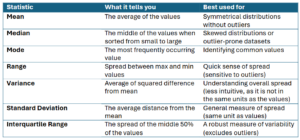

Summary statistics

USDA Freezes Payments Under Farm Labor Stabilization Grant Program

April 4th, 2025

The USDA has suspended payments under its $50 million Farm Labor Stabilization and Protection Pilot (FLSP) Program, leaving grant recipients in uncertainty just months after awards were announced. 

The FLSP was launched to help agricultural employers improve labor standards, increase worker retention and transition to more stable employment models such as H-2A. More than 140 employers nationwide received grants, with many already beginning work on funded projects. 

On March 28, 2025, USDA notified recipients that all payments and reimbursements were on hold pending a review to ensure compliance with federal grant rules. While grants have not been rescinded, the pause leaves employers unsure whether to proceed with planned investments. 

Very few Western Growers members applied for a FLSP grant due to concerns about the increased requirements under the program and uncertainty about which entities would be selected as “labor rights trainers.”  NCAE, which Western Growers is a member, is actively engaging USDA to seek clarity and push for a prompt resolution. In the meantime, grantees should: 

  • Document all FLSP-related expenses, and 
  • Avoid new financial commitments if grant dependent. 

Contact the Western Growers H-2A Services team at [email protected] for questions about the H-2A program or to explore exclusive Western Growers H-2A Service membership benefits.  

Lettuce Varieties Added to Risk-Based Sampling for Pest and Disease at Southern U.S. Border

April 4th, 2025

APHIS’ Plant Protection and Quarantine (PPQ) and the Department of Homeland Security’s U.S. Customs and Border Protection (CBP) has announced the expansion of Risk-Based Sampling at Ports of Entry (RBS POE) program to include new varieties of lettuce arriving at select U.S. ports of entry starting the week of March 31, 2025.

This expansion includes Head Lettuce, Romaine, Butterhead, Red/Green Leaf, and Other Lettuce originating in Mexico arriving to the US via the Southern Border, conveyed via truck.

Read the full announcement here: https://content.govdelivery.com/accounts/USDAAPHIS/bulletins/3d8aa8f

You may also subscribe to updates from USDA Animal and Plant Health Inspection Service in their announcement.

Guidelines for Preventing Employee Misclassification

April 4th, 2025

Times are tough, even for the government. There is speculation regarding a perceived increase in audits conducted by the California Employment Development Department (EDD) since the beginning of the year, which is being attributed to an anticipated budget shortfall. The audits initiated by EDD focusing on the misclassification of workers as independent contractors are considered a temporary measure to address the budgetary deficit. 

Increased focus or not, employers should keep the following best practices in mind: 

Different Tests for Classification: 

  • California classification reviews typically begin with the ABC Test presumption; that all workers are employees. However, multiple exceptions to the ABC Test could shift the analysis to the multifactor Borello test.   
  • In some cases, the economic realities test under the Fair Labor Standards Act may be used to determine worker classification.  

The Actual Relationship Determines Status: 

  • Employers need to remember that the actual relationship determines the classification. Being labeled an independent contractor, signing an agreement stating one is an independent contractor or being paid as an independent contractor does not determine employment status.  

Multiple Layers of Liability: 

  • If EDD, the Labor Commissioner or another part of the Labor and Workforce Development Agency (LWDA) finds that workers are misclassified, employers may face significant liability for restitution and penalties (e.g., payment of minimum wages and overtime, payment of unemployment insurance taxes and providing workers’ compensation insurance). This includes being required to pay the employees’ share of payroll taxes, along with penalties and interest.  
  • Civil penalties may also be assessed for violations resulting from a worker being misclassified, including penalties for willful misclassification.  

Audits and Training: 

  • Conducting an internal review of current worker classifications is a proactive step that will help employers identify and address potential risks associated with misclassification.  
  • Training all hiring personnel is also an effective way to avoid potential assessments and costly litigation. 

Understanding and correctly applying worker classification laws is crucial for employers to avoid substantial liabilities and penalties. By focusing on the actual relationship between the employer and worker, conducting regular audits and providing thorough training to hiring personnel, companies can safeguard against the risks of misclassification.  


Food Safety Video Resouces by University of Minnesota Extension

April 2nd, 2025

The Extension at the University of Minnesota put together a series of informative webinars for growers. There’s a wealth of useful information in this series that would benefit a broader audience, so be sure to check them out.

Topics include:

  • Excluding Wildlife from Produce Fields

  • About Wells Water Testing

  • Update on FSMA Water Rule

  • Low-Cost Packshed Designs

  • Postharvest Handling Tips

The videos can be found here.


Management Strategies for Food Safety Workshop (Fresno, Calif.)

April 1st, 2025

Navigating food safety compliance while meeting production goals is no easy task—but the right knowledge can make all the difference.

Join Joelle Mosso, AVP of Science Programs at Western Growers, in Fresno, Calif., for a workshop designed to equip leaders with the skills to confidently manage the dual responsibilities of food safety compliance and production demands. Gain a clear understanding of the qualifications necessary for food safety roles, the scientific principles behind food safety and the strategies for balancing regulatory adherence and production goals.

Participants will have practical tools to foster a culture of compliance and efficiency, helping you protect consumers and optimize operations. If you’re a business owner, senior executive, HR professional, operations manager, food safety manager or supervisor, this webinar is for you.

Webinar Details:

Date: Tuesday, May 13, 2025
Time: 2:00 PM to 4:00 PM (PT)
Location: California Fresh Fruit Association in Fresno, Calif

Register Here

*Space for this workshop is limited*

2025 LGMA Amendment Process Update

April 2nd, 2025

During the month of February and March, Western Growers facilitated the California LGMA priority setting process. On March 27, 2025, the CA LGMA approved the following two priorities: 

  1. Water Section Review: Continue the review of water, started last year, with the following objectives. 
    • Simplify and clarify requirement language to enhance understanding. 
    • Assess the metrics from a scientific perspective and update requirements based on the latest scientific evidence. 
  1. Formation of a Second Working Group: Establish a second working group to meet monthly and evaluate improvements related to AZ and CA LGMA alignment. The group will prepare a brief final report for the 2026 PSC outlining areas for possible improvement. 

What is next?  

  • April– May: The working groups for the selected priorities will begin working on drafting metric updates.
  • June: Western Growers will host a 30-day comment period for the public to provide feedback on the draft generated by the working group.  
  • July: the working group will address the comments submitted by the public.
  • July: A final draft of the metric updates will be presented to the CA LGMA Technical Committee and Board for approval.  

For any questions, please contact Gustavo Reyes [email protected].

Diamondback Moth Control: Lessons from New Zealand Webinar

April 1st, 2025

Diamondback moth (Plutella xylostella) is the most damaging and problematic pest for brassica growers. Similarly, in New Zealand, DBM can render vegetable brassica crops unmarketable – through damage to leaves or contamination of harvested parts by larvae and pupae. Pesticide resistance, climate change and loss of traditional control options have only escalated the urgency to find more effective solutions to control DBM.

Join us for a discussion about Diamondback Moth (DBM), a significant pest of brassica, and what future options show promise for control of this species. In this webinar, we will explore IPM as a tool for effective control of DBM in New Zealand fresh produce crops and introduce emerging opportunities and tools that show promise to growers.

Explore the webinar agenda and speaker bios here.


Webinar Details:
Wednesday April 30, 2025
2:00 PM to 3:30 PM PT
Online / Zoom

Register Here


Presented by Plant and Food Research and Western Growers Science.


     Plant and Food Research Logo

New Resource Highlights Alarming Trends for California Agriculture

April 1st, 2025

Despite being the dominant agricultural force in the U.S., California’s oppressive legislative and regulatory environment is driving food production out of the state.

Western Growers has compiled key data points into a handy booklet demonstrating the steady erosion of California’s farming economy due to the cumulative financial impacts of the state’s public policy climate.

Insights include:

  • Lost farms and acres between 1997 and 2022
  • Declining profit margins for California farmers over the past decade (in contrast to growing profit margins for the rest of the country)
  • Rising production costs between 1998 and 2023
  • Increasing California-specific regulatory costs between 2006 and 2024
  • And more

To access the booklet, click here.

If you are an agricultural stakeholder, we encourage you to share this resource with colleagues, elected representatives and regulatory officials to help raise awareness of the troubling trends facing California agriculture.

For more information, please contact Cory Lunde, VP, External Affairs, at [email protected].