Heather Mulholland Talks Citrus Roots and Future Fruit

September 5th, 2025

As a fourth-generation citrus grower, Heather Mulholland’s earliest memories are steeped in the scent of oranges and time spent picking fruit with her grandfather.

“In the beginning, it was just for fun,” she said. “I’d go out and pick oranges just to eat them.” But even as a child, she understood that this wasn’t just a backyard orchard—it was a full-fledged farming operation that she watched grow and evolve over the years.

Despite her upbringing and admiration for the farm, Heather didn’t intend to follow in her family’s footsteps. She studied political science and international relations in hopes of a career in international law or trade, attaining a bachelor’s degree at Cal Poly San Luis Obispo and a master’s at Cal State University, Fresno. “I wanted to work in business on a global scale,” she said. “Agriculture wasn’t the original plan.”

After some time away, the pull of the land brought her back to California’s Central Valley—but entering the family business wasn’t easy. In fact, her father initially told her no. “The door was not open, so I had to break it down,” she said.

Heather started at the bottom, cutting fruit samples on the packing house floor. It wasn’t long before necessity led her to managing the entire packing operation, where she spent the next seven years gaining firsthand experience.

Today, Heather is Chief Operations Officer at Mulholland Citrus in Orange Cove, Calif. and serves on the Western Growers Board of Directors. Of all the issues facing agriculture, labor remains the one most personal to her.

“Many of our employees have dedicated their entire lives to working with us, and now they face a climate of fear,” she said, highlighting the impact of current immigration policies and the prevailing uncertainty surrounding enforcement. “These individuals are integral members of our community. They coach youth sports teams, attend church and have children enrolled in local schools. They deserve the right to live without fear.”

Heather is also one of a growing number of women in agriculture stepping into leadership roles. Heather was among the first women to graduate from Western Growers Women, a leadership program that provides pathways for women to achieve the highest levels of leadership within the agriculture industry.

Heather described the program as a “fabulous opportunity to connect with other women.” Her favorite part? The mentoring aspect. “I participated as a mentor and as a mentee and found them both to be equally rewarding,” she said.

During her career so far, Heather said she has had incredible mentors, both men and women, who have supported her. “Being one of the few women in the room has become the norm, and it no longer feels unusual,” she said.

Mulholland Citrus is distinguished by its tightly-knit family structure. Heather, working alongside her father Tom, is the sole family member responsible for the day-to-day operations. She acknowledges that it’s rare for a successful operation to be carried forward by just one person in each generation—something that makes her role all the more meaningful. Heather takes great pride in continuing that legacy.

That pride now extends to the next generation. Her nine-year-old daughter, once her constant shadow on the farm, now dreams of being an engineer and designing robots—possibly for agriculture. “She’s always full of creative ideas,” Heather said. “You never know, she might just design the next game-changing ag robot.”

Despite the challenges growers often face, Heather remains cautiously optimistic about the future of California agriculture. “There’s always going to be a need and desire for healthy, nutritious food,” she said. “I just hope we can keep producing it here in California. We need policies that make it easier to do business in this state so the next generation has a chance.”

From Wonderful Achievements to Wonderful Laughs

September 3rd, 2025

This year’s Award of Honor Dinner Gala at the Western Growers 99th Annual Meeting promises an unforgettable evening as we celebrate the remarkable contributions of Stewart Resnick, one of agriculture’s most visionary leaders. The evening will open with a heartfelt tribute recognizing Resnick’s achievements and impact on our industry, which is sure to be a moment of pride and inspiration for all in attendance.

But the night doesn’t end there. Prepare for a shift from reverence to roaring laughter as we welcome Aaron Weber, a rising star in standup comedy and a regular at the legendary Grand Ole Opry. Known for his sharp wit and relatable humor, Weber has performed on the Opry’s Circle Network and was named a “New Face 2021” at the prestigious Just For Laughs Comedy Festival. His appearances on The Nateland Podcast only add to his reputation for tackling life’s quirks in the most entertaining ways.

This perfect pairing of recognition and comedy promises to make the Award of Honor Dinner Gala the perfect capstone of the Annual Meeting. Whether you’re joining us to celebrate Resnick’s achievements or to enjoy an evening of top-tier entertainment, this is one event you won’t want to miss.

Award of Honor Dinner Gala
November 11, 2025
Register Here

Grit, Growth and Giving Back: Wonderful Co.’s Stewart Resnick is Our 2025 Award of Honor Recipient

September 5th, 2025

For more than two centuries, the idea of the American Dream has inspired generations born on this soil just as much as those who arrived seeking opportunity. It’s the enduring belief that with hard work, grit and determination, anyone – regardless of where they start – can rise from modest roots to build something lasting, meaningful and entirely their own.

This is exactly what Stewart Resnick, Chairman, President and Co-owner of The Wonderful Company, has accomplished.

Resnick founded the company alongside his wife, Lynda Resnick, almost 50 years ago. Together, they’ve built one of the world’s largest privately held agricultural, real estate and consumer packaged goods companies, with nearly $7 billion in annual revenue and a more than 10,000-person global workforce. They own and produce iconic, healthy brands including FIJI Water, POM Wonderful, Wonderful Pistachios, Wonderful Halos, Wonderful Seedless Lemons, Teleflora, and JUSTIN and Lewis Cellars wines. Chances are, their products are already in your kitchen – or your neighbor’s – since nearly half of U.S. households have them in their pantries.

It’s these sorts of landmark accomplishments that have led to Resnick receiving the Award of Honor this year, Western Growers’ highest recognition of achievement, given to individuals who have contributed extensively to the agriculture community.

This industry giant didn’t take a straight path into ag, but that’s where his journey began.

He was born on a New Jersey farm on Dec. 24, 1936. “But we didn’t farm it because it was during the recession,” Resnick explained.

Growing up in a middle-class family, Resnick learned early on to appreciate the value of a dollar, and at the ripe age of 13, took it upon himself to get a job at the local pharmacy as a photo developer. By the time he was in high school, he had created his own business selling toys at farmers markets in Central Jersey and used this money to help pay his way through college. “At this point, my father had gone bankrupt, and we never had much money,” he said.

Resnick began his studies at Rutgers University before transferring to the University of California, Los Angeles, where he could take advantage of the better weather and more affordable tuition – $60 a semester at the time.

With an entrepreneurial mindset rooted since childhood, Resnick continued to work odd jobs, including washing windows.

“My father owned a local bar in Highland Park, New Jersey, at one point,” Resnick said. “And I remember he always had problems with the janitor. Sometimes they wouldn’t show up, and I thought, ‘Well, I’m reliable.’”

After getting a steady stream of clients on his own just by knocking on doors, Resnick decided to bring on additional employees and eventually launched his own janitorial business.

Starting with a small team of five, the company expanded to 100 in just three years, by the time Resnick graduated from law school. He eventually sold his business and used the proceeds to purchase other companies.

As the businesses grew, Resnick applied his sharp business acumen to scale and sustain lasting success.

“Interest rates were about 15 percent, and I was concerned about inflation. At that time, with kids and a family, I knew I had to figure something else out,” Resnick said.

So, as a hedge against inflation, Resnick purchased Paramount Citrus in 1979 – complete with 1,000 acres of land – and officially kicked off his career in the ag industry.

“It worked out well in the beginning. The citrus business was quite good,” Resnick said. “I was just going to be a passive investor, but I liked the opportunity – the business – so I built it up.”

By the mid-‘80s, Resnick was already eyeing his next big venture: cracking into the nut business, specifically pistachios.

“Lynda was a genius with our branding, and I had a pretty good idea about sales and how to scale from my other businesses. I thought if we could apply that here, we could be a leader in this business and eventually dominate it,” he said.

Implementing a vertically integrated model, Resnick didn’t stop at growing nut trees. He expanded to managing every step of the process in-house – from nurseries and harvesting to processing, packaging, merchandising, advertising and distribution.

Today, The Wonderful Company is the world’s largest grower and processor of pistachios, holding a commanding 60 percent share of the U.S. pistachio market and 40 percent of the global market. It is America’s largest citrus grower and one of the country’s biggest producers of mandarins, seedless lemons and pomegranates. Wonderful also owns the world’s largest flower delivery service with Teleflora and is a market leader in premium wines, with JUSTIN, Lewis Cellars and Landmark wines, as well as bottled water with FIJI Water and pomegranate juice with POM Wonderful.

In the face of a rapidly changing climate, environmental sustainability has been at the center of their work. Resnick believes Wonderful must be a deeply responsible steward of the environment and lead by example to create a sustainable future. That commitment extends to their philanthropy as well. In 2019, the Resnicks pledged a historic $750 million to Caltech to help combat climate change, as well as another $50 million to UC Davis to invest in the future of agricultural research.

While these brands and commodities are precious to Resnick, it’s not the what, but the who – in the factories and the fields – that means the most to him.

After establishing their pistachio factory, he and Lynda prioritized investing in the people from Lost Hills, Calif., a Central Valley town where one of every two households includes a Wonderful employee.

As they devoted time and resources into growing their businesses, Lynda urged her husband to consider how they might do the same for the people in that community.

“We didn’t think it was right that, for these employees, their roads were unpaved; they didn’t have sidewalks; quality education was lacking. So, we chose to really support that town,” Resnick said.

That commitment quickly expanded across the Central Valley. Starting with infrastructure, the Resnicks, along with their foundations and The Wonderful Company, have made a giant impact across the region where Wonderful operates – well beyond Lost Hills – focusing on education, housing, parks, health care and more. Their work includes building affordable housing, refurbishing parks, establishing community centers and playgrounds, and opening free health clinics at plants and schools.

The Resnicks and Wonderful opened two charter schools, which today offer a four-year college scholarship and mentoring to employees’ children and other high school students.

“Before we built this charter school, there was no high school in Lost Hills,” Resnick said.

Between charter schools in Delano and Lost Hills, more than 2,500 students are currently enrolled in Wonderful College Prep Academy (WCPA). WCPA is one of many education initiatives that Wonderful supports.

Wonderful Education programs offer a broad spectrum of support from cradle to career – including two preschools, a dual-enrollment program, college scholarships, career training and more. Each year, Wonderful Education serves more than 5,000 students in the Central Valley. To date, more than 3,000 college scholarships have been awarded—each worth up to $40,000.

That work came full circle last year, when the Resnicks attended the first high school graduation in Lost Hills’ history – a monumental achievement. Some of those grads went on to schools like UC Davis, Fresno State, Cal Poly, and even Resnick’s alma mater, UCLA. Others returned to the Central Valley and found opportunities in agriculture, health and wellness, education and more.

For the Resnicks, true impact means disrupting the cycle of poverty – not just through jobs, but through long-term, generational investments.

That includes free, on-site health care available to all employees, students, and their families in Lost Hills and Delano. Company-subsidized cafeterias in Del Rey, Delano, Lost Hills, Shafter and Los Angeles are foundational to the company’s mission of encouraging and supporting better health, offering only nutritious meals at affordable prices – a change that’s contributed to a 51 percent reduction in diabetes and prediabetes among Central Valley workers since 2015.

As a result, a once-underserved community has become a thriving hub where children receive a quality education, families earn better incomes and healthier lifestyles are the norm.

This commitment to healthy living is clearly seen in their business model, which includes selling only nutrient-rich foods to consumers: citrus, nuts and pomegranates, with wine rounding out the list as a heart-friendly bonus.

That same virtue extends to how Resnick does business. He said he wouldn’t be where he is today without staying true to his word.

“It’s a pleasure to do business with farmers because if you keep your word, that’s all that’s important. You don’t need a 50-page contract. If you don’t keep your word, you’re out. So, we’ve always met our commitments, and we take a lot of pride in that,” he said.

Resnick said he views the Western Growers Award of Honor as validation – recognition and acceptance by the ag community, despite being first-generation.

“I’m very honored to be part of this community and to receive this recognition from Western Growers – an award that’s gone to so many agriculture leaders I’ve long admired. For five decades, agriculture has been the heart and soul of my professional life. It’s been incredibly special to be part of California’s farming community and to help feed a growing world.”

From humble beginnings to building a lasting empire in the heart of California’s agricultural landscape, Stewart Resnick’s journey is proof that the American Dream is still alive – not just in what one can build, but in how one can empower others to rise as well. His story is one of vision, integrity and enduring impact – one that will continue to uplift families and communities for generations to come.

Blue Book Alert: Increasing Threat of Impersonation Fraud

September 8th, 2025

I am pleased to present a guest contribution from Mr. Bill Zentner of Blue Book Services. Mr. Zentner serves as Vice President of Rating Services and brings over 24 years of experience in fresh produce trade, sales, and market analysis. In this contribution, he will share best practices on safeguarding your business against the growing risks of fraud and imposter activity.

Scammers are increasingly targeting the produce industry by posing as legitimate businesses to exploit trust and fraudulently acquire products and services.

Multiple companies have reported that scammers typically initiate contact via email, though they may also initiate verbal communication and use social media.

Observed email communications often feature generic canned introductory scripts and requests for credit applications. Despite poor grammar, scammers demonstrate industry knowledge.

Communications may appear to be from employees that are presently working for the company, but a past employee or one that was never connected has also been used.

Their email domains frequently differ from the legitimate company domains they claim to represent. For example, a real company email might be [email protected], while a scammer’s altered email could be [email protected][email protected], or [email protected].

Scammer email signatures usually include logos and branding of the misrepresented company, and the phone numbers provided are often not found in Blue Book Online Services, though be mindful of phone spoofing.

If a credit application is offered and returned completed, it is crucial to validate the entire document and references, as they often contain bogus email domains and phone numbers as well.

This growing threat of impersonation fraud can lead to significant financial losses and damage to business reputations.

To safeguard your company and reduce the risk of falling victim to these schemes, consider these crucial steps:

  1. Confirm Identities: Ensure you know exactly who you’re communicating with, and thoroughly vet new contacts or unfamiliar companies.
  2. Verify Contact Information: Cross-check emails, phone numbers, and business references for authenticity. Watch for inconsistencies or suspicious communication patterns. Call the company directly after any suspicious contact.
  3. Consult Blue Book Services: Validate business credentials by logging on to www.bluebookservices.com.
  4. Report fraudulent or imposter activity: Contact the USDA-PACA division to report any suspicious activity by emailing [email protected].

Fraud is constantly evolving – stay vigilant and take these extra steps to reduce the rising risk of fraud.  Sharing experiences can help other industry participants stay informed and protected.

To share your experiences, email us at:  [email protected].

As always, I’m available to answer any questions you might have, and I will try to address them in upcoming blog posts. You may contact me at 949.885.4808 or email me at [email protected].

Western Grower & Shipper Magazine September/October Digital Edition is Available Now

September 5th, 2025

The September/October digital issue of the Western Grower & Shipper magazine is available for online viewing.

The issue features the articles, “Grit, Growth and Giving Back,” “Californians in Brazil,” the Western Growers Ag Legal Network Directory and more. You can also read President and CEO Dave Puglia’s column, “Can California Still Build Big Stuff?”

Find the full digital edition of the September/October issue here.

Best Practices: Developing an Effective Recruiting Process 

September 4th, 2025

The goal of effective recruiting is to find the right person for any job opening. Effective recruiting practices that consider the specific needs of the organization with an eye toward limiting potential legal risk, saves time as well as money. 

Developing a step-by-step recruiting process allows an employer time to identify its workforce needs, 

decide how to attract and find the best recruits and ultimately hire the most qualified candidates. Keeping in mind that specific details of the hiring process will be unique to your operation, we have included below some of the most common steps in the recruiting process. 

The first step in any recruiting process is to identify the hiring need. Is the operation looking at expansion efforts, filling a vacated position, or managing existing workloads? Answering this initial question will focus the recruiting efforts as you move through the plan. 

Recruitment efforts will begin and vary according to the position needed. If the position to be filled is newly created, it is important to clearly identify how the new role integrates with existing operations. Internal teams and employees impacted by the new position should be kept updated on recruitment efforts and estimated timelines. If the hiring need is to fill or expand existing positions, it will be important to consider who will be involved in the hiring decisions, recruitment timelines, and interview schedules. Other important factors to consider at this stage include how to publicize the open/new position, criteria for candidate screenings, what type of interview process will be utilized, and who will be conducting the interviews. 

Once these initial questions are answered, creating or updating the relevant job description(s) is the next step. 

With the job description prepared, it’s time to decide where to search for the most qualified candidates.  Apart from internal candidates, publicity efforts will likely include a combination of these resources. While most of these resources rely on interested candidates responding to advertising efforts, employers can take the initiative by actively seeking qualified candidates at job fairs and on social media platforms such as LinkedIn. Caution should be exercised if advertising on websites or social media sites such as Facebook that are not dedicated to job seekers.  

Once an employer has decided the best method for sourcing qualified candidates, the next steps include application review, initial screening efforts, interviews, selection, the conditional offer of employment, background/reference checks and final approval. 

Find these recruiting tips and best practices useful? Check out Western Growers Personnel Procedures Manual (PPM). The PPM is an information-packed employer tool that provides helpful guidance for agricultural employers navigating the employer/employee relationship from pre-employment to termination. Click here for more information. 

Mission Mexico Delays Changes to Interview Waiver Process for H-2 Visas 

September 4th, 2025

On September 2, 2025, Mission Mexico announced that the planned changes to the H-2 visa interview waiver process have been temporarily delayed at the instruction of the U.S. Department of State. This reversal means that consular sections in Mexico will continue processing H-2 renewals under the prior interview waiver procedures until further notice. 

Under this guidance: 

  • September 2 applicants: First-time or renewal H-2 applicants already scheduled for in-person interviews should attend their appointments as planned. 
  • Beginning September 3: Consular sections will resume processing H-2 renewals as interview waiver cases, provided applicants meet the eligibility requirements for interview waivers. 

Mission Mexico indicated that additional information will be shared as soon as possible, but no further details are available at this time. 

This is a welcome development for agricultural employers who rely on the H-2A program, as it preserves the former interview waiver option for returning workers. The Department of State had previously announced that it would narrow interview waiver eligibility for H-2 applicants effective September 2, 2025, a change that was expected to increase scheduling delays and slow the processing of returning workers’ visas. Western Growers covered that policy change here. 

We will continue to monitor developments closely and provide updates as new guidance is released. 

For questions about H-2A interview requirements or the H-2A program in general, please contact the Western Growers H-2A Services team. 

Spring 2025 Regulatory Agenda Released  

September 4th, 2025

The Office of Information and Regulatory Affairs (OIRA), within the Office of Management and Budget (OMB), has released the Spring 2025 Unified Agenda of Regulatory and Deregulatory Actions. This semiannual publication outlines the rulemaking priorities of federal agencies, providing employers and the public with transparency into regulatory initiatives that may affect their operations in the months ahead. 

Since 1978, federal agencies have been required under executive order to publish these agendas, and the Unified Agenda has become the central resource for tracking upcoming proposals and rulemakings. RegInfo.gov hosts the full agenda, dating back to fall 1995, and allows users to view rulemaking entries by agency. 

Department of Labor Proposal: AEWR Methodology 

Of particular interest to agricultural employers, the Department of Labor (DOL) has signaled plans to amend its regulations governing the certification of agricultural labor or services performed by H-2A workers. The proposal (RIN: 1205-AC24) would revise the methodology used to determine the  

Adverse Effect Wage Rate (AEWR) for non-range agricultural occupations. 

The AEWR sets the minimum wage employers must offer and pay H-2A workers, as well as corresponding U.S. workers in “corresponding employment.” Changes to AEWR methodology can significantly impact employer labor costs, particularly in high-AEWR states like California and Arizona. Although details of the DOL’s proposed revisions are not yet public, the agency’s entry in the Unified Agenda confirms that rulemaking is underway. Employers should monitor this closely, as the AEWR has been the subject of multiple legal challenges in recent years.  

The DOL’s entry regarding the AEWR methodology revision is available here. 

Accessing the Agenda 

Employers and stakeholders can review the full Spring 2025 Unified Agenda at RegInfo.gov. The site allows users to select agencies from a drop-down menu and view both proposed and final rules under development.  

The regulatory agenda for USDA and DHS are also of interest to agricultural employers. Western Growers will be closely monitoring the Administration’s regulatory priorities in the weeks and months ahead. 

Reliable Food Safety Programs Start with Stronger Foundations

September 3rd, 2025

Behind every successful food safety program are two things: accurate data and effective leadership. When sampling isn’t representative or when compliance and production feel at odds, programs struggle to deliver the reliability teams depend on. The key is knowing how to strengthen both the science and the management strategy.

That’s exactly what we’ll focus on during a two-part workshop led by Joelle Mosso, AVP of Science Programs, and Gustavo Reyes, Sr. Manager of Food Safety and Predictive Analytics, in Yuma, Arizona on September 23, 2025. In the morning session, they will cover how to refine sampling and testing practices for more accurate results. In the afternoon, Joelle will shift to management strategies that make food safety compliance, leadership, and decision-making more practical and sustainable.

Two focused sessions in one day using practical tools designed to strengthen your sampling, testing and management practices. Walk away with actionable strategies that can streamline operations and make your food safety program a reliable decision-making tool. View the full agenda and register today.


A lot goes into defining a “lot” 

September 3rd, 2025

Something occurred to me while participating in a metagenomics panel at the International Association of Food Protection (IAFP) this past summer in Cleveland, Ohio. I was attentively listening to the other panelists and how they have found value and promise in this emerging discipline, sharing insights into how they incorporate screening ingredients and processing facilities to understand their unique microbial and genomic profile. As I listened to their remarkable use cases, I couldn’t help but feel that the discussion about the entire genetic community of food and processing sounded remarkably static when referring to a microbial world that is not static at all.  

Thus began a long series of thoughts on my part – spanning months, not weeks. I’ve always approached food production through a microbiologist’s lens. Everywhere we produce food, whether in a field or in a facility, we should expect that shifts in conditions will cause microorganisms to quickly respond and evolve.  Whether in an agricultural field or in a facility, microorganisms live in constant flux, filling adaptive roles in the ecosystem. Simply put, to assume static populations in these environments is a scientific mismatch. Without constant change, they perish.  

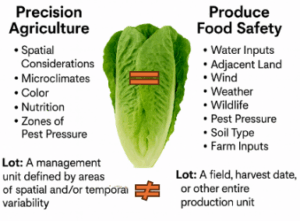
green lettuce with text about Precision Agriculture and Produce Safety This point of view gives me a slightly different vantage point than most, but it isn’t unique to microbiologists. Agronomists, horticulturists, plant geneticists, soil scientists, plant pathologists, and the like, all hold a similar viewpoint. For these experts, they would never consider every plant in a field the same. They would never assume uniformity in soil characteristics, a field of production, or assume that all inputs, agronomic practices, and climatic shifts lead to equal and uniform outcomes for crops planted within a field.  Their tools—stratified sampling, site-specific management, and targeted treatment—are built around acknowledging that fields are heterogeneous by nature. 

The disconnect between these two approaches on the same topic is disconcerting. One discipline (agronomic) would never assume homogeneity for plants within the same field – they would design treatments and needs based on stratified sampling and assessments to make sure they only treated plants with the need. The other (food safety) often considers the exact same plant as a homogeneous product when produced with the same inputs, during the same time frame, and on the same ranch/farm.   

Here’s the key question: At what point does an inherently variable plant become a food, and its unique lived exposure and state reduced to one lot code of operational production? 

Lotting is a challenging activity and generally comes down to functional operational units like those mentioned above (field, harvest day, single irrigation system, pack day). For produce food safety, we must balance these operational units with the known scientific variability (and potential risk) of the lot – like we do for precision agriculture, aligning food safety strategies with practices of agronomists, soil scientists, plant scientists, etc. What doesn’t make sense to food safety is to consider these highly variable factors within a field (adjacent land, microclimates, soil composition, crop treatments, pest pressure) and then lump all the plants in that field into one single production lot. Doing this, we lose (1) the ability to truly identify root cause by creating too broad a lot, (2) we assume guilt of a whole field, production day, or season when only a fraction of crop may carry risk, (3) we lose resolution in traceback and cause overly broad, non-risk-based recalls. 

Given the inherent variability in biological systems, environmental conditions within a field, and production practices, the burden should be on demonstrating that they are sufficiently alike to be considered one lot, and that the food safety risk they carry is truly uniform. Functionally, this means we need to find a more representative way to lot, likely more similar to that of Precision Agriculture. Precision Agriculture treats lots within fields as microzones, incorporating spatial variability and scientific differences to delineate lots for cultivation. Produce food safety must evolve to do the same. Given what we know about agronomic science, microbial ecology, remote sensing showing inter-field variability, and types of food safety risks – broad uniform food safety risks within fields are less likely to exist, and higher resolution is needed to pinpoint where risks are.   

With more granular lotting, we can approach food safety risk much like that of precision agriculture– managing where the needs are, and not by an arbitrary operational lot that ignores known variability. With higher resolution lotting, we (1) shift the burden of proof – no longer assuming uniformity, but needing to prove it, (2) use agronomic data to define microzones that can improve our ability to resolve where and when risks are present (3) align agronomic strategies along with produce food safety practices to optimize both outcomes.  

Designing higher resolution lotting for food safety in produce is a necessary evolution, just like precision agriculture and targeted agronomic treatments are necessary to improve sustainability and yield.  

Granular lotting for food safety offers us the opportunity for:  

  • Better resolution during root cause investigations 
  • More targeted risk mitigation and corrective actions 
  • Fewer unnecessary product losses 
  • Incorporates the variability that what we already know is inherent for plants, agricultural environments, and microbial ecology. 

Just as Precision Agriculture is offering better yields, resource allocation, and pest control, precision food safety can offer smarter prevention strategies, quicker and more accurate responses, and ultimately lead to better public health and economic outcomes for growers. 

From the WG Science Library: Flooding Resources 

September 3rd, 2025

At Western Growers Science, we are starting a new effort called “From the WG Science Library.” In this series, we will revisit resources we have already published and bring them back to you, making sure you can easily find and use the guidance, tools and research that remain relevant today. This week, Flooding. 

Flooding continues to be one of the most significant challenges to food safety in produce fields. Western Growers Science has previously published a set of resources to help members navigate these events. As the season brings renewed concerns, we are bringing these tools back to the forefront. 

New Voices of the Valley: Six Generations of Farming in California’s Central Valley

September 3rd, 2025

On the latest episode of Voices of the Valley, Western Growers hangs out with Cannon Michael, President and CEO of Bowles Farming Company, and the sixth generation to run his family’s farm. Cannon takes us behind the scenes of a truly unique operation that grows everything from tomatoes and melons to pistachios and cotton, while also caring for thousands of acres of wildlife habitat. Cannon also discusses the importance of water to California agriculture, his work on regional waterboards and how Bowles Farming is investing in sustainability and leadership to shape the future of farming.

Listen to the full episode here.

Produce Safety: All For One, or Every Stakeholder for Themselves?

September 10th, 2025

Western Growers Response to Reagan Udall Report: Roadmap to Produce Safety

“The produce (food safety) system is fragmented, uncoordinated, under-resourced, and not aligned around a common strategy for making produce safer.” This statement from the Reagan Udall Report: Roadmap for Produce Safety is a concise descriptor of the fundamental challenge to those willing to champion systematic change.

There is little alignment between public health authorities, buyers, sellers and academia when it comes to setting standards for field-level food safety, leaving growers with multiple standards, many that are arbitrary and non-value added. Add to this the urgency of decreasing domestic fruit and vegetable production. Every year, domestic production is lost to increased production costs, labor shortages, and local, state and federal policies that impact economic viability. Imported produce takes the place of lost domestic production, and the production does not return to the U.S.

Step one in the Roadmap for Produce Safety is the formation of a sustained stakeholder collaboration (SSC) that will serve to advance strategic priorities for fresh produce food safety. It is important that any resulting SSC also enhances domestic productivity.

The fresh produce industry is fragmented. Fresh produce growers vary by size, commodity, region and season. Building an SSC that fairly represents the diversity of grower perspectives will itself be a challenge. Balancing this diverse perspective within the context of the more dominant buyer and seller voices and the push for change rightly put forth by consumer advocates will require all stakeholders to confront and commit to their part in shared accountability in fresh produce safety. An SSC by itself will be of no service without a commitment to concerted action. Action comes from a high level of commitment to achieving shared goals.

Fresh produce growers and their representative organizations cannot achieve the systemic change needed in food safety on their own. They need the combined power of the full supply chain, consumers and academia. Bringing more resources to a system with a weakened infrastructure, driving alignment across government agencies and achieving transformative change is an ambitious and tough undertaking.

The SSC’s composition, membership and structure will be as critical to its success as the priorities it sets for action. It will need to respect and acknowledge successful work already in place, let go of past criticisms of existing organizations and allow for new, constructive and bold conversations.

The California and Arizona Leafy Green Marketing Agreements, although imperfect, reflect solid models of sustained continuous improvement in food safety for leafy greens. The recently completed Commodity-Specific Food Safety Guidelines for Cantaloupe and Netted Melons was developed using a transparent public process led by industry and guided by academic experts. The process was a pilot trial of bringing together diverse regional growers to create a single document that reflects the best scientific information available about growing practices for these crops.

The S.A.F.E. Think Tank (Sustainable Alliance for Food Ecosystems) brings together subject matter experts from government, academia and industry focused on food ecosystems and the movement of environmental pathogens. These successful working organizations (formal and ad hoc) represent grower commitments to improve food safety. Amplification of these efforts (as well as others not named here) should be a priority for any SSC.

Western Growers wants to see transformative, systematic change in fresh produce safety. We recognize the value of an SSC in achieving this goal. Growers deserve resources and support. Consumers deserve the systematic changes necessary to improve safety.


FDA’s Food Safety Strategy: Too Much Policing, Too Little Prevention

September 3rd, 2025

Western Growers Response to Reagan Udall Report: Roadmap to Produce Safety

The Reagan Udall Report:  Roadmap to Produce Safety states “The FDA’s implementation of FSMA’s regulatory framework and the national integrated produce safety that FSMA envisioned are incomplete.”

FSMA’s intention was to reimagine food safety oversight as a pro-active, science-driven system rather than a reactive one. To state that the FDA’s implementation of this intent is incomplete with respect to fresh produce is an unfortunately all too accurate statement.

Supporters of domestic growers, such as Western Growers, have long been concerned about the FDA’s overemphasis on inspections and sampling as primary methods of improving food safety. Given the agency’s resource constraints and the sheer number of growers, neither of these regulatory activities can—or will ever be—conducted at a reasonably preventive level.

Failure to adequately emphasize and fund education and outreach has left many domestic growers with too little directly applicable information to improve food safety. It seems the FDA’s emphasis has been to try to find what a grower may have done wrong with little direction on what a grower can do to improve.

We encourage regulators to seek a collaborative prevention-based partnership with domestic growers focused on improving food safety knowledge and its operational application.

  • Within state cooperative programs, the FDA should prioritize funding for local and regional food safety technical assistance and research.
  • FDA should partner with the fresh produce industry to develop and support standardized Food Safety Best Practices.
  • FDA should leverage public/private data-sharing partnerships.

Moreover, investigations of food safety events, such as outbreaks of foodborne illnesses, need a swift investigative response and root cause analysis. Information regarding the investigation findings need to be shared with other growers in a timely and actionable manner, and the affected grower(s) provided reasonable support to resolve the issue that led to the event. Achieving this requires technical experts, research capacity and local support. If these steps aren’t taken, then food safety events are likely to be repeated, causing unnecessary additional foodborne illnesses.

Modern genomic techniques facilitate the FDA’s ability to trace a food safety event to a farm; this helps public health authorities limit and understand outbreaks. The association of a pathogenic whole genome sequence with a specific farm or section of a farm makes it difficult for a grower to recover economically (which does not happen when imported produce is associated with a foodborne illness because the agency cannot easily access the foreign farm).

There remain many scientific unknowns regarding how environmental pathogens move around a farm and its surrounding ecosystem, and growers often cannot resolve the environmental source of pathogen. Coupled with sparse technical food safety resources to assist growers to address food safety events at the field level, farms have been decommissioned or moved to other non-edible crops when a pathogen whole genome sequence is associated with a farm or farm lot.

To best support domestic production of fresh produce in the U.S., the FDA needs to focus its resources on sustained prevention of foodborne illness, particularly to help growers avoid repeated similar events, rather than on “gotchas” when there are reoccurrences of the same event.

Western Growers members look forward to building a productive prevention-focused collaboration with the FDA, and we believe our recently announced data-sharing agreement is a strong step forward in this direction. For the agency, commissioning the Reagan-Udall Report certainly demonstrates their openness to engage with growers and other stakeholders to build more efficient ways of working. Consumers deserve a better food safety system—one that delivers accessible, proactive and science-based solutions that support fresh produce growers.


Agricultural Producers Encouraged to Apply for Federal Assistance Opportunities

September 17th, 2025

The USDA Natural Resources Conservation Service (NRCS) in California is encouraging agricultural producers to apply for federal assistance opportunities no later than November 21, 2025.

Applications will be considered for Environmental Quality Incentives Program (EQIP), the Conservation Stewardship Program (CSP) and the Agricultural Conservation Easement Program(ACEP).

For more information, visit USDA Natural Resources Conservation Service.