DHS and DOL Modernize and Streamline H-2A Process

October 3rd, 2025

Effective October 2, 2025, the Department of Homeland Security issued a final rule that lets H-2A petitioners for the first time file electronic petitions. They will also be able to file earlier for unnamed beneficiaries when filing electronically. Under the rule, USCIS may begin processing an H-2A petition after the Department of Labor issues a Notice of Acceptance (NOA) on the temporary labor certification (TLC) application, rather than waiting for the certification to be approved. USCIS still cannot approve the petition until DOL certifies the TLC. 

What changed 

  • Who qualifies: H-2A petitions for unnamed beneficiaries that are filed electronically using the new Form I-129H2A. Petitions naming specific workers are not yet eligible for this change. 
  • When you can file: After DOL issues an NOA on the TLC application. USCIS will verify the NOA and later the certification directly with DOL. 
  • Process impact: USCIS can now process in parallel with DOL (“concurrent processing”), which can move decisions forward sooner. 

Members with questions about the new streamlining initiative should contact the Western Growers H-2A Services Team. 


Court Blocks California’s “Captive Audience” Law (SB 399) 

October 3rd, 2025

In a major win for California employers, the U.S. District Court for the Eastern District of California has granted a preliminary injunction halting enforcement of California’s Senate Bill 399 (SB 399). As previously reported here, Western Growers, the California Chamber of Commerce, and coalition partners challenged the law, which sought to prohibit employers from requiring employees to attend meetings where political or religious matters are discussed, including the decision of whether to join or support a labor union. 

The Court sided with the plaintiffs on two critical grounds: 

  • NLRA Preemption: The Court held that SB 399 is preempted by the National Labor Relations Act (NLRA) to the extent it restricts employer communications about unionization. While the National Labor Relations Board (NLRB) may regulate such activity, states cannot intrude into this federally protected area of labor relations 
  • First Amendment Violation: The Court found that SB 399 regulates speech based on its content and viewpoint. Because it singles out employer communications on political and religious issues – especially union-related speech – it cannot withstand strict scrutiny. The Court concluded that SB 399 chills noncoercive speech and improperly puts “a thumb on the scale” in favor of unionization 

Why It Matters 

Had it taken effect, SB 399 (Labor Code § 1137) would have given employees the right to refuse to attend or listen to meetings where employers communicate with employees about unionization and other workplace matters, while still being paid for that time. Employers feared the law would silence their ability to speak directly to their employees about such matters. 

The Court recognized this concern, holding that SB 399 directly interfered with the balanced framework Congress created in the NLRA, and that it impermissibly restricted free expression in the workplace. 

Western Growers filed the lawsuit alongside the California Chamber of Commerce and other business associations, emphasizing that SB 399 distorted workplace conversations and unfairly burdened family farmers and other employers. 

“This decision affirms what we have said from the beginning: SB 399 tramples on federal labor law and the First Amendment,” said Dave Puglia, President and CEO of Western Growers.  “By enjoining this unconstitutional law, the court has preserved the right of agricultural and all California employers to communicate openly with their employees without the State tipping the scales in union organizing campaigns. We are proud to stand with our coalition partners in defending these fundamental rights.”  

What’s Next 

The preliminary injunction blocks enforcement of SB 399 while the case proceeds. The state may appeal, but for now, employers can continue to communicate freely with employees under the protections of federal law. 

California SB 617 Expands Cal-WARN Notification Requirements

October 3rd, 2025

The California Worker Adjustment and Retraining Notification Act (Cal-WARN), governs employer actions regarding mass layoffs, relocations, and terminations. The statute prohibits an employer, with certain exceptions, from ordering a mass layoff, relocation, or termination at a covered establishment unless the employer provides 60-days’ written notice to the employees, the Employment Development Department, and other local agencies. 

California’s SB 617, effective January 1, 2026, will now require employers to include in their written notice: 

  • Whether or not the employer plans to coordinate services (e.g., rapid response orientation) through the local workforce development board (LWDB), or another entity; and 
  • A description of the state’s food assistance program known as CalFresh, the CalFresh benefits helpline and a link to the CalFresh website.  
  • A functioning email and telephone number of the LWDB and the following description of the rapid response activities offered by the LWDB: 
    • “Local Workforce Development Boards and their partners help laid off workers find new jobs. Visit an America’s Job Center of California location near you. You can get help with your resume, practice interviewing, search for jobs, and more. You can also learn about training programs to help start a new career.”  
  • A functioning email and telephone number of the employer for contact purposes.  

If the employer chooses to provide coordinated services, they must be arranged within 30 days from the date of the notice.  

DOL Issues Interim Final Rule Restructuring H-2A Wages

October 2nd, 2025

H-2A employers are rejoicing on news that the Department of Labor has taken further steps to reign in runaway H-2A wages. On October 2, 2025, the U.S. Department of Labor’s Interim Final Rule (IFR) on Adverse Effect Wage Rates (AEWRs) takes effect, immediately changing how wages are calculated in the H-2A program. 

Key Changes: 

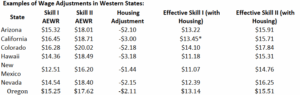
  • Two Skill Levels: DOL will now publish OEWS-based AEWRs at two levels. Skill Level I applies to entry level job qualifications with no to minimal experience requirements (e.g., up to two months’ prior experience), while Skill Level II applies when experience (e.g., at least 3 months prior experience) or special licenses are required. 
  • SOC Assignment by Majority of Workdays: Jobs will be classified based on duties performed for most of the contract period, reducing the risk that incidental duties (like occasional CDL driving) will trigger a higher wage. 
  • Five-SOC Combined Category: Most field and livestock jobs fall into a single statewide AEWR for each skill level. 
  • New Housing Adjustment: Employers may reduce H-2A worker wages by a state-specific housing adjustment when free housing is provided. U.S. workers must still be offered the full AWE. 

AEWR Wage Adjustments v3

What It Means for Growers: 

  • The AEWR paid to H-2A workers will be lower going forward. 
  • Job orders should be carefully drafted to align qualifications with the intended skill level. 
  • For job orders filed before the IFR, the AEWR that applied under the 2010 rule will remain in force. Employers will not be permitted to lower wages of earlier filed job orders.  
  • Employers must continue to pay the highest of the AEWR, state minimum, prevailing wage, or CBA rate. In California, the state minimum wage is higher than the AEWR. However, in Arizona, for example, the AEWR is higher than the state minimum wage.  

Western Growers President and CEO Dave Puglia praised the Administration’s announcement: 

“Western Growers members have long been struggling under unsustainable wage pressures that threaten the competitiveness of American agricultural production. This new wage rule is a meaningful step toward restoring the viability of American farmers and ranchers. By tying H-2A wages more closely to actual market data and recognizing the value of employer-provided housing, Department of Labor is helping restore much-needed balance to the program. Our members need predictability in labor costs, and this rule provides a framework that allows them to plan and continue supplying safe, healthy produce for American families. We appreciate the responsiveness of Secretary Chavez-DeRemer and Secretary Rollins in addressing one of agriculture’s most pressing challenges.” 

The rule is effective immediately, with a 60-day public comment period. Western Growers will provide additional guidance and resources to help members navigate this significant change.  For questions about the IFR and how it may impact your H-2A program, please contact the Western Growers H-2A Services Team. 

Farmers Take the Driver’s Seat at FIRA USA 2025: Hands-On Autonomous Ag Robotics 

October 2nd, 2025

Woodland, California – September 24, 2025 – FIRA USA 2025 puts farmers at the center of agtech innovation. From October 21–23 in Woodland, California, growers get free admission and access to the brand-new VIP Grower Tour, featuring tailored visits, one-on-one meetings with robotics manufacturers, and a curated agenda addressing real farm challenges — from automating harvests and precision weed control to data-driven decision-making. The event also showcases Grower Pitches, where farmers share their experiences with cutting-edge technologies, and includes networking breakfasts and hands-on demos. The highlight: John Deere’s Autonomous 5ML Orchard Tractor — first unveiled at CES 2025 — will make its exclusive debut at an agricultural event during FIRA USA.

A Vision Resolutely Focused on the Needs of Farmers

At the heart of FIRA USA 2025 is a clear mission: to accelerate the adoption of agricultural technologies in North America, ensuring they precisely meet the expectations of producers. 

Ag robotics is booming, but every farm is different,” says Gwendoline Legrand, co-director of FIRA USA. “That’s why FIRA now focuses on direct matchmaking between growers and tech providers, ensuring automation delivers real value in the field and drives business on the spot.”

Exclusive VIP Program Designed for Growers

This year, FIRA USA 2025 launches the VIP Grower Tour, a free and exclusive program designed to welcome farmers with tailored guided tours, one-on-one meetings with ag robotics manufacturers, and a curated agenda to bring the right solutions to their specific needs.

All VIP Growers are invited to the exclusive John Deere’s Autonomous 5ML Orchard Tractor demo on Wednesday, October 22 (8-9 am): first revealed at CES 2025, the autonomous tractor will be demoing for the first time at an ag event at FIRA USA.
They are also kindly invited to the exclusive VIP Breakfast, sponsored by the California Farm Bureau, on Thursday, October 23 (9-10 am), for peer-to-peer networking and open discussion with robotics experts. 

“If I’m a grower leaving this event today, I’m going home with a pocket full of business cards and a pocket full of ideas,” says Josh Roberts, VP Global Ag Development, Taylor Farms.

To secure your personalized VIP Growers Experience, please apply at this link, or contact [email protected].

Hands-On Field Demonstrations

A highlight of FIRA USA 2025 is the series of live field demos, where attendees can see ag robotics and automation technologies in real-world farm conditions. The official program is available online, allowing growers to plan their visit and select demos and sessions most relevant to their operations.

Producers Share Innovations and Challenges at FIRA USA

“I’ve attended FIRA the past 2 years and found an invaluable way to stay informed on the latest robotics and automation innovations for California agriculture”, Tim Nuss from Nuss Farm. “Seeing product demonstrations firsthand is a great way to envision real world applications on our farm. We’ve connected with several companies at FIRA as a result and currently evaluating how we adopt their technologies on the farm. The event is a good mix of tangible field ready tech as well as early stage developments. I highly recommend the event and am excited to attend again in 2025!”

Building on the momentum of 2024, which saw farmer participation increase by 53%, FIRA USA 2025 will give the floor directly to growers through a series of Growers Pitches. These sessions will highlight the cutting-edge tools already being implemented on farms and open discussions about ongoing technological needs.

Among the key topics:

  • Automating the Harvest: Cutting-Edge Technologies Revolutionizing America’s Farming (October 21)

  • Weed Management Showdown: Lasers, Precision Spraying, or Mechanical Solutions? (October 22)

  • From Vineyard to Value – Feedback on Farming Automation (October 22)

  • Data-Driven Farming: Transforming Grower Decision-Making (October 23)

Free registration for growers at FIRA USA: https://fira-usa.com/ 

About FIRA USA:

FIRA USA is the leading North American event dedicated to robotics and automation in agriculture. It brings together farmers, manufacturers, researchers, and investors to accelerate the adoption of innovative technologies in the face of modern agricultural challenges.

Press Contact:

Gwendoline Legrand [email protected] +33 688 87 17 11

Western Growers Gustavo Reyes Among the 2025 “40 Under 40” Leaders in Food Safety 

October 1st, 2025

We are proud to celebrate Gustavo Reyes, Senior Manager of Food Safety and Predictive Analytics at Western Growers, for being named to the 2025 “40 Under 40” by the Alliance to Stop Foodborne Illness. 

This recognition honors rising leaders under 40 who are making significant contributions to food safety. At Western Growers, Gustavo develops data programs through the GreenLink® platform, leads science-based updates to leafy greens safety standards and creates accessible resources that support proactive decision-making across the fresh produce industry. 

Congratulations, Gustavo, and thank you for advancing food safety with passion and impact. View the class of 2025 here. 

CDC Releases 2023 Summary of Multistate Enteric Disease Outbreaks 

October 1st, 2025

The CDC has released a summary of possible multistate outbreaks of enteric diseases for 2023, highlighting key trends in foodborne animal-related illnesses. 

The CDC and state and regulatory partners investigated 181 possible multistate outbreaks caused by Salmonella, STEC, Listeria and Campylobacter. Of these, 84 were confirmed as outbreaks, and investigators were able to solve 50, identifying confirmed sources for 28 and suspected sources for 22. Altogether, these outbreaks resulted in over 3,100 illnesses, nearly 950 hospitalizations, and 10 deaths. Among the solved outbreaks, 32 were linked to contaminated food, including fruits, vegetable row crops and chicken. While 18 were linked to animal contact, with backyard poultry causing the most illnesses. 

This report highlights the ongoing public health challenge of preventing foodborne illnesses and underscores the importance of continued surveillance, outbreak investigation and collaboration among partners. 

You can read the full CDC summary here. 

FDA Officials Visit Salinas Valley Farms

October 1st, 2025

Officials from the FDA Human Foods Program, including Deputy Commissioner, Kyle Diamantis, visited Salinas Valley farms on September 23rd.  Their visits included a carrot harvest hosted by Grimmway’s Russ Hamlin, a romaine harvest with the addition of the view of a new automated equipment at D’Arrigo Brothers ranch, and finally a strawberry harvest presented by Natruripe.

Following the field visits, the group met for lunch with growers, food safety personnel, CDFA representatives and others representing the local agricultural community at Monterey County Farm Bureau. Lunch-time discussions included industry-led food safety efforts related to adjacent land risk, next steps with data-sharing between the industry and the FDA, as well as plans for reviewing the results from the California Longitudinal Study which begins in December 2025.

The final stop of the tour was a visit to the Taylor Farms foodservice processing plant.  Many thanks to all the individuals from Grimmway, D’Arrigo, Naturipe, Markon and Taylor Farms as well as the local associations that supported the supported successful the visit.

Government Shutdown: What It Means for Fresh Produce

October 1st, 2025

With the federal government now shut down, several agencies vital to agriculture have scaled back operations. Essential services such as produce inspections, export certifications and outbreak response remain in place, but many programs – like organic oversight, pesticide residue testing, USDA data reports and H-2A labor certifications – are suspended. Members should expect delays in labor processing, reduced regulatory oversight and gaps in market intelligence until funding is restored. Western Growers will continue to monitor developments closely and keep members informed of any changes affecting your operations.

USDA

  • AMS (Marketing Services)
    • Operating: Specialty crop inspections & grading (fee-funded), Market News (as needed).
    • Paused: Organic Program oversight, Pesticide Data Program, labeling initiatives, most grant/marketing programs.
  • APHIS (Animal & Plant Health)
    • Operating: Port inspections, import/export certifications, phytosanitary certificates, emergency pest response.
    • Paused: Certain research reviews may be delayed, but most core operations continue.
  • Disaster Programs
    • Operating: USDA staff coordinating federal disaster response remain available.
    • Paused: Paperwork processing for the 2023-2024 ad hoc disaster program.
  • ERS/NASS (Research & Statistics)
    • Paused: Most market/economic data products and reports.
  • NIFA (National Institute of Food and Agriculture)
    • Paused: Estimated 4 percent of employees will be working.
  • NRCS (Natural Resources Conservation Service)
    • Paused: Paperwork and payments for conservation programs and projects.
  • REE (Research, Education, and Economics)
    • Paused: Citrus greening, crop production and food safety research.

FDA

  • Operating: Outbreak and recall response, import entry review, for-cause inspections, enforcement actions tied to immediate threats. Routine food facility and farm inspections are expected to continue.
  • Paused: Long-term food safety initiatives, policy development.

DOL

  • H-2A (Foreign Labor Certification)
    • Paused: Most H-2A-related activities, including foreign labor certifications and case processing. Expect delays and backlogs once funding is restored.
  • Wage & Hour Division
    • Operating: Emergencies, child labor or serious harm cases.
    • Paused: Most other enforcement.
  • OSHA
    • Operating: Imminent danger/fatality investigations, time-critical enforcement.
    • Paused: Routine inspections.

Homeland Security

  • Homeland Security
    • Operating: U.S. Customs and Immigration Services plays a role in H-2A processing. Most employees remain on the job, so operations will largely continue.

State Department

  • Operating: All foreign embassies remain open and consular interviews will continue.

Day-to-Day Impacts

  • Produce at Ports: Import inspections and export certifications continue; shipments should move, but expect bottlenecks if staff stretched.
  • Domestic Facilities: Fewer FDA inspections unless there’s an outbreak; reduced oversight in the short term.
  • Labor: H-2A certifications stall; risk of labor shortages if the lapse continues.
  • Market Data: AMS Market News continues; USDA reports (ERS/NASS) paused; less intel for planting/marketing decisions.
  • Organic/Residue Programs: Suspended; delays in certification/data release.

Operations Checklist for Members

  • Confirm AMS inspection services (fee-based programs remain available).
  • Line up export certifications early (APHIS still operating).
  • Prepare for potential H-2A delays; check status of pending certifications.
  • Communicate food safety readiness internally; FDA still active on outbreaks/recalls.
  • Adjust market intelligence expectations; some USDA data reports won’t be published.
  • Monitor OSHA/WHD guidance but expect fewer routine visits unless there’s imminent risk.

If members have any questions, please contact Cory Lunde, VP of External Affairs, at [email protected].

Exclusive FIRA USA 2025 Perks: Free for Growers, Discounts for WG Members

October 1st, 2025

The fourth annual FIRA USA event is scheduled for Oct. 21-23, 2025, in Woodland, Calif., and growers can attend for free.

Additionally those who are part of the WG network can use promo code WGAMEMBERS50 to receive a 50 percent discount.

FIRA USA is described as the greatest and only three-day event for autonomous farming and agricultural robotics solutions, where industry leaders in ag and innovators come together.

Attendees will experience groundbreaking innovations, live demonstrations and expert roundtables that are sure to shape the future of the industry.

FIRA’s exciting agenda and panel discussions include:

  • Automating the Harvest: Cutting-Edge Technologies Revolutionizing America’s Farming
  • Technical Talks #1 – Building the Tech Stack for Agricultural Autonomy
  • Farm to Fork: Greater Sacramento’s Agrifoodtech Innovation Ecosystem by Greater Sacramento Economic Council
  • Beyond GPS: The Role of Inertial Sensors in Unlocking True Agricultural Autonomy by XSens
  • Precision Meets Power: John Deere’s Smart Farming Revolution for High Value Crops, by John Deere
  • Technical Talks #2 – Building the Tech Stack for Agricultural Autonomy
  • Scaling Ag Robotics: Brutal Truths & Winning Strategies
  • And much more

This is an event you won’t want to miss! For the full agenda, click here.

Growers can register for all three days for free by clicking here.

Part of the WG network? Use promo code WGAMEMBERS50 to receive a 50 percent discount.