Applications Open for AZDA’s Ag, Soil Health and Water Efficiency Pilot Program

October 15th, 2025

The Arizona Department of Agriculture (AZDA) is now accepting applications for the Agriculture, Soil Health and Water Efficiency Innovation Pilot Program. The final application deadline is Tuesday, Nov. 25, 2025.

The program provides funding for agricultural landowners, beneficial owners of trust land, lessee of agricultural land or irrigation districts to implement and collect data for water-focused soil health innovations in agriculture.

AZDA anticipates that grant funds will be available to successful applicants by late 2025.

Applicants must submit their application packets on-line.

Two informational sessions will be held via Zoom: Tuesday, Oct. 28, 2025, and Friday, Oct. 31, 2025. Register for your preferred date here.

You can find more information about the pilot program here.

CDFA Seeks Public Comment for California’s Climate Resilience Strategy for Agriculture 

October 15th, 2025

Comment accepted through Friday, November 7, 2025.     

The California Department of Food and Agriculture (CDFA) has released its Climate Resilience Strategy for California Agriculture for public comment. The plan helps agricultural communities prepare for and adapt to a changing climate. 

“We are already feeling the effects of climate change and want to do all we can to build resilience in agriculture,” said CDFA Secretary Karen Ross. “This strategy reflects the many actions the state is already taking, and we look forward to hearing from farmers, ranchers, and the public about what more we need to support agriculture and healthy communities.”   

How to Participate: 

Read the full announcement from the CDFA here. 

The Predictive Power of YOUR Data 

October 14th, 2025

Data, Data, Data… 

Over the past decade, almost every conversation I’ve had as it relates to food safety seems to revolve around data. The promise is always the same: if we just collect enough of it, we’ll uncover the answers to all our problems. 

And honestly, data can solve many challenges. But it’s equally important to recognize what data cannot do, and even more critical, to understand what it can do when given the right context, quality, and purpose. Data on its own is just numbers, many times without context; it’s the meaning we attach to it that creates insight. 

That’s where predictive modeling enters the picture. Predictive models take what we already know, the history that is in our data, and use it to estimate what might come next. They transform information into foresight, turning static records into living systems of learning and anticipation. Figure 1 below shows the progression from data to hindsight, insight, and ultimately foresight reflects how predictive modeling transforms our understanding. We begin with raw data, individual observations that, once analyzed, offer hindsight about what has occurred. From these reflections emerge insights that reveal underlying patterns and relationships of what already exist. Predictive models then build on these insights to generate foresight, allowing us to anticipate future conditions and make more proactive, data-driven decisions rather than reactive ones. 
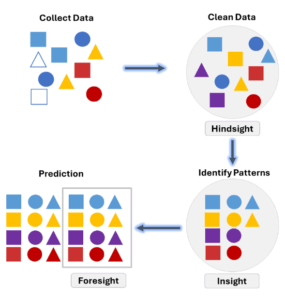
Figure 1 below shows the progression from data to hindsight, insight, and ultimately foresight reflects how predictive modeling transforms our understanding.

What Predictive Models Really Do 

Predictive models do exactly what their name implies: they use patterns in historical data to make predictions about new situations (foresight). 

Think back to the simple equation y = mx + b. That’s the foundation of a linear model. Here, m represents the effect of one variable, and b is your baseline, the starting point of your prediction. 

Imagine this in action: 

  • y = price of a house 
  • x = number of rooms 
  • m = how much price changes per extra room 
  • b = the price of a one-room home 

Even if you’ve never seen a seven-room house, you can still predict its price using that model. That’s the power of patterns in data. 

But wait…rooms aren’t the only thing that affects home prices. School districts, square footage, neighborhood, even the year built may matter more. If your model only knows about rooms, is it wrong? Not entirely. But could it be better? Absolutely. 

Predictive power depends on the story your data tells, and what pieces of that story are missing. 

The Data You Feed the Model Matters 

A predictive model can only work with what it’s given. Feed it limited or overly broad data, and it will give you limited answers. 

If you train a model with data from an entire city and then ask it to predict neighborhood-specific prices, it will fail, not because it’s bad, but because it doesn’t know what you’re asking. The same is true in produce safety. If your dataset only captures general weather patterns and not field-level differences, you can’t expect it to predict which specific field might face higher risk next week. 

The lesson: models reflect our interests and hypothesis. The better our questions and the more intentional our data collection, the more meaningful the insights. 

So, Start with a Hypothesis 

Before we start collecting data or building models, we need a why. 

  • What are we trying to solve? 
  • Where might contamination occurs within a field? 
  • What time of year is riskiest for a certain crop? 
  • Which environmental factors influence outcomes most? 

A clear hypothesis guides what data to collect or reveals what’s missing. If you don’t have the data yet, that’s not failure. It’s a signal to start collecting today so you can predict tomorrow. 

Once ready, make sense of the results 

Predictive models generate probabilities, not certainties. They measure outcomes with accurate metrics like sensitivity, specificity, or RMSE (Root Mean Squared Error). But beyond accuracy, they offer insight. 

  • Prescriptive Power: Predictions can guide action. If the model shows that risk is higher in early spring, you can adjust your sampling strategy accordingly. 
  • Diagnostic Power: By examining coefficients (the m in y = mx + b), you learn which variables have the most influence. That knowledge can refine future models or direct further research. 

Predictive models aren’t just black boxes, they’re learning tools. Each iteration teaches us something about the system we’re studying, we ask more questions and keep learning and improving them. 

Can Models Be Trusted? 

That’s a fair question. Trust in predictive models comes from validation and transparency. Validation: We test the model with new data, data it hasn’t been seen before, and compare predictions against real outcomes. Performance: The goal isn’t perfect; it’s reliability. Weather forecasts, Zillow home estimates, and even your car’s GPS predictions are never exact, but they’re useful enough to guide decisions. 

In produce safety, it’s the same. A model may not predict every event, but it can help you know when and with enough granular information where to pay closer attention. Models are wrong most of the time in the literal sense, but incredibly useful in practice. They don’t replace human judgment; they amplify it. So yes, when performed correctly, and used in the right context, models can be trusted as a tool to amplify our knowledge and understanding.  

Where do we go as an industry. We need data with purpose.  

If we want to make predictive models truly work for us, especially in fields like producing safety, here’s the roadmap: 

  • We need to be intentional in data collection. Collect with purpose, not convenience or compliance.  
  • Start with a clear hypothesis. Knowing the question before chasing the answer, most likely is that to answer your questions, new data must be collected. 
  • Recognize imperfection. Models won’t be perfect, but they can be consistently helpful, and they will improve with more high-quality data.  
  • Trust the models and amplify your knowledge: The goal isn’t about replacing our judgment with algorithms, but about empowering smarter, faster, more informed decisions. 

So, we keep building larger, more diverse datasets.
We test what the models tell us, learn from those insights, and refine our approach.
We let data challenge our assumptions.  The real power of predictive modeling isn’t in prediction itself; it’s in how it changes the way we think. It pushes us to move from reactive to proactive, from guessing to reasoning, from data collection to data understanding. The models give us direction.  

Register for the WGU Having Tough Conversations Webinars

October 14th, 2025

HRCI credit is available. 

Are you struggling to give direct feedback and helpful corrections? This interactive session will provide you with tools to structure difficult conversations in ways that are both respectful and productive. You’ll learn seven proven tips to navigate tough discussions that build more authentic, meaningful working relationships while driving stronger performance across your team. 

Join Priscila Cisneros, as she explores how to prepare for and guide challenging discussions with clarity, delivers feedback that motivates change and addresses sensitive issues in ways that build trust rather than tension. 

Participants will discover how to overcome common communication barriers, stay calm and solutions-oriented and turn even the toughest conversations into opportunities for growth. By the end of the session, you’ll walk away with the confidence and practical strategies you need to foster open dialogue and improve performance across your team. 


English Webinar 

Tuesday, October 28, 2025 

9 a.m. – 10:30 a.m. PDT 

Register here 


Spanish Webinar 

Wednesday, October 29, 2025 

8:30 a.m. – 10:00 a.m. PDT   

Register here 


This program has been pre-approved for 1.5  HR (General) recertification credit hours) toward aPHR®, aPHRi™, PHR®, PHRca®, SPHR®, GPHR®, PHRi™ and SPHRi™ recertification through HR Certification Institute® (HRCI®). 

New Date: Register for Automation Lunch and Learn Virtual Event (Western Growers Members Only)

October 14th, 2025

The date for the Automation Lunch and Learn Virtual Event has changed to Tuesday, December 2 from 1 p.m. to 2 p.m. PST. The registration link remains the same.

Western Growers members are invited to attend a presentation hosted by the team at Plug and Play on Tuesday, Dec. 2, 2025.

This session will delve into why automation matters now (labor, costs, ROI). Presenters will give a full overview of the harvest automation landscape, paired with a reality check on timelines (5–10 years to fully integrated harvest) and actionable wins available today. They will also highlight near‑term “harvest‑plus” opportunities with practical ROI, including harvest assist/logistics (e.g., Burro‑class), better planning and scheduling via improved yield prediction, post‑harvest coordination to cut idle time and misses and crop/field system design that enables automation (e.g., high‑rise brassicas and trellising/training analogs).

The last 20 minutes of the presentation will be blocked off for a Q&A session.

This virtual event will kick off a recurring series, where member input will steer future topics.

Event Details:

When: Tuesday, Dec. 2, 2025, 1 p.m. – 2 p.m. PST

Where: Online. Register here.

Note: If you try to register while using a VPN, the link will not work. Please make sure any VPN is turned off while registering.

If you experience any registration-related issues, or have any questions, please contact Anne Gunden at [email protected].

New Research Article Reviews Cadmium Mitigation Strategies in Spinach and Carrots 

October 14th, 2025

A new article published in HortScience, “Factors Affecting Cadmium Accumulation and Mitigation: A Literature Review to Inform Spinach and Carrot Producers,” explores how cadmium (Cd), a nonessential element with potential adverse health consequences, can potentially enter the human food system predominantly through plant uptake from soils and the available agronomic practices used to reduce dietary exposure.   

The publication builds on insights shared during a 2023 pilot workshop hosted by Western Growers, the Food and Drug Administration (FDA) and the US Department of Agriculture (USDA), which brought together growers, researchers and regulators to address Cd in spinach and carrots grown in California and Arizona.  

The review highlights key considerations for these two crops and outlines available agronomic mitigation strategies to help growers evaluate their individual soils, crops and production conditions. The work supports the FDA’s Closer to Zero initiative, which aims to minimize dietary exposure to heavy metals in foods consumed by infants and young children. 

The article was co-authored by De Ann Davis, PhD, SVP of Science at Western Growers, reflecting the organization’s ongoing commitment to advancing science-based understanding of food safety challenges and helping the industry apply new learning in the field. 

Read the full article here 

Caribbean Fruit Fly Quarantine Issued in Part Of Los Angeles County

October 13th, 2025

A portion of Los Angeles County, Calif. has been placed under quarantine for the Caribbean fruit fly (CFF) following the detection of two adult CFFs in and around the City of Montebello.

The quarantine area measures 75 square miles, bordered on the north by the city of Alhambra; on the south by the city of Downey; on the west by the city of Huntington Park; and on the east by the city of South El Monte. A link to the quarantine map can be found here.

The Caribbean fruit fly is a serious threat to the state’s agriculture and natural resources, with a very wide host range, including avocados, figs, citrus, peaches, pears and tomatoes.

To prevent the spread of this fruit fly through homegrown fruits and vegetables, residents living in the CFF quarantine area are urged to not move fruits and vegetables from their respective properties.  Fruits and vegetables may be consumed or processed (i.e. juiced, frozen, cooked or ground in the garbage disposal) at the property where they were picked.   If they are not consumed or processed, please dispose of them by double-bagging in plastic bags and putting the bags in the garbage bin for collection.

The most common pathway for these invasive species to enter our state is by “hitchhiking” in fruits and vegetables brought back illegally by travelers as they return from infested regions around the world, or in packages of home grown produce sent to California from other states or countries.

To help prevent infestations, officials ask that residents do not transport or mail fresh fruit, vegetables, plants or soil into California unless agricultural inspectors have cleared the shipment beforehand, as fruit flies and other invasive species can hide in a variety of produce.

You can find more information here.

Government Shutdown: E-Verify Is Back Online 

October 9th, 2025

After being off-line due to the ongoing government shutdown, the Department of Labor’s E-Verify system is once again active. The system was shuttered as of October 1, 2025, due to a lapse in government funding, and reactivated October 7, 2025. Employers are encouraged to begin processing backlogged cases as soon as practicable.  

As with previous shutdowns, employers will not be penalized due to system unavailability. However, it is important to remember:  

  • Without exception, employers are required to comply with Form I-9 obligations. 
  • Form I-9’s should be internally processed in compliance with the law when online systems are unavailable; and  
  • No adverse action should be taken against an employee whose employment eligibility verification cannot be confirmed in E-Verify due to a shutdown.   

To help lower the risk of compliance issues associated with delayed processing of E-Verify cases, employers are encouraged to: 

  • Track all new hires with completed I-9s where there are no E-Verify queries due to the shutdown.  
  • Create a memorandum to attach to a master E-Verify file tracking system to account for the days that the system was unavailable.  

For more information on E-Verify, visit the United States Citizenship and Immigration Services E-Verify webpage.   

Employers Prepare: California Tightens Data Breach Notification Rules with SB 446 

October 9th, 2025

California employers are facing a significant update to their data privacy responsibilities. SB 446, recently signed into law and effective January 1, 2026, overhauls the state’s data breach notification requirements — imposing strict new deadlines, clearer standards, and added accountability for businesses that handle personal information. 

Historically, California’s data breach laws required companies to notify affected individuals in “the most expedient time possible and without unreasonable delay.” That vague standard led to delays in notification — sometimes lasting months or years — potentially leaving consumers vulnerable to identity theft and other harms. 

SB 446 changes this landscape. Under the new legislation, businesses and organizations that “own or license computerized data” containing personal information must notify affected California residents within 30 calendar days of discovering or being notified of a breach. Should a breach affect more than 500 California residents, the company must also submit a sample copy of the notification to the state Attorney General within 15 days of notifying those affected. 

The law includes two important exceptions: 

  • Notification may be delayed if required for law enforcement purposes. 
  • It may also be delayed to determine the full scope of the breach or restore system integrity. 

Additionally, SB 446 codifies a model breach notice format with clear headings — “What Happened,” “What Information Was Involved,” “What We Are Doing,” and “What You Can Do” — setting a compliance standard for both written and electronic notices. 

What Does it Mean 

This legislation significantly elevates the obligations of California employers on three fronts: 

  • Acceleration of response time: Businesses must now act quickly when they suspect a breach. The 30-day clock starts ticking as soon as the breach is discovered — not later. Delays due to “reasonable investigation time” will require firms to prove that they were needed to determine the breach’s scope or to comply with law enforcement. 
  • Stricter oversight and reporting: By mandating disclosure to the Attorney General for large-scale breaches, the law increases transparency and potential regulatory oversight. 
  • Standardized disclosure format: Employers must comply with the prescribed plain-language structure for breach notices. Failure to use consistent headings or adequately describe the breach may constitute a compliance risk. 

It is also important to note that a failure to provide the required notice within the 30 calendar-day period could be used as “per se” evidence of a violation of the law. Further, under California law, businesses regulated by the California Consumer Privacy Act (CCPA) could face both regulatory fines and a private right of action for data breaches resulting from a business’s failure to implement reasonable security measures. 

Employers should treat the revised statute as an opportunity to upgrade their privacy and data security protocols. The following best practices can aid compliance: 

  • Maintain a ready-to-implement breach response plan. Develop and regularly test a breach response that triggers investigation, communications, and notifications quickly. The plan should include legally vetted notice templates aligned with SB 446 requirements. 
  • Establish robust monitoring and detection systems. Because 30 days is such a short response period, early detection is critical. Consider initiating intrusion detection tools, conducting regular audits, and implementing strong logging and alert systems to shorten discovery times. 
  • Mandate Training on data privacy obligations. Employees should understand how breaches occur (and how best to prevent them), their reporting obligations, and the importance of swift escalation. 
  • Update Third-Party Vendor Agreements.  To assist in meeting notification response deadlines, be sure to review all third-party vendor agreements to ensure they impose an obligation on the vendor to provide you with immediate notification in the event of a breach.  

SB 446 makes clear that California considers timely data breach notification a cornerstone of consumer protection. For employers, it raises the stakes by replacing vague timing standards with specific deadlines and penalties for noncompliance. As cybersecurity evolves, compliance will require more than just legal wordsmithing — it will require proactive planning, rapid response, and clear communication with affected individuals and state regulators alike. 

WG Submits Comments on SB 54 Final Draft Regulations

October 8th, 2025

On Oct. 7, 2025, Western Growers submitted comments on CalRecycle’s latest SB 54 “Plastic Pollution Prevention and Packaging Producer Responsibility Act” Final Draft Regulations.

You can find the comment letter here. In addition to submitting our own comments, WG signed on to two coalition letters: CA Chamber of Commerce and Agricultural Council of California. These three letters combined cover the full scope of our concerns with the Draft Regulations and our support for the beneficial changes included.

What Comes Next:

  • CalRecycle will work toward publishing their Final SB54 Regulations by the end of this year. There is a possibility that CalRecycle will open another 15-day public comment period following their review of this round of public comments.

Stay tuned for updates.

New California Law Clarifies Immunity for Bias Mitigation Training

October 9th, 2025

Signed into law on October 1, 2025, California’s SB 303, a new bill strengthening an employers’ ability to provide bias mitigation training, went into effect immediately by adding Section 12940.2 to the California Fair Employment and Housing Act (FEHA). SB 303’s key purpose is to make clear that an employee’s good-faith participation in bias mitigation training — including self-assessment, testing, or acknowledgment of implicit biases — cannot, by itself, be considered unlawful discrimination. 

What Does it Mean 

SB 303 encourages California employers to conduct bias mitigation training, including components such as self-reflection exercises, workshops, and facilitated discussions, without fear of legal retaliation or discrimination claims arising solely from those activities.  

SB 303 explicitly states that such participation won’t constitute unlawful discrimination as long as it’s conducted in good faith and is intended as part of comprehensive bias mitigation training. The legislature’s intent is twofold: to encourage employers to adopt bias-mitigation education and to remove legal obstacles to doing so. 

To ensure effective implementation of a bias mitigation training program, consider the following best practices: 

  • Foster a psychologically safe environment. Before beginning any bias awareness training — particularly activities that involve self-assessment or discussions of personal beliefs — communicate clearly that the purpose is to learn and grow, not to shame or blame. Ensure facilitators are well trained and emphasize that honest participation is voluntary. 
  • Integrate training with broader equity initiatives. Bias mitigation efforts work best when embedded in a broader strategy that includes reviewing recruiting practices, promotion policies, performance evaluations, and compensation structures. This demonstrates organizational commitment and connects training to concrete outcomes. 
  • Provide ongoing education — not a one-time session. A single workshop is unlikely to shift implicit biases meaningfully. Instead, consider offering continuous learning opportunities, such as follow-up sessions, self-guided anti-bias modules, peer-learning groups, or coaching. These types of reinforcement activities can help employees apply learning to real workplace interactions. 
  • Monitor, assess, and refine. Collect feedback after training sessions through anonymous surveys or focus groups, and track metrics related to representation, turnover, and complaints. Use this data to adjust your program and demonstrate impact to leadership — a crucial step for gaining buy-in over the long term. 

Citrus Virus Quarantine Boundaries Established for Los Angeles and Tulare County Regions in October 2025

October 7th, 2025

Citrus yellow vein clearing virus (CYVCV) is an emerging disease of citrus that can cause serious damage to most citrus species and can dramatically diminish fruit marketability.

  • CYVCV is transmitted by aphids including Aphis spiraecola Patch, Aphis craccivora Koch, and a whitefly Dialeurodes citri. All three of these insects are present and widespread in California. The most prominent mechanism for long-distance spread of CYVCV is caused by grafting infected budwood.
  • Symptoms are variable depending on environmental and inherent conditions: leaves of young lemon and sour orange trees display a water-soaked appearance and yellow, clear veins on their front side, and wrinkled and warped leaves.
  • Quarantine Map 

Boundaries are in the Hacienda Heights area of Los Angeles County and the Tulare and Visalia areas of Tulare County.

Sign up for citrus quarantine updates here.


Traceability Regulation: A Global Impact Beyond U.S. Borders

October 7th, 2025

When it comes to food safety regulations, what happens in the United States does not stay in the United States. Companies that want to sell into the U.S. market must comply with U.S. regulations—regardless of where they operate. That is why the FDA’s Food Traceability Rule under FSMA 204 has global significance.

Why This Matters for International Operations

Traceability requirements will not be limited to U.S. farms, packers, or distributors. International suppliers that ship to the U.S. will also need to meet the same recordkeeping and reporting requirements. In other words, advancing awareness and readiness is critical not only for domestic businesses but also for international operations that may not yet realize they are within scope.

How This Impacts Fresh Produce Entities

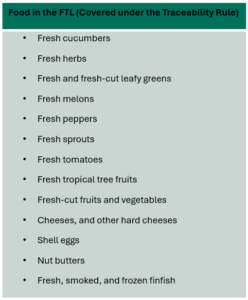
The FDA’s Food Traceability List (Table 1) includes many produce items subject to the FDA’s Traceability Regulation.

Food in the FTL (Covered under the Traceability Rule)

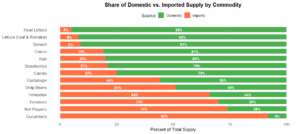
Given that produce markets are more global, imports of key produce commodities have increased in the U.S. For example, cucumbers—one of the commodities on the list—are imported at rates as high as 92 percent. See the graph below regarding the percentage of total supply imports for several key commodities. This diversity of sourcing underscores the need for global compliance.


Source: Based on data from USDA ERS summary tables for vegetables and fruits. Data from 2023 was used when 2024 data was not available.


Preparing Through Training and Resources

The good news is that resources are becoming available. FSMA 204 Training is nearing launch, with industry training sessions anticipated in the coming months.  We continue to monitor updates on the official launch. In the meantime, industry stakeholders are encouraged to stay engaged and start evaluating their traceability systems against the new expectations. See the story on Global Compliance, click here. See efforts supported by the Partnership for Food Traceability (PFT).

The Takeaway

Traceability regulation is not just for domestic operations. If you look at the Food Traceability List, you’ll quickly see that compliance extends across borders and supply chains.

Biologicals Breakout Session at CAPCA: Advancing Adoption and Case Studies

October 7th, 2025

Western Growers is hosting a breakout session at the upcoming CPACA conference in Grand Sierra Resort, 2500 E 2nd St, Reno, NV 89595. This session will explore the growing role of biological products in sustainable agriculture and highlight case studies for novel biopesticide products.

Biological products, especially biopesticides, are gaining traction among California growers—with over 60% using them across 10+ million acres of specialty crops in 2023. This session will explore how these tools can help close existing pest management gaps, focusing on their efficacy, unique modes of action and value proposition for growers. The WG Innovation team will share progress on Platform10, a global, multi-year initiative designed to identify, test and accelerate innovative biopesticide companies.

Technical and Case Study topics include:

  • Biopesticide Focus Introduction and Product Profiles by Dr. Mohammad Aghaee from the CA Strawberry Center
  • Case Study Review of RNAi for various crops
  • Case Study Review of DMB virus for brassica crops
  • Case Study Review of Biofungicides for seedling and root diseases

Online registration for the CAPCA conference is closed, however day passes or full registration can be purchased on site. See full program and hotel information here.

Pesticide MRL Quick Reference Sheets for 60 Specialty Crop Commodities are Now Available

October 7th, 2025

Pesticide MRL Quick Reference Sheets for 60 specialty crop commodities are now available and are provided by USDA/FAS through Assisting Specialty Crop Exports (ASCE). Access these Quick Reference Sheets online on the MRL Quick Reference Sheets website, which cover the top export markets for each commodity and will be updated twice annually.

Additionally, the USDA/FAS-funded Starter Plan access to the Regulatory Limits MRL database has been expanded to now cover specialty crop MRLs in 50 top countries/markets, as well as veterinary drugs in 36 markets, through the end of 2027. Anyone based in the United States (including individual growers/shippers, companies, associations, registrants, researchers, etc.) can take advantage of this USDA-provided subscription to see current MRLs by creating an account here:  https://go.foodchainid.com/BC-Starter.

Please contact [email protected] with questions.

CAP University Offers Free Virtual Learning Session to Explore Challenges Facing Colorado River

October 2nd, 2025

Policy, science and water management enthusiasts are set to gather for “CAP University: Deeper Dive on the Status of the Colorado River,” a free virtual event aiming to shed light on the critical issues confronting one of the Southwest’s most essential water sources.

This session will provide information and updates on the status of the post-2026 negotiations, Colorado River conditions, Arizona’s conservation efforts, the Central Arizona Project’s (CAP) supply outlook and more. CAP University’s Deeper Dive courses build upon the foundation that is set in our CAP 101 course.

What to Expect:

  • Presentations from Water Experts and Scholars
  • Panel Discussion & Q&A
  • Policy Implications and Actionable Strategies
  • Networking and Stakeholder Engagement

Details

Date: October 30, 2025

Time: 9 a.m. – 10 a.m. PST

Location: Online

Cost: Free

To register or for more details, click here.

Western Growers Association Joins U.S. Food Waste Pact

October 7th, 2025

The Grower Association Becomes the First Signatory Representing the Agricultural Sector

[Chicago, IL, October 7, 2025] — Western Growers Association, the trade association representing farmers in the West and Southwest regions of the United States, has joined the U.S. Food Waste Pact (Pact), a joint initiative led by nonprofits ReFED and World Wildlife Fund (WWF) to reduce food waste throughout the supply chain. Western Growers becomes the first Pact signatory to represent growers and farmers, with the association joining 24 other food businesses and organizations participating in the collaborative food waste reduction effort.

According to ReFED, 31% of the food supply goes unsold or uneaten in the United States each year, and the majority of that surplus food is sent to waste destinations like landfills, incinerators, and sewer systems. Wasted food generates 10% of the United States’ methane emissions, and it accounts for 16% of freshwater use and 16% of land use. Over 17 million tons of food loss is reported annually, just in the agricultural production phase, which requires water, land, and energy to grow, process, and transport fresh produce crops. This surplus equates to nearly 30 billion meals per year, valued at over $13 billion.

“We’re proud to sign onto the U.S. Food Waste Pact,” said Jeana Cadby, Environment and Climate Director at Western Growers Association. “Food waste touches so much of what the farmers in Western Growers care about—from efficient and sustainable resource use to developing new markets for otherwise unmarketable produce. Collaborating with Pact signatories in other sectors will help maximize our impact and bolster our sustainability work, and we are eager to bring that growers’ perspective to the table.”

Through initiatives like the Global Farm Loss Tool, the Sustainable Produce Packaging Alignment (SPPA), and WG food safety programs, Western Growers is committed to supporting growers to increase profitability, reduce environmental impact, and ensure more fresh produce reaches consumers rather than going to waste. Joining the Pact amplifies the work of its members and the fresh produce industry to build a healthy, sustainable, and profitable future.

“We’re so pleased to welcome Western Growers into the Pact,” said Jackie Suggitt, vice president of business initiatives & community engagement at ReFED. “We’ve had the pleasure of working with them already on one of our whole chain projects, and it’s great to officially have them in the Pact. We look forward to the supply chain perspective they bring as an organization that works with growers.”

Western Growers Association is the twenty-fifth business to join the U.S. Food Waste Pact, which uses the “Target, Measure, Act” framework to make meaningful progress on food waste reduction. Other current signatories are retailers Ahold Delhaize USA, Albertsons Companies, ALDI US, Amazon Fresh, Kroger, Raley’s, Sprouts Farmers Market, Walmart Inc., and Whole Foods Market; manufacturers Bob’s Red Mill, Del Monte Fresh Produce Company, and Lamb Weston, Inc.; coalition signatories FMI—The Food Industry Association, Health Care Without Harm, and the R&DE Stanford Food Institute; foodservice signatories Aramark, Compass Group USA, ISS Guckenheimer, and Sodexo USA; quick-service restaurants Chick-fil-A, Starbucks, and Wawa; hospitality signatory Hilton; and distributor Organically Grown Company.

###

About the U.S. Food Waste Pact

The U.S. Food Waste Pact is a national voluntary agreement that uses the “Target, Measure, Act” framework to reduce food waste across the supply chain. The Pact works with waste-generating food businesses to collect and analyze data about food waste in their operations, share best practices through precompetitive working groups, and pilot and scale solutions through intervention projects. The Pact is an initiative between nonprofits ReFED and the World Wildlife Fund. For more information about the U.S. Food Waste Pact, visit http://usfoodwastepact.org/.

About Western Growers Association

Founded in 1926, Western Growers represents local and regional family farmers growing fresh produce in Arizona, California, Colorado and New Mexico. Our members and their workers provide over half the nation’s fresh fruits, vegetables and tree nuts, including nearly half of America’s fresh organic produce.

Media Contacts:

Nia D’Emilio, ReFED

[email protected]

Susan McCarthy, WWF

[email protected]

Western Growers University: Having Tough Conversations Webinar – English and Spanish Sessions

October 6th, 2025

Are you struggling to give direct feedback and helpful corrections? This interactive session will provide you with tools to structure difficult conversations in ways that are both respectful and productive. You’ll learn seven proven tips to navigate tough discussions that build more authentic, meaningful working relationships while driving stronger performance across your team.

Why Attend?

  • Gain confidence in handling difficult conversations.
  • Learn practical strategies for giving direct, constructive feedback.
  • Build stronger, more trusting relationships with employees.
  • Improve workplace performance through better communication.

Event Details:

This program has been pre-approved for 1.5 HR (General) recertification credit hours toward aPHR®, aPHRi™, PHR®, PHRca®, SPHR®, GPHR®, PHRi™ and SPHRi™ recertification through HR Certification Institute® (HRCI®).

For questions about this or any course, contact Priscila Cisneros at [email protected]

Ag Leaders Urge Emergency Aid for Specialty Crops

October 6th, 2025

WASHINGTON, D.C. (Oct. 6, 2025) – The co-chairs of the Specialty Crop Farm Bill Alliance (SCFBA) today urged President Trump to ensure specialty crops be included in any emergency economic aid initiatives for the agricultural sector.

Fruit, vegetable, tree nut, and landscape plant growers across the country are facing an immediate and mounting economic crisis. The group’s letter to the President highlighted the need for targeted assistance and cited the successful implementation of economic relief measures during his first administration as a possible framework for future support.

In the letter, the group writes:

“During this challenging time of crisis for farmers in rural America, we are optimistic that Congress and your Administration will provide necessary relief to producers, including those who grow specialty crops.”

“Although our growers are experiencing similar economic challenges to those confronting row crops, American specialty crops are different. During your first Administration, you created a program that addressed those differences and made economic relief from USDA finally workable for the family farms that produce our nation’s specialty crops…”

“…To ensure that we continue to have a safe and abundant supply of the fruits, vegetables, tree nuts, and landscape plants grown here in the United States, we ask that you provide emergency economic assistance uniquely tailored to the needs of specialty crop growers at the earliest opportunity.”

The full letter is available here.

The SCFBA is co-chaired by Cathy Burns, CEO of the International Fresh Produce AssociationMike Joyner, President of the Florida Fruit & Vegetable Association; Dave Puglia, President and CEO of Western Growers; and Kam Quarles, CEO of the National Potato Council.

# SCFBA #

The Specialty Crop Farm Bill Alliance is a national coalition of more than 150 organizations representing growers of fruits, vegetables, dried fruit, tree nuts, nursery plants and other products. The Alliance was established to enhance the competitiveness of specialty crop agriculture and improve the health of Americans by broadening the scope of U.S. agricultural public policy. For more information, visit farmbillalliance.com

MEDIA CONTACTS:

Christina Morton, Florida Fruit & Vegetable Association, [email protected]

Sarah Gonzalez, International Fresh Produce Association, [email protected]

Mark Szymanski, National Potato Council, [email protected]

Ann Donahue, Western Growers, [email protected]

Registration Open for the Organic Grower Summit on Dec. 3-4

October 6th, 2025

Registration is now open for the 2025 Organic Grower Summit, taking place Dec. 3-4, 2025, at the Hyatt Regency Hotel in Monterey, Calif.

Co-hosted by Western Growers and Farm Progress, the Organic Grower Summit brings together producers and suppliers to explore the latest advancements and trends in organic farming. This annual event provides a valuable opportunity for industry experts to exchange insights, share best practices and discuss success stories in sustainable agriculture.

The two-day summit will feature agtech presentations, a supplier showcase, a tradeshow and more. Attendees will also hear from speakers representing organizations, such as D’Arrigo California, JV Smith, Driscoll’s, Taylor Farms and more.

Tickets: Western Growers members have an opportunity to secure their tickets at a discounted rate of $199. Just register as a Grower, select the Grower Pass and then use the WGA discount code: WGAMEMBER25.

This is an event you won’t want to miss. Secure your spot today by visiting: https://ogs.swoogo.com/OGS25/register?code=WGAMEMBER25.