Wage & Hour Tips for the Holiday Season

December 5th, 2025

With the holiday season upon us it is important to understand wage and hour obligations associated with holiday pay and the impact of holiday closures.  

California law makes no special provision for holiday pay; holidays, like Saturdays and Sundays, are treated like any other workday. As always, the focus in California is on making sure employees are paid for all hours worked – including overtime – irrespective of the “day” the work is performed. There is no statutory provision mandating an employer provide holiday pay to an employee when a holiday happens to fall on a regularly scheduled workday. However, there is also nothing that prevents an employer from offering holiday pay as a benefit or though the collective bargaining process.  

The same applies in other of our member states (Arizona, Colorado, and New Mexico) where the focus is also on assuring payment of wages for all hours worked and the correct calculation of overtime.

It is also important to note that holidays can impact the timely payment of wages. Under California law, if the holiday falls on the company’s regularly scheduled payday, employers may shift the payment of wages to the next business day after the holiday. The California Secretary of State’s website provides a listing of state holidays. Bank holidays can vary from state to state. Employers outside of California should check which Bank holidays may impact the payment of wages in their states. 

Court of Appeal Dismisses Wonderful’s Challenge to Card Check Law as Premature

December 5th, 2025

The California Fifth District Court of Appeal (Fresno) has ruled that Wonderful Nurseries, LLC cannot challenge the certification of the United Farm Workers (UFW) as the bargaining representative of its employees in court before exhausting administrative channels. The court held that the Kern County Superior Court lacked jurisdiction to interfere in ongoing proceedings before the Agricultural Labor Relations Board (ALRB) concerning a Majority Support Petition (MSP or “card check”) filed under Labor Code section 1156.37. 

The UFW filed an MSP in early 2024, claiming majority support among Wonderful’s workers. After reviewing evidence, the ALRB certified the UFW as the exclusive bargaining representative. Wonderful objected, alleging misconduct and constitutional violations, and attempted to halt the process through a trial court injunction. 

Under California’s Agricultural Labor Relations Act, employers may not challenge union certification directly in court unless the challenge arises as part of an unfair labor practice proceeding. The appellate court reiterated that trial courts may only intervene in “extraordinary” circumstances, such as when the ALRB plainly exceeds its statutory authority and no other judicial review is available. Finding none of these exceptions met, the court ordered the case remanded to the trial court with directions to dismiss Wonderful’s case. 

Wonderful Company General Counsel Craig Cooper told Cal Matters “the decision explicitly does not address the merits of Wonderful Nurseries’ constitutional challenge.” 

Currently, the company is waiting for the ALRB’s final ruling on the election certification case before considering any additional judicial review in the Court of Appeal. Additionally, consolidated cases filed by Wonderful Nurseries, and Western Growers and Olive Hill Greenhouses, contesting California’s binding mediation law are ongoing in the Fifth District Court of Appeal. 

Western Growers Testifies on Key Priorities for USMCA

December 3rd, 2025

As the U.S. begins its review of the U.S.-Mexico-Canada Agreement (USMCA), Western Growers is adding its voice to the discussion. During a public hearing this week, Western Growers’ Dennis Nuxoll, VP of Federal Affairs, delivered testimony outlining the priorities of the fresh produce industry and the critical role USMCA plays in supporting American growers.

You can read Nuxoll’s testimony here.

Read Western Growers’ full comments here.

Nuxoll was joined at the hearing by Western Growers Board Member and Driscoll’s CEO Soren Bjorn, whose remarks can be found here.

Data 101: Understanding Statistical Significance

December 3rd, 2025

It has been a while since the last Data 101 episode; things have been busy! 

For this new post, I want to break down one of the most common (and commonly misunderstood) concepts in data analysis: 

  • statistical significance, 
  •  p-values,  
  •  And the basic idea behind hypothesis testing 

What is Statistical Significance? 

Statistical significance is a way to determine whether the patterns we observe in data are likely to be real or could have happened by random chance. If something is significant, we are likely to observe that same pattern as we collect more data or conduct additional trials. 

What is Statistical Significance

Hypothesis Testing 

Now that we know what statistical significance means, the next question is: significant compared to what? 

To decide whether an observed difference is meaningful, we compare it against a scenario where nothing is happening or expected to be different. 

We do this by defining two hypotheses, one that assumes nothing is happening, and one that represents that there is a change. We call these null hypotheses and alternative hypotheses.  

  • Null Hypothesis (H₀): The assumption that there is no difference, change, or effect. 
  • Alternative Hypothesis (H₁): There is a difference, change or effect that might be true. 

Example: Comparing Water Quality Between Two Months
Suppose you want to evaluate whether Generic E. coli levels in your canal water are on average different in July compared to August. 

  • H₀: The average Generic E. coli levels in July and August are the same. 
  • H₁: The average Generic E. coli levels in July and August are different. 

Most significance tests: t-tests, ANOVA, non-parametric tests, etc., follow this exact logic. The specifics change depending on the test, but the basic structure remains the same. Sometimes you test for any difference (a two-sided test), and sometimes you test for a difference in a specific direction one is greater or lower than the other, (one-sided test), but the basic structure remains the same. 

What is p-value? 

Once you define your hypotheses, you need to determine whether the data support the null or the alternative. The p-value helps answer this.  

Think of p-value this way: 

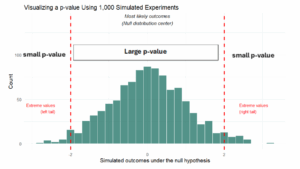
When thinking about p-values, imagine running an experiment 1,000 times (where you pick numbers close to 0, but can go up to -3 or 3). Most outcomes would fall within a common, expected range, but occasionally you’d see more extreme results purely due to chance. If your observed result falls in the range of outcomes that occur frequently when nothing is happening, the p-value will be large. If your result lands in the extreme tail, something that only happens in a small percentage of those 1,000 repetitions, the p-value will be small. 

The plot below illustrates this idea. Each green bar represents how frequently different outcomes occurred across 1,000 simulated experiments where the null hypothesis is true. Notice how: 

  • Most of the simulated outcomes cluster around the center (near 0), this region represents the “most likely outcomes”, the kinds of results we would expect to see repeatedly if nothing meaningful is happening. 
  • The two red dashed lines represent the extremes:  Anything beyond these cutoffs falls into the “extreme tails.” These are the values that occur rarely when the null hypothesis is true (everything is the same). 
  • The tails represent the p-value area: The p-value is simply the proportion of all simulated outcomes that fell as far out into the tails as our observed result 

If only a small fraction of outcome land in these extreme regions, then our observed value is considered unlikely under the null hypothesis, this is what we call a statistically significant result. 

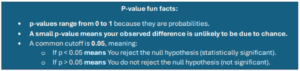
p-value fun facts

Applying This to our Water-Quality Example 

Again: Imagine you are evaluating a well or surface water source and want to know whether generic E. coli levels in August are different than in July. If they are different, you will evaluate and apply management practices accordingly 

Your hypotheses would look like: 

  • H₀: The average Generic E. coli levels in July and August are the same. 
  • H₁: The average Generic E. coli levels in June and August are different. 

After running the test, you would interpret the p-value: 

  • If p < 0.05, you would typically say the difference is statistically significant and reject the null hypothesis. 
  • If p ≥ 0.05, you fail to reject the null hypothesis, meaning the evidence is not strong enough to conclude a difference exists. 

Failing to reject the null does NOT mean the levels are the same, it only means your data did not provide strong enough evidence of a difference. 

Revised Ag Expert Panel Sessions for Statewide Irrigated Lands Regulatory Program

December 1st, 2025

The State Water Resources Control Board (State Water Board) is holding several upcoming working group sessions for the Second Statewide Agricultural Expert Panel. The Panel will be discussing, evaluating and taking testimony regarding – among other regulatory issues – appropriate amounts of nitrate applications per crop and whether the state water board should establish formal limits.

Note that the Meeting Agenda has been recently revised. You can view the revised Meeting Agenda here.

These discussions will directly impact farming operations and future regulatory requirements. Farmers are strongly encouraged to participate and share input during these important meetings.

The workshops will be held on Friday, Dec. 5 from 3 p.m. to 6 p.m. PST and on Friday, Dec. 12 from 3 p.m. to 6 p.m. PST.  Registration is required.

Additionally, the State Water Board will hold the second public listening session of the Second Statewide Agricultural Expert Panel on Wednesday, December 17 from 1 p.m. to 5 p.m PST. The Agenda is now available here.

For any additional questions, please email [email protected].

What is Food Safety Data Anyway? 

December 2nd, 2025

I think a lot about food safety data. I doubt that surprises anyone who knows me, and especially those who have known me in the past few years. I talk about it constantly, almost obsessively. But here’s the twist – I don’t only think about food safety data. Shocking, I know. But many people have first encountered me not as a food safety geek, but as an entrepreneur and business leader, a passionate builder of teams and multimillion-dollar product lines and businesses. In short, I am not just about food safety data.  

So why take the time to point out this distinction? Why write about it now? 

Because as I was (yes) thinking about food safety data recently, it occurred to me that somewhere along the way, food safety data diverged from the rest of our operational and business data. Maybe that separation was an intentional effort to give food safety the visibility and seriousness it deserves. Maybe it grew naturally as the food industry matured, and regulations emerged around an existing business infrastructure. Or, maybe, it simply just happened. 

Regardless of the origin, the result is the same – operational data and food safety data often live in different worlds. And, that separation is a missed opportunity – and an amazing chance to find unrealized value for innovation, new product/solution development and overall business optimization.  

That missed opportunity appeals and fuels my entrepreneurial passions and love for innovation and food safety optimization. 

Over the past decades, we have created a curated list of what qualifies as food safety data. For instance: microbial testing, pH measurements, temperature logs, sanitizer concentrations, training records, etc. We have binders and binders full of this type of data – all ready to be thumbed through and reviewed during audits and customer visits. 

So, here we stand on our mountain of data assembled and curated to tell a food safety story. But what might that story be telling, and how can we better use it?  

Herein lies the challenge with siloed, separate and limited food safety data. It is disconnected from the system it lives in. The true value and opportunity (both for food safety and business optimization) lie not in the measurements themselves, but the conditions and context surrounding it. The why, where, when and what else is happening at the same time.  

Chances are high that the answers and optimizations you are looking for to scale your businesses, find new businesses and identify new risk-reductions may already be sitting quietly on your servers, notebooks and within your operational KPIs (key performance indicators). The value is there – it’s an exciting time to unlock it.  

Western Growers’ data initiative is not just to improve food safety, but also to support the industry to grow and build innovative solutions, vet new markets and ultimately, unlock the unrealized value food safety data can offer us. Join us.  

Produce Industry Leader Fred Webber Mourned

December 1st, 2025

Fred Webber, retired president and CEO for the Fruit & Vegetable Dispute Resolution Corporation, died November 24. He leaves behind a remarkable legacy shaped by his dedication to fairness and ethical trading in the fresh produce industry.

Fred began his career in the USDA PACA Branch as a Marketing Specialist, where he developed his signature craft and became an impartial defender of produce industry contract law. He further honed his skills and leadership abilities when he joined Bluebook Services, Inc., serving as the company’s Chief Arbitrator and becoming the Vice-President of Special Services. It was during this time that he was called upon by industry leaders to play a key role in developing and implementing Trading Standards and Arbitration and Mediation Rules for the newly established DRC, which was created to provide dispute resolution services primarily to the Canadian industry and North America.

From his first day as DRC Vice-President of Trading Assistance, Fred dedicated himself to establishing fair and ethical trading practices, not only for North America but also internationally. Fred was well recognized and respected for his steadfast commitment to fairness. It was this philosophy and his continued integrity that earned him the respect of so many in the fresh produce industry.

Throughout his time at the DRC, Fred was relentless in his efforts to move forward with a PACA-like deemed trust for Canada. In his retirement, he collaborated on the drafting of Bill C-280 – The Financial Protection for Fresh Fruit and Vegetable Farmers Act a private member’s bill, which provides a mechanism to protect against insolvencies contributing to the stability of the produce supply chain.

His legacy lives on through the values he espoused throughout his career and his deep passion for the produce industry. Those who had the privilege of knowing him will feel his absence greatly, and the DRC Staff will miss his dedication and mentorship.

A Moth, a Tractor and the Bigger Picture

December 5th, 2025

A long time ago as a college student, I took a course on bureaucracy. That one word constituted the entire name of the course, which felt a little like Dante’s warning: “Abandon all hope, ye who enter here.” Friends who had taken other political science courses with
me now waved off; not one of them dared dedicate an entire semester to something so mind-numbing as “bureaucracy.”

These days that feeling of hopelessness is as pungent as ever, thanks to the intransigence and impenetrability of California’s bureaucracies.
This came to mind recently during a Western Growers membership meeting in Salinas, where several growers once again pleaded for help with the Diamondback Moth (DBM), a small but destructive pest that causes billions of dollars in losses every year, particularly for growers of broccoli, cauliflower, cabbage, brussels sprouts and other brassicas.

Specifically, growers pointed out that California’s Department of Pesticide Regulation (DPR) is slow-walking approval for the usage of a new product to combat the DBM, showing none of the urgency the federal government is to get effective pesticides through the bureaucratic tangle. While a biological solution on the horizon shows some promise, the here-and-now reality is that California’s growers are losing significant crop production to the DBM.

As in so many other areas of regulatory policy, California stands alone among the states. Farmers in the other 49 states operate under the pesticide regulatory regime of the U.S. Environmental Protection Agency(EPA); that federal science-based system of evaluation and registration of crop protection products is among the most stringent and conservative of its kind in the world.

But California just has to be different, requiring crop protection companies to produce and submit research and data tailored to California’s unique requirements and then wait for years to hopefully gain regulatory clearance. It is not uncommon for farmers elsewhere in the nation to utilize a crop protection tool for years before their Golden State counterparts gain approval to use the same product.

Despite all our pleas and pressure to act on the Diamondback Moth, the glare of common sense fails to illuminate in Sacramento.

In a similar frustrating manner, while California’s political class boasts of the state’s leadership in technological innovation, the state’s regulatory apparatus today stands athwart the most common-sense innovation awaiting farmers: the autonomous tractor.

The state’s occupational safety board (Cal-OSHA Standards Board) has for years refused to allow farmers to deploy autonomous tractors, citing a 47-year-old regulation intended to protect employees from injuries that could result from jumping off a moving tractor. Of course, today’s autonomous tractors operate without employees and thus there is no one to jump off. But union-aligned activists on the Cal-OSHA Board have for years claimed the risks are just too great.

Meanwhile, other states (such as another WG state, Arizona) have come to the common-sense conclusion: Autonomous tractors are here, they’re safe and they can help farmers struggling with soaring labor costs stay in business.

Come to think of it, even some very progressive California cities have reached a similar common-sense conclusion, giving autonomous taxi company Waymo the green light to deploy thousands of driverless Jaguars in San Francisco and Los Angeles. Surely someone in Sacramento must understand that a driverless car winding its way through streets crowded with cars, bicycles and pedestrians presents a higher safety concern than a tractor on a lonely field in farm country.

And yet we suffer increasing economic losses from a destructive pest while sitting on solutions, and we suffer from the unavailability of cost-saving technology that farmers around the country and the world are rapidly deploying.

This should be cause for embarrassment in the state capital. And for the state’s chief executive, it should be more than that. In midwestern and southern states where agriculture is the dominant economic sector (rather than one of several major economic contributors as in California), these California-only regulatory shackles are unlikely to be welcomed.

A deliberate and outcome-motivated initiative to cut away the bureaucratic thickets that have ensnarled the state’s agriculture industry would demonstrate a real understanding of regulatory overreach and the economic imperatives of a common-sense approach to fast-changing conditions in the private sector economy.

It feels to me like that would sell well in Iowa.

Looking at you, Governor Newsom.

Can California Still Build Big Stuff?

December 5th, 2025

This may be unfair to former Gov. Jerry Brown, but I want to reflect on a comment he made years ago that haunts me as we consider the increasingly tenuous fate of the Sites Reservoir project.

Shortly after returning to Sacramento in 2011 for his third term as Governor, the WG Executive Committee met with Brown over dinner. He was intensely focused on advancing two big infrastructure projects. One of those – the Delta tunnels project – had our keen interest and support. (The other was the High-Speed Rail project.)

Brown was highly informed and energetic, exuding confidence about his ability to drive both projects
forward before his term(s) ended. As we talked about the roadblocks that would inevitably emerge – mostly involving litigation brought by environmental organizations that had mastered the use of lawsuits
to block water infrastructure projects – the Governor turned dour and said, “I’m not sure California is capable of big projects anymore.”

It was jarring coming from an ambitious governor whose father, Gov. Pat Brown, made several really
big projects happen, including much of the State Water Project.

Soon after, in 2014, Jerry Brown championed Prop. 1, a somewhat scaled down version of the 2009 water bond passed by the Legislature with former Gov. Arnold Schwarzenegger’s heavy push. With strong voter approval of a water bond with $2.7 billion targeted toward water storage projects – both above ground and below – it seemed that California might actually do big things, at least relative to water supply.

Eleven years later, we can say that Sites Reservoir – well-positioned for Prop. 1 funding – is a lot closer to breaking ground. But we can also see cause for concern. After all, it’s been 11 years. When major infrastructure projects hit the initial planning stage, construction costs are pegged. But as we all know, especially in California, construction costs are sadly not static.

This was one of the reasons another initially favored water storage project, expansion of the Los Vaqueros Reservoir in the East Bay, fell apart last year. Initially projected to cost about $915 million, the project cost increased to $1.6 billion by 2024. That pain was compounded by regulatory requirements added by state fish and wildlife regulators that reduced its projected water yield by up to 30 percent. A jump of 57 percent in cost for 30 percent less water. Predictably, the water districts that would pay for all this bolted and the project has been abandoned.

Could this be the path Sites is on? When it was first proposed for Prop. 1 funding, Sites was projected to cost $4.4 billion. Recently, the cost projection was increased to as much as $6.8 billion. Construction cost inflation, regulatory (i.e., environmental) requirements and design changes have combined to the chagrin of the water users responsible for paying for the water that would
be provided.

Helpfully, Gov. Newsom recently upped the state’s commitment by $219 million, on top of the $875 million previously awarded under Prop. 1.

And that got me thinking about the “beneficiary pays” principle in water projects. Under the construct of Prop. 1 and previous state water bonds, taxpayer funds are to be used only for the public benefits of a water project.

Environmental flows that support fish and wildlife downstream, for example. Water that is utilized for other purposes, like agriculture and municipal systems, is to be financed by those water users.

In reality, this construct has forced water users, at least in the case of Los Vaqueros, to walk away as the price per acre foot of water reaches economically impractical heights.

When the water users (again, think cities and farmers) walk away, and the storage project dies, the impacts go far beyond the narrow definition of “beneficiaries.” As the Sustainable Groundwater Management Act and constricted water supply via the Delta are demonstrating already, when farming scales back due to water cuts, the economic well-being of entire regions and millions of people is threatened. Sure, a canal delivers water to a farm, but that farm and thousands like it together form
the foundation of a regional economy. The people who own and work in businesses that are ”ag-adjacent” are as much the beneficiaries of water delivered to farms as the farmers themselves.

Call me crazy, but I think it’s time to revisit the “beneficiary pays” principle in water policy. California
writ large is the beneficiary of a large and vibrant agriculture sector, thanks to the tax revenue it generates, and many millions of our fellow Californians are connected in myriad ways to the industry.

Jerry Brown may or may not agree, but it just might be true: California will not build big water projects again unless we toss this outdated and narrow-minded policy out the window and think bigger.