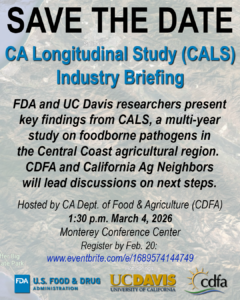
CA Longitudinal Study (CALS) Industry Briefing — Register by February 20

February 18th, 2026

U.S. Food and Drug Administration (FDA) and UC Davis researchers will present key findings from the California Longitudinal Study, a multi-year study on foodborne pathogens in the Central Coast agricultural region. The California Department of Food and Agriculture (CDFA) and California Agricultural Neighbors will lead discussions on next steps resulting from this work. Learn more and register here.


Wednesday, March 4, 2026
1:30 p.m. to 4:30 p.m. PT
Monterey, CA

Specialty Crop Leaders Renew Call for Additional Dedicated Aid for the Sector

February 17th, 2026

WASHINGTON, Feb. 13, 2026 — Specialty crop leaders issued the following statement in response to the U.S. Department of Agriculture’s (USDA) announcement providing bridge payments for specialty crops and sugar totaling up to $1 billion as part of the Assistance for Specialty Crop Farmers (ASCF) Program.

“We are still reviewing the details of today’s announcement and will be reaching out to USDA for additional clarity.

President Donald J. Trump’s widely successful CFAP-2 program provided essential aid to family farms during his first term, and as we wrote to the President on Oct. 6, 2025, CFAP-2 should be the model for providing economic aid to America’s specialty crop producers. That approach also has broad bipartisan support in Congress. It was recently endorsed by more than 100 bipartisan Members of Congress in a letter to the leaders of the U.S. House and U.S. Senate Agriculture Committees on Dec. 18, 2025, and it has been included in bills introduced this year by both Chairman G.T. Thompson and Ranking Member Angie Craig.

The hard truth is that even with today’s announcement more help is needed, which is why we continue to urge Congress to provide not less than $5 billion in dedicated aid for the specialty crop sector. This support is critical to the continued sustainability of American agriculture and the communities specialty crop producers serve.”

The SCFBA is co-chaired by Cathy Burns, CEO of the International Fresh Produce Association; Mike Joyner, President of the Florida Fruit & Vegetable Association; Dave Puglia, President and CEO of Western Growers; and Kam Quarles, CEO of the National Potato Council.

# SCFBA #

The Specialty Crop Farm Bill Alliance is a national coalition of more than 150 organizations representing growers of fruits, vegetables, dried fruit, tree nuts, nursery plants and other products. The Alliance was established to enhance the competitiveness of specialty crop agriculture and improve the health of Americans by broadening the scope of U.S. agricultural public policy. For more information, visit farmbillalliance.com.

Showing Up for the Specialty Crop Industry at the 102nd Annual Agricultural Outlook Forum

February 25th, 2026

Last week, I had the privilege of attending the 102nd annual Agricultural Outlook Forum in Washington, D.C., marking not only my first experience at this long-standing national event but also my very first visit to our nation’s capital. The Forum brought together agriculture leaders, policymakers, innovators, and growers from across the country—yet even amid its impressive scale, it offered valuable reminders of where specialty crops stand today and where they must go next.

One of my immediate observations was how specialty crops remain significantly underrepresented in national level discussions. While the Forum covered a wide range of topics, the dominant focus consistently returned to corn, soybeans, and protein production. These sectors are undeniably critical to U.S. agriculture, but the imbalance highlights an ongoing challenge: specialty crops continue to be treated as an afterthought rather than a cornerstone of American food and farm policy. As labor challenges grow and production realities evolve, it is increasingly important that specialty crops receive the attention and resources they deserve.

Despite this gap, several sessions offered meaningful insights. I was particularly glad to attend the panel discussion titled “Improving Nutrition for a Healthier America.” USDA leaders emphasized the importance of encouraging Americans to eat whole, healthy foods—a message closely aligned with the role our growers play in providing the fruits, nuts, and vegetables that support healthier diets. The conversation spanned nutrition security, equitable food access, and the need to integrate more fresh produce into federal nutrition programs. Hearing national leaders champion whole food nutrition reinforced how essential our industry is to public health outcomes.

On the second day of the conference, Secretary of Agriculture Brooke Rollins delivered a forward-looking assessment of the farm economy, emphasizing the agency’s commitment to strengthening producer support and expanding U.S. agricultural exports. Rollins highlighted USDA’s continued focus on bolstering trade performance and underscored key priorities within the emerging farm bill framework. She stressed that supporting farmers through volatile markets remains central to USDA policy, noting the importance of improved data accuracy, enhanced safety net programs, and strategic updates to farm support mechanisms. Rollins’ remarks set the tone for the Forum’s broader discussions on commodity outlooks, market conditions, and the path ahead for U.S. agriculture.

Another highlight came when Walt Duflock, Danny Bernstein, and I were invited to participate in the panel, “From Silicon Valley to the Farm—Driving Innovation Through Agriculture Technology.” This session brought together voices from across the innovation ecosystem to explore how technology is reshaping modern agriculture. It was an honor to represent our growers and share how Western Growers members are leading the way in practical, field ready innovation.

During my portion of the discussion, I focused on the real-world innovations specialty crop growers are already deploying—particularly solutions designed to combat labor scarcity, input resistance, and rising input costs. From advanced automation and robotics to precision tools and emerging biological inputs, specialty crop producers are not waiting for the future to arrive; they are actively building it. I highlighted how these solutions deliver value today, while also positioning growers for long term resilience in a rapidly changing regulatory and economic environment.

What stood out throughout the Forum was a growing national interest in agricultural innovation—yet also a clear opportunity to bring specialty crops more fully into the center of that conversation. Our growers operate some of the most labor intensive, technologically challenging, and economically significant production systems in the country. Their stories, needs, and innovations deserve a stronger platform at future federal and national gatherings.

Overall, the Agricultural Outlook Forum was a valuable and memorable experience. It offered fresh perspective, important connections, and a chance to spotlight the incredible work being done across our specialty crop community. As I left Washington, I felt both grateful for the opportunity to participate and motivated to ensure that specialty crops play a larger, more visible role at next year’s Forum.

I’m already looking forward to returning—and to continuing the work of bringing specialty crop challenges, innovations, and opportunities front and center in national agriculture conversations.

Blurry Print, Clear Message: CA Supreme Court Provides Arbitration Agreement Guidance

February 13th, 2026

The Supreme Court of California, in the recent case Fuentes v. Empire Nissan, Inc. (Fuentes), held that small blurry print in an arbitration agreement was not enough to support a valid claim of unconscionability under California law. In Fuentes, an employee applicant signed the company’s arbitration agreement even though the font size was tiny, blurry and the document contained complex, jargon-heavy language. After a termination following a medical leave of absence, the employee sued and opposed the employer’s motion to compel arbitration by claiming the signed agreement was unconscionable.  

To establish that a contract is unenforceable because it is unconscionable, the party opposing enforcement must show unfairness both in the procedure by which the contract was formed and the substance of its terms. In reviewing the Fuentes case, the Court found that a contract’s format, such as illegibility, is generally irrelevant to substantive unconscionability, which concerns the fairness of the contract’s terms. However, the Court did clarify that courts must more closely scrutinize the terms of contracts that are difficult to read for unfairness or one-sidedness when there is high procedural unconscionability. It also found the Court of Appeal improperly relied on a pro‑arbitration presumption and cut off consideration of unresolved factual issues about contract formation. The Supreme Court reversed and remanded for further proceedings. 

Given the Court’s holding, employers should consider the following best practices when drafting and implementing arbitration agreements:  

  • Ensure substantively fair arbitration terms. Courts focus on whether the terms are balanced – not formatting alone – but will scrutinize fairness more closely when agreements are imposed through standardized hiring processes.  
  • Reduce procedural unconscionability during hiring. Seasonal and high-volume onboarding increases risk; allowing time to review and clearly presenting arbitration agreements helps demonstrate fairness.  
  • Use clear, readable agreements for a diverse workforce. Small or blurry print alone is not fatal, but difficult to read agreements invite closer judicial review – especially where workers have varying language proficiencies.  
  • Assume Close Judicial Review. Draft arbitration agreements conservatively, with the expectation that a court may review them line by line. Provisions that appear even modestly one-sided may be vulnerable when applied to agricultural employment relationships.  

USDA Ag Outlook Panel – Keeping the Automation Funnel Healthy with Economic Development Federal Grants

February 25th, 2026

Last week was a great week for specialty crop automation in Washington, DC. Big thanks to Chris Purdy, the Chief Innovation Officer at USDA Agricultural Marketing Service (AMS) for setting up a panel on specialty crop labor challenges and automation and innovation opportunities for me, Western Growers Senior Director of Automation and Commercialization Ben Palone, and Reservoir Farms Founder and CEO Danny Bernstein. The key message was around the economic development opportunity that combines agriculture and AgTech opportunities.

I opened with the usual problem statement around labor: the lack of domestic availability has pushed H-2A usage up by three times in five years, and H-2A now represents 10% of California’s farm work force and that is out of a total $16.3B spend in 2024. The H-2A labor fully loaded costs growers $28-30/hour because of housing, transportation, and food costs. Meanwhile, regulatory costs (Cal Poly data) have risen from $109/acre/year (2005 leafy greens research) to $1,600/acre/year (2024 data­—same grower, same farm, same crop). Because of the cost challenges, California is forecast to lose 32% of farming acreage and 51% of California growers over 55 years (1997 – 2052). Washington state is forecast to lose as well, but by less (25% of acreage; 33% of farms).

Regions like Peru are making very different policy decisions than California around labor, water, infrastructure, and economic development. In addition, Peru has set explicit targets publicly of $40 billion in ag exports for 2040 and 1 million new hectares (2.47 million acres) by 2040. This is after Peru grew ag exports from $465M in 2000 to $12.7B in 2024 (1,869%) while California grew 129% to $22.4B over roughly the same period.

From an automation perspective, two thirds of hours are spent on harvest and one third of hours are spent on non-harvest. We are making progress on non-harvest automation, which looks like it grew from $250M to $310M (24% YoY) from 2024 to 2025. At that revenue level, automation is helping to reduce labor required by 3-5%. If you straight line the growth rate for the segment at 24% and push it out through 2030, specialty crop AgTech automation becomes a $900M category in North America. We are confident that with the international players included, the category goes over $1 billion in revenue in 2030. At $1B in revenue, most technology segments create complementary opportunities in systems and operations integration (25-30%) and data and analytics tools (20-25%). In short, a $1B automation category likely supports another $500M in related revenue.

On harvest, the picture is not as positive. Venture capital has dropped from $53B in 2021 to $10B in 2025 (85%). The short version is the entire venture capital work shrunk by 50% ($354B to $171B from 2021 to 2023) but got rescued (as often happens in tech investing) by the AI segment, which pushed venture back over $200B by itself even though IPOs dropped 85% from 2021 to 2023 (1,046 to 153). The lack of liquidity outcomes from IPOs has not dampened anyone’s interest in AI investments or valuations that appear to be many to be a bit bubbly (we’ll see on that one).

This lack of venture capital means fundraising for AgTech startups is as challenging as it has been in a long time. AgTech did not get an AI bump (in fact, you can argue it takes an AI hit in some ways because the cost of engineering talent is being driven up massively the last couple of years from the AI arms race in the form of engineering recruitment and retention) and 42% of the $53B in 2021 was from two categories (vertical farming and alternative proteins) that I have not been kind to and will remain critical of because they took billions of dollars and basically lit them on fire for multiple years with virtually no good outcomes. As a result, the capital available and margin for error for AgTech startups is very small at the moment – the team, the product, the strategy, and the revenue metrics must all line up and the pitch needs to be stellar.

Given the lack of outcomes in harvest automation to date, we are concerned about the ability of harvest to secure venture capital and are engaging in alternative capital strategies. One of them is to learn from the Strawberry Commission, which looked around over ten years ago and realized that every activity that needs automation in strawberries is too small for venture capital investments (the market size is too small) except harvest. So they prioritized the other activities (hole punching, strawberry de-topping, etc.) and used industry capital to fund professional engineers and house them at the Cal Poly Strawberry Center where they work with student teams on R&D for solutions to each of these problems. The program is working well, with three projects getting past R&D and to commercialization with an open source strategy where the drawings and equipment specifications are made available to growers who can give them to whichever Central Coast OEM they want to use.

We are leveraging a similar approach but moving forward with a Product Requirements Document (PRD) and Request for Proposal (RFP) process for existing OEMs instead of student teams because of the complexity involved with harvest (with a particular focus on the end effector and software to do the picking/harvesting and placement in a bin or product holder). The PRD for the initial project is being developed right now for iceberg lettuce harvest automation. Rhishi Pethe is helping by taking on the PRD effort for us. Grower feedback and field visits have given Rhishi much of what he needs to complete the PRD, and we anticipate completion in the next 5-7 weeks. After that, part 2 is to take the PRD and turn it into an RFP that OEMs can respond to which we will launch within 3-4 weeks of PRD completion. By May, we should have the RFP process live and OEMs will have 60 days to respond. That means we hope to have all responses in by July and we can select the most likely winner candidates and work in a group to debate strategy and approach before coming up with one final RFP winner. As with Strawberry Commission, this process will require no venture capital and will use industry capital and grower feedback to maximize the chances for success.

There are multiple approaches in play. For non-harvest, we believe the category can become $1 billion by 2030 (particularly once we open the global lens up) with venture capital investments. This would mean we would have automated somewhere between 15-20% of non-harvest activity. For harvest, we believe a grower collaborative capital model and PRD/RFP can open up alternative capital sources and help us get from the current 0-1% that is automated to something closer to 3-5%. All of that supports innovation funding from many of the traditional sources, including USDA, CDFA, and SBA. Everything up until now in this article has been a long preamble summarizing the work of Ben Palone and I the past few quarters.

But here’s where things get really interesting (I know, a thousand words in – sorry, I think the above is needed to set the stage for what follows). I took a look at a couple of items involved with the venture investing funnel and instead of focusing on startup revenue results and commercialization, I focused on the capital needed to keep the innovation funnel healthy and (more importantly) took a look at the economic impact as measured by jobs created and job years delivered. My thesis was that we should reposition AgTech investments from both venture capital and grant funding around an economic development thesis with jobs as the key metric. That thesis appears to be correct as I gather more data.

To start the process, I estimated the amount of venture capital that AgriFoodTech is likely to get in the next five years (2026-2030). Based on the drop from $53B to $10B and current under-performing trends for exits overall, most of my investor friends and I believe that AgriFoodTech is likely to stay in the $8-$12B/year range for a few years until exits start to become more common. That is unlikely to come via IPO because AgTech does not grow revenue fast enough and large enough to support the metrics needed for an S-1 filing. Therefore, the most likely exit path to see some growth on is M&A and that is not likely to continue until the OEMs (John Deere, Case New Holland, et al) are in a financial position to support more acquisitions. Based on all of that, I am forecasting the 2026-2030 AgriFoodTech venture capital at $50B ($10B a year – the midpoint of the estimate above – straight lined for five years). I believe $50B is a conservative estimate that is more likely to have upside over the next five years.

Part two of the exercise is to estimate how much of the $50B will be invested in automation. For this, I looked at the last couple of years. The short version is that 4-7% looks to be the recent trend, and with the CEA/alt-protein money going away, it is trending towards 7% and likely to go higher. Unlike CEA and alt-protein, automation is solving a real problem – maybe the biggest problem facing California growers – labor challenges. For this forecasting exercise I chose to straight line 6% per year for the entire five years. I believe this is another conservative estimate that has upside more likely than downside the next five years. If $50B is our forecast for VC and 6% is out automation percentage, we have a total forecast for automation investment of $3B.

With the $3B established, the next part of the exercise was to figure out how much job creation AgTech is likely to establish on the back of the $3B investment. After some analysis comparing AgTech to other tech segments, the prediction is that $3B in AgTech automation investment over five years can create 6,000 – 7,000 total jobs. That breaks down into two groups. First, 4,500 direct jobs are created, including engineering, manufacturing, deployment, and field service jobs at the startups that received funding. Second, 2,000 – 2,500 indirect jobs are created in supporting industries that are not on the startup’s payroll but support it.

Next, I took a look at the mix of VC funding across investment levels from seed rounds through A rounds through B rounds and above. The main reason for this is different rounds create different headcount expectations. That is even more true when manufacturing is involved. Early on, you can pay more for engineering headcount for R&D, but as product gets to commercialization the amount needed for manufacturing goes up and people cost has to decrease. So each round has different profiles of hiring. Here’s another interesting point. Because of the complete drop off in VC, the amount invested in seed and A rounds compared to B rounds and later has completely flipped in 10 years. It was 78% seed and A rounds in 2015 and 22% B rounds and later. In 2025, that flipped to 22% seed and A round and 78% B round and later. This makes sense because as capital dries up many VCs follow their instincts and strive for portfolio protection – i.e. let’s continue making investments in companies we already know and have invested in and avoid making new bets.

The problem with that is that there is an established ratio between early stage rounds and later rounds to maintain a healthy innovation funnel. In short, you have to plant a lot of acorns over years (seed and A rounds) to get a lot of trees that can use and need larger amounts of capital years later. That is not what is going on with portfolio protection. In fact, if left in its current state, the funnel would start to be in poor health fairly soon.

So what is the ratio for AgTech? Well, you need to factor in the extensive hardware development cycles that often include multiple prototype cycles, the fact that field validation often takes multiple seasons, and the reality that exit pathways (the aforementioned IPOs and M&A) are slower and fewer than software sectors. When you account for all of those, AgTech requires .75-1x early capital per $1 of B round and later investments. In short, for every B round dollar you need 75 cents to a dollar in seed and A round to keep the innovation funnel healthy. If 78% is invested in B rounds and later and $3B is the total automation investment, B+ rounds represent $2.3B and seed/A rounds represent $660M ($.66B). But the early capital needed for funnel health is somewhere between $1.8B and $2.3B, so the existing 22% we can expect ($.66B) leaves a capital shortfall of between $1.1B and $1.7B.

Where can we make up the shortfall left by a venture capital total for the category that is shrinking and over-weighted toward B round and later startups? Well, we could look at grants, and both federal and California grants are in play. If we look at the economic development grants, the federal side is where most of the action is. If you combine the fiscal year (FY) 2024 funding across multiple categories, you get to $4.7B – $5.2B. First, Economic Development Administration (EDA) provided $1.14B. Second, Economic Development Initiative (Community Project Funding) provided $3.29B. Other federal economic development grants from DOT (Department of Transportation), DOE (Department of Energy), USDA (US Department of Agriculture), and RD (Rural Development) provided money. Depending on how startups are classified, there can potentially be access to all four of these categories.

By comparison, California provided $120M for GO-Biz and California Competes grants (using state dollars across multiple sectors), $17.5M for GO-Biz (additional grants) and Jobs First, and $23.3M for CDFA Specialty Crop Block Grants (which deserves an asterisk, this is the administration of USDA funds at the state level). Finally, the US provides USDA Specialty Crop Block Grants ($72.9M and Multi-State Grants ($9.4M) for a total of $82M). You quickly see that the majority of the grant dollars are in Federal Economic Development from EDA, EDI (CPF), and the four horsemen of DOT/DOE/USDA/RD at $4.7B – $5.2B.

If we take a look at the five-year estimate for this federal grant total, it’s a little challenging because there are things that could lower it (i.e. DOGE, budget allocations) or raise it (budget allocations, revised strategic priorities – i.e. MAHA). If we just go with a straight-line estimate at the mid-point, you come up with a five-year estimated total of $25B ($5B x 5 years). Of course, this is for multiple industries and multiple departments, so it is very competitive. For now, we’ll use $25B as the five-year federal funding target estimate.

We know that for $50B of AgriFoodTech VC, we can expect $3B (6%) in automation funding. That will create 6,000 – 7,000 jobs. It will also lead to a shortfall of $1.1B – $1.7B required for a healthy innovation funnel because portfolio protection means 78% of the $3B ends up in B round and later investments. If we then source an additional $1B from federal grant funding (roughly 4% of the total available funding expected over five years) and look at the expected job count, I am estimating that an additional 2,000 – 3,000 jobs can be created if the $1B were focused on mid-stage innovation (licensing, IP, technology transfer, commercialization) instead of early stage and primary R&D. This has the benefit of both preserving the health of the automation funnel while providing a significant count of incremental jobs. The combined totals with the $1B in grant funding are that $4B split 75%-25% between VC and federal grant funding over 5 years can create 8,000 – 10,000 jobs over 5 years and a total of 40,000 – 50,000 Jobs-Years. This is a significant amount of rural economic development in agriculture communities everywhere specialty crops are grown.

From here, I plan to do a few things to advance the research. First, I am going to look at other economic development funding to see what kind of metrics there are for other grants in terms of job creation to see how competitive this overall proposal is relative to other similar grants. In short, are we capital-efficient job creation relative to our peers? Second, I want to look at the breakdown of federal funding to see how much and how best to deliver grants that can land the right amount of funding to help with the shortfall. Third, I want to measure ag GDP as a percentage of overall US GDP to see what kind of pro rata investment spend we would expect if every industry received the same % of funds as their % of GDP represented.

For now, I am confident that this economic development strategy provides availability of far more funding than innovation grants and food security provides. I am increasingly growing confident that the economic development metrics around rural jobs that this proposal provides will put AgTech in a competitive position with other grant applicants. I’ll share more of what I’m finding as I dig into the issues above.

U.S. OSHA Launches New Safety Champions Program

February 12th, 2026

The U.S. Department of Labor’s Occupational Safety and Health Administration (OSHA) has launched a new initiative called the Safety Champions Program, designed to help employers cultivate and sustain robust safety and health practices in the workplace. The new program aims to significantly reduce workplace injuries, illnesses, and fatalities by providing a structured framework based on proven safety principles. 

Central to the Safety Champions Program are seven core elements outlined in OSHA’s Recommended Practices for Safety and Health Programs: 

  • Management Leadership 
  • Worker Participation 
  • Hazard Identification and Assessment 
  • Hazard Prevention and Control 
  • Education and Training 
  • Program Evaluation and Improvement 
  • Communication and Coordination among host employers, contractors, and staffing agencies 

The Safety Champions Program is organized into three self-guided steps:  

  • Introductory: OSHA’s guidelines are used as a starting point to spot safety gaps and build a basic program. 
  • Intermediate: Safety programs are strengthened, worker involvement is increased and hazard controls are improved.  
  • Advanced: Safety is embedded in the culture with ongoing improvement and active worker involvement.   

Participants can progress through each of the three stages at their own pace and have the option – at any point – to request assistance from a Safety Champion Special Government Employee (SGE) in assessing their safety and health program and Step progress.  

While the Safety Champions Program provides a valuable framework for promoting workplace safety, employers must remain mindful that mere participation does not eliminate hazards or ensure OSHA compliance. The program functions as a foundational guide, requiring employers to proactively implement actionable strategies in order to safeguard employees effectively.

LWDA Proposes New PAGA Regulations

February 12th, 2026

California’s Labor and Workforce Development Agency (LWDA) has issued proposed regulations aimed at clarifying and tightening key parts of the Private Attorneys General Act (PAGA). The proposal follows the 2024 reforms to PAGA and is designed to curb abusive litigation practices LWDA believes undermine the purpose of the notice-and-review process. 

The comment period is open through March 23, 2026, and LWDA has indicated the regulations would apply to existing cases once adopted. 

Why this matters 

PAGA allows an “aggrieved employee” to pursue civil penalties for alleged Labor Code violations in a representative capacity. Penalties are generally split between the state and affected employees (65% to LWDA, 35% to employees). Because PAGA claims often move quickly from notice to litigation, even modest changes to notice requirements, cure opportunities, and settlement oversight can significantly affect strategy and cost on both sides. 

1) A push to curb boilerplate LWDA notices 

Before a PAGA lawsuit can be filed, a claimant must submit a notice to LWDA describing the alleged Labor Code violations and the facts and theories supporting them. LWDA’s proposal is squarely aimed at mass-produced notices that are vague, generic, or not tailored to the claimant’s actual circumstances. 

LWDA is also proposing new attention on repeat filers: 

  • A “high-frequency filer” category for attorneys or firms filing more than 200 PAGA notices in a 12-month period, with extra certification and cover-letter requirements. 
  • A “vexatious filer” category for those repeatedly submitting noncompliant notices, which could trigger a pre-filing screening process. 

Bottom line: these changes would make it harder to initiate a PAGA case based on broad, non-specific allegations, and may give employers clearer early information about what is being claimed. 

2) More guidance on the cure process for employers with fewer than 100 employees 

The 2024 PAGA reforms created a “cure” option for employers with fewer than 100 employees, but left a lot of the practical mechanics unclear. LWDA’s proposed regulations aim to spell out who qualifies and how the cure process would work, and they also make clear that cure-related communications are intended to be protected under Evidence Code section 1152. 

3) Greater oversight of settlements, and fewer “global” resolutions 

LWDA’s proposal also tightens oversight of PAGA settlements, aimed at addressing a concern that settlement submissions are sometimes missing or lack enough detail for meaningful review. If adopted, the rules would make it harder to expand a case after a deal is reached and would add more notice and review steps. 

FixPAGA Coalition Applauds New PAGA Regulations 

The FixPAGA Coalition, which includes Western Growers, endorsed the rulemaking, publicly welcoming LWDA’s focus on curbing abusive filing practices and bringing more rigor to the notice process. The coalition has also emphasized the value of mechanisms that discourage repeat noncompliance and improve transparency, including new categories aimed at high-volume and repeatedly noncompliant filers. From an employer perspective, the coalition’s message is straightforward: clearer rules and stronger gatekeeping up front can reduce gamesmanship and help legitimate claims get addressed faster and more fairly. 

Updates from the CIT: Week of February 16, 2026

February 18th, 2026

The Western Growers Center for Innovation & Technology (WGCIT) in Salinas is experiencing an exceptionally active week as industry, government and regional partners converge for key conversations on agricultural technology, policy and innovation.

With the AgSafe Conference taking place in Monterey, the WGCIT will host a visit from the U.S. Department of Labor, including Deputy Assistant Secretary Wood Laihow. The center has convened a group of growers to participate in a roundtable discussion with the visiting delegation. Given this week’s rain across Central California, field demonstrations will be postponed. Instead, Secretary Wood Laihow’s team will receive an in-depth overview of current agricultural technology advancements housed within the WGCIT. A follow-up visit will be scheduled to allow the delegation to see these technologies deployed in the field under normal conditions. Walt Duflock, Western Growers’ Senior Vice President of Innovation, will open the meeting and introduce the grower participants, setting the stage for a productive dialogue between producers and federal leadership.

WGCIT will additionally host Emilio Contreras, Representative Zoe Lofgren’s newly appointed agricultural staffer, for two important meetings. Contreras will first meet with Salinas Mayor Dennis Donohue to discuss the region’s unique agricultural landscape and the role of the WGCIT in shaping the future of agtech. Later in the day, he will meet with Walt Duflock to learn more about Western Growers’ innovation priorities, including emerging work in automation and biologicals. Contreras also has several meetings planned with grower–shipper–processor organizations throughout the region to gain a comprehensive understanding of local needs and opportunities.

On Tuesday evening, AgTech Alchemy will host a networking event at the AgSafe Conference in Monterey. The gathering is designed to connect directly with the broad range of industry professionals the conference attracts, fostering collaboration across the safety, compliance and innovation communities.

While activities continue on the Central Coast, Western Growers will also be represented in Washington, D.C. this week. Walt Duflock and Ben Palone will participate in a series of USDA meetings on behalf of the organization, ensuring growers’ innovation needs and policy priorities are clearly communicated at the federal level.

AgTech Ecosystem – Thoughts from Homecoming Week, err, Tulare World Ag Expo!

February 18th, 2026

Well friends, it is Homecoming Week here in Tulare as much of the agriculture and AgTech community gathers for World Ag Expo to show off products, talk shop, catch up with old friends and make some new ones. Here were my thoughts from a WG Innovation Newsletter article written before heading to Tulare.

And now that I have been at the show all day on Tuesday and Wednesday, I’ve got a few thoughts (and a few more that are worthy of separate posts later).

  1. In terms of launches, I will take a detailed look at the annual “Top 10 New Products and Exhibit Highlights” winners list in a future post. The two automation solutions that jumped out to me were (1) Amiga Max – a compact autonomous robot that can spray, tow, haul and lift in multiple specialty crops (already in the space, Amiga Max and Burro Grande / XL will likely compete against each other in the marketplace, and I believe there is room for at least two players in this segment; (2) Carbon ATK from Carbon Robotics – an after-market autonomy solution that brings a new entrant into this space along with many of the OEMs (including John Deere, who offers an integrated autonomy option for many of their tractors) and startups. I like it because anything that can help growers get more benefit out of their existing equipment and help solve the driver shortage is a win for all.
  2. Who are the new exhibitors? Well, in this case, the answer was clearly “Back to the Future!” Compared to 2021 (when of course we had $53B in AgriFoodTech VC), there were a lot fewer startups than just five years ago and even many fewer compared to two to three years ago. In their place there were a lot of old school equipment exhibitors, but there were some notable swaths of open exhibit space that was either never paid for or paid for and then companies could not exhibit at the last minute. Exhibits by old school components and supply manufacturers or distributors had the feel of a World Ag Expo from 10-15 years ago from before AgTech became a big thing and then became AgriFoodTech and became a bigger thing. Meet the old exhibitors, same as the new exhibitors (to loosely paraphrase Roger Daltry and The Who­—lyrics are from Won’t Get Fooled Again”—you kids can Google it and then build a playlist with tunes from The Who, Roger Daltrey, and Pete Townshend. You won’t be disappointed!)
  3. How is the show doing? I am a keen observer of trade shows, probably attending 40 a year for the past 10 years. Tulare is one of the larger and more influential ones. It recovered after a few shutdown years, but this year was a little funky and the folks I talked to do not want to put all of that on weather because it actually did not rain either of the first two days but the crowd after 2:30 on Tuesday was dismal. The Wednesday crowd was noticeably better but for both days once the 10:00 – 2:30 window was done the crowds just got smaller. I am concerned that that 4.5 hour window is not enough to support the costs required (time and $s) for startups (or other exhibitors candidly) to make the show investment ROI-positive. And if you’re just there to meet with folks, you can do that while walking instead of paying for and parking in an exhibit booth.
  4. I’ll have more to say about fundraising – I had some conversations that will remain non-public for now while some startups figure a few things out. Suffice to say there will be some startups that need to raise capital this year and the space is likely to have somewhere between $8-12B in 2026 so capital will be tough and pitch decks and narratives will need to be completely buttoned down to successfully pull in capital this year. Ben Palone and I plan on having a lot of conversations with startups, investors and our friends in the AgTech ecosystem to help where we can.

One final macro thought on what I saw the last two days. It appears entirely possible that a couple of things are happening at the same time and the interplay impact is yet to be determined. First, as above, venture capital is down 80% in five years, so a lot of startups no longer have capital (and time) to spend with over a week in setup, exhibit and take down at Tulare.

Second, if startups are not taking booth space they used to, the World Ag Expo sales team will have to dust off the Rolodexes and find a few folks that are no longer exhibiting, displaced by the cool new AgTech kids with money the last several years. But what if the folks who used to take booths no longer need them? Then the World Ag Expo sales team will be in a bit of scramble mode because somebody has to fill some of those slots or the show economics get rough. And what if the folks who used to take the booths are now using things like online advertising, email advertising, social media advertising and content marketing to attract leads and customers in new ways. Ironically, AI is making social media and search marketing more effective even as AI added 48 billion (with a B folks!) hours on mobile devices last year (up 10x in two years – yes, two years – I know, it’s crazy!) And here is a fun fact: that 48B hours is less than 1% of global time spent on mobile devices last year, so yes they’re using AI a lot but folks are using their phones an awful lot too!

Both Facebook (Meta) and Google (Alphabet) have used AI to deliver better and more relevant ads which get clicked on more often and generate more revenue per click. It is entirely possible that when the old-school exhibitors got run out of town by new-fangled startups with their fancy Silicon Valley money, they used some of that other new-fangled tech to help them not need their former exhibit spot. We will see. It’s also worth noting that if you’re using the new kids platforms to successfully advertise, you might not be wild about telling everyone you’re doing it and inducing competition, so I’m not outing anyone and I’m not saying all these platforms are working. I am saying that there have to be some good reasons for the empty booth space and lighter crowd this year. At the very least, everyone running events on the west coast that are not World Ag Expo should realize that even the granddaddy of west coast shows can struggle, and if that’s true, it should send shivers up every other event organizer’s spine.

More thoughts from Tulare later. The other realization from this week is that World Agri-Tech is about four weeks away and it will be the next epicenter for figuring out who’s raising, who’s investing and how it’s going, along with how the four weeks played out for some of the key players. That’s why you have to go to the shows to keep up, folks – you can get highlights from some of the media and some of the posts from folks who write up the visits (like me!), but you only get all the stories when you make the trip! See you in SF in a few weeks!

State Water Board Releases List of Potential 2026 Temporary Transfers

February 12th, 2026

The State Water Resources Control Board (State Water Board) has compiled a list of potential temporary transfers that may be filed in 2026. The list is posted on the State Water Board’s Water Transfers Program website under News and Announcements:

https://www.waterboards.ca.gov/waterrights/water_issues/programs/petitions/transfers.html.

If you would like to be included as an interested person for one or more of the proposed transfer(s) and receive notice(s) of the petition(s) directly, please send an email request with “Temporary Transfer Interested Person” in the subject line to [email protected] no later than March 1, 2026, with the following information included in the email:

  1. An email address to be used as your point of contact;
  2. The water right (permit or license number) for which you request notice of a petition for temporary transfer; and
  3. The concerns you may raise in comments on the petition related to effects on other legal users, fish, wildlife, instream beneficial uses, or groundwater conditions.

You may submit one email to identify interest in multiple potential transfers. Your email should identify which concerns apply to which water right(s).

The State Water Board will forward the email contact information of interested parties and their concerns to the applicable water right owner. The water right owner may consider the concerns in their preparation of a complete petition or contact you via email to resolve potential concerns.

If you have any questions, please contact [email protected].

What a Pile of Broken Drones Says About Commercialization in Agtech

February 11th, 2026

Early in my technical career, I learned one lesson faster than almost anything else: agricultural equipment doesn’t get days off. There is no “pause” button in farming. Tools must be fixed, repaired and returned to the field immediately, often within hours, because the entire operational system depends on continuity. Break the chain, and you risk breaking the season.

Since the arrival of modern agtech, this reality has created a nagging concern among growers: Can sophisticated, sensor‑laden, software‑heavy equipment really hold up in a world where downtime isn’t an option? Farmers are not just evaluating performance—they are evaluating whether a piece of technology fits seamlessly into the nonstop rhythm of agriculture.

A trip to Yuma, Arizona last month gave me one of the clearest signals yet that at least one category of agtech—broadcast input‑application drones—has officially crossed the line into full commercialization.

During a visit with Nick Copass at the Keithly Williams Fabrication shop, I walked into a scene that would horrify any drone manufacturer but is a clear signal for anyone watching for signs of real‑world adoption. Near the back of the shop sat a pile of drones—a mangled heap of shattered carbon fiber, broken rotors, and twisted bits if metal. These weren’t museum pieces. They were fresh off the farm, looking like they had bounced off telephone poles, fallen from 20 feet, or run over by a 5-series tractor.

When I asked Nick what happened, he just laughed.
“Growers drop them off whenever they crash or get knocked over,” he said. “Sometimes I don’t even know who dropped which one off. We come in in the morning and there’s a mangled drone by the door. It’s cheaper to rebuild them than replace them—so we fix them up, send them back, and send the bill.”

That was the moment I knew drones for broadcast applications had “made it.”

This is what commercialization looks like.

Agtech is truly adopted when farmers stop treating equipment as fragile technology and start treating it as a tool—one that gets beaten up, pushed hard and expected to perform day after day. The fact that growers are using drones aggressively enough to break them, drop them, flip them, and still bring them back for repair is real‑world proof that these machines have earned their place in the agricultural system.

Of course, getting here was never guaranteed. Commercializing agtech is notoriously difficult, in part because these smart machines must overcome:

  • Seasonality, which limits testing windows and stretches development timelines
  • The need for a quantifiable ROI, often within razor‑thin margins
  • Utility in less‑than‑ideal conditions, not just perfect demo plots
  • Sufficient ground‑coverage capability to match agricultural scale
  • Operation across multiple geographies and growing configurations
  • Compatibility with tight timing constraints and multi‑input workflows
  • Serviceability and maintenance, often far from factory support

Each of these hurdles has stalled and, in some cases, stopped more than a few promising startups—and continues to shape the pace of innovation today.

But the scene in that Yuma shop offered something rare in agtech: a clear, unambiguous signal that a technology category has made it past the theoretical stage and into the messy, demanding, day‑to‑day world of commercial agriculture.

And the unsung heroes of that progress are trusted dealers and industry partners like Keithly Williams Fabrication. They are the ones “putting Humpty Dumpty back together again”—quietly absorbing the maintenance burden that makes adoption possible. Their repair benches, not pitch decks or prototypes, are where true commercialization becomes visible.

If piles of broken drones sound like bad news, think again. They’re a sign of heavy use. A sign of repeat value. A sign that growers trust technology enough to rely on it, abuse it and bring it back for more.

And in agriculture, that’s as commercial as it gets.

Business Coalition Applauds Key Provisions of New PAGA Regulations

February 9th, 2026

SACRAMENTO, CA – The FixPAGA Coalition, first formed in 2021 to support needed reforms to California’s Private Attorneys General Act (PAGA), today issued the following statement after the release of draft regulations to modify the filings of claims with the state’s Labor & Workforce Development Agency:

“We are encouraged by much of what we’ve seen in the Agency’s proposed regulations. The reforms signed into law in 2024 will only be successful if they are carried out with effective regulations.

“In particular, we support the designation of law firms filing more than 200 PAGA notices in a 12-month period as ‘high frequency filers’ that are subject to additional administrative steps. Agency officials report that in the most recent fiscal year, almost one-quarter of all PAGA notice filings were submitted by just five law firms. And almost one-fifth of all filings came from just five attorneys.

“We also support the Agency’s proposed regulations to label certain filers as ‘vexatious’ when they repeatedly don’t comply with legal notice requirements — a designation that would subject those filers to a screening before they file a PAGA case.

“The Agency should also be commended for crafting regulations to create a new system for document submission that discourages filers to copy and paste boilerplate notices.

“While we are still reviewing the proposed regulations as a whole, these are positive, important steps into ensuring PAGA works as it was intended. The benefits to businesses, employees and ultimately, consumers will be far-reaching.”

The coalition members include the California Chamber of Commerce, the California New Car Dealers Association, the California Restaurant Association, the California Retailers Association, and the Western Growers Association.

For Immediate Release
Contact: John Myers
[email protected] | [email protected]

Western Growers 2025 Year in Review Now Available

February 10th, 2026

The Western Growers 2025 Year in Review is now available online. The Year in Review shares an overview of Western Growers activities throughout the year to support and advocate for the agricultural industry.

This report includes updates from the following teams:

Federal and State Government Affairs

Science

Center for Innovation and Technology

Legal

H-2A

Western Growers University

Healthcare Solutions

Financial Services

Public Affairs and Communications

Commodity and Supply Chain Services

Human Resources

Western Growers Women

Membership and the Annual Meeting

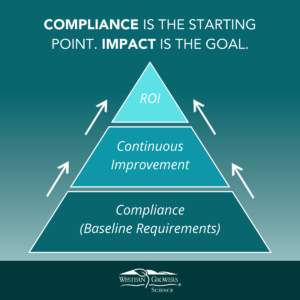
The Bridge Between Compliance and Continuous Improvement – Food Safety Data Must Look Different. 

February 10th, 2026

A few weeks back, I wrote an article about the value that food safety data should have in driving our operations. It can be found here and is titled Compliance to Impact – Making Continuous Improvement Count. It came with this nice-looking pyramid image that was posted on our social media accounts (thank you WGA Marketing).  

Since then, I have had a few conversations on the matter – discussions with experts, industry, stakeholders, etc. on the topic and a few things just kept resonating and lingering in my thoughts. Hence, a second article to build upon the first round – a little ascension on my own hierarchal continuous improvement thought pyramid.  

All discussions on this topic of Food Safety Data and continuous improvement centered around what should be and, more realistically, what food safety data currently is. As you might imagine, these should be/is states are quite different. Not surprising, that feels about on point for most things in life these days. This presents a problem though, if we continue to want improved food safety metrics and look for improvements in overall public health and food safety outcomes, we need to call out (productively) that we might need to reimagine what and how we approach it. Compliance information will always be important, but I have little hope (open to debate here) that compliance information, data, and hierarchy is suddenly going to become predictive or efficient at reducing residual risk in the system. We didn’t design it that way, and my guess is that it won’t remarkably surprise us. As a result, conversations about food safety systems that rely on data or their findings have an inherent and glaring weakness – they won’t be successful unless we get honest about the type of data we need to collect. This is not novel. When thinking about operational key performance metrics (KPIs), we know how to look at KPIs critically, to design six sigma systems as an example (i.e., ~3.4 defects per million opportunities) – a disciplined way to reduce variation, prevent defects, and make performance predictable using data. The challenge is to make the leap from operational production data into food safety data – first accepting that food safety “defect” rates aren’t zero, and that we can improve them. If this were tied to top-line sales or bottom-line profits directly, the incentive and motivation would be clearer. Are we failing? No, we’re just missing the opportunity to revision food safety programs into a system that passively drives improvement based on operational and financial metrics. I am all for “hopes and prayers”, but this is not, and will never be, a successful food safety strategy.    

The next thing most conversations touched upon – there is some latent frustration that the industry, and/or individual companies depending on how you look at it, don’t self-promote to the next level on the pyramid (continuous improvement).  

I am also frustrated and disappointed with this point. As someone who has worn many hats in my career (food safety, auditor, laboratory leader, business unit leader/general manager), I have seen firsthand the decision-making process at food companies. It often (not always) leaves us wanting, with budgets and resource constraints taking precedence over “nice to have” food safety improvements. If we are compliant and successful (i.e., no outbreaks, recalls) why then would we allocate limited resources to improving the process. Thinking back to my school days, why put in the extra effort for the “A” when a “C” gets you to the same endpoint (i.e., graduation). It’s a good thought, and one I have wrestled with my whole life given the overachiever that I am. What have I really gotten for always getting the “A”? My joke is generally that I am just more stressed and tired, but I suppose that I also developed a keen sense of determination and grit too. I refuse to accept the “C”, and I refuse to stay at the lower level of the food safety program pyramid too. 

As such, what do we need to do to move up the pyramid? How can we enable the system to naturally select for the “continuous improvement” and “ROI” level? My hypothesis is to stop talking about it, and instead show how it works, highlighting other benefits along the way. We need to build a different data ecosystem for food safety – one that supports the outcomes we want and the business successes that we need. Just like operational KPIs that deliver financial incentives and productivity gains, so must our food safety systems. They’re not separate, and they are not distinct types of data.  

Getting to a new system of operation won’t be easy. It will require that we discern what type of information will improve us, what will make us more resilient, and what will generate more proactive programs. The first step is to build the bridge, not just to show what can be done, but to ultimately create the pull and destination that others move to. Once the old system is no longer acceptable, a new system will have to naturally emerge…hopeful? Yes – most definitely. Hopeless? Hardly.  

I didn’t move into food safety to accept the status quo and hope you won’t accept it either.  Join us on working to design data systems that drive measurements on what matters, that incentivizes the system to invest in solutions and improvements. Food safety data needs to look different. Help us create it. GreenLink® and our data efforts are far more than a data-sharing program, it’s the chance to reimagine what compliance and food safety improvement(s) can look like 

Arizona Specialty Crop Block Grant Program Accepting Applications Until March 6

February 9th, 2026

The Arizona Specialty Crop Block Grant Program (SCBGP) grant manual is now available and applications are being accepted. The grant application deadline is 10:59:59 p.m. (PST) / 11:59:59 p.m. (MST) Friday, March 6, 2026. All applications must be submitted online.

The purpose of this program is to enhance the competitiveness of specialty crops in Arizona. The Arizona Department of Agriculture (AZDA) anticipates that approximately $1.25 million will be available for distribution to successful applicants in the fiscal year 2026 funding cycle.

Application packets are required to be submitted online here. Instructions can be found in the manual. It is highly recommended that you review the instructions as soon as possible to become familiar with the online application process.

Webinars

The AZDA will hold two virtual webinars via Zoom on Tuesday, February 17 and Friday, February 20. You can register to learn more about the purpose of the program, the required application documents and how to apply online. See page 15 of the manual or the website above for more details and register here.

Visit Specialty Crop Block Grant Program for more information.

Best Practices: Navigating Workplace Romance

February 6th, 2026

With Valentine’s Day quickly approaching, love is in the air, even in the workplace. While office romances can lead to meaningful relationships, they also come with potential risks that employers need to manage carefully. Understanding these risks and implementing best practices can help maintain a professional and safe work environment. 

Some interesting statistics on workplace dating. According to Forbes.com:  

  • Over 60% of adults have had a workplace romance. 
  • 43% of workplace romances have led to marriage. 
  • 57% of employees report that workplace relationships have impacted their work performance. 
  • 40% of workplace romances involve cheating on an existing partner; and 
  • 50% of people have engaged in flirtatious behavior with colleagues. 

With those statistics in mind, it’s easy to see how workplace romances can lead to conflicts of interest, favoritism, and even claims of harassment or discrimination. When relationships sour, the fallout can affect team dynamics and productivity. Additionally, if a relationship involves a supervisor and a subordinate, it can create power imbalances and perceptions of bias.  

Below are a few recommended best practices to help employers navigate the potential complexities associated with workplace romance: 

  • Establish Clear Policies and Expectations: Employer policies should outline acceptable behavior, disclosure requirements, and consequences for non-compliance. 
  • Encourage Transparency: Individuals tasked with HR responsibilities should work to cultivate an atmosphere of trust and transparency when it comes to office relationships. Employees should be encouraged to disclose relationships in an HR setting to assist the company in managing potential conflicts of interest. Transparency helps in addressing any issues proactively. 
  • Provide Training: Regular training on workplace conduct and harassment prevention can help employees understand the boundaries and maintain professionalism. 
  • Maintain Professionalism: All employees, especially those involved in a relationship, should be reminded to keep their personal and professional lives separate. The company’s policies as well as its culture should make clear that public displays of affection and favoritism are to be avoided. 
  • Address Conflicts Promptly: Any issues arising from workplace relationships should be addressed promptly and fairly to prevent escalation. 

While workplace romances can be tricky to navigate, with the right policies and practices in place, employers can foster a safe, respectful and professional environment.  

DOL Clarifies Bonus Inclusion for Overtime Under FLSA

February 6th, 2026

A newly issued U.S. Department of Labor Wage and Hour Division (DOL) opinion letter makes clear that an incentive bonus, awarded automatically when employees satisfy predetermined criteria, is not discretionary and must be included in the regular rate of pay for overtime calculations. The determination rests on the Fair Labor Standards Act (FLSA) and the nature of the bonus itself. 

The Facts 

According to the facts outlined in the opinion letter, the bonus plan developed by the employer pays its hourly drivers a base wage and additional “Safety, Job Duties, and Performance” bonuses defined by predetermined criteria and formulas communicated to employees in advance. The bonuses apply to all hours worked in the pay period when earned. However, the employer states in the letter that it excludes the bonuses when calculating employees’ regular rate of pay for overtime, using only the base hourly wage instead. 

The Law 

Under the FLSA,i a bonus may be excluded from the regular rate only if all of the follow requirements are met: 

  • The employer retains sole discretion over whether to pay the bonus and in what amount at or near the end of the period; 
  • The bonus is not promised or expected; and 
  • The payment is not tied to prior contracts, agreements, or promises. 

The Opinion 

The DOL found that these crucial requirements were not met because the bonus was determined by a set plan that used measurable factors like punctuality, completion of safety tasks, and job performance. Since meeting these criteria automatically results in a specific bonus amount, the employer no longer has discretion over whether to pay the bonus or how much to pay. Additionally, employees were informed of the criteria in advance, so they knew what was expected, which further indicated that the bonus was nondiscretionary. Lastly, since the employer’s bonus rewards safety compliance, attendance, and job performance, it was designed to induce desired behavior, further solidifying is nondiscretionary nature. 

As a result, because the bonus did not meet the statutory requirements for exclusion, it should have been included in the regular rate of pay calculation. 

What Does it Mean 

The DOL’s opinion letter emphasizes that overtime premiums must reflect one-half an employee’s regular rate of pay for the relevant workweek, which includes all nondiscretionary bonuses earned that week. 

When the employer calculates overtime based solely on the regular hourly wage, they end up underpaying the required overtime, resulting in payments that fall short of federal law requirements. 

Similarly, in California, non-discretionary bonuses must also be included when calculating the regular rate of pay for overtime purposes. California requires that overtime pay be one and a half or, as applicable, two times the employee’s regular rate, which means that all earnings, including applicable bonuses, must be factored into the overtime calculation. 

Cal/OSHA Issues Form 300A Summary Filing Reminder

February 6th, 2026

Cal/OSHA is reminding employers to post their 2025 annual summary of work-related injuries and illnesses by February 1, 2026. The Form 300A summary must be posted each year from February 1 through April 30. The annual summary must also be placed in a visible and easily accessible area at each worksite.  

It is important to note that even employers with no workplace injuries during the reporting period are required to complete and post Form 300A. 

Many employers in California must also comply with electronic submission of workplace injury and illness records requirements by March 2 each year. See federal OSHA’s Injury Tracking Application website for information and instructions on electronic submission. 

To be recordable, an illness must be work-related and result in one of the following: 

  • Death 
  • Days away from work 
  • Restricted work or transfer to another job 
  • Medical treatment beyond first aid 
  • Loss of consciousness 
  • A significant injury or illness diagnosed by a physician or other licensed health care professional. 

Employers are required to complete and post Form 300A even if no work-related injuries or illnesses occurred. A copy of the annual summary or the log must be provided to current and former employees and their representatives upon request.  

Instructions and form templates are available for download from Cal/OSHA’s Record Keeping Overview. The overview gives instructions on completing both the log (Form 300) and annual summary (Form 300A) of work-related injuries and illnesses. 

Western Growers, National Coalition File Amicus Brief Supporting H-2A Rule

February 4th, 2026

Western Growers recently joined a national coalition, led by the NC Chamber, in filing an amicus brief in United Farm Workers, et al., v. U.S. Department of Labor, et al., a case currently pending in the U.S. District Court for the Eastern District of California. The national coalition’s brief supports the Adverse Effect Wage Rate (AEWR) methodology rule issued by the Trump administration’s Department of Labor (DOL) in October 2025.

The underlying case involves a challenge to the Trump Administration’s efforts to address aspects of the temporary agricultural guestworker program that hurt American farmers, including how the AEWR is determined. 

The coalition’s brief urges the court to reject the Plaintiffs’ request, warning that the lawsuit seeks to block DOL’s rule nationwide and force the agency to abandon its existing wage framework in favor of an undefined new approach that could create significant uncertainty for agricultural employers nationwide and disrupt planning for the 2026 growing season. Thousands of farmers have already been assigned H-2A wage rates for 2026, calculated operating costs, secured capital to finance their operations, and begun hiring workers under wage rates approved by DOL. 

“The H-2A program plays a vital role in supporting agricultural production across the United States,” said Ray Starling, general counsel of the NC Chamber and president of the NC Chamber Legal Institute. “Employers need a system that provides reliable access to labor, delivers certainty for businesses and workers alike, and supports the production of safe, affordable, and domestically grown food for American families.” 

The Administration’s revised H-2A rule and updated AEWR calculation methodology is supported by the NC Chamber and its partners and reflects recommendations for reform outlined in independent economic research commissioned last year. Conducted by a former member of the White House Council of Economic Advisers, that research found the inflationary wage costs associated with H-2A participation had skyrocketed when compared to other major economic indices. The analysis concluded that using an AEWR that more closely reflects the economics of an agricultural industry that competes in a global market would better protect U.S. workers, support domestic food production, increase Americans’ consumption of domestically grown fruits and vegetables, create jobs, and strengthen rural economic growth. 

The amicus brief points out what the coalition believes are two flaws in the Plaintiffs’ request for sweeping, extraordinary relief.  First, the Plaintiffs have not met the legal requirements to establish “standing” to challenge the Department of Labor’s rule. The Plaintiffs’ claims rest entirely on speculation, not standing: no worker represented by the Plaintiff can show a real, present injury caused by the AEWR methodology enacted by DOL. Second, on the merits, the amicus argues the challenge fails because DOL acted within its statutory authority, replacing an unworkable system with a lawful, data-driven methodology that balances worker protections with the realities of American agriculture. The Plaintiffs want the AEWR to operate as an escalating one-way ratchet, rather than what the statute requires: a flexible, discretionary tool DOL may adjust to prevent adverse effect. 

“Over the last decade, access to the H-2A program has become the deciding factor in whether an increasing number of Pacific Northwest tree fruit farms remain in business year after year. At the same time, the increasing costs to comply with the terms and conditions of this program have only made that barrier to access higher and higher,” said Mark Powers, president of the Northwest Horticultural Council, a member of the coalition. “The Trump Administration’s rule to reform the AEWR methodology is a critical step toward realigning H-2A wage requirements with market conditions—giving our tree fruit growers who are still standing the chance they so desperately need to continue to farm another day. This rule is critical for not only our growers, but also the domestic farmworkers and rural communities that rely on their continued success.”

The H-2A program is a 40-year-old visa program that enables farmers to bring foreign workers into the U.S. on a temporary, seasonal basis to perform agricultural work only after the government confirms there are not enough American workers willing and available to fill the job.  At the end of the seasonal job with an American farmer, an H-2A worker returns to their home country. 

About the Coalition 

The H-2A reform coalition was formed by the NC Chamber in 2025 to challenge the status quo surrounding how the Adverse Effect Wage Rate (AEWR) is determined and to advocate for a more appropriate methodology. Informed by independent economic research published by the coalition in 2025, the coalition’s coordinated advocacy efforts have consistently emphasized the need for an approach that continues to meet the statute’s requirement to protect the U.S. workforce, while also allowing agricultural employers to remain competitive in local and global markets. 

The 2025 research, A Broken Baseline: The Flawed Economics Behind AEWR Calculations, found that the current AEWR methodology is disconnected from broader economic benchmarks and contributes to higher food prices, increased imports, and economic strain in rural communities, concluding that indexing AEWR to the Employment Cost Index would better protect U.S. workers while supporting domestic food production, job creation, and rural economic growth. 

Following the U.S. Department of Labor’s release of the Interim Final Rule (IFR), the coalition focused its efforts on maximizing engagement during the public comment period. While the IFR was generally viewed favorably by agricultural employers, the coalition played a key role in ensuring broad participation from a diverse set of stakeholders across the agricultural value chain. That work laid the groundwork for the coalition’s continued involvement as the rule faces legal challenge. 

Coalition Members:  

  • Agriculture Workforce Management Association 
  • American Farm Bureau Federation 
  • AmericanHort 
  • Baucom’s Nursery 
  • Georgia Fruit & Vegetable Growers Association 
  • Grower Shipper Association of Central California 
  • International Fresh Produce Association 
  • Metrolina Greenhouses 
  • Michigan Asparagus Association  
  • New York Farm Bureau 
  • North American Blueberry Council 
  • North Carolina Agribusiness Council 
  • North Carolina Chamber 
  • North Carolina Farm Bureau Federation 
  • North Carolina Growers Association 
  • North Carolina Sweetpotato Commission 
  • Northwest Horticultural Council 
  • National Council of Farmer Cooperatives 
  • Texas Farm Bureau 
  • Tobacco Associates 
  • U.S. Apple Association 
  • USA Farmers 
  • Virginia Agricultural Growers Association 
  • Virginia Farm Bureau 
  • Washington State Tree Fruit Association 
  • WAFLA 
  • Western Growers Association 

Western Growers Innovation Launches New AgTech Newsletter

February 4th, 2026

Want an inside look at how innovators, growers and industry partners are working together to advance technology in agriculture? The Western Growers Innovation Team has launched a new weekly agtech newsletter focused on technology shaping specialty crops. From agtech trends and developments to hands-on case studies and industry events, the Western Growers Innovation Team keeps you informed on the trends shaping the future of fresh produce.

Sign up today to get the latest insights delivered straight to your inbox.

Click here to explore and subscribe to all Western Growers newsletters.