Western Growers Issues Statement in Response to U.S. DOI’s $889 Million Western Water Infrastructure Investment 

March 17th, 2026

IRVINE, CALIF. (March 17, 2026) – Western Growers issued the following statement in response to the U.S. Department of Interior announcing an $889 million investment in Western water infrastructure:

“We are excited to see federal water infrastructure funds being deployed to address critical canal system deficiencies to ensure reliability for California farmers served by those systems,” said Western Growers President and CEO Dave Puglia. “Farmers in California’s Central Valley are grateful to President Donald J. Trump and Secretary Doug Burgum for this much-needed investment in economic sustainability.”

###

For more information, please contact:

Ann Donahue
(949) 302-7600
[email protected]

About Western Growers:

Founded in 1926, Western Growers represents local and regional family farmers growing fresh produce in California, Arizona, Colorado and New Mexico. Western Growers’ members and their workers provide over half the nation’s fresh fruits, vegetables and tree nuts, including half of America’s fresh organic produce. Connect and learn more about Western Growers on Twitter and Facebook.

###

Reservoir Opens Specialty Crop AgTech Innovation Center

March 17th, 2026

Partners Create High-Density Hub of Innovators and Growers to Accelerate R&D and Field-Ready Technology for Food Production

Salinas, CA, March 17, 2026 – Reservoir today officially opened Reservoir Farms – Salinas, its flagship on-farm innovation hub for specialty crops, turning its vision for an on-farm agtech innovation center into a working reality. The new site features multiple innovation barns and 24 acres of dedicated commercial test fields, creating the most concentrated ecosystem of technology leaders, growers, and startups anywhere in agriculture to rapidly scale solutions for global food production challenges.

“From our early days, Reservoir listened intently to partners to understand where innovation in agriculture was stuck,” said Danny Bernstein, founder and CEO of Reservoir. “Once our vision to create an on-farm innovation center was clear, we worked relentlessly with partners across the industry to bring the energy, focus and skills necessary to manifest the space and people necessary to make this a reality. With the doors open, the focus turns to execution and impact – in the form of real-world solutions for growers, upskilled jobs for rural communities, and a more secure food supply for American consumers.”

More than 300 growers, ag leaders, federal and state officials, community partners, investors and media attended the grand opening of Reservoir Farms – Salinas. Throughout the afternoon, guests met with partners and saw prototype- and early-stage innovations from nearly a dozen resident startups and scaleups focused on specialty crops.

“High‑value crops are some of the most dynamic systems in agriculture. Each crop requires its own unique production system, and their perishable nature makes precision not optional, but essential,” said Jason Brantley, vice president of production systems, small ag & turf at John Deere. “Our partnership with Reservoir ensures our front‑row seat with growers and startups to advance next generation technology. As part of the Reservoir community, we are building upon our long-standing commitment to our customers and investing in practical, scalable solutions that fit day‑to‑day farm operations.”

Visitors toured newly opened collaboration spaces and prototyping studios in multiple barns, along with test fields on farmland leased from Tanimura & Antle. Reservoir partners—including John Deere, Western Growers, the State of California, Nutrien Ag Solutions, Netafim, Tanimura & Antle, Naturipe Berry Growers, Hartnell College, and others—are contributing equipment, agronomic expertise, workforce programming, and R&D support to help turn promising ideas into tools that work on commercial farms today. The initial Reservoir Farms – Salinas, cohort includes Agtom, Beagle Technology, BHF Robotics, Bonsai Robotics, Cropr, Farmblox, High Degree Machinery, Neuralzome, Numanac, and TRIC Robotics, demonstrated technologies ranging from in-field sensing and AI-driven insight platforms to autonomous harvest and novel crop protection methods.

Reservoir and Western Growers Form Multi-Year Partnership

At the event, Reservoir discussed the continuation of its strategic partnership with Western Growers that formalizes WG’s continued role in connecting the hub’s work with the needs of specialty crop producers across the West.

“Growers have been at the heart of Reservoir from day one,” said Walt Duflock, senior vice president of agtech innovation at Western Growers. “Through Western Growers’ partnership, our members have had a seat at the table from the very beginning to make sure this isn’t innovation for innovation’s sake, but rather innovation focused on solving the labor, cost, and sustainability pressures they feel every season. Our new multi-year partnership with Reservoir is designed to take this model from Salinas into more crops and regions, and to turn promising technologies into rugged tools growers can trust.”

Multi-Region Expansion and Venture Fund Milestones

Last summer, Reservoir announced plans to expand its on-farm innovation center model across California, Arizona, and other major growing regions, with each hub anchored by leading academic and R&D institutions. As part of this multi-region strategy, Reservoir startups were invited to run pilots over the winter months at the University of Arizona’s Yuma Agricultural Center, testing technologies in commercial desert vegetable production.

Reservoir also announced that it will break ground on Reservoir Farms – Central Valley in Merced, this June and is moving toward the first close of its venture capital fund, Reservoir VC. These milestones mark the next phase of a platform designed to support agtech startups from early R&D through on-farm validation and commercial scaling.

“Through all our efforts, our mission remains ‘Technology as Resilience’ – to help derisk and accelerate R&D through on-farm testing in commercial operations across the country’s largest permanent, bedded, and other high-value specialty crops,” said Bernstein. “We’re building a network of places where growers, innovators, and investors can work side by side to bring solutions to market faster. And we are just getting started.”

ABOUT RESERVOIR

Reservoir is an agricultural innovation center and venture capital fund focused on helping agtech startups succeed where agriculture happens—in the field. Reservoir Farms are the world’s first on-farm robotics innovation centers, starting in the Salinas Valley and expanding to other key regions across California and the American West. Reservoir VC backs startups solving real problems in high-value crops and the rugged physical AI stack. By combining R&D space, hands-on grower input, and early-stage capital, Reservoir helps turn promising ideas into tools for the growers who feed the world. Learn more at https://reservoir.co.

New Report: Guidelines for Biopesticide Validation and Adoption

March 17th, 2026

Western Growers and the Bioeconomy Science Institute have published Guidelines for commercial field trials, grower assessment and industry adoption.

Through a global collaborative effort involving industry and research experts, this framework was drafted at the International Biopesticides Research Workshop, sponsored by Western Growers, held in June 2025 at the University of California, Davis. The guidelines consolidate insights from international researchers, product registrants, growers, and commodity groups to create a scientifically sound path for evaluating biopesticides.

The agricultural landscape is shifting due increasing pest resistance and a changing policy and social landscape for pest control tools, among other pressures. While the biological products market is projected to reach nearly $28 billion by 2028, growers often find it difficult to navigate the diverse array of new biopesticides. The guidelines address the complexity of trialing biopesticides, which often differ from traditional synthetics in terms of knockdown speed and environmental sensitivity as well as provide a transparent framework for validation. Growers are in need of further resources to navigate the process of identification for high-performing products and those in need of further development. This practical framework to help growers overcome barriers to integration, can support biopesticide adoption as a reliable tool for sustainable agriculture.

Key takeaways include:

  • Rigorous Field Validation: Successful adoption will rely on trials that reflect real-world commercial conditions, including variations in climate, soil, and water quality.
  • Economic Viability (ROI): Trials must demonstrate a clear Return on Investment (ROI) for growers, measuring benefits like yield improvements, input cost savings, and labor efficiency.
  • Standardized Reporting: The industry is encouraged to use standard reporting templates to ensure consistency, transparency, and comparability across different regions.
  • IPM Integration: Biopesticides should be evaluated for their fit within existing Integrated Pest Management (IPM) programs, focusing on how they can reduce resistance and protect beneficial species.
  • Food Safety and Compliance: Rigorous adherence to regulatory standards, including microbial purity and pre-harvest intervals, remains a top priority for products used on fresh produce.

For detailed protocols on commercial trials, grower assessment checklists, and the full biopesticide development pipeline, please refer to the complete document here:

View Biological Assessment Guidelines (March 2026)

How the Same Data Can Lead to Different Conclusions

March 17th, 2026

Have you ever heard the saying “data does not lie, people do”?  The saying captures a real challenge in data analysis: numbers do not interpret themselves. People decide what to measure, how to clean the data, which methods to use, and how to present the results. Those choices can shape the conclusions just as much as the data themselves. 

Data are simply observations, the challenge begins when people decide how to analyze, interpret, and present those observations. Those decisions can lead to very different conclusions, even when everyone starts with the exact same dataset. This is an important distinction, because not all differences in analysis are inappropriate. Some show reasonable scientific judgment, while others cross the line into selective interpretation, incomplete context, or analytical choices that push the data toward a preferred conclusion. Understanding that difference is essential. 

One of the clearest examples of this comes from a well-known project called the “Many Analysts, One Data Set” study. In that project, 29 research teams, producing 61 separate analyses, were given the same dataset and the same research question: did a player’s skin tone influence the likelihood of receiving a red card from a referee? Even though every team worked from identical data, they made different analytical choices. They used different statistical models, selected different variables, and applied different assumptions. The result showed wide variability of the importance of the skin tone variable, with 69% of the team finding a positive association, and 31% of the team finding no association at all.   

The important point is that most of these analyses were not “wrong.” There were different, but still reasonable, ways of approaching the same problem. What the study showed is that analytical choices matter. The path an analyst takes through a dataset can shape the story that emerges from it. 

Bias as Part of Analysis 

Bias in data analysis does not always mean manipulation or bad intent. More often, it comes from a series of ordinary decisions made throughout the analytical process. As shown in the above example, analysts decide how to clean the data, which variables to include, which statistical model to use, how to handle missing values, how to define categories, or which subset of data to analyze. Each decision may be justified on its own, but together they influence the result. 

For example, two analysts working with the same food safety data might make different decisions about how to group samples, how to treat outliers, or whether to adjust for seasonal factors. These decisions can shift estimates, alter statistical significance, or highlight different relationships within the data. This flexibility in analysis is sometimes referred to as researcher degrees of freedom.” The more analytical choices available, the greater the potential for results to vary across analysts. 

This type of variation is not necessarily a problem. In many cases, it is an unavoidable part of the scientific process. The key is that these decisions should be transparent, justified, and grounded in research.  

When Bias Crosses the Line 

Not all bias in data analysis is harmless. Some differences in approach reflect legitimate scientific judgment, but others cross the line into practices that distort the evidence and create a misleading picture of what the data actually show. The issue arises when choices are made not because they are scientifically justified, but because they move the analysis toward a preferred conclusion.  

This can take several forms. One example is p-hacking, where many analyses are tried and only the statistically significant result is reported, or where the data are manipulated in ways that create the appearance of significance. Another is selective reporting, where results that support a preferred conclusion are emphasized while null or conflicting findings are ignored. A related issue is data dredging or fishing, where large datasets are searched until an interesting pattern appears, even if that pattern may simply be due to chance. IBM has a great article in bias, for those interested in learning more.  

These practices may produce conclusions that look rigorous on the surface, but they overstate confidence and make weak relationships appear stronger than they really are. Unacceptable “not ok” bias happens when decisions are hidden, manipulated, or driven by the desire to produce a more compelling result rather than a more accurate one. 

Examples of Misleading Data Use 

A peer-reviewed article published in 2025 evaluated 341 studies using NHANES data to examine associations with health outcomes. The review found recurring signs of problematic analytical flexibility, including selective use of survey years or cohort subsets without clear justification, patterns consistent with data dredging, and evidence of post-hoc hypothesis formation. The real lesson is that large, flexible datasets can easily generate misleading findings when researchers are not disciplined and transparent about how analyses are conducted.  

Another example comes from the recent discussion around PFAS pesticides in California fresh produce. In 2026, EWG used, 2023 California residue monitoring data to claim that nearly 40% of non-organic California-grown produce was contaminated with PFAS pesticides. But the issue was not simply whether residues were detected. A more complete reading of the same data shows that the residues highlighted in the article were, on average, only about 7% of the applicable EPA tolerance levels (Figure 1), meaning the presence of a detectable residue did not by itself indicate a meaningful health risk. 

That context matters because EPA tolerances are not arbitrary thresholds. They are regulatory established through risk assessment and designed with conservative safety margins. Just as important, pesticide risk is not evaluated based on detection alone, but through exposure assessment that considers dose, and cumulative safety frameworks. By emphasizing the percentage of samples with detectable residues while giving much less attention to residue magnitude, tolerances, and cumulative exposure context, the article presented a different more targeted interpretation. 
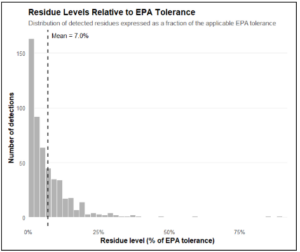
Figure 1: Residue levels relative to EPA tolerance for detected samples. Although residues were detected, their levels were generally low, averaging only about 7% of the applicable EPA tolerance. 

What Responsible Data Use Looks Like 

The responsible way to analyze data is not to pretend that analysis can ever be completely free of judgment. Rather, it is to make that judgment visible. Good analysis should clearly document and explain how data was cleaned, which assumptions were made, why certain variables were included, and whether alternative analytical approaches were considered. When multiple reasonable choices exist, analysts should be willing to show how the results change under different assumptions rather than presenting a single interpretation as if it were inevitable. 

IBM has emphasized (in the referenced article) the importance of understanding how data are collected, interpreted, and communicated. In practice, reducing bias means being transparent about methods, clearly defining hypotheses in advance when possible, reporting alternative analyses, testing how sensitive results are to key assumptions, and presenting findings in their full scientific and regulatory context. These strategies help separate legitimate interpretation from selective storytelling. 

“PFAS Pesticides” and Fresh Produce: What Does the Data Really Say?

March 13th, 2026

Communicating science while navigating misconceptions and mistrust is no easy task. Sometimes a message conveyed about a scientific study is easy to trust and believe, perhaps because of the messenger, or an appeal to common sense and our values.   

A recent article by the Environmental Working Group (EWG) titled “Forever Chemicals contaminate nearly 40% of non-organic California-grown produce” delivers a simple and alarming message: forever chemical pesticides are contaminating the fresh fruits and vegetables we eat. This headline may ring alarm bells for many readers, but there is notable scientific weakness in their analyses and thus, their message. 

In this article, the EWG relies on pesticide monitoring data from the California Department of Pesticide Regulation (CDPR), published in the 2023 California Pesticide Residue Monitoring Annual Report, which includes information on 3,544 fresh produce samples. Raw data can be found here. The EWG report summarizes that 37% of non-organic California produce samples have residues of per- and polyfluoralkyl substances (PFAS) pesticides and that current use of “PFAS pesticides” raises concerns about soil and water contamination. There are two notable weaknesses in EWG’s analysis of the data: their classification for PFAS, specifically as applied to pesticide classification, and how the safe use of pesticides is evaluated and monitored for human and environmental health.  

It’s best to start with the scientific classification of PFAS and what scientists consider “forever chemicals.” PFAS represents thousands of different chemical compounds that have a variety of industrial and medical uses, including waterproofing and flame-retardants. PFAS vary widely in structure and composition, which influences their application as well as human and environmental health impact. Because of PFAS’ wide-scale and varied uses, these chemicals and their by-products can be detected even in remote and pristine environments around the world; and certainly, their presence in agricultural soils and water is a concern and an active area of research.  

The EWG article classifies certain pesticides as PFAS based on a broad Organization for Economic Co-operation and Development (OECD) definition for this group of chemical compounds, one of many regulatory and scientific frameworks that classify PFAS based on their toxicity and environmental persistence.   

In the U.S., the EPA finalized the definition of PFAS in 2023, after years of research and stakeholder input. The EPA differs from that of the OECD and excludes chemical compounds that contain only one fluorine, having determined that these chemical structures pose a lower risk of environmental persistence. According to the EPA, “Extensive scientific evidence and public input demonstrate molecules with only one fluorinated carbon generally lack the persistence and bioaccumulation properties that are commonly associated with forever chemicals.”  The definition of PFAS matters because it conflates all PFAS and “PFAS pesticides” as “forever chemicals” thereby ignoring the importance of PFAS chemical structure to its human or environmental health risk.  

Detection of pesticide residues on fresh produce does not equal health risk. Unfortunately, that is also the simple message communicated by EWG in their discussion of CDPR’s study of pesticide residue. Of course, it may seem like common sense that if a chemical that is described as a forever chemical is present as a residue on fresh produce, you wouldn’t want to serve that produce to family. But, common sense, or intuition, is not science (thankfully). If society had relied only on intuition to drive discovery, human health would have missed critical discoveries like penicillin, x-rays and other complex scientific advancements.   

If we look at the data in the CDPR residue study with a more complete scientific perspective, the study provides strong support for the absence of any substantial risk to human health from pesticide exposure related to the consumption of fresh fruits and vegetables (grown in California). Here are the facts: 930 non-organic fresh produce samples were tested, and 582 of those samples (or 63%) had no PFAS pesticide (per OECD definition) residue detected, and 348 samples (or 37%) had PFAS pesticide (per OECD definition) pesticide residue detected. Almost 40% may sound like a lot, but what’s important for human health risk assessment is that when pesticide residue was detected, the average residue level represented was a fraction (less than 7%) of the total EPA tolerance level determined as safe for the respective pesticide. In practical terms, any given residue level would need to increase over 10-fold before reaching the regulatory limit established by federal regulatory authorities for fresh produce. Regulatory limits for pesticides in fresh produce are based on several conservative assumptions that include well-established toxicological safety factors (often 100-fold) as well as dietary exposure models. These limits are also designed to overestimate expected real-world residues. 

There are multiple rigorous scientific review processes in place before a pesticide is registered, including an additional state registration process completed by the CDPR, which follows an EPA approval of a pesticide. The CDPR review can take additional months to years before a pesticide is allowed to be used in the state. These multiple reviews and conservative residue limits ensure that even the most sensitive consumers can safely eat non-organic fresh produce.  

Pesticide residue monitoring studies, such as the one discussed by EWG in its article, frequently detect trace levels of pesticides in produce as part of routine surveillance programs. The USDA Pesticide Data Program is a national pesticide residue monitoring program that provides a comprehensive dataset to inform the U.S. Food and Drug Administration and other government agencies. These residue data are used by regulators and academic human health and environment risk assessors to continuously review and verify regulatory approvals and challenge and further study the impact of pesticides. The data are valuable, and the agricultural industry fully supports their collection and use.  

Pesticide use in the production of fresh fruits and vegetables is an important topic for the safety of agricultural workers, consumer health and the environment. Growers are investing in precision application techniques, integrated pest management, biological pesticides and other agronomic practices to continuously improve pest management while maintaining safety, quality and cost. Science will continue to drive improvements in pest management. Well-informed consumers and legislators will ensure the research funding, regulatory frameworks and change management solutions remain available to ensure domestic productivity as the industry transitions to new technologies and approaches.   

Simple and misleading messages construing data from complex surveillance studies on pesticide residues meant to alarm are irresponsible and intend to shake confidence in the safety of fresh fruits and vegetables grown in California. The stakes are much too high to jeopardize growers’ access to the best pest management solutions they need to deliver affordable, safe and quality fresh produce for the nation’s families.  

Best Practices: AI-Assisted Performance Evaluations: How Managers Can Use It Well (and Avoid the Traps)

March 13th, 2026

Performance review season puts a spotlight on how managers document results, development, and expectations. This period is critical for both managers and employees as they assess achievements, set future goals, and provide constructive feedback. As annual or biannual reviews approach, leaders are seeking effective strategies to streamline the process and ensure evaluations are fair, thorough, and actionable. Today, as AI becomes central to many aspects of work, managers are increasingly turning to Artificial Intelligence (AI) tools to speed up performance evaluation writing—summarizing accomplishments, spotting themes across notes, and improving consistency from one review to the next. 

Used thoughtfully, AI can be a tremendous partner in reducing administrative time and helping leaders focus on coaching and performance improvement. Used carelessly, AI can amplify bias, introduce inaccuracies, and create documentation risk. Overall, the goal for managers shouldn’t be to “let AI write the review,” but to use AI as a drafting and analysis assistant while staying accountable for fairness, accuracy, and context. 

When managers provide high-quality inputs (e.g., goal statements, project outcomes, examples of impact, and timely feedback notes), AI can meaningfully improve the review process. Common wins include faster first drafts that managers can refine; clearer writing that translates technical work into business impact; more complete coverage of the review period by summarizing across multiple sources; and more consistent structure and language across a team, which can help reduce “style variance” that sometimes looks like unfairness. 

Conversely, the use of AI tools in the performance management space can also introduce a wide range of risks. AI tools can produce confident-sounding text that is incomplete, misleading, or poorly grounded in facts. For example, if the prompt is vague (e.g., “write an evaluation for Alex”), the output may lean on generic stereotypes, exaggerate strengths, or gloss over specific performance issues. AI can also mirror bias embedded in historical language (e.g., different adjectives commonly used for different groups) and can unintentionally shift tone—turning balanced feedback into overly harsh or overly soft wording. 

Finally, there are confidentiality and compliance concerns: performance evaluations often contain sensitive Human Resources data, heightening the need for managers to strictly follow company policy on what information can be entered into third-party tools, where data is stored, and who can access it. 

To help lower these risks, employers should assist managers by making them aware of the more common pitfalls and how best to avoid them. Below are a few key takeaways to guide the use of AI in preparing performance evaluations: 

  • Use AI to summarize evidence, not to invent it: Prompt AI with concrete examples (i.e., goals, deliverables, metrics, peer feedback) and verify every claim before it goes into the final review. 
  • Actively check for bias and tone drift: Review the output carefully for uneven language—for example, using “abrasive” vs. “direct,” or “helpful” vs. “high-impact.” It is also important to ensure feedback is anchored to expectations and observable behavior. 
  • Protect sensitive information: Emphasis and guidance should include clear directions to follow the organization’s rules on what employee data can and cannot be entered into AI tools. Guidance should also instruct managers that when in doubt, they should remove identifiers and keep drafting inside approved systems. Key information to remove/replace includes: employee name, company name, coworker/customer/vendor names, specific locations, exact dates (if not needed), unique project code names, ID numbers, medical/leave/benefit details; anything that could identify the individual or the company.  
  • Keep human accountability: Managers must own the evaluation and be held accountable; AI can speed up drafting, but only the manager can weigh context, apply judgment, and ensure fairness. 

You’re Invited: Ag Leaders to Host California Gubernatorial Candidate Forum – April 1 in Fresno

March 9th, 2026

A broad coalition of more than 30 agricultural organizations will host a California gubernatorial candidate forum focused on affordability and rural issues in the state.

The California Gubernatorial Candidate Forum: Affordability and Rural California will bring together many of the major gubernatorial candidates from both parties for a substantive discussion on the issues shaping the future of California agriculture, rural communities and food affordability. The forum is designed to elevate agriculture’s voice, highlight the connection between regulatory costs and food prices and provide candidates with the opportunity to engage directly with the agricultural community.

Event Details

Date: Wednesday, April 1, 2026

Time: Doors open at 11:00 a.m. PST | Program: 12:00 p.m. – 1:30 p.m. PST

Location: Resnick Student Union, California State University, Fresno

REGISTER TODAY!
RSVP by Friday, March 27, using this link.

After you register, you will receive your digital ticket, which will be required for entry.

Space is limited and attendance will be available on a first-come, first-served basis. Those interested in attending are encouraged to register in advance to receive a digital ticket required for entry.

We encourage you to join agricultural leaders from across California for this important and timely conversation.


Guidelines for Youth Employment in Agriculture

March 13th, 2026

Every year, millions of teens work part-time or summer jobs. In California and Arizona many of those jobs are agriculture related. These early job experiences can be valuable for young people, giving teenagers meaningful chances to develop essential work skills. It is important for employers to recognize and be familiar with state and federal child labor laws ensuring minors receive access to safe occupations that do not jeopardize their health, well-being, or educational opportunities. Federal child labor laws tend to be stricter than most state laws and must be applied in all circumstances where they provide greater protection including the payment of wages. 

Arizona Youth Employment Laws 

The Arizona Department of Labor enforces and administers the state’s Youth Employment Laws. As noted above, the federal FLSA under the Wage and Hour Division of the U.S Department of Labor also regulates the employment of minors. Employers faced with differing state and federal laws must apply the law most protective of the minor. State laws regulate the hours a minor can work and prohibit certain occupations in which they can be employed. 

In Arizona, severe limitations placed on the hours and type of work that can be performed by minors under the age of 16 can make their employment impractical. 

Minors working in Arizona are not required to obtain government work permits. Minors between the ages of 16 and 18 are employable if the occupation in question is not deemed hazardous under state or federal law. Minors under 17 years of age working in agriculture are prohibited from employment as motor vehicle drivers or outside helpers and may not be involved in the operation of “power-driven hoisting apparatus” (e.g., forklifts, cranes). Minors between 16 and 17 years old may drive on the job so long as the total drive time does not exceed two hours per day or 25% of their workday and is limited to not more than fifty or more miles per day. However, since federal law prohibits 16 and 17-year-olds from driving on the job, employers should consult counsel before employing such minors in any job that requires them to drive. 

Exceptions to the state’s occupational restrictions are as follows: 

  • When youths are employed by a parent or relative and that person owns at least 10% of the company and is actively engaged in the daily operation of the organization. 
  • When youths are employed in career education programs, vocational or technical training school programs. 
  • When youths are employed as apprentices and registered by the Arizona Bureau of Apprenticeship and Training. 
  • When youths are employed under the 4-H Federal Extension Service or the United States office of education vocational agriculture training programs. 

California Youth Employment Laws 

California employers must comply with both state and federal laws regulating the employment of minors. Like Arizona, severe limitations placed on the hours and type of work that can be performed by children under the age of 16 can make their employment impractical. With some exceptions, California has adopted federal agricultural occupational prohibitions for minors under the age of 16. The U.S. WHD’s Child Labor Bulletin provides detailed information on FLSA provisions applicable to minors employed in agriculture. The California Department of Industrial Relations also provides a very helpful table summarizing its child labor laws. 

With limited exception, all California minors under the age of 18 must have a permit to work. Employers seeking to employ minors must possess a valid Permit to Employ and Work. The Permit is typically issued by authorized individuals at the minors’ school or from the school’s superintendent when school is not in session. Minor Work Permits are also typically issued by the individual’s school officials. Work Permits must be renewed on an annual basis. 


Additional useful resources: 

ICA Labor Department – Youth Employment 

California Labor Commissioner’s Child Labor Law Booklet 

California DIR Information on Minors and Employment 

U.S Wage and Hour Division Youth Rules 

DOL Wage & Hour Division: Child Labor Bulletin 

DOL Wage and Hour Division Fact Sheet on Child Labor for Agricultural Occupations 

DOL Wage and Hour Division Child Labor

What To Do If You Receive an SSN Mismatch Notice After ACA Reporting 

March 13th, 2026

Applicable large employers (ALEs) that sponsor health coverage are required to file annual Affordable Care Act (ACA) information returns with the Internal Revenue Service using Forms 1094-C and 1095-C. These forms report information about the employer’s offer of health coverage and include identifying information for employees and covered dependents, including names, addresses, and taxpayer identification numbers (TINs), typically Social Security numbers (SSNs).  

Occasionally, employers receive a notice from the IRS indicating that an employee’s name and SSN reported on a Form 1095-C do not match the IRS or Social Security Administration records. These “SSN mismatch” errors are common in ACA reporting and typically arise from data entry mistakes, name changes, or discrepancies in the employee’s records.  

While these notices can be concerning, employers should understand that they generally relate to reporting accuracy, not immigration status or employee work authorization. 

Why the IRS Sends SSN Mismatch Notices 

The ACA added reporting requirements under Internal Revenue Code sections 6055 and 6056. These provisions require employers and coverage providers to report identifying information for covered individuals so the IRS can administer the employer shared responsibility rules and determine eligibility for premium tax credits.  

If the name and SSN reported on a Form 1095-C do not match IRS records, the ACA Information Returns (AIR) system may flag the filing as “accepted with errors” or generate an error code identifying the mismatch.  

Although an incorrect SSN may expose employers to potential information-return penalties, the IRS regulations provide a “reasonable cause” process that can protect employers who make documented efforts to obtain accurate information from employees. 

The IRS TIN Solicitation Safe Harbor 

IRS regulations allow employers to avoid penalties for missing or incorrect SSNs if they follow the IRS taxpayer identification number (TIN) solicitation process described in IRS Publication 1586.  

Under this framework, employers must make reasonable efforts to obtain the correct SSN through a three-step solicitation process: 

  • Initial solicitation. Employers should request the employee’s SSN at the time of enrollment in health coverage or shortly thereafter. 
  • First annual solicitation. If the SSN is missing or incorrect, the employer must request the information again by December 31 of that same year (or shortly after the error is discovered). 
  • Second annual solicitation. If the information is still missing or incorrect, a final request must be made by December 31 of the following year.  

If an employer follows this process and maintains records of these solicitations, the IRS generally treats the employer as having reasonable cause for the reporting error. Employers may consult IRS guidelines and regulations here. 

Practical Steps for Employers 

If your organization receives an SSN mismatch notice related to ACA reporting, consider the following steps: 

  • Review the filing for clerical errors. Confirm that the employee’s name and SSN were entered correctly and match the information on the employee’s payroll records. 
  • Notify the employee. If the information appears incorrect, ask the employee to verify their legal name and SSN as reflected on their Social Security card.  
  • Document your solicitation.  Follow the solicitation cadence outlined above and maintain written records showing when the request for corrected information was made and any responses received.  
  • Correct the filing if necessary. If a corrected SSN is obtained, file a corrected Form 1095-C (and associated Form 1094-C if required) following the IRS instructions for ACA reporting corrections. 
  • Retain records. Keep documentation of your outreach and corrections to support a reasonable-cause defense if the IRS later proposes penalties. 

Avoid Overreacting 

An SSN mismatch notice should not be treated as evidence that an employee lacks work authorization. These notices simply indicate a discrepancy in IRS records and may be caused by typographical errors, name changes, or outdated records. Employers should focus on correcting reporting data rather than taking employment-related action based solely on the notice. 

Bottom Line 

ACA SSN mismatch notices are relatively common and typically relate to reporting accuracy rather than compliance failures. Employers that follow the IRS TIN solicitation procedures, request corrected information from employees, and maintain documentation of those efforts can often avoid penalties for reporting errors. 

If you have questions about ACA reporting requirements or how to respond to an IRS notice, consult with your payroll provider or experienced employment counsel.

EPA Accepting Nominations for National Drinking Water Advisory Council

March 11th, 2026

The Environmental Protection Agency (EPA) is seeking nominations for qualified candidates to serve on the National Drinking Water Advisory Council (NDWAC), according to a recently published notice in the Federal Register.

EPA welcomes candidates from the general public; state and local governments concerned with water hygiene and public water supply; and representatives of private organizations or groups demonstrating an active interest in the field of water hygiene and public water supply.

The NDWAC reserves two spots for rural stakeholder representatives.

Nominations will be accepted through April 8, 2026. Individuals interesting in serving or recommending a candidate can submit nominations through the Federal Register notice.


Produce Safety Alliance Seeks Feedback for Pilot Grower Training Course

March 11th, 2026

The Produce Safety Alliance (PSA) is developing Version 2.0 of its Grower Training (GT) course curriculum and is inviting members of the produce industry to help pilot the updated program.

To ensure balanced representation across stakeholder groups, a selection process to participate in these courses is being conducted using a Qualtrics survey. PSA is targeting these four specific groups:

  • Fresh produce growers who have never attended a PSA GT
  • Fresh produce growers who have already taken a PSA GT
  • Extension educators or others who are currently serving as PSA Trainers
  • Regulatory personnel engaged in FSMA Produce Safety Rule inspections

If you belong to one of these groups and are interested in being considered for one of the pilots, please fill out the survey before March 20.

To learn more about the PSA and the GT course, please visit: https://cals.cornell.edu/produce-safety-alliance/training/grower-training-course.

UCANR Publication Reflects on INSV and Thrips in 2025 Lettuce Season

March 11th, 2026

An article by University of California Agriculture and Natural Resources (UCANR) identifies important weeds that can host Impatiens Necrotic Spot Virus (INSV), particularly broadleaf weeds growing upwind of farming operations. Old and unmanaged weeds have the highest risk for INSV infection but there is still opportunity to manage and reduce the risk of INSV. USDA and UCANR have been monitoring INSV in weed populations as well as thrips populations in the Salinas Valley. INSV is a highly problematic virus for leafy green crops, and can infect hundreds of different species, including weeds adjacent to agriculture, where these weeds can serve as a harbor for the pests and the disease.

Read the publication here.

Join the Effort to Help Improve Food Safety in the Agricultural Ecosystem

March 11th, 2026

The California Agricultural Neighbors (CAN) Scientific Engagement and Communication Work Group (Working Group #5) brings together growers, livestock operators, researchers, regulators and industry leaders to translate emerging science into practical food safety strategies for agricultural landscapes. The group will be focusing on applying findings from the California Longitudinal Study (CALS) and related research to improve how neighboring agricultural operations, such as fresh produce fields, livestock production, wildlife habitat, and compost operations, can work together to reduce overall ecosystem microbial pathogen risk.  

Through collaboration and projects, the working group will review current science, develop practical guidance, and create tools that help producers apply co-management strategies that protect both public health and agricultural sustainability. The goal is to move scientific insights into real-world actions that strengthen food safety while recognizing the interconnected nature of modern agricultural ecosystems.  

The work group requests and welcomes participation from producers, researchers, industry partners, and other stakeholders interested in contributing their expertise and perspective to help shape the next generation of science-based agricultural food safety practices.  

To learn more about participating, please fill out this form 

New Study Introduces Framework for REP Strains of Foodborne Pathogens

March 11th, 2026

A new peer-reviewed article published in the Journal of Food Protection introduces a framework for describing Reoccurring, Emerging, and Persisting (REP) strains of foodborne pathogens. The paper, written by scientists from CDC, FDA, USDA-FSIS, Association of Public Health Laboratories, ASRT, Inc., and Gret Hill Solutions, outlines a framework for understanding strains that cause human illness over extended periods of time rather than appearing only as sporadic outbreaks. 

The paper also reflects how advances in whole genome sequencing (WGS) have improved pathogen surveillance, and how WGS now provides much higher resolution for determining genetic relationships between bacterial isolates. These tools allow investigators to identify groups of closely related strains and link illnesses that occur across multiple years, geographic regions, or exposure pathways. To illustrate the application of the proposed framework, the paper presents six case studies representing REP strains identified through historical foodborne disease outbreaks. 

Key Takeaways from the Article 

  1. Most illnesses are not part of recognized outbreaks: The authors note that acute outbreaks represent only a small fraction of foodborne illnesses reported through surveillance systems. As a result, many infections appear sporadic and are difficult to link to specific sources using traditional outbreak investigation methods. 
  • Some pathogen strains persist in the food system or environment: With the use of genomic surveillance, investigators have identified groups of genetically related strains that cause illnesses over months or years. These strains may appear repeatedly or continuously in surveillance data, even when they are not associated with a single outbreak event. 
  • The REP framework classifies strains based on illness patterns. The framework groups strain into three categories: 
    • Reoccurring strains: trains that periodically cause a substantial number of illnesses, typically in outbreaks, separated by periods when the strain is not isolated from humans or causes very few illnesses. 
    • Emerging strains: trains that cause illnesses that are increasing in frequency or are thought to have the potential to increase in frequency. 
    • Persisting strains: cause illnesses consistently over time, although the number of illnesses may fluctuate from month to month or year to year. 

The authors emphasize that these designations are dynamic, meaning a strain may move between categories as new information becomes available. They also note that the term “persisting” refers to continued detection in human clinical isolates, not necessarily persistence in animals or environmental reservoirs.  

  • High-resolution genomic methods are essential for identifying REP strains: REP strains are defined as groups of genetically related isolates that cause illness over long periods, typically a year or more. The paper explains that these strains are most effectively identified and tracked using WGS-based methods that allow for differentiation between isolates. 
  • 6 case studies demonstrate how the framework can be applied: The article presents six case studies representing the three REP categories. These include: 
    • A reoccurring E. coli O157:H7 strain linked to outbreaks associated with leafy greens 
    • A reoccurring Salmonella Typhimurium strain associated with contact with pet hedgehogs 
    • An emerging multidrug-resistant Salmonella Newport strain linked to multiple exposure pathways 
    • An emerging Salmonella Reading strain associated with turkey products 
    • A persisting Listeria monocytogenes strain with a possible link to potatoes 
    • A persisting multidrug-resistant Salmonella Infantis strain linked to chicken products 

These examples demonstrate how strains can cause illnesses over extended timeframes and across different reservoirs, including food, animals, and environmental sources. For the leafy greens case study, the paper describes a reoccurring STEC O157:H7 strain (REPEXH02) that caused several outbreaks between 2016 and 2020 in the United States and Canada. Whole genome sequencing allowed investigators to determine that the illnesses across multiple years were caused by closely related isolates, connecting events that would otherwise appear as separate outbreaks. During investigations, the strain was detected in environmental samples, including sediment from an agricultural water reservoir used for irrigation and post-harvest activities. 

Why this matters: 

The REP framework represents a new way in how REP strains are characterized. Rather than focusing only on isolated outbreaks, this approach emphasizes long-term surveillance and understanding of pathogens. By identifying strains that repeatedly cause illness, investigators can begin to better understand potential transmission pathways and factors that may contribute to illness. The authors note that effective monitoring and control of REP strains will require continued collaboration among public health agencies, regulatory partners, academia, and industry, along with further development of genomic and epidemiologic tools to support these investigations. 

New Voices of the Valley: From San Francisco to the Farm with Jacie and Zac

March 10th, 2026

In this episode of Voices of the Valley, we sit down with Jacie Johnston Green and Zac Green of Johnston Farms and WN Citrus, a fourth-generation family operation nestled at the base of the Tehachapi Mountains. What began nearly 80 years ago with a single potato crop has grown into a diverse farm producing citrus, potatoes, peppers, carrots and more across thousands of acres.

Jacie and Zac share their agriculture journey, from Jacie returning to her family’s farm after working in the Bay Area to Zac leaving a successful San Francisco coffee business to join the operation. Together, they reflect on the challenges and rewards of farming in California, the realities behind common agriculture myths and what it means to carry forward a multigeneration legacy.

Listen to the episode here.

WG Joins State and Academic Leaders to Launch California Agricultural Research & Innovation Roadmap

March 10th, 2026

A coalition of state, academic and agricultural industry partners has introduced the California Agricultural Research & Innovation Roadmap, a new blueprint designed to accelerate research, innovation and real-world adoption of next-generation tools for California agriculture.

Developed collaboratively by the California Department of Food and Agriculture (CDFA), University of California Agriculture and Natural Resources (UC ANR), the California State University Agricultural Research Institute (ARI), California Community Colleges, Western Growers and the California AgTech Alliance, the roadmap identifies 10-year research priorities and near-term innovation opportunities to help address the biggest challenges facing agriculture.

Research priorities include: Climate Resilience and Environmental Sustainability; Water Management, Use Efficiency and Quality; Integrated Pest and Disease Management; Food Safety and Consumer Health; Technology, Automation and Data‑Driven Farming; and Economics, Policy and Adoption Pathways.

“No single institution can carry the future of agricultural research and innovation alone, and the significance of this plan is the commitment from multiple parties to work together to turn the plan into action. This roadmap clearly shows the need for inter-disciplinary approaches to the many challenges we face now and into the foreseeable future. California’s world-class public academic institutions have long been partners in the innovation of California farming and ranching. With the support of agricultural leaders, they have the power to accelerate the discovery of solutions to drive the health of our rural communities, the environment, and all California citizens,” said CDFA Secretary Karen Ross in a press release.

In support of the roadmap, each partner has committed to aligning its resources to support the plan. Western Growers will involve farmers in validating the roadmap’s priorities, align ag tech solutions with those priorities and help drive widespread industry adoption of research based‑ innovations.

Other partner commitments include:

CDFA will convene state agencies and partners, inform policymaking with the latest science and align grant opportunities with roadmap priorities.

UC ANR will direct research funding toward these priorities, translate science for policymakers and help farmers adopt new practices through Cooperative Extension, while also introducing the roadmap to new researchers.

ARI will prioritize research aligned with the roadmap in its funding decisions, launch a Collaborative Innovation Grant for teams across institutions and disciplines, modernize workforce training‑ curricula and support skills development for students.

California Community Colleges will codevelop new agricultural curricula, align workforce training with the roadmap, promote ag careers through recruitment efforts, expand apprenticeships, provide reskilling and upskilling for current and future workers, and support climate focused‑ initiatives that advance sustainable agriculture.

California AgTech Alliance will develop a list of farmer- and workforce-driven innovation priorities with commercialization potential to be updated every two years.

While the plan is being rolled out, it is constantly evolving. Stakeholders are encouraged to provide feedback on the roadmap, and those who fund agricultural research are encouraged to do so in alignment with the research priorities. To learn more about how you can support the roadmap or get involved, contact Josh Eddy at 916-654-0462 or [email protected].

You can read the full CDFA press release here.


California Pay Data Reporting is Open

March 6th, 2026

As a reminder, on February 2, 2026, the California Civil Rights Department (CRD) announced the opening the pay data reporting portal for data from 2025. Under California law, private employers of 100 or more employees or workers hired through labor contractors are required to report pay, demographic, and other workforce data to the state each year. The deadline for employers to file with CRD is May 13, 2026. 

As discussed here, the CRD has published updated pay data guidance and FAQs – accessed via the CRD Pay Data Portal – to help filers with expected format and data fields for reporting year 2025.  

Additional information and resources about pay data reporting can be found on the department’s website 

NLRB Issues New Case Handling Guidance

March 6th, 2026

On February 27, 2026, the National Labor Relations Board’s Office of the General Counsel issued a new Case Handling Guidance memorandum (GC Memo) outlining updated expectations for how Regions investigate, resolve, and prioritize unfair labor practice cases.  

For employers, the GC Memo signals a more streamlined and pragmatic enforcement approach to enforcement, with increased emphasis on settlements, tighter controls on evidence requests, and reduced pursuit of cases based solely on technical rule maintenance without demonstrated impact. 

The GC Memo confirms that prior guidance issued by former Acting General Counsel Cowen remains in effect, including the rescission of several earlier General Counsel memoranda and the implementation of the Agency-Wide Docketing Protocol. The GC Memorandum further affirms that the agency will discontinue efforts to prompt the Board to reconsider specific precedents and is currently engaged in a review and withdrawal of related allegations in ongoing cases. 

The GC Memo further reinforces that settlement remains the preferred resolution whenever feasible. Regions are directed to approve lawful settlements even where allegations remain, and enhanced remedies—such as notice readings, apology letters, or nationwide postings—should not be routinely sought, but instead reserved for egregious or repeat violations.  

Furthermore, the General Counsel raised issues about cases based solely on the existence of possibly illegal workplace rules, especially when there is no proof that these rules have been enforced or affected employees in any way. Regions are instructed to seek settlement or dismissal in such cases, particularly where employers agree to remediate the challenged rule.  

Finally, the GC Memo tightens expectations around evidence requests. Charging parties are expected to produce supporting evidence within two weeks of filing, and requests to employers must be specific, relevant, and limited to what is necessary to assess the merits of the case. Going forward, broad or boilerplate document requests—such as demands for entire handbooks—are discouraged unless directly pertinent.  

A few key takeaways for employers to keep in mind: 

  • Settlement is Strongly Favored. Based on the GC Memo, the NLRB stance will be to prioritize settlements over litigation and discourage routine use of enhanced remedies (e.g., apology letters, notice readings), signaling a more practical, resolution oriented enforcement posture.  
  • Rule Only Allegations Face Greater Scrutiny. Cases that rely only on the existence of workplace rules—without proof that they have been enforced or affected employees—are less likely to move forward, especially if employers are willing to change or remove the rule. 
  • More Focused Investigations and Evidence Requests. With regions being instructed to limit evidence requests to what is directly relevant and necessary, the burden on employers in responding to complaints should be reduced and will hopefully encourage faster case resolution. 

NLRB Publishes Final Rule Restating 2020 Joint Employer Standard

March 6th, 2026

On February 27, 2026, the National Labor Relations Board (NLRB) published a final rule withdrawing its 2023 joint employer standard and formally restoring the prior rule governing joint employer status under the National Labor Relations Act (NLRA). The rule took effect immediately upon publication and reinstates the regulatory text originally promulgated in February 2020. 

How the Rule Came to Be Published 

The final rule follows a series of legal and procedural developments that prevented the 2023 joint employer standard from ever taking effect. In October 2023, the Board issued a rule intended to rescind and replace the 2020 joint employer rule. That 2023 rule was subsequently challenged in federal court, and on March 8, 2024, the U.S. District Court for the Eastern District of Texas vacated it in its entirety. As a result, the Board determined that the 2023 rule had no legal effect and that the 2020 rule remained the operative standard. 

To comply with the court’s order, the Board revised its regulations to remove the vacated 2023 text and replace it with the previously effective 2020 rule. The Board characterized this action as “ministerial in nature” and invoked the Administrative Procedure Act’s good cause exception to finalize the rule without notice and comment. Because the rule merely implements the court’s vacatur, the Board concluded that the action has no independent economic effect and was not subject to the Congressional Review Act. 

What Does it Mean 

Under the restored rule, an entity may be found to be a joint employer if it possesses and exercises substantial direct and immediate control over one or more essential terms and conditions of employment as would warrant finding that the employer meaningfully affects matters relating to the employment relationship of another employer’s employees. Joint employer determinations must be based on the totality of the relevant facts in each particular employment setting, and the burden of proof rests with the party asserting joint employer status. 

The rule defines “essential terms and conditions of employment” to include wages, benefits, hours of work, hiring, discharge, discipline, supervision, and direction. It further explains what constitutes “direct and immediate control” for each of these categories, emphasizing actual decisionmaking authority rather than indirect influence or contractual reservations that are never exercised. Indirect control and unexercised contractual authority may be considered only to the extent they supplement evidence of direct and immediate control. 

Key Takeaways for Employers 

  • Direct control is the cornerstone of joint employer status. An entity must actually exercise substantial, direct, and immediate control over essential employment terms to be deemed a joint employer; indirect influence alone is insufficient. 
  • Reserved authority, standing alone, is not enough. Contractual rights that are never exercised do not establish joint employer status unless they reinforce evidence of actual direct control. 
  • Routine operational coordination remains permissible. Setting project timelines, operating hours, or performance expectations—without controlling how work is performed or employment decisions are made—does not constitute direct and immediate control. 
  • The 2020 framework is now firmly reinstated. Employers should evaluate labor management relationships, vendor agreements, and franchise or staffing arrangements under the restored 2020 standard, as it is once again the operative rule for NLRA purposes. 

Multi-Year FDA Study Provides New Insights to Advance Produce Safety in California’s Growing Region

March 5th, 2026

New findings from a five-year federal study are offering fresh insights into how foodborne pathogens move through California’s Central Coast growing region and what it means for produce safety.

On March 5, 2026, the U.S. Food and Drug Administration (FDA) shared initial findings from its California Longitudinal Study (CALS), launched in 2020, to better understand the environmental factors that influence the introduction, persistence and spread of foodborne pathogens in California’s Central Coast agricultural region.

What the Study Found

Conducted in collaboration with the Western Center for Food Safety at the University of California, Davis; the California Department of Food and Agriculture; and regional stakeholders, the study provides the following insights:

  • Longitudinal data on the trends in pathogen presence in the region over time
  • Identification of potential sources of STEC, including wildlife and livestock on adjacent or nearby land
  • Analysis of how environmental conditions influence pathogen persistence and movement
  • Greater understanding of pathogen diversity within the region

What Can Growers Expect

The FDA is now engaging stakeholders to review the data, discuss findings, and assist with the development or revision of risk management practices as needed.

In response to the study’s release, Western Growers is taking an active role through the California Agricultural Neighbors (CAN) initiative. Western Growers is leading CAN Working Group #5: Scientific Engagement & Collaboration to translate the CALS findings, evaluate existing best practices, develop guidance and strengthen coordinated efforts to reduce risk across the agricultural ecosystem. Click here to learn and join this group.

Western Growers will continue to work with other fresh produce industry associations, the entities engaged in this study, and other stakeholders to support efforts that strengthen produce safety and promote continuous improvement.

For additional information regarding the study, visit the FDA’s California Longitudinal Study webpage. To see the FDA’s Constituent Update, click here.

To read an update posted by the CDFA, click here.

For any questions related to the study findings and the work of the CAN working group #5 reach out to the WG Science team.