Mark Mason from Huntington Farms Kicks Off WGCIT Lunch & Learn Events for 2023

January 23rd, 2023

In the first WGCIT Lunch & Learn event of the year, Mark Mason from Huntington Farms shared his thoughts about the future of agriculture, both in terms of workforce development and how to integrate new innovation into existing systems.

Mason, who manages Huntington Farms’ location in the Salinas Valley, spoke about the potential for the Next-Gen Ag Workers program, coining the term “two-year tech,” and his hope to hire these students for his ranch.

The Next Gen Ag Workers program is a Western Growers effort to implement modules into the current two- and four-year college programs to educate students about technology and systems unique to a career in agriculture. The modules are set to be utilized in the upcoming Spring 2023 semester. Once a student completes five of the 10 modules available, they will be to have access to internship opportunities with Western Growers members.

For the representatives from 18 startups that were in attendance, Mason talked about “farming by committee” and how the integration of new technology has to marry itself with the systems that already exist on a farm for implementation to happen.

For more information about WGCIT’s monthly Lunch & Learn events, visit the website here.

VofV Podcast: Seana Day on How Farmers Can Use Technology to Make Financially Sound Decisions

January 24th, 2023

In this episode of Voices of the Valley, Seana Day, Partner with Culterra Capital and Venture Partner with Better Food Ventures, joins Dennis Donohue and Candace Wilson to share her perspective about the need for digital systems to better utilize farmers’ time, information and resources.

“When we think about the role of technology and optimizing our assets, our resources, it just doesn’t make sense to me why more companies aren’t thinking about integrating those technologies…it’s always surprising to me how much loss or waste operators are willing to assume as just a cost of doing business,” Day shares.

Day also speaks about the growing need for a workforce trained in the unique environment of an agricultural organization and how important it is for those working in specialized roles to integrate with one another and the software that’s available.

“I’m looking at all of this information and it’s siloed,” Day says. “It’s so disconnected. It’s so analogue. It’s all done on pen and paper, and it takes forever. Making any kind of remotely real-time decision – let’s be honest, there’s a lot of risk. You leave revenue on the table. Your costs are inflated. There’s more risk than there should be because we’re not able to access information…to make those swift decisions.”

As Venture Partner, Day also offers insight into the three things that stand out to her when she’s assessing startups and what sets the two-to-four that are chosen apart from the hundreds that apply.

Click here to listen to this week’s episode.

Join the California DRIP Collaborative for Drought Planning, Response and Management

January 24th, 2023

The Drought Resilience Interagency and Partners (DRIP) is an opportunity for representatives from a wide range of water-related interested parties to be a part of a standing interagency drought and water shortage task force for the state of California.

This task force will facilitate proactive state planning and coordination for pre-drought planning, drought emergency response and post-drought recovery; develop strategies to enhance collaboration; and develop plans, responses and strategies in a way that considers all water users.

Two representatives will be selected to represent agriculture to work with eight representatives from state agencies and two representatives each from local governments, community-based organizations, Tribal representation, nonprofit technical assistance providers, the public, environment, public water systems, and experts in land use planning, water resilience and water infrastructure.

Selected members are expected to serve for a two-year term for three meetings within those two years.

Visit the California Department of Water Resources website here for more information.

To apply visit the California Department of Water Resources page here or fill out the PDF template here and email it to [email protected]

Letters of interest are due Feb. 24, 2023.

WG VP of Innovation Walt Duflock Takes a Deep Dive into Vertical Farming

January 24th, 2023

Controlled Environment Agriculture (CEA) remains a very controversial and high-profile space. As one of the largest investment categories in AgriFoodTech, vertical farming and greenhouse startups have received over $7 billion in venture investment the past five years.

Companies like Plenty, Bowery and AeroFarms have received large investments in part because of the media’s over-hype of the entire space. Vertical farming, in particular, has been seen as a game changer for food production and positioned as a fully buzzword-compliant Farming 2.0 offering that meets all of the modern consumer’s requirements around sustainability, locally grown, traceability, and organic (or at least organic-equivalent) production.

But a funny thing happened on the way to the finish line after investors wrote all those checks. It turns out that vertical farming is not all green fields and unicorns – in fact, it turns out that almost all vertical farming products end up competing on the way to the customer with a lot of Western Growers members that have worked hard to optimize supply chains and relationships with the person buying food in stores and restaurants.

The lack of a clear go-to market strategy around products that taste great, are priced right, and are something consumers want to put in their shopping cart or on their plate is hurting a lot of well-funded vertical farms – and that should not be a surprise. There will be a few winners in vertical farming and green house operations, but there’s going to be a lot of bad investment outcomes as well.

All the investors and founders who didn’t understand the competitive dynamic of the food space now have a huge clean up on Aisle 10 (and 11 … and 12).

To read more from WG’s VP of Innovation Walt Duflock, visit his blog

Train-the-Trainer Virtual Workshop

January 25th, 2023

Prepare your HR Professionals with this four-hour Harassment, Discrimination, and Abusive Conduct training designed to equip them with the knowledge they need to comply with the requirements outlined in SB-1343, AB-1825, AB-2053, SB-396, SB-400, and SB-188. Participants will also gain a deeper understanding of how sexual harassment affects health, productivity, quality, and service. By the end of this training, individuals will be able to effectively:

  • Train managers and non-supervisory staff in federal and state anti-harassment practices
  • Identify abusive conduct and harassment based on gender identity, gender expression, sexual orientation, and other protected classes
  • List the costly consequence of not addressing complaints and conducting a thorough investigation
  • Recognize adverse employment actions made against those who file a complaint and address retaliatory behavior
  • Apply best practices that support a more inclusive culture.

Event Details

Date: February 16, 2023

Time: 8:00 a.m. – 12:00 p.m.

Cost:

  • Early Bird Discount – Expires February 9, 2023
    • Member: $590
    • Non-Member: $770
  • Regular Cost
    • Member: $660
    • Non-Member: $860

To register, contact Anna Bilderbach at [email protected] or click here today!

The water supply crisis is devastating California’s farms. It’s time for a crisis-level response.

January 25th, 2023

Editor’s note: This opinion piece was first published Dec. 1 in The Bakersfield Californian. Reprinted with permission.


For decades, California has been paralyzed, prevented from securing an adequate water supply by endless debate, red tape and litigation over where, how, and even if the state should create more water supply infrastructure. In the last few years some major farming regions have received almost no water from state and federal projects built specifically to provide water for food production—yet calls to further choke off water to these and other farming regions have grown even louder. As farms are starved of water, California sacrifices critical food production, jobs in agriculture and the economic health of entire regions of California.

It doesn’t have to be this way, and this shouldn’t be our destiny. Gov. Gavin Newsom’s recent call for a direction, California’s Water Supply Strategy: Adapting to a Hotter, Drier Future, projects—for the most part—an overdue end to the decades of futzing and fighting that have transformed the state from water secure to water crisis. With the strong warning that some aspects of Newsom’s strategy could be counterproductive—particularly upending the state’s water rights laws—it is now time for follow through.

California policymakers, starting with the Legislature and Newsom’s own regulatory agencies, must change course and make big investments—some of which the Governor explicitly called for—to protect California’s position as the backbone of America’s food production while ensuring the water security of residents and businesses in every region. California’s agriculture industry—the most productive in the country and the world—is feeling the pressure more than any industry in the state.

An analysis from Yale University calls California “America’s garden,” noting that the State produces two-thirds of all fruits and nuts grown in the U.S. Because of the failure to secure adequate water for farming, cutbacks in food production are already occurring and will get progressively worse.

Up and down the state, farm fields are being left unplanted, susceptible to wind-blown erosion and loss of soil health. Californians are confronting yet another dry year as 2023 approaches, defined by emergency conservation orders, wildfires and rolling blackouts. California’s existing water system, which has not seen significant improvements since 1968, is not equipped to handle climate change, a population of 40 million and extreme drought. According to a UC Merced study, the drought from 2020-2022 cost California’s agriculture sector about $2 billion and nearly 19,420 full- and part-time jobs. The California Farm Water Coalition warns of another 23,000 jobs lost and at least $3.21 billion in economic losses related to water shortages. This is not sustainable.

California farmers have developed the most sophisticated and technologically advanced food production systems in the world, creating more healthy foods with the highest commitments to sustainability and efficient use of resources, especially water. But there is a reality that cannot be avoided: Producing the foods we need requires a lot of water.

The Governor stated: “We have a renewed sense of urgency to address this issue head on…we can’t do the same thing anymore, and I think all of us recognize that.” As our water supply crisis threatens the state’s farming regions with uncontrolled economic and social harm, Newsom and the Legislature have an opportunity—indeed, an obligation—to act boldly and expeditiously on immediate generational solutions including more storage, improved conveyance, regulatory certainty and new supply. California farmers, businesses and residents all deserve and desperately need definitive action.

Understanding the Drivers of Corporate Health and Wellness

January 25th, 2023

A perfect balance of health and well-being. Does it exist? To a small few, it does—but for a majority of people, finding that balance can prove extremely challenging. That’s when things can start taking a toll on employees’ mental and physical health, and the negative effects can spill into their work performance and eventually their employers’ bottom lines.

“The Great Resignation” and “work-life balance” are buzzwords we’ve all been seeing lately, and these are reflective of the fact that the U.S. Bureau of Labor Statistics found that nearly 4.15 million people quit their jobs in August 2022. Employees are prioritizing their mental health, so much so that an estimated 64 percent of full-time employees said they would choose working in a less stressful environment over a 10 percent increase in salary, according to research from the Lincoln Financial Group. More interestingly, nearly two-thirds of employees said they have left a previous job or would like to leave their current job because it’s interfering with their mental health.

Here are other concerning statistics:

• U.S. workers are some of the most stressed employees in the world (Gallup’s State of the Global Workplace 2022)

• 40 percent of workers reported their job as being very stressful (The American Institute of Stress)

• 25 percent of workers view their job as being the number one stressor in their lives (The American Institute of Stress)


The Impacts of Health and Wellness

Employers are recognizing that in order to mitigate the consequences of unhappy and unhealthy employees, they need to support them in a more meaningful way. Wellable Labs released its 2022 Employee Wellness Industry Trends Report and found that 90 percent of employers reported increasing their investment in mental health programs.

We also need to take into consideration that the impacts of health and wellness go well beyond employee productivity, retention and morale. Taking care of employees’ mental health can also help lower health care costs for both employers and employees, as stressors can often lead to physical ailments (weight management issues, diabetes, depression, high cholesterol and high blood pressure, to name a few). In fact, the American Institute of Stress reports that job stress is more strongly associated with health complaints than financial or family problems.

The Centers for Disease Control and Prevention conducted a systematic review of more than 50 published studies of worksite health programs and found that well-implemented programs can lead to 25 percent savings each on absenteeism, health care costs and workers’ compensation and disability management claims costs.


Investing in Employees

Employers have options to ensure their employees receive the support they need to help manage their health and wellness more effectively and reduce medical costs. At Western Growers Assurance Trust (WGAT), we partner with Pinnacle Health Management to offer care management programs at no cost to employees diagnosed with a range of chronic care conditions. This program is included with every WGAT health plan purchased. Additionally, employers can obtain our Wellness Program as an add-on, which includes quarterly wellness challenges, wellness toolkits, newsletters on popular health topics and customized reports at the end of all wellness challenges.

Our previous wellness challenges included “Ditch the Sugar,” which focused on reducing sugar consumption; “Destination You,” which encouraged participants to complete a set of health challenges over a course of several weeks; and the “Rest and Revive Challenge,” a mental health challenge that promoted positive emotional wellbeing through preventing and managing stress.

If you don’t have the WGAT plan, which includes a care management program and the added option of a Wellness Program, contact us to see how we can help you better manage your health care costs at (800) 333-4942.

In addition to serving as executive vice president of Western Growers Assurance Trust, David Zanze is the president of Pinnacle Claims Management, Inc.

WG Women Profile: Marisol Moreno, Controller at Allied Potato

January 25th, 2023

Not too many people can say that the owner of their company made them a sandwich, but that’s exactly what happened to Marisol Moreno when she discovered her passion for agriculture. At the time, she was working for a table grapes company as a senior accountant and was told she’d need to cover for the owner’s secretary whenever she was out of the office.

“I didn’t realize in the moment how much I’d take away from this,” Marisol said. “I’m not a normal accountant where it’s always about numbers. I want to know specifics, like why are farmers adding certain chemicals to soils, what’s in their yield, and what makes their yield not come to fruition as they expected.”

As these questions burned in Marisol’s mind, she’d engage in conversation with the farm’s owner whenever she could. And before long, he was asking her to sit and have lunch with him in the kitchen. “He opened my mind to a lot of things about generational farming, and it was from that point on I knew I would always want to work for a family-owned farming company,” she said. “That’s where the passion lies.”

Today, Marisol works as the Controller for Allied Potato in Bakersfield, Calif., where she’s been working for the last three years. She’s the latest WG Women member to complete the course credits to receive her Certificate of Completion.

Marisol initially joined the WG Women program because in an industry that is heavily dominated by men, she felt it was important to connect with other strong women with whom she can learn from and receive support.

“I feel like this industry can be intimidating for some women, and sometimes even the greatest and strongest women need a little reassurance. Men and women learn things differently and engage a little differently on a social level, so it’s good to bond with women I can relate to for that extra ‘pick me up’ and receive that reassurance that we aren’t contributing less,” she said. “There’s nothing better than having someone—a friend, in the community of agriculture.”

Marisol’s favorite part of the program has been the DiSC training on Productive Conflict, which helps individuals determine a course of action when dealing with problems in the workplace and enables them to develop a proactive response plan. “I learned a lot about myself and at the same time, I was able to identify certain things about my employees and their preferred methods of engagement,” she said. “That resonated with me—just because I have my own way of approaching conflict resolution doesn’t mean it works for someone else.”

Marisol also enjoyed the Arbinger leadership training and uses what she learned for her annual assessments. In fact, she said the owner of the company now wants to start implementing the tool for himself. “In my career, it’s nice to know that I’m contributing to something that is actually being brought to the table,” she said.

When Marisol isn’t dedicating her time to agriculture, she enjoys fly fishing. She’s a member of the Southern Sierra Fly Fishers club headquartered in Kernville, Calif., where she is also a participant in the club’s annual women’s program.

Marisol encourages all women to get involved in the WG Women program to support their personal growth, no matter their roles or career goals. “You’re bound to find someone in the program you can relate to and use as a resource. I always believe in making yourself better, whether it’s improving the way you communicate, the way you deal with conflict and even your skillset. You’re never going to do yourself a disservice by improving on yourself.”

Visit https://www.wga.com/services/wg-women to find out more about the program.

How California Let Arizona Take the Driver’s Seat When It Comes to Using Autonomous Farm Vehicles

January 25th, 2023

California is the top agriculture-producing state in the U.S., according to the U.S. Dept. of Agriculture. But when it comes to autonomous vehicle ecosystem superiority, Arizona has not only taken a front seat—it’s also become the driver. The state has deployed a pro-business approach that has made it the hub for businesses in autonomous technology—and it’s now enjoying all the spoils that come along with it.

Arizona made its move early on to embrace new technology platforms when Gov. Doug Ducey stopped a sting operation on rideshare drivers at the 2015 Super Bowl in Phoenix shortly after being elected. Instead, Arizona legalized autonomous ridesharing, fostering an environment where officials have worked with industry to balance the competing interests of innovation and regulation, collaborating to solve challenges as they come up. The result? Arizona has become the hub for dozens of autonomous vehicle companies, including Waymo, Lyft and Uber. This, in turn, has laid the groundwork for the use of autonomous vehicles for agriculture.

At a time when the industry is facing labor shortages, increased costs of doing business, water shortages and environmental concerns, California needs to ensure the success of the agriculture industry by welcoming innovation. Walt Duflock, VP of Innovation for Western Growers, explained that while Arizona embraces this technology, California is at risk of losing its competitive edge by evading it and pushing companies to Arizona. “It makes sense, because the market is there, and the Arizona market is a lot friendlier for the companies developing it,” he said.

Ducey’s open-for-business approach is an excellent example of the impact embracing and adapting to new technologies can have on the world. “When you’re recognized as the autonomous ecosystem leader, all the benefits coming from the tech world flow toward your ecosystem hub in tech and agtech. Arizona is working hard to deliver these economic benefits for their state and the Greater Phoenix to Yuma corridor,” Duflock said.

While some see California limiting innovation and change with its bureaucracy and over-regulation, Arizona’s hands-off approach has encouraged many of the businesses to establish their operations in Arizona. Companies including Google, Uber and Ford have fought California lawmakers on self-driving regulations. They felt some of the rule requirements, specifically with reporting on the number of times a driverless car switched from autonomous mode to human-driven mode, can give misleading impressions when it comes to safety.

Earlier this year, the agriculture industry in the state of California was dealt a major setback when California’s Occupational Safety & Health Standards Board (OSHSB) denied a petition by Monarch Tractor, maker of fully electric, driver-optional tractors, to amend the state labor code that would “allow for the use of driver-optional tractors without a human operator stationed at the vehicular controls within a strict set of safety guidelines.”

Cal/OSHA cited that there wasn’t enough evidence in the hearing to determine if autonomous equipment was safe. A similar petition, brought forward by the Association of Equipment Manufacturers (AEM) in 2019, was also denied by Cal/OSHA for many of the same reasons.

As a result, in the state of California, manufacturers must obtain a special permit to operate autonomous equipment. Monarch Tractor was granted a temporary variance in 2021 to allow its autonomous tractors to operate without onboard drivers. At the time of the petition, Monarch Tractor revealed that its technology “operated 760 hours with zero incidents of any kind.”

The current labor code, which was written in the 1970s, states that “all self-propelled equipment shall, when under its own power and in motion, have an operator stationed at the vehicular controls.” Monarch’s proposed amendment suggested that current regulations were outdated, ambiguous and didn’t accommodate emerging technologies of the 21st century.

Proponents of this technology agree that autonomous equipment can bring tremendous opportunities for the agriculture industry, including sustainability, food quality and even improved safety for farmworkers. One can even consider some autonomous equipment would allow growers to operate their fields 24/7 and improve productivity.

“If you look at the types of equipment, it’s my understanding that manufacturers are looking at the types of applications that are the most dangerous for a worker, and they’re creating the autonomy where it makes the most sense, where you’re removing a worker from danger and replacing it with autonomy and reducing safety concerns,” said Joani Woelfel, President and CEO at Far West Equipment Dealers Association (FWEDA), an advocacy group for equipment dealers in the states of Arizona, California, Colorado, Hawaii, Nevada, Utah and Wyoming.

But there are many people who are familiar with the issue who feel that lack of safety data isn’t the issue, but rather the concern comes from labor. According to Woelfel, the only way around that concern is through education and engagement. “Unless the industry invites labor, regulators and legislators to participate and engage in this process, they’ll have a hard time getting them on board,” Woelfel said.

In November, Arizona Sen. Kyrsten Sinema toured JV Smith Farms in Yuma, hosted by Western Growers member and former Board Chair Vic Smith, CEO of JV Smith Companies, for a chance to see cutting-edge technologies used by farmers in the field. Woelfel agrees that more of this needs to happen to increase education.

“If the industry really made a concerted effort to engage legislators and regulators, similar to Sinema’s visit, and get them out there more, we’re happy to facilitate. Sometimes it’s just about connecting all the appropriate parties together to start that conversation,” Woelfel said.

Naturally, as technology evolves, there are some concerns about automation replacing workers. But many in the industry see automation as an opportunity to create more jobs.

“The way I see it, California may have just walked away from thousands of great paying, high-tech jobs in the motor vehicle industry generally and the agriculture industry specifically,” Duflock said. “We’re missing out on jobs that support the design, development, sales and maintenance of equipment, even when California still has a lead in the early R&D stages for many of the new autonomous vehicle companies. There are engineering needs up and down the stack. We have to look at it as an opportunity—what’s being created is new jobs and greater opportunities for workers. In turn, farms can become more profitable and successful and create new jobs.”

Woelfel explained that when it comes to automation, it still involves people—but with a different set of skills as well as a need to change the way we educate up-and-coming workers. “What these workers do is very different, so the industry needs to work together to identify the skills needed to work the equipment and improve their skills,” she said.

But until we engage with and educate decisionmakers and labor and improve the messaging on safety, things will be slow to progress. Western Growers will continue supporting its members and the industry, through the Western Growers Center for Innovation and Technology (WGCIT), to move toward market adoption and get funding and scale.

“We need to make sure their roadmap makes sense, and their economic model makes sense for the growers, and once they do a field trial, we need to spread the word and educate growers that there’s an opportunity to make a change,” Duflock said. In the meantime, California will have to continue to sit in the backseat while Arizona drives the ecosystem of autonomous technology that advances the industry.

“Autonomy is coming. It’s a major growth area and tech driver and will push the industry forward. California can only lead if it doesn’t over-regulate, and if we don’t change course, Arizona will continue in its current leadership position,” Duflock said.

Upon His Retirement, the Western Growers Family of Companies Celebrates David Zanze’s 38 Years of Service

January 25th, 2023

When you start a new job with a company, the last thing you’re thinking about is the legacy you’ll be leaving behind. Rather, you may be thinking about how you’ll fit in with your new colleagues and hoping you’ll be successful in your new

role, among others. When David Zanze joined Western Growers Family of Companies (WGFC) in the mid-‘80s, he was just excited to jump at the opportunity to be a key player in the health benefits sector and use his expertise to help lead the organization to further success. Well, it has been nearly 38 years of dedicated service, and David’s endless contributions have helped shape Western Growers Assurance Trust (WGAT) and Pinnacle Claims Management, Inc. into the flourishing organizations they’ve become today.

After I joined the company several years ago, one of the first things I noticed very quickly was the impact and influence David had not only on our members and bottom line, but also our employees. Serving as the hub for all things WGAT and Pinnacle, David was everyone’s first choice when they wanted to find solutions and gather industry insight. When talking to several colleagues about their professional experience with David, he was repeatedly described as a leader, an entrepreneur and someone who thinks outside of the box.

“I have been working with David for the past 28 years and have always had great respect for him and his unrelenting creativity. Once in a while, David breaks down his thought process to share some of his wisdom, and these moments are the ones I’ll cherish the most,” said Raquel Lugo, Senior Director, Client Services & Mexico Operations.

Whenever I had a question (and boy, did I have many!), David always had the answer. I’m not ashamed to admit that I’ve always managed to walk away learning a number of things about our industry and our organization after every conversation. Did that mean I was bad at my job? Definitely not. What it meant was that David was exceptionally good at his.


Strengthening Operations

David’s breadth and depth of knowledge in agriculture and health care gave him the ability to innovate in areas where our organization could better serve companies in need. David has been an ardent supporter of not only the ag industry, but also other industries seeking healthcare solutions. Impressively, after only 10 years with WGFC, David spearheaded the formation of Pinnacle in 1996. This move enabled the company to diversify and expand its offerings into a suite of health benefit services for self-funded employers. “Diversifying ourselves and expanding our services also allowed us to avoid financial difficulties similar businesses were facing in the industry during this time,” Zanze said.

David had a clear and solid vision for Pinnacle, which has allowed Pinnacle and all of its divisions to grow significantly into what they are today: Pinnacle Health Management, Pinnacle Rx Solutions, Pinnacle Print and Transaction Solutions, Pinnacle Risk Management Services, Pinnacle Insurance Solutions and our successful partnership with Covered California for Small Business. These additional entities helped to further enhance David’s vision of Pinnacle becoming a one-stop solution for employers’ health care needs.

David was also instrumental in the implementation of our Cedar Health & Wellness Centers and associated Cedar Network, enabling our organization to provide affordable health care services with copays that cost less than standard plans, while further delivering exceptional care and keeping costs under control. For David, our Cedar Health and Wellness Centers were an opportunity to expand access to high-quality, cost-effective patient care throughout the communities we serve.

“During my tenure with the organization, one of the things I’m most proud of is creating Pinnacle and turning it into a profitable enterprise with multiple successful subdivisions, as well as Western Growers Assurance Trust being financially healthy with a significant surplus,” Zanze said. “I was fortunate enough to have been given the opportunity to create a new business line and new sources of revenue for the organization and bring a significant portion of that revenue back to our partner company.”

And generate revenue these subdivisions did. Today, WGAT and PCMI are responsible for managing over $500 million in health care claims with over 60,000 covered employees. Additionally, the organization’s retail network of pharmacies totals more than 65,000 nationwide and fills more than one million prescriptions each year through its mail order program. For scale, compare that to our humble beginnings when the Trust was first established in 1957—in our first month of operation, WGAT’s sole plan covered 144 lives.

“David is member-driven to the core and has dedicated his career to helping build the Western Growers Family of Companies. His relentless entrepreneurship has met many member and marketplace needs while creating the firm financial footing that has allowed our association to prosper. There is no adequate way to sum up his 38 years of service except to say that his impact on our organization and industry will be realized for decades to come,” said Western Growers President and CEO Dave Puglia.


Continued Contributions

At the 96th Western Growers Annual Meeting in November, David was honored with the Service Award in recognition of his dedication and tenure with the company. David addressed the crowd, expressing his appreciation for being provided with an opportunity to work for an organization that has a solid mission. “It’s hard to put into words why I’ve been here so long—it’s an emotional feeling. I’ve stayed with this organization because of the members we serve, our mission and our supportive staff. If you cut my arm, I bleed green,” he said.

Although David is exiting Western Growers as a full-time employee in February, it’s not completely goodbye. David will continue to lend his support and expertise to the family of companies as a consultant in the areas of strategic planning, new business and retention strategies, product development, and budgetary assistance and cost analysis.

When I asked him about his decision to stay on as a consultant, David spoke of the importance of integrity and loyalty. “I like doing things the right way, and I’ll always put our company’s mission first over anything else. I want to continue providing my expertise, sharing my knowledge and staying active in the industry so I can further my contributions in shaping the industry and moving our company forward.”

And of course, David said you can’t just walk away from a company where you dedicated almost 40 years of your life. “I’ve spent most of my adult life with this organization, and I love and have a deep connection with the members we serve, our customers and our staff,” Zanze said. “I am always thinking of new ideas and ways to stay innovative, and I want to keep sharing my ideas on how we can continue to stay successful in the marketplace.”

When David isn’t spending his time consulting, he’ll be enjoying his partial retirement in ultimate style. David is an active pilot and plans to continue hanging out several thousand feet above the ground flying his airplanes and gliders. And as an avid guitar player for most of his life, David hopes to sharpen his guitar skills and expand on his musicality.

But there’s no doubt his constant presence and leadership will surely be missed. In the words of Pericles: “What you leave behind is not what is engraved in stone monuments, but what is woven into the lives of others.” Cheers to you, David!

In addition to serving as Executive Vice President of Western Growers Assurance Trust, David Zanze is the President of Pinnacle Claims Management, Inc.

WGCIT Resident: Carbon Robotics

January 25th, 2023

When the majority of Americans think about robotics and artificial intelligence, one of the last things that comes to mind right now is the farming industry. But Paul Mikesell, Founder and CEO of Seattle-based Carbon Robotics, is looking to change that.

Founded in 2018, Carbon Robotics is an agricultural startup that builds innovative tools that provides farmers with precise and cost-effective weed control solutions for large-scale specialty crops. And the company’s innovative influence now extends to Salinas, Calif., after joining the Western Growers Center for Innovation and Technology (WGCIT) six months ago.

“We wanted to become a part of the Western Growers Center of Innovation and Technology because Western Growers is known as a center of excellence by all the farmers and growers we work with, and it’s important to be a part of an organization that supports a vital industry,” he said.

Mikesell has been a huge contributor in the tech startup space for nearly 20 years, working on robotics and advanced techniques for AI-driven computer vision systems for notable companies in Silicon Valley. As someone who has always had an interest in the way our food is grown, Mikesell started to talk to farmers about what was happening in their fields and discovered that weed control was a constant problem.

Before Carbon Robotics took its first round of Series A financing, the company spent a lot of time in the field talking with farmers. “We dedicated a lot of our time to understanding where there’s room for optimization and improvement, and we looked at our skills and abilities to see where we could help. It’s crucial to spend time in the fields with the farmers to see what’s really going on,” he said.

Carbon Robotics launched its first product, the Autonomous LaserWeeder, in the spring of 2021. Using the latest techniques in AI and deep learning technology, the LaserWeeder instantly identifies, targets and eliminates weeds using high-powered lasers and thermal technology. Its computer vision model is trained to identify weeds and crops from images of field pictures and can accurately spot weeds in all types of soil and weather conditions amid different crops. The bot’s laser beam hits the weeds at the meristem, destroying those cells through applying heat energy and destroying the cell membranes. The result? A dead weed that is unable to photosynthesize and dies in the field.

The technology has since been responsible for killing more than 100 million weeds, a figure that is proudly tracked and displayed on a big screen in the company’s office. “We’ve heard from multiple growers that we’re saving them 80 percent on their weed control costs, and that’s a number that a couple of different growers came to independently,” Mikesell said.

His team is currently focused on gathering more data around increased yield and crop quality. “Over time, we plan to demonstrate increased yield because the laser doesn’t hurt the crops—it just targets the weeds.”

To date, Carbon Robotics has received orders from more than 50 farms. “We’re fulfilling current orders through next year and taking orders all the way out into 2024,” he said. And while the company is just selling in the U.S. for now, Mikesell has plans to start exploring international opportunities after generating interest from the UK, EU, Australia and New Zealand.

“Growing food is one of the most important things humans can do for each other,” he said. “Helping farmers has a much deeper and greater affect than anything else we can do in the tech space. Providing access to high-quality, nutritional food in a way that doesn’t harm the environment and protects farmers’ land is a real challenge, and that’s what we’re trying to do at Carbon Robotics.”

WGCIT Sponsor: Nutrien Ag Solutions

January 25th, 2023

For most professionals involved in agriculture, they say ag is in their blood. For Carson Britz, his family started out in agriculture as a crop retailer in the 1940s. After working a number of years in areas that include production, growing, processing, food safety, R&D and ag tech, he’s come full circle, and is now the Senior Manager of Sustainable Ag in the Western U.S. region for Nutrien Ag Solutions.

A retail division of Nutrien Ltd., the world’s largest crop inputs company, Nutrien Ag Solutions is an innovator in providing full-acre solutions to help growers achieve the highest yields with sustainable solutions around the globe. Its WG membership stems back to 1969, and most recently, the WG Center for Innovation and Technology (WGCIT).

Britz saw WGCIT as an opportunity not only for Nutrien Ag Solutions to communicate and work with up-and-coming companies, but to also share and compare his company’s needs versus what’s in the market today.

“Our slogan is leading the field. We intentionally make decisions that drive us toward wanting to be leaders in innovation and overall stewardship. Western Growers’ commitment to the center has made it an important hub for conversations to take place, and it’s a good way to aggregate entrepreneurs, startups and well-established businesses with opportunities for collaboration,” Britz said.

Nutrien Ag Solutions provides a full suite of digital tools that enables its customers to have an all-encompassing view of their operations. Currently, the company is fine-tuning a sustainability tool geared toward developing reports and analysis for growers to give them a better view of their sustainability scoring benchmarks set for their operation.

Two years ago, Nutrien began a pilot program with the goal of showing associated traceable outcomes from the seed all the way to the market. “We’re looking to scale this up and out. Through our data tools, growers will effectively be able to report what they’ve done to the field and how a crop was grown,” he said.

“If we’re able to demonstrate that traceability effort, there’s a premium associated with it,” he said. “This last year, we saw a customer come in and purchase a product at a 30 percent premium in the market just for having that kind of visibility on the farm. That’s significant because we’re helping tell the story of what growers are already doing.”

Britz commented that part of the value proposition Nutrien is looking to enhance is its participation in the supply chain. Specifically, greenhouse gas emissions are a hot-button topic for many retailers because they recognize the market requires accountability as it relates to the carbon footprint for products sitting on their shelves, he explained.

One of the biggest contributors to greenhouse gas emissions is nitrogen fertilizer, of which Nutrien is not only the largest producer in North America, but also the world. “Our sustainability solutions and tailored recommendations will help growers take advantage of reducing their farm nitrogen applied while incorporating other biological products that will help efficiency and efficacy of those applications,” Britz said. “This is the grander vision for how we want to impact specialty crops.”

Growers will not only become more efficient with their use of nitrogen fertilizer, but they also will have the ability to report on its use to show good environmental stewardship. “When it comes to that reconciliation with the end user and customer, they can have a choice on what they’re actually buying,” he said.

Britz said that it’s important to continually look for innovative ways to influence growers to make practice changes that drive optimization, efficiency and revenue.

“We’re bringing new opportunities for growers that provide value-added revenue streams that haven’t existed before,” he said. “We share and enjoy these benefits with the growers, and we truly do look at it as a longtime relationship and partnership that we want to perpetuate for years to come. We want to make sure growers continue to successfully farm for future generations to come.”

Highlights from the 2022 Western Growers Annual Meeting

January 25th, 2023

The 96th Western Growers Annual Meeting continued its long tradition of being the marquee event in the fresh produce industry. Over four days in early November, hundreds of growers and industry stakeholders gathered at The Venetian Resort in Las Vegas to strengthen the bonds that contribute to our continued collective success.

The Annual Meeting also provided a platform to recognize the significant accomplishments of our members, the visionary leadership of our volunteer Board of Directors, and the integral role our sponsors and suppliers play in ensuring the competitiveness and profitability of our farming businesses.

Following a packed opening Welcome Reception Wednesday evening, Nov. 2, the Annual Meeting hit the ground running Thursday morning, Nov. 3, with a riveting Keynote Kickoff presentation by Jennifer Sey, the former Levi’s top executive who resigned in early 2022 rather than be silenced for her views on COVID school closure policies.

Concurrent with the Kickoff Keynote, the Board of Directors conducted their quarterly meeting to deliberate on critical issues facing Western fresh produce growers. In addition to its official business, the board recognized the service of seven outgoing directors, including three former chairs—one of which is part of the only grandfather, father and son trio to serve as WG Chair (John D’Arrigo). The 38-year tenure of David Zanze, Executive Vice President of Western Growers Assurance Trust and President of Pinnacle Claims Management, was also celebrated.

Contributing to the strongest lineup of speakers in recent Annual Meeting memory, former Deputy Chief of Staff and Senior Advisor to President George W. Bush Karl Rove headlined the WG Political Action Committee (PAC) Luncheon. Considered one of the most influential Presidential appointees of all time, Rove captivated the audience during his on-stage interview with WG President and CEO Dave Puglia, as the two covered everything from the vibrant-but-discordant history of American politics to President George W. Bush’s unexpected skill as a painter.

The first featured session of the Annual Meeting took place Thursday afternoon as WG Chair Albert Keck moderated a dynamic panel titled: When Family Farms Give Way to Outsiders. Featuring Brandon Grimm, General Manager, Organic Operations at Grimmway Farms; Heather Mulholland, COO at Mulholland Citrus; Ted Reimers, Vice President, Agribusiness at American AgCredit; and Derek Yurosek, Managing Director at Arable Capital Partners, the panelists covered a range of topics related to the increasing role of private equity in the Western fresh produce industry.

Thursday evening concluded with an evening of ‘60s glitz and glamour at the Party with the Partners. Partygoers danced and sang along with “The Rat Pack and Marilyn” while enjoying the greatest hits from Frank, Dean and Sammy.

Friday morning, Nov. 4, began with a special breakfast recognizing the highest tier of Annual Meeting sponsors. Representatives from Diamond Sponsor companies Bayer, Farm Credit, Nutrien Ag Solutions and RDO Equipment networked with the board of directors, and each enjoyed a moment on stage in the spotlight.

The morning continued with the fifth annual AgSharks competition, where three selected startups pitched their innovations in front of a panel of judges and a live audience of more than 300 fresh produce growers and industry leaders. Hosted by Stuart Woolf, President and CEO of Woolf Farming and Processing, NutJobs—which transforms nutshell waste into bio-based, compostable alternatives to single-use plastics—emerged as the winner of the competition, earning a record $6 million investment from S2G Ventures. NutJobs was also the winner of the Audience Choice Award.

WG Chair Albert Keck hosted the Chair’s Luncheon and Keynote, where Four-Star Admiral William McRaven shared wisdom he gleaned from 37 years in the U.S. Navy, including high-ranking positions of command during the Persian Gulf War, the War on Terror and the wars in Afghanistan and Iraq. Drawing on his lifetime of service, Admiral McRaven captivated the audience with a dramatic recounting of the mission that led to the killing of Osama bin Laden in 2011 and his message of teamwork, personal accountability and resilience.

Later that afternoon, the educational portion of the Annual Meeting wrapped up with one final featured session: The Promises and Challenges of New Breeding Technologies. Moderated by Jenny Maloney of Bayer CropScience Vegetables, the panel featured experts from the plant genetics industry, including Dr. Sarah Evanega, Lead, Stakeholder Communications to the Pairwise Team; Ernie Farley, Partner at Andrew Williamson Fresh Produce; and David Marguleas, President and CEO of Sun World. Together, the panel discussed the viability of cutting-edge breeding technologies in the fresh produce industry.

Friday concluded with the VIP Sponsor Reception, an intimate venue for premier-level Annual Meeting sponsors to socialize with WG grower members and executive staff, and the Award of Honor Dinner Gala honoring agricultural icon John Harris of Harris Farms. With more than 50 years of experience in ranching, farming, hospitality and thoroughbred horse racing, Harris embodies the diversity and entrepreneurship in California agriculture. Following the award ceremony, the audience was treated to the spectacular sounds of Super Diamond, a tribute band that honors the much-loved international pop icon Neil Diamond.

The Annual Meeting wrapped up Saturday morning, Nov. 5, with some friendly competition during the 2022 Western Growers Par and Away Golf Tournament at the Revere Golf Club.

As we look forward to another memorable gathering next year at the 97th Western Growers Annual Meeting, to be held at the Grand Hyatt Kauai Resort & Spa Nov. 12-15, 2023, we remain committed to delivering a top-notch experience for our members.

Cal/OSHA Reminds California Employers About Work-Related Injury and Illness Reporting Date

January 25th, 2023

Cal/OSHA is reminding California employers to post their 2022 annual summary of work-related injuries and illnesses, which includes COVID-19-related illness, by February 1 using Form 300A.

In addition, employers in California that meeting one of the following requirements are required to electronically submit Form 300A injury and illness data by March 2, 2023:

  • All establishments with 250 or more employees, unless specifically exempted by section 14300.2 of title 8 of the California Code of Regulations 
  • Establishments with 20 to 249 employees in the specific industries listed in Appendix H of Cal/OSHA’s regulations regarding occupational injury and illness records.

To verify if your establishment qualifies, visit the State of California Department of Industrial Relations webpage to see if electronic submissions are required. Please click here: Electronic Submission of Workplace Injury & Illness Records (ca.gov)

At the end of every calendar year, employers are required to review the Cal/OSHA Form 300 to verify that the entries are complete and accurate and correct any deficiencies identified, create an annual summary of injuries and illnesses recorded on the Cal/OSHA Form 300 using the Cal/OSHA Form 300A Annual Summary of Work-related Injuries and Illnesses, certify the annual summary and post the annual summary. The annual summary must be posted in every worksite so that employees are aware of work-related illnesses and injuries that occurred in the previous year.

According to Cal/OSHA, work-related illnesses must result in one of the following:

  • Death 
  • Days away from work 
  • Restricted work or transfer to another job 
  • Medical treatment beyond first aid 
  • Loss of consciousness 
  • A significant injury or illness diagnosed by a physician or other licensed health care professional. 

For more information about recordkeeping requirements, visit Cal/OSHA’s Brief Guide to Recordkeeping Requirements page. Brief Guide to Recordkeeping Requirements (ca.gov)

Western Growers Insurance Services is a full-service insurance brokerage offering a suite of insurance and tailored risk management solutions to agribusiness and related industry members. For more information or assistance, please contact Ken Cooper, Director Risk Strategy for Western Growers Insurance Services, at [email protected].

Looking Ahead at Q1 2023 in Agtech

January 25th, 2023

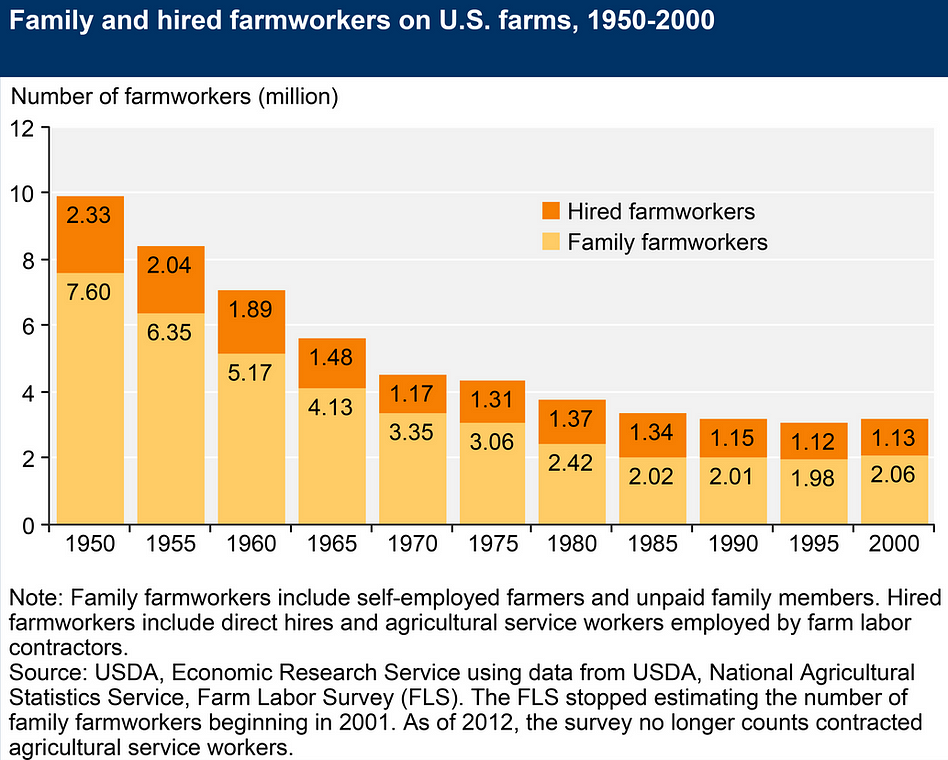
Labor remains a top challenge for specialty crops, and it’s getting harder to find. U.S. farmworkers decreased by 70 percent in 70 years, regulatory costs increased 795 percent in 12 years, and U.S. H-2A labor increased from 48,000 in 2005 to 300,000 in 2021—which add transportation and housing costs. Innovation remains the best solution to turn manual tasks like planting, weeding, thinning, harvesting and spraying into automated tasks with mechanization and automation.

So what does the market look like in early 2023? Weeding is the leading robot category for the moment. Carbon Robotics, Stout AgTech and FarmWise are all delivering solutions that provide growers with quality economics. Carbon Robotics has raised $36.8 million and has a one-year order backlog for $1.4 million laser weeding robots that break even at two years or less with 3,000–4,000 acres of production. FarmWise has raised $65 million and is in multiple regions with a weeding-as-a-service option that is price competitive with labor crew economics. Stout AgTech just got a 10 percent investment from CNHI and has sold over 25 mechanical cultivators for around $350,000 each, and its machines can also return a payback to the grower of less than two years. In addition to these, Verdant Robotics just raised $46 million and Naio just raised $33 million, so increasingly the segment is finding capital to help scale out the number of robots in market.

Harvest Assist is also beginning to scale. The best use case for this is Burro, which helps table grape crews by increasing their logistics efficiency by moving harvested product back to the truck via use of an autonomous small platform tractor. The efficiency gains are often 15-30 percent and provide growers with a 6-12 month payback depending on usage and acre count. Burro sells $10,000 robots and has over 100 robots in market with plans to manufacture several hundred more in the coming year.

Spraying automation solutions are one of the emerging areas approaching quality grower economics. GUSS is one of the early leaders offers GUSS sprayer machines for vineyards and orchards, a smaller Mini GUSS for easier turning in smaller fields and Herbicide GUSS. Also delivering an on-the-ground spraying solution is Robotics Plus, which launched in the U.S. market this quarter. Both appear to offer quality economics for growers. In addition to GUSS and Robotics Plus, Rantizzo offers a drone-based spraying solution with competitive economics to tractor-based spraying options.

On the other hand, harvest robots are still in the relatively early stages of product development, testing and roll out. Harvest is proving to be harder to develop than weeding because each crop requires its own robotic solution and the end effectors that pick the fruits and vegetables have to be significantly more gentle with them then weeding robots, which can just destroy weeds. None of the harvest robots have yet gotten to scale, and most have raised $25 million or less (as compared to the weeding robots, which as mentioned above, have been successfully fundraising over the past couple of years.)

So that’s the state of play with specialty crop automation—if you’re looking for weeding, harvest assist or spraying solutions, there are good options with good economics available. On the other hand, if you’re looking for harvest robotics, keep an eye out for emerging players but they are likely a few years away from getting to market at scale.

Director Profile: Chad Amaral, D’Arrigo Bros. Co. of California

January 25th, 2023

D’Arrigo California will be celebrating 100 years of business in 2023, and Chad Amaral, Vice President of Sales and Business Development for D’Arrigo and newly elected Western Growers Board Member, has been with the company for 25 of them.

Amaral recently attended his first WG board meeting at this year’s 96th Western Growers Annual Meeting. He described the experience of engaging with today’s agricultural leaders who are driving the association and moving the industry forward as nothing short of inspiring. For Amaral, WG has been integral to the agricultural industry and an important association to D’Arrigo, which has been a member of the association since the 1930s.

“In the short time that I’ve been able to interact, the association and board of directors have been extremely welcoming and supportive. My goal is to assist and contribute to the progress Western Growers has and will continue to have in advancing the various aspects of the agricultural industry,” Amaral said.

Born and raised in Salinas, Calif., Amaral graduated from Cal Poly San Luis Obispo with a degree in agricultural business and management. “If you’re from Salinas, you know agriculture is a big part of the community, so once I graduated, I knew it was something I wanted to get into,” he said. It wasn’t too long before he landed a job with D’Arrigo on the sales side, eventually rising up the ranks to become the company’s Vice President of Sales and Business Development.

“I started my role closely interacting with our customer base in the segments of wholesale, food service and retail and understanding their needs. As I’ve gained more responsibility, I’ve focused a lot of my efforts on having a better understanding of our business as a whole and looking for ways we can collectively interact and bridge gaps between different departments so we can work more synergistically,” he said.

While Amaral describes himself as having a Type A personality and appreciates structure and planning, he also recognizes that the agricultural industry is in the midst of a lot of change. “The world has become a small place in that the buying and supply community is shrinking. I think there’s going to be a need for more collaboration, and I’m looking forward to being a part of conversations that bring those segments of the business closer together and educating both sides. People operating in silos will be a thing of the past, and what used to be competitors in the past could become partners in the future,” he said.

As far as getting elected to the Western Growers board this year, Amaral said one of his major goals is not only contributing to a traditional history, but also coming up with solutions for the future. “When you think about the ag community, you think a lot about tradition and family-owned companies. Moving forward, I think there’s an opportunity to use and understand the history of agriculture and at the same time, evolve into something that allows you to be fluid and flexible so you can remain relevant in the industry.”

Amaral considers being a part of the WG board as an opportunity to acquire further insight into areas of the industry he hasn’t been exposed to previously while also gaining a better understanding in aspects that are pivotal to the evolution and advancement of agriculture, such as labor, water and innovation.

“The board members are established and reputable individuals within the industry, and I’m looking forward to learning from all of them and hearing about their experiences,” he said. “They’ve created strong foundations in agriculture, and being part of an incoming group, I want to build upon the foundations they’ve created.”

Walt Duflock: Stop it, Civil Eats. Agtech robots are not taking any jobs and farm workers are already a big part of Agtech.

January 30th, 2023

Civil Eats put out an interesting Op-Ed on January 23 entitled “Want an Agtech Revolution? Center Farm Workers’ Expertise. It’s primary narratives are: (1) Agtech robots are coming to take all the farmworker jobs; (2) Agtech startups are targeting farmworkers for replacement and will eliminate tens of thousands of jobs across rural America; and (3) farmworkers should be part of the discussion process around AgTech innovation. My responses: (1) no, and this is a large misunderstanding of the farm labor dynamic; (2) no, startups are positioning a market opportunity, not planning on killing jobs; and (3) yes, farmworkers are already part of the discussion in multiple ways. Let’s dive into each of these points.

Agtech robots are not coming to take all the farmworker jobs.

The first premise is that Agtech companies who are regularly raising capital from Silicon Valley investors, Agtech investors, and strategic investors, are openly targeting farm workers for replacement and will eliminate tens of thousands of jobs across rural America. Having helped many startups build pitch decks around automation, and having reviewed many others that make the same or similar pitches, I can tell you that this is not the case.

The reality is that automation startups are needed in Agtech because there is already a gap between the labor that specialty crop agriculture needs and the labor that is available, and that gap is only getting worse with time. Finally, the gap is going to increase even more and potentially accelerate if trends around organic growth and restrictions on the use of chemical inputs. Let’s take a look at some of the available data to back up this claim.

So how do I know that Agtech automation is not taking away any jobs? The first data point is to find out what has been happening to the available domestic farm workers over the last several decades. This graph from USDA tells the tale. From 1950 to 2000, family farmworkers decreased from 7.6 million to 2.1 million as many small family farms got sold and the family farmworkers that worked on those farm stopped working on those farms. At the same time, hired farmworkers (which includes those paid for directly by the farmer and those employed by farm labor contractors) decreased from 2.3 million to 1.1 million. In short, agriculture lost almost 70 percent of the farmworker labor force over 50 years.

The labor shortage has been an ongoing challenge for years. This reduction in farm workers is a big problem because specialty crops are some of the highest value crops and they require some of the highest amounts of labor to do a variety of activities — including planting, thinning, weeding, spraying, and harvesting. If there are less farm workers, there is less labor available to get all the work done on the fruits, nuts, and vegetables that represent a lot of west coast agriculture, which is much more labor-intensive than mid-west crops like corn and soy. So the labor problem is felt more severely in the western U.S., specifically California, which produces over $50 billion in ag products annually, with many of those dollars coming from fruits, nuts, and vegetable growers. If they can’t find enough labor to harvest, all the prior work to get things planted and grown goes for naught.

To respond to the shortage, increasingly specialty crop farmers have to rely on immigrant farmworkers. This labor comes into the U.S. via H-2A permits given by the U.S. Department of Labor. The growth in H-2A labor by U.S. farmers has been significant the past couple of decades.

Source: USDA, Economic Research Service using data from U.S. Department of Labor, Office of Foreign Labor Certification

The graph above shows the growth in the H-2A program by segment. The growth has been even more significant when you extend the time frame from 2005 to 2021. The overall growth in that time frame was from 48,000 to 317,000 H-2A workers — a 6x lift in 16 years. This growth was driven by the lack of available domestic workers inside the US and the need to find more labor somewhere outside the U.S.. For most U.S. farmers, the move to hire H-2A workers comes with a steep price.

When a U.S. farmer cannot find domestic workers and needs to shift to H-2A workers for part of their workforce, it adds significant costs to the cost of ag labor. First, the H-2A employer has to pay for housing for the H-2A workers. Many of the housing units in the Salinas Valley and other agricultural areas range from 400–800 worker capacity and resemble a college dorm or apartment floor plan. In the Salinas Valley, the cost for many H-2A housing complexes ranges from $10–15 million and they take years to get permitted and built. In Monterey County, where our ranch is located, H-2A housing complex permit applications have been some of the most divisive conversations in county politics the last couple of decades. Divide that cost by the workers housed each year and the number of months they are in the housing complex to get a feel for the increase housing makes to the cost of a farmworker. Then add in the transportation cost to and from the field where the work occurs, and for many H-2A complexes meals are provided daily.

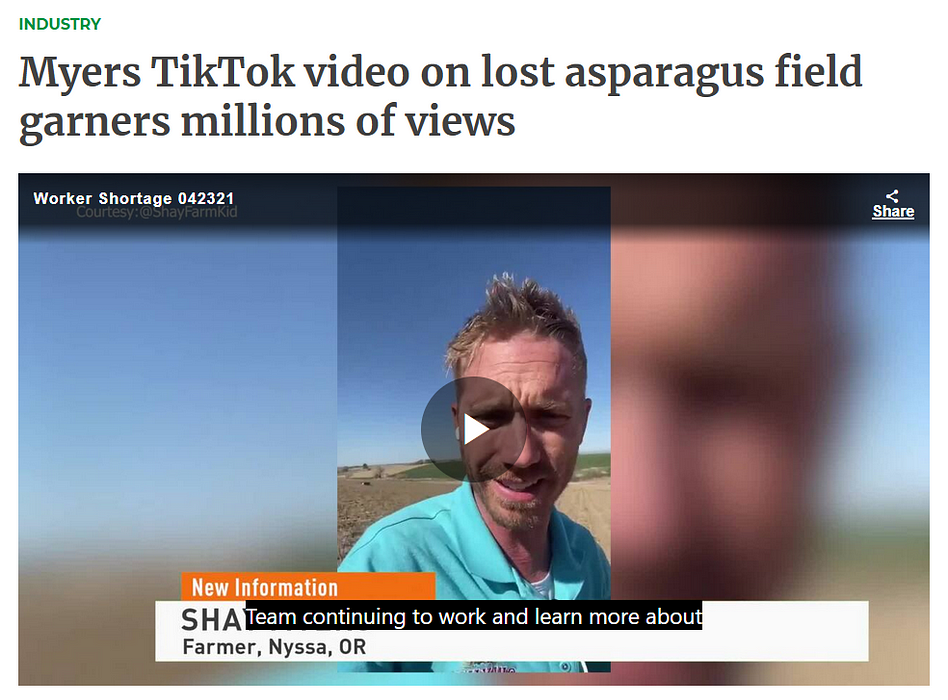
So the domestic work force is declining and has been for decades, the growth in immigrant labor is increasing and has been for decades, and the increase in labor cost from H-2A program costs (housing and transportation) are combining to make the labor problem even more challenging for farmers. Just to throw one more wrinkle into the H-2A process, consider Shay Myers from Owyhee Produce. Shay applied for H-2A labor to help him harvest asparagus in early 2021 and when it became apparent that permit delays due to bureaucracy would prevent the labor from arriving in time and that the asparagus would be lost and have to be destroyed, Shay began a social media campaign to raise awareness of his problem and invite the public to come pick the asparagus since he would not have any labor to help.

Shay is a great story teller, ag advocate, and has a large social media following. His significant following helped the video get 2.4 million views, 460,000 likes, and 30,000 comments. This raised awareness of some of the risks of increased use of the H-2A program, and definitely helped people understand the impact on a significant farmer who was unable to do anything to solve the problem. So add that to the risk of H-2A permits — if not approved in time, using H-2A labor can still mean you don’t get your crop harvested.

So it is not the AgTech robots taking all the jobs — the jobs are not being filled already because domestic workers are not filling them. The jobs are already going unfilled because the domestic farm work force is shrinking and increasing usage of H-2A workers comes with significant cost increases and additional risks.

There is one factor that is pushing farmers towards automation, and it wasn’t even mentioned in the Civil Eats Op-Ed. The factor that helps put some numbers behind the ag problem is the growth in regulatory costs of farming specialty crops in California. Cal Poly SLO professor Lynn Hamilton has done extensive work on this topic and her findings give a very clear picture of the increase and primary causes. Between 2006 and 2017, the cost of regulatory compliance went up from $109/acre/year to $977/acre/year. Cal Poly Professor Lynn Hamilton led both studies. Professor Hamilton found that the increase was due primarily to health care (Obamacare — Affordable Care Act), food safety (Leafy Greens Marketing Agreement and Food Safety Modernization Act), and labor wage requirements (minimum wage and overtime rules). All 3 of these factors went from $0 in the first study to top 4 factors 12 years later.
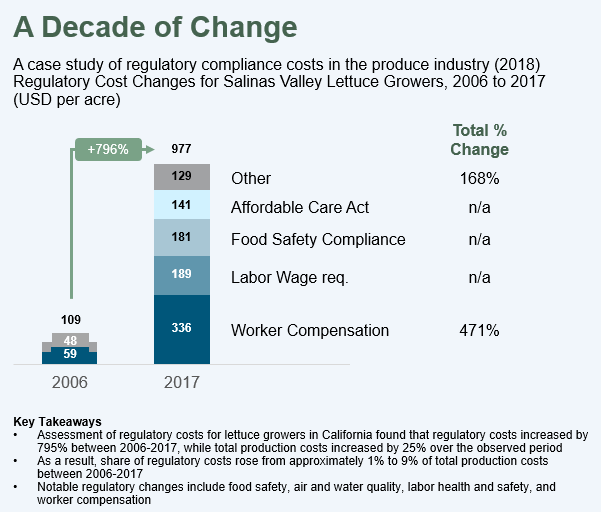
This increase puts massive pressure on California farmers to try and stay competitive with farmers in other states and other countries. Together, the lack of domestic labor, increased use of more expensive H-2A labor, and regulatory cost increases all combine to put pressure on farmers to look for automation solutions. Many farmers have told me for years that if California continues to impose these high regulatory costs on farmers, the will be forced to look at acreage in other locations. So even for farmers that can adopt H-2A (and the increased costs of housing and transportation make this a tough solution for small and medium-sized farmers), the increased cost of labor is pushing farmers to look at automation solutions.

It is availability and cost increases of farm worker labor that are pushing automation in an attempt to close the labor gap. Compare the situation that farmers are in with the other end of the food supply chain. When McDonald’s and Panera faced a labor shortage, they responded by rolling out self-service kiosks in stores to help reduce the need for labor. That may look like robots taking jobs away, but as a frequent patron at both of those brands, I can tell you that many of the stores with kiosks also have Help Wanted signs on the door and my local McDonald’s has had a Help Wanted sign with $16/hour starting wage for months. Kiosks at these stores are not taking any jobs from anyone — they are attempting to fill a job gap that is an ongoing problem. Farming is in a similar situation.

And in case you think this labor problem is going to be “transitory” and go away soon, I would advise you to think again. I believe that the gap is likely to get larger faster for two reasons. First, the trend is for more organic growth and organic growing requires more labor because you are not allowed to use some inputs conventional growers use. So every time a farmer changes growing formats from conventional to organic, the farmer is or should be anticipating an increase in the labor required when the shift is made. Second, even for conventional growth, the pressure to reduce pesticide and other inputs via regulation is gaining significant momentum. If that happens, and regulation of pesticides is implemented, that will also create increased demand for more labor because the functions that the inputs that can no longer be used were handling now have to be completed by labor. So whatever increase in labor is already being forecast, it needs to be increased by the organic acreage shift and the potential increased regulation/restriction of pesticide usage. These last two factors will result in the automation push increasing further.

Agtech startups are positioning the labor gap as a market opportunity to secure venture capital, they are not planning on killing jobs.

Let’s turn to the second premise — Agtech startups are specifically positioning their companies as job killers. This is not at all what is happening. I’ve worked with a lot of Agtech startups on strategy and pitch decks. There are several points startup founders need to make to secure venture capital funding, including: (1) we are solving a real problem; (2) the problem is really big and getting worse; and (3) our product solves it and improves economics by x. The second point is where labor frequently comes up. This is known as the Total Addressable Market definition, and it helps convince (or not) venture investors that if a startup can solve the problem they can generate significant revenue and potentially a lucrative exit for the startup and investors.

In the case of automation startups, frequently the best definition of the addressable market is the cost of labor being used to complete the function currently. If you are building a weeding robot, you need to understand how the economics of your robot compare with weeding the same field with a human labor crew. The addressable market for weeding robots is the cost of labor crews that are currently performing weeding in specialty crop fields. To make that market look as large as possible, you can take weeding costs for every acre of specialty crops and define that as your total market. That point is true — if the weeding robot were able to capture 100% of the market overnight with global presence and had no competition, that would indeed be the addressable market for that robot. That would also get some serious grilling from any venture investor — oh, you’re just going to take over the entire market? And how are you going to sell the product and get it manufactured at scale quickly with a global footprint? And more and more to follow — not fun for a founder fundraising.

So the startup avoids that grilling by shifting the discussion to two key points: (1) here are the crops we are going to focus on; and (2) here are the geographies we are going to start in. That then ties to a go-to market plan aimed at a serviceable market opportunity that the startup can realistically target. In short, the startup is using labor as a total market to help investors see the opportunity for their startup. In fact, decks I have helped startups with use the graph above from Lynn Hamilton to help investors understand the urgency for their solutions. As I said in the Medium post from 2 years ago, the one place where your TAM keeps growing is labor solutions because the underlying cost of that labor is only increasing.

(Note — I did a deep dive on the labor as TAM topic almost 2 years ago — and there’s a link in the article for a deeper dive on TAM, SAM, and SOM for those that are interested. Here’s the post on Medium — https://medium.com/@waltduflock/agtech-riddle-when-does-tam-always-keep-growing-28151a42f69a)

Farm workers are already part of the Agtech discussion, and Agtech is already working in collaborative ways with farm workers.

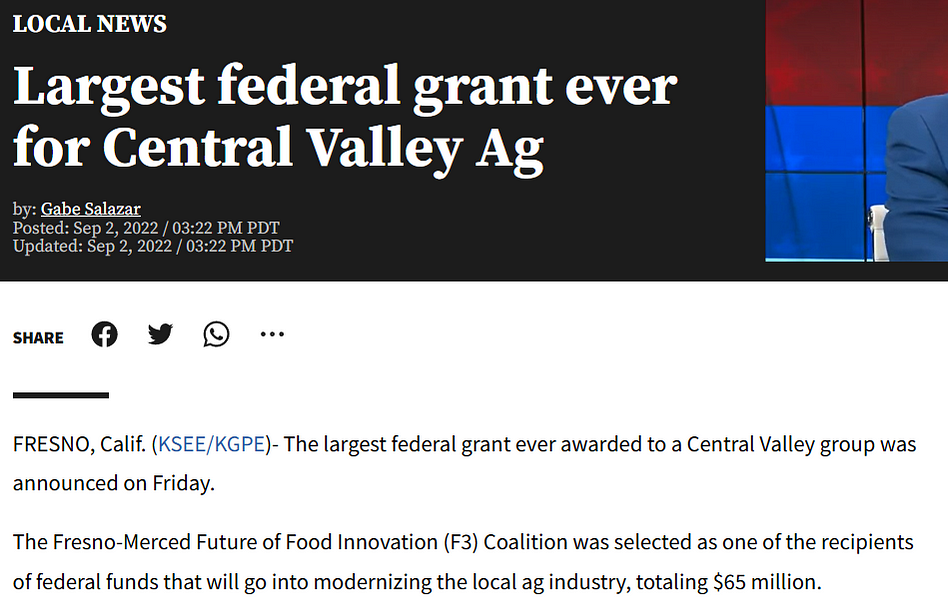
Finally, let’s go to the third premise of the Op-Ed. There is an underlying sense that farm workers need to be part of AgTech discussions (as if they’re not currently). The good news is they already are, and I’ve got receipts and examples to share (you’re welcome, Civil Eats!) They are there directly with people like Hernan Hernandez, Executive Director for the California Farm Worker Foundation. Hernan has been part of the discussions of some of the largest AgTech grant activity, including the F3 grant that Ashley Swearingen led that received $65.1 million for economic development based on ag and AgTech in greater Fresno. Hernan was at the table the entire time and now has a target objective of retraining over 8,000 farm workers on new AgTech technologies over the next few years.

The farm worker community is well represented and will be well served by Hernan. Hernan is also working with an industry coalition on an NSF Engines grant that is similar to Fresno in that it would be measured by economic development metrics — this would be a $160M award and would provide significant funding for farm workers to get re-trained and get skills up-leveled to work with the new AgTech solutions. Even if our group does not get one of the 5 awards, Hernan has been a key part of the group and has represented the farm worker industry effectively.

F3 Grant announcement

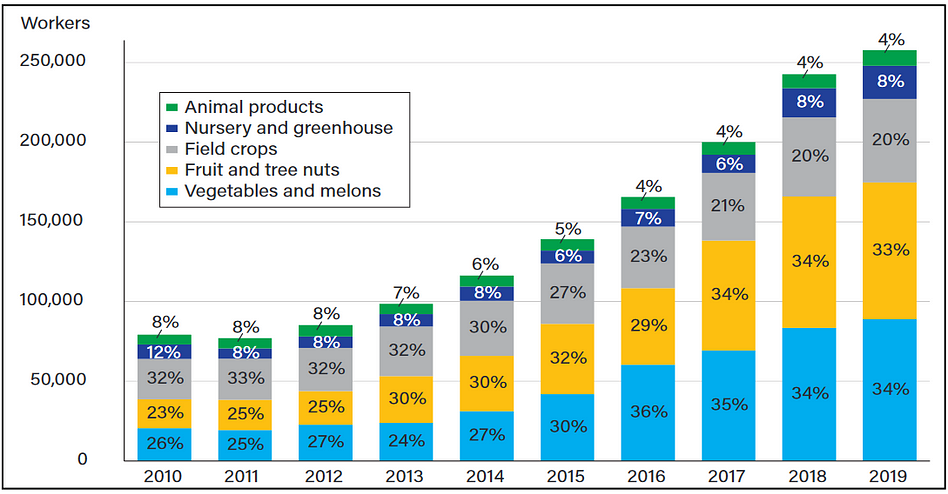
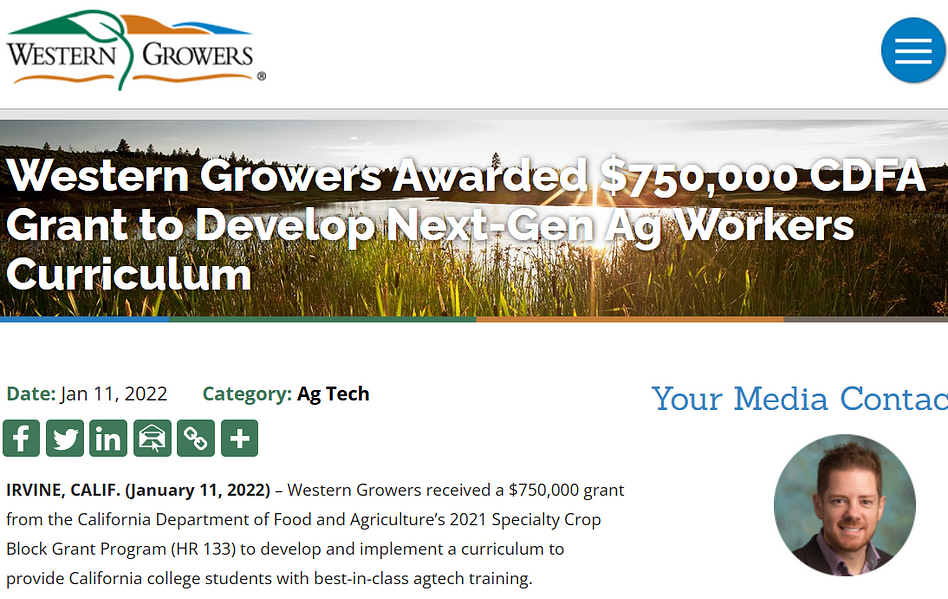
Farm workers are also at the table with a $750,000 grant from California Department of Food and Ag to help deliver Next Gen Ag Workers (NGAW), which Western Growers won a year ago and the key goal of this project is to train 3,000 AgTech enabled workers for farmers, ag companies, and startups that need them. The first part of this project was identifying the largest gaps these groups had and then identifying curriculum that can help solve these challenges. The second part is getting the curriculum distributed statewide across 2-year and 4-year colleges. So between F3 and NGAW, there will be over 10,000 AgTech-enabled farm workers produced in the next 5 years. All of these jobs will pay these workers more for being AgTech enabled. Farm workers that are willing and able to take on new skills and new platforms will be rewarded with higher pay and better jobs.

So how does this play out in practice? Let’s take a look at Burro. They are building Burros for harvest assist to help table grape growers and farm labor crews get harvested product from the crew to the truck with efficiency gains of 15–30 percent. CEO Charlie Andersen has stayed focused on this one crop and this one functionality (Burro could work today on other functions and in other crops, but the decision was made to stay focused on one functionality and one crop, and I think it has served the Burro team and their grower customers well. Here’s an article from S2G Ventures, one of the investors that participated in Burros’ latest fundraising round.

I saw Burro working in a Central Valley table grape orchard several months back, and it was a great example of up-leveling skills in real time. One member of the harvest crew stopped harvesting and managed the Burros to optimize the efficiency delivered by Burro. The success metric was time to complete harvest per acre. The Burro team lead determined that 3 Burros per crew was the best ratio of robots to crew. This team lead is instantly elevated based on this new skill set.

Burros in their native habitat — in this case a table grape orchard in California.

I believe this will be the most common scenario — AgTtch enables workers to increase pay with new skills and new capabilities. This will not be for everyone, but for those farm workers that are willing to take on the new challenges and develop a deeper understanding of Agtech solutions, there will be many potential rewards.

So, I will close this post with the three points I made at the beginning responding to the Civil Eats Op-Ed:

  1. AgTech robots are not coming to take away farm worker jobs — they are coming to help farmers close a labor gap that is large and getting larger every year for multiple reasons.
  2. AgTech startups are not positioning themselves as taking away thousands of jobs. They are positioning the labor problems they help solve as a large enough market to get venture investors interested in writing checks.
  3. Farm workers already are at the table and are part of the discussion. Hernan Hernandez and others represent the farm worker industry in many of the key funding discussions, and startups like Burro are focused on helping increase the farm worker crew efficiency with Burros, not replacing any farm workers.

One final thought — if anyone from Civil Eats would like to come out to Salinas Valley and see how growers and agtech companies are working together on a daily basis to improve growing operations, I would encourage that to happen and will be happy to set up tours with both groups.

VofV Podcast: Belinda Clarke and the Many Ways Science Can Help Growers Adapt

January 31st, 2023

Belinda Clarke, Director of Agri-techE, joins Dennis Donohue and Candace Wilson on this week’s Voices of the Valley to share her knowledge about the many ways science works with growers to adapt and respond to environmental and political changes.

Clarke describes the work that Agri-techE does as creating “an innovation ecosystem for agtech bringing together growers and farmers, technology developers and researchers.”

Donohue, Wilson and Clarke touch on the different industries that are coming to the table to offer agricultural tools from space tech to biology. But tech solutions are nothing without the proper mindset. “Innovation is not just about in-field technology, it’s around processes, it’s around mindset. Innovation is around just doing things differently,” Clarke shares.

The move toward adoption of available and developing resources will be a process, but Clarke and Agri-techE are making the space to provide education and opportunity to the agricultural industry both for England and abroad.

Don’t miss this episode of Voices of the Valley to hear more about the ways agtech is working to address challenges at all levels of complexity.

Create and Adhere to a Strong Company Credit Culture

January 23rd, 2023

Creating a strong company credit culture provides a universal way of doing business with the proper checks and balances in place from top to bottom within an organization. Making decisions about credit is just as important as other critical initiatives that make your company successful. After all, selling produce to companies who will pay for the purchase makes for a successful sales transaction.   

Routinely, Western Growers’ members request my assistance with collection efforts for slow-pay or no-pay sales contracts. It is not uncommon to hear feedback from a member when I first inquire about the credit procedure that they have no official company policy. With all the technology and access to information we are afforded these days, not having a well-defined credit policy that is strictly followed is no longer acceptable. To help limit your company’s bad debt experience, it is essential that shippers have a mandatory credit policy, and if possible, have a credit manager, or at a minimum, a point person (champion of sorts) to ensure that all agreed-upon credit policy procedures are followed.   

An internal policy detailing how to approve and authorize a customer in your system and set a credit limit is essential and a best practice. The Blue Book is a good, foundational first step in addition to seeing and reviewing the customer’s audited financials, and they also provide some predictive financial and analytical tools to explore. Other steps are bank references, customer references, how many years has the company been in business and having a general understanding of the customers’ business model. 

Below are eleven general items to consider, to begin implementing your own credit policy and creating a strong company credit culture:

  1. Utilize credit reporting companies as well as other resources to assist in making your decisions.
  2. Obtain audited financials and bank references.
  3. Ask about what the pay practices will be with your shipments.
  4. How many years has the customer been in business?
  5. Do they have a current PACA and DRC license?
  6. Who are the principal owners and officers?
  7. Check other supplier references and, if appropriate, call those references.
  8. Have any employees with the customer related to prior companies that have experienced payment issues?
  9. Talk with other shippers, if appropriate, that may be supplying that customer to check on their experiences with payment practices
  10. Call Western Growers Trade Practices Department to obtain any information we may have on the account, i.e., any PACA or DRC complaints pending.
  11. If you cannot obtain the needed information to make an informed business decision, make the tough decision not to sell until you can get the information to make an appropriate business decision.

Important to remember that a customer assessment should be an ongoing work in progress, so always be assessing any changes in payment or other changes to the customer. Once a customer has been established, it is understood that some flexibility will be needed to allow for a consensus with any changes to credit limits or other terms.   

Having a strong company credit culture will take leadership in order to inculcate that policy throughout your company but adhering to an established credit policy will pay dividends to your company by minimizing bad debt write off.

Please forward your questions or suggested blog topics to me at 949.885.4808 or [email protected].


USCIS Proposes Massive Hike in H-2A Fees

January 6th, 2023

The US Citizenship and Immigration Services (USCIS) has proposed a massive hike in immigration petition fees, including fees to petition for H-2A visas for temporary and seasonal agricultural workers. Under the proposed ruled, published by USCIS on Jan. 4, 2023, the fee for an H-2A Petition for unnamed beneficiaries would increase from the current $460 to $530, a 15% increase.  The fee for an H-2A Petition for named beneficiaries would rise from the current $460 to a whopping $1,090, a 137% hike. The rule would also limit the number of named beneficiaries to 25, so an employer would have to file four petitions for 100 named beneficiaries, instead of one, for example.

USCIS is also proposing to implement a new $600 asylum program fee to be paid by all employers sponsoring temporary (nonimmigrant) workers including H-2A workers. This new fee is intended to cover some of the costs associated with asylum processing, which does not currently require a fee. Employers will be responsible for this fee each time they file an I-129 petition, including all new, extension and transfer petitions, which poses a great concern for farm labor contractors moving large numbers of H-2A workers between temporary labor certifications.

Employers file petitions for unnamed workers for new H-2A applications. Petitions for named workers are required to extend the length of time an H-2A visa holder can remain in the U.S. on a contract with an extended end date. Named worker petitions are also used to transfer workers who are in the U.S. on an H-2A visa between different H-2A applications of the same employer or to a different employer. It is common for employers with multiple H-2A contracts to transfer workers from one contract to another rather than send the workers home and bring them or replacement workers back into the U.S.

Western Growers and other industry groups submitted comments to the Department of Homeland Security critical of the proposed rule