Cal/OSHA Publishes Modifications to Proposed “Worker Walk-Around” Rule

July 9th, 2026

As previously reported by Western Growers, Cal/OSHA has proposed a California version of the federal OSHA “worker walk-around” rule that would define who may accompany a Cal/OSHA inspector during the walk-around portion of a workplace inspection. Cal/OSHA has now published revisions to the proposed text and is accepting written comments on the modifications until 11:59 p.m. on July 16, 2026 

The revisions are limited but important. First, Cal/OSHA added language stating that employer and employee representatives accompany the inspector “for the purpose of aiding such inspection.” This addition helps frame representative participation as tied to the inspection itself, rather than broader advocacy, organizing, or other activity unrelated to Cal/OSHA’s inspection. 

Second, Cal/OSHA revised the third-party representative standard. The prior text referred to whether a third party’s “participation” was reasonably necessary. The modified text now refers to whether the person’s “accompaniment” is reasonably necessary to conduct an effective and thorough physical inspection. The proposed rule would still allow an employee-authorized representative to be an employee, a third party, or the collective bargaining representative. If the representative is neither an employee nor the collective bargaining representative, the inspector may allow the person to accompany the inspection only if good cause has been shown.  

For employers, the main concern remains the potential presence of outside third parties during Cal/OSHA inspections. Even with the revised wording, the proposal gives Cal/OSHA inspectors significant discretion to decide whether a non-employee representative may accompany the inspection based on knowledge, skills, experience with workplace hazards or similar workplaces, or language and communication skills. 

The proposed rule also confirms that Cal/OSHA controls the inspection and may limit representative interactions to ensure the inspection remains fair, effective, and appropriately focused. Cal/OSHA may also deny accompaniment to anyone whose conduct disrupts a fair and orderly inspection. 

Agricultural employers should consider whether to submit comments focused on the modified language, especially if they have concerns about safety, biosecurity, trade secrets, food safety requirements, customer confidentiality, employee housing, disruption to operations, or unclear limits on third-party access. 

Comments may be submitted by email to [email protected]Only comments related to the latest modifications will be considered. Cal/OSHA requests that email comments, especially those with attachments, include the regulation identifier “Employer Representative and Representative Authorized by Employees” in the subject line. Comments may also be mailed or hand-delivered to Silas Shawver, Staff Counsel, Cal/OSHA Legal Unit, 1515 Clay Street, Suite 1901, Oakland, California 94612. 

Arizona AG Creates New Community Civil Rights Advisory Council

July 9th, 2026

Arizona employers should take note of a recent development from the Arizona Attorney General’s Office: Attorney General Kris Mayes has announced the creation of a new Community Civil Rights Advisory Council within her office. The move follows the Arizona Legislature’s decision earlier this year to eliminate the state’s long-standing Arizona Civil Rights Advisory Board. 

For nearly 60 years, the former Advisory Board worked with the Attorney General’s Civil Rights Division to research and address civil rights issues across the state, including hate-based crimes and incidents, fair housing, accessibility concerns impacting individuals with disabilities, and civil rights issues in rural communities. According to the Attorney General’s Office, the newly created Council intends to continue that community engagement and support the office’s work to address unlawful discrimination in Arizona. 

What Does it Mean? 

While the announcement does not create new employer obligations, it signals continued attention from the Arizona Attorney General’s Office on civil rights and anti-discrimination issues statewide. Employers should view this as a reminder to review workplace practices, policies, and complaint-response procedures to ensure they are aligned with applicable federal, state, and local anti-discrimination requirements. 

The Council’s work may also help shape future areas of focus for the Attorney General’s Office, particularly around accessibility and broader civil rights concerns. A few key next steps to consider include the following:  

  • Review equal employment opportunity, anti-harassment, anti-discrimination, and reasonable accommodation policies for compliance with applicable state and federal laws. 
  • Confirm that managers and supervisors understand how to identify, escalate, and respond to discrimination, harassment, retaliation, and accommodation-related concerns. 
  • Evaluate complaint intake and investigation procedures to ensure employee concerns are handled promptly, consistently, and appropriately documented. 

FDA Food Traceability Rule Training Course

July 8th, 2026

Western Growers is hosting a Food Safety Preventive Controls Alliance (FSPCA) Traceability Rule Training. This in-person course is intended for fresh produce companies covered by the FDA’s Food Traceability Rule (FTR), including growers, harvesters and coolers of raw agricultural commodities (RACs) on the food traceability list, and all fresh-cut fruit and vegetable processors.

The training will help participants understand the importance of this rule, identify its key requirements, learn practical steps to achieve compliance, and develop a traceability plan for their operations.

Participants who complete the course, including full attendance and participation, are eligible to receive an FSPCA certificate of completion. This course is intended for individuals who want to learn about this rule and the steps to achieve compliance. To register and learn more about this course, click here.


Course Date & Time

  • Monday, August 24, 2026, from 8:00 a.m. to 4:00 p.m. Pacific Time — AND —
  • Tuesday, August 25, 2026, from 8:00 a.m. to 12:00 p.m. Pacific Time (2 DAYS)


Course Location:

Monterey County Farm Bureau

1140 Abbott St., Ste. C, Salinas, CA 93901


Course Instructors:

Jennifer McEntire, Ph.D.

Founder, Food Safety Strategy, LLC

Sonia Salas, M.S.

AVP Food Safety & Regulatory Affairs, Western Growers Association


Registration Fee:

WG member: $600

Non-WG member: $800

Food, soft drinks, and snacks are included.

Register by August 14th to ensure a space and printed materials. The space is limited.


New Report Examines Economic Impact of 2022–2023 Hepatitis A Strawberry Outbreaks

July 8th, 2026

A new report published by Western Growers examines the economic and food safety implications of the 2022 and 2023 Hepatitis A outbreaks linked to imported strawberries. While both outbreaks were ultimately traced to a single foreign grower, the report found that California strawberry growers experienced an estimated $125 million in short-term wholesale revenue losses following the 2022 FDA public health advisory, despite no recall being issued for domestic strawberries. The analysis concludes that the decline was driven by a temporary, industry-wide drop in consumer demand rather than changes in supply. The analysis of these outbreaks highlights the importance of traceability, transparency, and timely follow-up when a source is identified, as well as the need for consistent oversight and regulatory responses across both domestic and foreign supply chains.  

Here are a few takeaways. To access the full report, click here. 

  • The U.S. Food and Drug Administration’s initial announcement during the 2022 outbreak did not clarify that the impacted strawberries were imported.  
  • Short-term demand shocks from the 2022 outbreak cost the California industry approximately $125 million. In the five weeks following the FDA’s May 28, 2022, announcement of the 2022 outbreak, FOB prices fell by nearly 30% for both conventional and organic strawberries beyond what could be expected for typical seasonal and supply price trends 
  • Because the announcement of the outbreak was released on the Saturday of Memorial Day Weekend, which is the unofficial start of peak strawberry season for California growers, farmers in California shouldered disproportionate costs from the demand shock.  
  • Based on industry interviews, long-term and ongoing costs for California growers related to the outbreak have been minimal. But that is because California strawberry growers were already leading in food safety practices and had not had to implement additional measures in response to the outbreaks.  
  • Even though an enteric virus outbreak in berries has not been traced to U.S. berry growers in over 35 years, California strawberry growers bore the brunt of the 2022 outbreak-related revenue declines. 
  • Strawberries have a global supply chain. Foodborne viruses and bacteria do not know borders.  

The Barrier Is Not Always Data Results. Sometimes It Is Decision Culture

July 8th, 2026

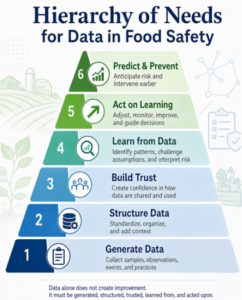
A major barrier to learning from data is not always the absence of evidence. Sometimes the learning is clear, but the culture is not ready to accept it. 

For academics, subject matter experts and industry groups that are advising industry, developing best practices or recommending how learnings should be applied, this raises a deeper responsibility. The legal concept of duty of care is useful here: are we acting reasonably, based on what is knowable at the time, to help reduce foreseeable risk? 

Food safety systems have often treated uncertainty, understandably, as a reason for inaction when considering changes to programs, systems or practices. New data, models or trends may be dismissed as “just math,” “not enough information,” or “not definitive enough to act on.” But once data are structured to provide more contextualized learning, and those learnings begin to clarify risk or improve decision-making, ignoring them may no longer be a neutral or advisable choice. 

The real question is whether the data improves the quality of the decision compared with the status quo. A learning system must help the community move from “we do not know enough” to “we now know enough to adjust, monitor, and improve.” That responsibility is anchored in the role of the advising group: to ensure that emerging learnings are adequately discussed, interpreted and translated into guidance for the community they are intended to serve. 


Advancing Control of Diamondback Moth in Brassica Crops (Webinar July 30)

July 8th, 2026

Diamondback moth (DBM) continues to be one of the most persistent and costly pests facing brassica growers worldwide. With increasing resistance pressure and limited effective tools, the need for new, innovative solutions has never been greater.

Join us for an informative webinar as we introduce new tools, Liepigen® and Incipio® (isocycloseram) for control of diamondback moth. Understand how these novel DBM tools support resistance management, sustainable production, and integrate into IPM strategies.

Liepigen® is a highly selective, Organic biological insecticide based on a naturally occurring baculovirus (IRAC Group 31) that specifically targets DBM larvae. Once ingested, the virus infects and kills larvae while releasing additional viral particles that spread control throughout the pest population. Lepigen® is described as an excellent fit for IPM programs, offering control of resistant populations while preserving beneficial insects and leaving no residue concerns.

Incipio®, powered by (isocycloseram) is a next-generation insecticide with a novel IRAC Group 30 mode of action. Effective through both contact and ingestion, DBM rapidly stops feeding and leading to paralysis and death. Incipio® is described as a valuable new option for managing difficult and resistant insect pests, including diamondback moth, in vegetable production systems.

What You’ll Learn:

  • Review of Liepigen® and Incipio® use on DBM and brassica crops
  • Best-use recommendations for maximizing control and crop protection
  • PCA insights from field trials and early use experiences


Agenda:

  • 30 min — Introduction to Lepigen, field trial results, and best practices for efficacy
  • 30 min — Introduction to Incipio, field trial results, and best practices for efficacy
  • 10 min — PCA Q&A


Event Details:

Date: Thursday, July 30, 2026
Time: 1:00 p.m. to 2:00 p.m. PT
Location: Online via Zoom

Register Here

Building Connections During Big Week in Salinas

July 22nd, 2026

Each year, Big Week in Salinas brings together leaders, innovators, growers, and community members from across the agricultural industry during the week surrounding the California Rodeo Salinas. As one of the region’s most anticipated annual traditions, Big Week provides countless opportunities to reconnect with colleagues, strengthen professional relationships, and celebrate the people who drive agriculture forward.

This year, the Western Growers Center for Innovation & Technology (WGCIT) Innovation Team fully embraced the spirit of Big Week by attending the California Rodeo and participating in networking opportunities throughout the week. The event served as a valuable reminder of the strength and reach of the agricultural community, as the team connected with friends and industry partners from across the sector, including representatives from John Deere, Reservoir Farms, and many Western Growers members.

Beyond the rodeo grounds, the Western Growers Center for Innovation & Technology welcomed a special group of future agricultural leaders. During Big Week, the Florida Fruit & Vegetable Association (FFVA) Emerging Leaders Class 15 visited the Salinas-based innovation center twice as part of their leadership development program.

The first visit took place on Tuesday, when members of the FFVA Emerging Leaders Class gathered at the WGCIT for lunch followed by a public speaking workshop. The session provided participants with valuable communication skills while introducing them to the collaborative environment that supports agricultural innovation in California.

The group returned on Thursday for a second day of programming focused on leadership development. The visit concluded with an innovation-focused networking session that connected Emerging Leaders Class 15 members directly with WGCIT agtech startups. These interactions gave participants the opportunity to learn firsthand about emerging technologies, discuss industry challenges, and explore how innovation is helping shape the future of agriculture.

The combination of rodeo traditions, leadership development, and startup engagement demonstrated what makes Big Week such a meaningful event for the agricultural community. By bringing together growers, innovators, students, industry partners, and emerging leaders, the week reinforced the importance of building relationships and fostering collaboration across all segments of agriculture.

Monterey County 2025 Crop and Livestock Report Highlights Resilience Amid Challenges

July 15th, 2026

The Monterey County Farm Bureau released the 2025 Crop and Livestock Report on July 7, 2026, providing a snapshot of one of the nation’s most productive agricultural regions. The report reflects both the strength of Monterey County agriculture and the challenges growers continue to face in an increasingly complex farming environment. According to the report, Monterey County recorded a gross agricultural production value of approximately $4.82 billion in 2025, representing a 3% decline from the record-setting values reported in 2024.

Despite the overall decrease in production value, strawberries remained Monterey County’s highest-value crop for the fifth consecutive year. The commodity generated more than $1 billion in gross production value and posted a 3% increase over 2024, underscoring the crop’s continued importance to the region’s agricultural economy.

While several leading commodities maintained strong market positions, growers are navigating a range of economic and production pressures. Rising input costs, labor shortages, regulatory expenses, shifting consumer preferences, and market volatility continue to challenge farm profitability. The report emphasizes that gross production values do not necessarily reflect growers’ bottom lines, as increasing costs for labor, compliance, pest management, and other operational expenses continue to erode margins.

In addition to economic headwinds, destructive pests and crop diseases remain a significant concern for local agriculture. Growers are contending with threats such as the diamondback moth, a persistent pest affecting brassica crops, and Impatiens Necrotic Spot Virus (INSV), which has impacted lettuce production. These challenges add to production costs and create uncertainty for farmers striving to maintain yields and crop quality.

One of the most notable declines in the 2025 report was in the wine grape sector. Monterey County wine grapes experienced a 25% drop in gross production value compared with the previous year. The decline was attributed largely to oversupply and reduced consumer demand, reflecting changing market trends in the wine industry.

Looking ahead, growers are hopeful that 2026 will bring improved market conditions. Many are optimistic that commodity prices will strengthen while production and input costs stabilize, helping restore profitability across key agricultural sectors.

As producers confront growing labor shortages and rising operating expenses, agricultural technology continues to play an increasingly important role in Monterey County farming. Growers are investing in innovative tools and automation solutions to improve efficiency, reduce costs, and supplement limited labor resources. Technologies such as automated harvesting equipment, precision irrigation systems, advanced sensing technologies, robotics, and data-driven farm management platforms are helping producers remain competitive while maintaining high standards of productivity and sustainability.

The county’s leading crops are also among those at the forefront of agtech adoption. Strawberries, leaf lettuce, head lettuce, broccoli, cauliflower, celery, spinach, and wine grapes are increasingly utilizing technology in the field to improve operations and address workforce challenges. These innovations are expected to play a critical role in ensuring the long-term viability of Monterey County agriculture as growers adapt to changing economic, environmental, and market conditions.

The 2025 Crop Report ultimately paints a picture of an industry that remains resilient despite significant challenges. While total production value declined and several sectors experienced setbacks, Monterey County continues to be a global leader in specialty crop production. The combination of innovative technology, grower adaptability, and a strong agricultural heritage positions the region to meet future challenges and continue feeding consumers around the world. For the complete report and detailed crop statistics, visit the Monterey County Farm Bureau’s website.

Western Growers Women 2026-27 Program Schedule Now Available

July 7th, 2026

The 2026-27 Western Growers Women program schedule is now available, offering another year of leadership development, professional growth and networking opportunities for women in the fresh produce industry.

Participants can choose from a variety of virtual and in-person programs designed to strengthen leadership skills, expand industry knowledge and build meaningful professional relationships. This year’s lineup includes leadership workshops, policy and advocacy webinars, the Western Growers Annual Meeting, a Washington, D.C., advocacy trip and a leadership retreat, giving participants multiple ways to earn credits toward their WG Women Certificate of Completion.

Whether you’re a returning participant or considering the program for the first time, the new schedule provides valuable opportunities to learn from industry experts, connect with peers and grow as a leader throughout the year.

View the full 2026-27 schedule here.

Foreign Supplier Drone Ban Resources

July 7th, 2026

A timely discussion on the current landscape surrounding the foreign supplier drone ban, what these developments could mean for agricultural drone use and how growers and ag service providers may be impacted moving forward. Our webinar recording and additional resources are now available below.

For questions, please reach out to Ben Palone at [email protected].


Reservoir Welcomes Salinas Residents in its First Public Open House

July 15th, 2026

Last year, a shipping container with the Reservoir Farms logo facing traffic showed up on highway 68 just outside of Salinas. Many looked up the newest AgTech addition to the valley and wondered what would be going on behind its fences. Last Wednesday, the Salinas public had their first official view of Reservoir Farms at its open house. Beagle Technologies, LUMO, TRIC Robotics, High Degree, and Bonsai all had booths educating attendees on the struggles farmers are facing and what they’re doing to help. Reservoir founder, Danny Bernstein, and Salinas mayor, Dennis Donohue, both spoke about the increasing necessity of AgTech and the great work the Reservoir members were doing.

Also in attendance was Salinas High’s robotics team, Steel Boot. In his speech, Bernstien talked about the importance of introducing the next generation to AgTech, offered them a $1,000 donation, and announced an extended donation to any other local high schools that were interested in coming to Reservoir. He talked about how farming is local and emphasized that companies like High Degree have already begun hiring people from the area.

Most of these startups already had some form of prototype before the creation of Reservoir. The value Reservoir offers is a complete fabrication shop made by Andros, as well as acres of California specialty crops designed to be used for trials. When these startups are in the prototype stage, the fields can be used to refine the technology. If a startup were working directly with a grower, any malfunctions or misinputs would affect a farmer’s margins, but at Reservoir, these shortcomings are expected. Once a startup is more fine-tuned, these same facilities can be used to gather data on return on investment, making Reservoir a one-stop-shop for all stages of a startup.

One of the groups that stood out was High Degree, a startup that uses steam to kill weeds and soilborne pathogens. It works at up to 14 inches of depth, requires no REIs and is completely safe to use in organic production. At the event, they were telling attendees that all three of their prototypes were made at Reservoir Farms. They essentially started from the ground up and used the facilities Reservoir provided to build three complex, functioning machines.  What was initially just an idea when the company started in 2025, is now being used on select farms and already helping growers.

This was the first of hopefully many opportunities for the public to step into Reservoir’s fences and put faces to the company. Many drive past the barn inscribed “Home of Agtech” every day on the way to or from work. Hopefully now they have a greater appreciation of what is happening inside.

The $5 Billion AgTech Strategy

July 22nd, 2026

Last week, we took a look at the overall $5B strategy for specialty crop AgTech automation. This week we are going to dive into some of the specific re-allocation requests and rationale.

First, let’s look at the Inflation Reduction Act (IRA) Climate-Smart Ag Funding, which represents $19.5B and is being used to increase existing conservation programs through NRCS through payments for practices that reduce GHG emissions, improve soil carbon, reduce nitrogen losses, or sequester carbon. The major spends are: (1) $8.5B on cost-share practice payments (EQIP); (2) $5B on regional partner-led conservation projects (non-profits, Universities – RCPP); (3) $3.3B on multi-year stewardship contracts for conservation; (4) $1.4B on wetlands easements (ACEP); (5) $1B on conservation technical assistance. While there is demand for the program (it’s a government subsidy – that should not surprise anyone), it provides mediocre climate accounting (at best) while providing no improvement to grower economics. The success metric is the carbon sequestered and the funds deployed. It is already being modified to allow reallocation to wider funding options.

Much of this money would be better spent  subsidizing grower automation purchases. Keep in mind that many of the climate smart ag programs are positioned as meant to help farmer’s economics. The reality is that for many of these programs, farmer success metrics aren’t measured at either baseline or incremental performance and are rarely used as success metrics when evaluating the programs. Automation spending success can be measured by evaluating the actual impact on labor and grower economics, as well as by job creation (economic development impact).

Second, let’s look at the USDA Partnerships for Climate-Smart Commodities, a 2022 Pilot Grant Program that is going to spend $3.1B on 141 projects for: (1) technical and financial aid to farmers; (2) monitoring, reporting, and verification; and (3) market development (premiums for “climate smart” products). The Trump Administration reframed the program as “farmer first” and added requirement that 65% of funds go to farmers (by putting in place lower admin cost caps). So how is this program doing? Well, the original USDA targets were 60,000 participating farms, 25M+ acres, 60M metric tons CO2e. The actual results (two years in are 14,000 farms, 3.2M acres, 400k metric tons). As with the IRA program, there are no farmer success metrics established as targets or measured. As above, the metrics for automation incentives are much easier to manage and tie directly to labor and job creation metrics. These are better targets for rural communities than emissions reductions.

Now let’s take a look at the model for building the AgTech incentives infrastructure to help support accelerating AgTech purchases. It already exists and is part of the Climate Smart Funding efforts of the last 10 years. It’s the electric (EV) tractor subsidies program that uses CARB (California Air Resources Board) payments. The first program is FARMER, which pays for EV tractors that replace diesel FARMER, requires proof that the replacement tractor was turned into scrap (particularly wasteful by the way – there are a lot of farming communities that could use old diesel tractors that are not going to be used in the US market anymore), and provide an average check size of $80,000 – $100,000. FARMER represents 85% of program payments through CARB. The second program is CORE, which pays to incent EV tractor purchases, represents 15% of program payments, and has an average check size of $50,000 – $60,000.

As an example, one of the program participants (companies that want to participate in CARB programs need to be vetted and selected), Monarch Tractor made EV tractors that received significant CARB dollars. The business model for Monarch was selling 40 horsepower (HP) tractors for $85,000 and receiving a $50,000 – $60,000 payment from CARB. Even after receiving $155M in VC funding and significant CARB funding to help support their EV tractors being purchased by growers, Monarch was unable to raise more capital and was acquired by Caterpillar after attempting to pivot from a tractor company to an IP company.

Now let’s look at the success metric for these two programs. The program win was based on emissions reductions based on the number of hours the EV tractor was driven. But here’s where the EV tractors meet the road. It’s very hard to prove these emissions because it appears that the system was largely based on an honor system of self-reporting and tops down economic models that are not verified via any bottoms up analysis. I have seen some of these EV tractors in their native habitat at growing operations. They are very rarely in use because of the lack of a compelling use case, but the same unused tractors are getting credit for success metrics because of the factors mentioned above.

Next, let’s look at the Regenerative Pilot Program, USDA’s $700 million program that was announced December 10, 2025. It is being run by NRCS as an FY2026 pilot that redirects/set-asides funding inside two existing conservation programs: $400 million through EQIP and $300 million through CSP. The stated goal is to move USDA conservation funding from isolated “practice-by-practice” payments toward whole-farm regenerative conservation plans focused on soil health, water management, and “natural vitality.” It is a large conservation delivery pilot layered on top of EQIP/CSP, with a stronger emphasis on whole-farm planning, soil-health testing, bundled practices, and public-private supply-chain partnerships.

To date, many of the success metrics for similar practice payment programs want credit for approving a budget and spending the money. You can excuse farmers for not being overly impressed with passing a budget and actually spending the money. That’s basically table scrapes for any grower operations team. The real key is measuring the success of the spend. For many pilots and launched programs around regenerative practices, the success is only measured to the allocation and spend stage. It never makes it to actual grower metrics that improve their economics. As above, reallocating some of this capital toward automation incentives provides a much better set of metrics for rural economies.

I am in the middle of the analysis around federal economic development grants. For now, know that there looks to be $4.7B – $5.2B a year in federal grants in programs like Community Project Funding (EDI) ($3.3B in FY 2024), Economic Development Admin ($1.1B), Revitalization Grants ($320M), and USDA + DOE Econ Dev ($800M). The next action item is to identify which of these apply to rural economies and how the success metrics are measured to see how competitive the economic development impact of automation incentives compares to existing programs.

So that is the summary of programs we are looking to re-allocate dollars from to support the growth of automation revenue to $5B annually.

SAMI Robotics Becomes First Recipient of the Western Growers–Reservoir Farms Sponsorship Program

July 15th, 2026

The Western Growers Innovation Team is proud to announce that SAMI Robotics has become the first company selected to receive sponsorship through the new Western Growers Association (WGA) and Reservoir Farms partnership. This milestone represents more than support for a single AgTech company; it marks the launch of a new model designed to accelerate the commercialization of technologies that address some of specialty crop agriculture’s most pressing challenges.

The partnership between Western Growers and Reservoir Farms was established with a shared vision: creating an environment where innovative agricultural technologies can be evaluated under real commercial farming conditions while generating objective data that helps growers make informed decisions and provides technology developers with meaningful feedback. Rather than relying solely on demonstrations or pilot projects, the program is designed to produce measurable performance data that reflects the realities of commercial specialty crop production.

One of the first major initiatives under this partnership is a series of field demonstration events that bring growers, technology developers, researchers, and industry stakeholders together to evaluate technologies in side-by-side comparisons. These events go beyond traditional equipment showcases by incorporating replicated field layouts, pre-treatment evaluations, and standardized trial protocols that allow participants to observe technologies performing under identical conditions.

SAMI Robotics is the first company to participate through this sponsorship, showcasing its automated harvesting platform in front of growers and industry leaders. As labor availability continues to be one of the greatest challenges facing specialty crop agriculture, harvest automation remains one of the industry’s highest priorities. Programs like this give emerging companies an opportunity to validate their technology where it matters most—in commercial fields alongside the growers who will ultimately determine its value.

At Western Growers, we believe successful commercialization requires far more than innovative engineering. Technologies must demonstrate reliability, operational efficiency, ease of integration into existing farming practices, return on investment, and measurable value for growers. By creating opportunities for companies to collect objective field data while working directly with commercial farming operations, the Innovation Team helps bridge the gap between promising concepts and practical, scalable solutions.

The collaboration with Reservoir Farms represents an important evolution in how the Innovation Team supports both growers and AgTech companies. Reservoir Farms provides a commercial production environment where new technologies can be tested under realistic operating conditions, while Western Growers contributes its extensive grower network and experience conducting independent technology validation. Together, the partnership creates a platform that accelerates innovation while keeping grower needs at the center of the process.

The sponsorship awarded to SAMI Robotics recognizes companies with the potential to solve meaningful challenges facing specialty crop agriculture. As the program expands, additional sponsorship opportunities will be available for emerging companies developing technologies in harvesting, weeding, spraying, automation, artificial intelligence, sensing, and precision agriculture.

This initiative reflects Western Growers’ ongoing commitment to helping its members identify technologies that can improve labor efficiency, increase productivity, strengthen sustainability, and enhance long-term competitiveness. Equally important, it provides growers with transparent, objective information to support future technology investment decisions.

The Western Growers Innovation Team thanks Reservoir Farms for its partnership and congratulates SAMI Robotics on becoming the first recipient of the WGA–Reservoir Farms sponsorship. This is just the beginning of a collaborative effort to bring growers, innovators, and researchers together to validate the next generation of agricultural technologies and accelerate their adoption across specialty crop agriculture.

Why Ruggedize Matters

July 22nd, 2026

Because Salinas Valley can benefit from the progress Silicon Valley is making on AI and this event will help both sides recognize that.

There have been a lot of (and many are ongoing) discussions about the interplay between Silicon Valley and Salinas Valley. Lately, Silicon Valley is heavily focused on AI – how it’s getting used, how many vibe coders it is enabling, how many jobs it’s going to create, which industries may lose a lot of jobs, and the amazing hockey stick revenue growth of two of the largest “startups” (hard to use that word without quotes when revenue gets to the billions … hello OpenAI and Anthropic) that most of us have literally never seen before. That part is awesome. Better AI tools enable all tech startups to build faster, rollout better, and scale more aggressively while helping growers get access to AgTech faster because it is using AI. In a Silicon Valley world of “live fast, break glass, try everything – and report back by lunch” AI is like an adrenaline IV for tech developer teams.

Meanwhile, in Salinas Valley, it’s less about hockey sticks and more about boring old spreadsheets, because in order for someone to start buying robots, the math has to math. It’s bad to break glass or too many other things, and one failed experiment may mean you don’t get a second or third one without some serious back pedaling and a great explanation for why that happened … that the grower operations team believes (and that does not depend on you showing remorse for the failed test.)

While there’s plenty of dialogue on the funding fit side of things (some of my investor friends say Silicon Valley funders need to figure out how to tweak their model to AgTech. I’m of the opposite view that Salinas Valley needs to figure out how to grow companies that can scale on a growth curve that looks more like other tech segments because Silicon Valley is doing just fine creating unicorns for the most part and doesn’t need to tweak the model for an under-performing segment relative to its peer group), there is complete agreement on the product side of things.

AI is changing everything in all segments and Silicon Valley is leading the way. OpenAI, Anthropic, Google Gemini, Facebook Llama, and Apple’s (well, whatever Apple ends up doing with AI – some day!) are all in the heart of Silicon Valley, as are many of the AI investors. All of the advancements in AI can and will eventually benefit vertical markets like AgTech. It has always been this way. The platforms and infrastructure build and scale and then the verticals follow, leveraging what the horizontal players learned and built.

Enter Physical AI – the cross-over point between the two valleys. Yes, Nvidia (and now AMD and Intel and a bunch of others) is building chips and hardware for AI performance across several key functions (inference, training, etc.) to increase and to drive token capabilities up while driving cost per token down so the subscription plans can bump up in price as margins hopefully go up because token prices plummet. In theory, a win for everybody. In practice, well we will see, and mileage may vary. And every other Tuesday a new model arrives from one of the big dogs that create awesome new capabilities that all users get to take advantage of right now. So, the pace of change is accelerating and tools and infrastructure are getting better at the same time.

Now we go over to AgTech where hardware means tractors and robots and hardware and software have to work 24/7/365 in obscenely tough conditions – outdoors, all kinds of weather, not many days off, and it better not break down very often and get fixed quick when it does. Other than that…well, you get the idea. The part where Salinas Valley needs to pay attention is to watch the growth of the platform components and figure out how you can do Physical AI better and faster by leveraging the Silicon Valley toolkit and using it to speed up your AgTech automation solution.

Enter Ruggedize – the first show designed to bring those exact two audiences to the table in the same place at the same time. Naturally, it happens in Salinas at Reservoir Farms next month – this is the first one, and I predict it will be a big success because both sides will benefit from the panels, conversations, and lessons exchanged and learned over two days. When people ask me what’s the benefit of having someone like Danny Bernstein come down from Silicon Valley to found Reservoir Farms, Ruggedize is a great example of exactly the benefit – someone who knows both Valleys well is building an event that both Valleys will get a win from.

Ruggedize information here.

The Most Important Number to Watch in Specialty Crop AgTech

July 15th, 2026

The most important number in specialty crop AgTech is annual automation revenue, and the big target we are taking on is how we can get that number up to $5B in one year. I’ve written before on the importance of getting automation to become a category with over $1B in annual sales. That metric is a big one from a segment perspective because in many tech categories there is precedent for that level of revenue generating follow-on segments of significance. In the case of automation, the opportunities are: (1) systems integration (helping ag operators incorporate the robots into their farming operations); (2) data/analytics (taking the data from multiple robots and turning it into a recommendation engine for agronomic decision making on future rotations; and (3) manufacturing/service ecosystem (at a certain level it becomes it worth it for manufacturers to begin manufacturing equipment close to their customers, no matter where HQ is located). In the case of enterprise data centers, as various iterations of storage (NAS, SAN – basically any combination of storage (S) and networking (N) you can acronym) reached $1B, the supporting infrastructure around systems integration and data/analytics tools often got to be 25-50% as large as the underlying $1B category.

So then I started doing some analysis on what the projections for automation revenue could look like over the next 5-10 years and beyond. As I dug into the amounts of venture capital already invested, the amount and trajectory of current revenue from known players in the space, and the likely trends of VC and revenue going forward, two things became apparent. First, with just the known players and expected growth trajectory, AgTech automation is poised to go from ~$310-325M in 2025 to $1B in 2030. This is a 26% compound annual growth rate (CAGR), and the growth rate for the last couple of years has been at least 25-30% with some spike years. Second, if you look at the expected AgriFoodTech VC funding for the next 5 years and the expected percentage on automation, it is very likely that a clear path to $2.5 billion in the next 10 years is not just possible but approaching probable.

How does the $1B show up? Well, over the last 10 years there has been $2.8-$3.2B in automation investment, and that has generated the momentum to reach $1B in revenue by 2030. This will largely come from non-harvest automation, including weeding robots from Carbon Robotics (laser weeders) and Stout (mechanical weeders); spraying robots from GUSS, Ecorobotix, and Verdant; thinning robots from Niqo (and worth noting that some of the weeding robots can also thin – and vice versa over time), harvest assist (Burro), and autonomous mobility platforms (Bonsai/Farm-NG and Agtonomy). These players can get most of the growth to $1B without new entrants – any new entrants (and we do expect some) will accelerate the growth rate and bring the target data for $1B into play earlier. So that is the clear glide path to $1B category status in 5 years.

Now let’s look at the path to $2.5B. Even with AgriFoodTech venture capital dropping 70% in 4 years ($54B in 2021 to $16B in 2025), we are still at $16B for 2025 after $16-17B the past two years. For the moment, it’s fair to model the next 5 years of VC at $15B per year (in range lower than the last 3 years in case there is further reduction). This means we can expect the total AgriFoodTech VC number for the next 5 years to land around $75B. Then, let’s look at the automation percentage of that number to see where we should forecast the investment for the category. It should be no surprise that once the funding for vertical farming and alt-proteins largely stopped (they turned 42% of the $54B in 2021 into a dumpster fire and stopped getting checks – or at least got a lot fewer – as a result), the percentage that invested in categories solving real problems started to increase. Automation, which is solving the real problem of labor, went from 1.6% to 5.6%. If I had to bet, I would bet that the percentage invested in automation is more likely to go up than down in the next 5 years. For modeling purposes, I used a flat line allocation of 5.6% of the $75B. That gets to $4.2B over 5 years that is forecast to be spent on automation.

Now we can make some assumptions about the impact of that $4.2B based on what we have seen from other segments in the past. We know that capital efficiency increases for a segment when it moves from going from $0 to $1B to $1B to $2.5B. This makes sense. The first billion in revenue supports the build-out of infrastructure and the next billion (and beyond) are able to leverage the installed base and ecosystem built for getting the first billion created. Recall that the clear path to the first $1B in revenue was based on ~$3B in AgriFoodTech VC. Based on what we know about history, it’s easy to model the next $4.2B as more than capable of generating an incremental $1.4-$1.5B (if you just straight-line the $3B result to $1B, $4.2B would expect to generate $1.4B – I think there is upside because any new progress from automation startups from the first $3B will capture upside beyond the model. For these reasons, I believe that if the $4.2B in automation revenue provides a clear path to $2.5B in annual automation revenue.

Now that we have a clear path to $1B in revenue based on $3B in investment and an equally clear path emerging to $2.5B in revenue based on the next forecast of $4.2B in investment, the clear next question is what do we need to do to get to $5B in revenue. And a supporting question is what does that number enable in terms of new business opportunities, and, even more importantly, what does it mean in terms of job creation?

First, let’s look at the capital we need to get to $5B. Based on the fact that $3B in VC resulted in a clear path to $1B in annual revenue and $4.2B in VC should get us to $2.5B, it makes sense that less than $7.2B (the number modeled for the first $2.5B) in VC to get to the next $2.5B in revenue. But we have to be honest about the VC space, particularly in AgriFoodTech. While AI remains a high-flyer and solid performers in cybersecurity and fintech continue to emerge and get good outcomes, AgTech remains a long slog with limited exits, almost no IPOs, and very few M&A transactions. So the entire extent of VC for automation may be the $4.2B for the next 5 years we already have modeled in. For the rest of the exercise, I assumed we would need additional non-VC sources of capital to fund the additional $2.5B in activity.

So what are these new sources? I have been looking at both potential capital sources and programs for re-allocating spending from other programs to AgTech automation. I have found some programs that are using poor metrics and/or not measuring their success (or failure) very well. Three large areas of potential re-allocation that have been identified so far are climate-smart funding, regenerative ag practice payments, and federal economic development grants. I’ll dive into each in a future article. For now, I just want to summarize the high-level findings. I identified $23.8B in federal funding that are aimed at agricultural operations: (1) $19.5B in IRA (Inflation Reduction Act) climate-smart ag funding; (2) $3.1B in USDA Climate Smart Commodities; and (3) $700M USDA Regenerative Ag Pilot Program.

If we re-allocated 5% of that total to provide incentives for AgTech automation investment, we would have $1.1B in incentive payments. If you turn those incentives into an equipment repayment program similar to the EV tractor programs FARMER and CORE (which are run by CARB – the California Air Resources Board) and provide 40% public funding payments to support the 60% made the private funders (the growers buying the equipment), you get an additional $2.9B in additional automation revenue (which is comfortably over the $2.5B needed to reach $5B). We already have equipment support purchase programs for agriculture and other industries. We can re-use that infrastructure to accelerate faster towards the $5B target. We do not need VC funding – equipment funding can help reach the same goal.

And now we get to the point of the exercise – what does it mean when we get to $5B in automation revenue for specialty crop AgTech? I have been digging into this from a few viewpoints. The short version is we get three great outcomes at the same time:

  1. There are 67,000 new jobs created that significantly over-index in rural communities: (1) 42,000 – 50,000 direct jobs at the startups that are designing, building, selling, and supporting the robots; and (2) 25,000-40,000 indirect jobs in related industries (like AgTech dealerships or manufacturing firms). This is why we believe that at $5B in automation revenue, this effort becomes rural economic infrastructure all across the US in places where specialty crops are grown.
  2. Between 20-25% of the total US farm labor hours are automated. Much of this is continued growth in the non-harvest segments discussed above. We are also modeling some (but limited) progress in harvest automation. This will help reduce the pressure on farmer operations from increased H-2A immigrant farm workers. This is a significant percentage of the ongoing labor challenges that get solved through the use of automation solutions.
  3. Based on what we have seen from tech segments historically, when a primary category like automation reaches $1B, there are sub-categories that tend to emerge. When we can push that category number to $5B, the sub-categories increase in opportunity size and in this case increase in count. In the case of automation, I believe there are 5 sub-categories that get created at $5B in annual revenue: (1) systems/operations integration – the dealers and support network that help the robots work inside of and integrate with grower operations represent a $1-2B annual opportunity; (2) the data/analytics tools that emerge from all the data captured by the robots that are making regular passes through fields also represent a $1-2B annual opportunity (this is software solutions – no hardware required); (3) manufacturing growth inside of specialty crop growing regions (we are already seen home grown manufacturing in US specialty crop areas as well as additional manufacturing from international startups seeing success and traction in the US market; (4) bio-circular economy solutions (the re-use and recycling of bio-mass from permanent crop acreage – trees and vines – that are being pulled out for market and SGMA water risk considerations and from the food production facility waste streams in many grower operations that produce things like bagged salads; and (5) AI workflow optimization – which will certainly increase operational efficiencies across the agriculture supply chain based on what we are already seeing from organizations in other segments the past 3+ years. Together, these 5 represent $3.5-$5.5B in annual opportunity in addition to the underlying $5B in automation.

There’s the summary of the strategy around automation – existing VC investment pushes us to $1B in annual revenue and expected VC investment pushes us to $2.5B, then $1B in re-allocated capital supports an incremental $2.5B based on $1B in investment for an equipment support program with 40% subsidies on selected automation equipment. That $5B then creates the 3 outcomes above: (1) 67,000-90,000 jobs; (2) 20-25% of labor automated; and (3) the 5 sub-segments above, which represent $3.5-$5.5B in known adjacent annual opportunity.  We will be working hard with our partners in agriculture, AgTech, DC, and Sacramento to dial in a lot of the details the next several years.

There is more to be done to continue building this out. We need to continue tracking progress towards the $1B in 2030 and $2.5B in 2035, as well as the VC funding for automation to support it. We need more and better solutions around harvest automation to round out the portfolio and drive revenue targets even higher. We need to model the path to $5B to make sure that the startups on the field and emerging soon can get to the kind of manufacturing volume we need to support the $5B target. Lastly, we need to do a fairly complete re-think on the strategy for Universities. To me, this is one of the largest opportunities. Our ability to change the strategy from primarily research deliverables to commercialization deliverables is job 1, and to do that we need to re-allocate dollars toward increased investment in IP protection, licensing, and start creation and we need to incent those outcomes at equal importance to research. We need a healthy front end of the funnel for innovation to create the number of startups required to get enough successfully commercializing to get to the $5B number. More on these topics later. For now, we are excited to share the outline for what we are working on in the WG Innovation team and what we’re building for over the next 10 years.

Agriculture v AI Data Centers

July 8th, 2026

Water is once again right in the middle of a hot California dispute!

Kudos to Erik Benson for a great article on the market dynamics that are impacting both agriculture and AI data centers around water rights, land values, and the relative impacts on state economies that are or are considering the impact if both are increased or decreased. This is not a hypothetical exercise. Data centers are indeed looking for land, and some of it is or has been used for agriculture. Erik does a great job of diving into the details. I recommend giving the full article a read. It’s worth it because of the time he took to frame things up and reality check a few assumptions many of us that cross both ag and AI ecosystems end up buying into without always wrapping the whole story and context around it.

I think this topic deserves a full response (but that will take me a while!) For now, here are my quick thoughts to provide a little more context around the water conversation:

1) The SGMA allocations around groundwater are getting real this year as allocations from Groundwater Sustainability Agencies start passing out groundwater allocations that will require farmers to fallow acreage in high-risk groundwater basins. In some cases, depending on the type of water rights and basin classification risks, farmers are already making decisions to move from permanent crops (tree crops like nuts and stone fruits or vine crops like wine grapes and table grapes) to rotational crops to mitigate the risk of a fallow allocation from SGMA.

California could have avoided the looming crisis that is SGMA by building more surface water storage and conveyance (Sites Reservoir and many others like it, supported by canals and aqua-ducts) or desalination plants. The solution for a supply shortage is often building more storage. See Peru­—$24B in government commitments for 22 water storage projects— as the opposite approach to California.

2) The water wars were already happening before AI data centers. The water costs and supply challenges were already pushing agricultural acreage toward the highest and best use. Combine rising water costs and supply challenges with the overall regulatory landscape of California agriculture and the never-ending labor cost increases and farmers needed to continually move to better and better economics well before AI became a buzzword.

Crops will now compete with AI data centers just like they competed against other agricultural uses the past couple of decades. In that sense, everything old is new again, and where AI provides the highest and best use it will take some of the agricultural land and convert it.

Link to Erik’s article – (19) Dirty Water | LinkedIn

Next Gen. Ag. Worker Program Continues!

July 8th, 2026

The Next Gen. Ag. Worker Program grant started back up this April.  This round of funding is through the California Governor’s Office of Business and Economic Development (GO-Biz) and will run for two years.  It will continue to support the Internship Reimbursement Program, Ag Tech X Ed events at community colleges, the LinkedAg.com website, and workforce development initiatives that connect growers with local community colleges and four-year universities.

Internships are in full swing with nearly 45 students working in ag tech internships throughout the state.  Interns are community colleges and four-year university students, and employers are providing opportunities for students to have hands-on learning experiences in the field, office, laboratory, and plant. There is a $3,000 reimbursement stipend paid to the employer for each ag tech intern once the internship is completed.  There are still a few spots left.

If you currently have interns and would like to inquire about the program, please contact Carrie Peterson at [email protected].  (Please note that there is no final “N” in her last name in the email address.)

The Internet’s Role in the Ag Tech and Consumer Disconnect

July 1st, 2026

On June 12, 2026, Danny Bernstein of Reservoir Farms made an X post featuring a field demonstration by TRIC Robotics. Chaos ensued. Within a few hours of the post going up, it had millions of views, thousands of reposts, and hundreds of comments. In these comments, there was plenty of support, but users questioned safety, effectiveness, and trust in AI and machines in farming.

“@POTUS, We demand these on every farm. NO MORE CHEMICALS. MAKE IT HAPPEN,” @scdlcaramia.

“This is what decimating the night time pollinator population looks like,” apparent entomologist @FedUpInTheMid.

“AI will replace jobs in every industry on the globe,” @MartiniGuyYT.

“Plants need dark to respire and facilitate flowering hormone triggers, here you are with a UV, Genius,” @Fugaziplacebo.

“Don’t they get UV light during the day (from the sun)??!” @Justcuriousjta.

These are just some of the hundreds of comments that reveal the disconnect between the work that startups like TRIC are doing and general population awareness. Current trends and initiatives like MAHA are leading people to seek healthy living practices and pesticide-free produce, but consumers remain distrustful of technology. Now more than ever, there is a desire to be connected to the processes of growing food.

When something from the agtech world is successful enough to be seen by the general audience and becomes part of the zeitgeist of current ag trends, it offers some useful insight into the consumer. Capturing their attention also provides an opportunity to educate and help bridge the gaps between those growing food and those buying it. Most of the comments listed above are made in good faith, but many of them are thrown into the void of the internet and never taken advantage of and followed up on. At best, people ask grok, which is a form of education, but lacks the nuances that a company like TRIC could share about their own technology.

What do we do with this information?

Despite the sceptics, this post’s virality was a good thing. Danny Bernstein, TRIC Robotics, and Reservoir Farms follower counts skyrocketed, creating an audience for future posts. 6 million people have seen the post, and if you look up TRIC Robotics on X, there are at least a dozen copycat posts, working to do free advertising for TRIC.

The phrase “all publicity is good publicity” is certainly not true. Every year we see companies’ reputations torn apart by poor choices from their executives or media people.

Figures in the ag tech ecosystem must be intentional with what they share and how they share it. Media needs to be something that is monitored, measured, followed up on, and most importantly, constant. Companies must maintain a flow of communication with both their clients and the general public to build a reputable brand. One successful post with no follow up actions is just a blip in the X timeline, but post after post after post has the potential to give a startup real staying power and attract the attention of those that they want to attract.

Beyond the Demo: Measuring What Matters in Spray Technology

July 1st, 2026

Over the past several years, specialty crop growers have seen an increasing number of new spraying technologies enter the market. From electrostatic systems to retrofit spray enhancement technologies, manufacturers continue to make claims around improved coverage, reduced inputs, and increased efficiency. While many of these innovations show promise, growers consistently ask one simple question before making an investment:

Does it kill bugs?

That question became the driving force behind a new research initiative led by the Western Growers Innovation and Science Teams.

Last week, Western Growers Innovation partnered with researchers from UC Davis, led by Dr. Ian Grettenberger, to launch the first of several independent field trials focused on evaluating insect control performance of emerging spray technologies under commercial production conditions.

Rather than relying on manufacturer data or laboratory studies, the objective is straightforward: generate independent, university-led data that helps growers make more informed equipment decisions.

Working alongside Mark Mason of Huntington Farms, who helped identify the most important validation criteria from a grower’s perspective, the research team designed a repeatable field protocol centered around the one metric growers care about most—effective insect control.

The trial compared three different spray approaches operating under commercial conditions:

  • A conventional broadcast boom sprayer
  • An on-target electrostatic spraying system
  • A MagrowTec retrofit spray enhancement system

Before any applications were made, the UC Davis team established replicated treatment plots, verified diamondback moth pressure across the field, and mapped treatment zones to ensure the study would produce statistically meaningful results. Each participating technology then completed its application according to the research protocol, allowing researchers to evaluate performance using consistent scientific methods rather than anecdotal observations.

With applications now complete, researchers are monitoring the trial and collecting post-treatment data to quantify differences in insect control across the three systems.

While these results will provide valuable insight, Western Growers views this study as only the beginning.

Pest pressure, weather, crop growth stage, and environmental conditions can all influence spray performance throughout the season. For that reason, the Western Growers Innovation Team will continue conducting additional trials over multiple application windows to build a more comprehensive dataset before drawing conclusions.

This approach reflects a broader commitment by Western Growers to generate practical, grower-focused information that reduces uncertainty around technology adoption. Independent validation from trusted researchers gives growers greater confidence when evaluating new technologies.

A big thanks to On Target Spray Systems and MagrowTec for their willingness to participate in this independent research effort. Advancing agricultural innovation requires collaboration between growers, researchers, and technology developers, and their participation helps generate the unbiased data that benefits the entire specialty crop industry.

Once multiple trials have been completed and the data has been analyzed, Western Growers plans to publish the findings as a publicly available resource for the specialty crop industry. By making these results broadly accessible, growers will have objective information they can use to compare technologies, evaluate return on investment, and make decisions that best fit their operations.

Innovation in agriculture isn’t simply about introducing new technology—it’s about generating trusted data that helps growers adopt the right technology with confidence. Through continued collaboration with leading researchers, progressive growers, and technology developers, Western Growers is helping build the independent evidence needed to accelerate practical innovation across specialty crop production.

We Need to Re-Think How We Do Bio-Controls Testing

July 1st, 2026

It was a great week at the Salinas Biological Summit last week at the Salinas Rodeo Grounds. A full day of workshops and a VIP gathering on Monday, a full day of bio-controls content on Tuesday, and a full day of bio-stimulants on Wednesday. From a content perspective, I believe it was the best Summit yet. One of the topics that continually came up in content and conversations was the need for more tests for bio-controls to measure their results relative to pesticides, herbicides, and fungicides.

I was talking to Pam Marrone about this topic. As one of the pre-eminent founders and advisors in the biologicals space, few are more familiar with the requirements and costs and processes for successful tests than Pam. I asked her what she thought the current cost for a test was for a bio-control and she estimated $25,000-$30,000. That is in line with what we have seen at Western Growers from a variety of Contract Research Organizations (CROs). I then asked how many tests the average product required to get to registration and ready for commercialization. She estimated 80-100 and leaned toward 100 as the right number because products need to be tested in a wide variety of soil, water, and crop conditions.

So basic math suggests that $30,000 per test times 100 tests is … $3,000,000. That means that every product (and startups are usually built to go beyond one product after the first one works and begins to commercialize), a startup will need to come up with $2,500,000 – $3,000,000 just for testing before they can raise an A round. Let’s walk through the expectations for general startups and then for AgTech startups.

For most startups (any tech segment), the fundraising progression and expectations looks like this:

Pre-seed: Can this be real?
Series A: Is it working?
Series B: Can it scale?

For AgTech, it’s a slightly different:

Pre-seed: Can this solve a specific farm problem?
Series A: Does it work in real commercial field conditions and produce measurable grower ROI?
Series B: Can it be deployed, supported, and expanded at scale with improving unit economics?

Among the challenges an AgTech startup must address before raising an A round is whether you can solve a specific farm problem. In this case, that means proving that the bio-control can solve the specific problem of replacing a chemical application that has been restricted or banned. To prove that, the startup has to get through the trials process mentioned above. This means that before most startups get to an A round, they need to complete 100 trials and come up with $2.5-$3.0 million in capital.

I believe the AgTech ecosystem needs to work on developing platforms that can help reduce both the number of trials required for registration and the cost of each trial. Pam and I and others are going to start working on some strategic options for reducing both numbers. Here are my early thoughts on that process:

  • Reducing the cost of each test

There are hard costs associated with each test, and the $25,000 – $30,000 number includes the cost of preparing the test acreage, planting it, growing it, and harvesting it so that the ground is put back into it’s original state before the trial. Many of the tests are done by Contract Research Organizations (CROs) and can happen on a variety of acreage types, depending on what the requirements are for each test. Western Growers works with multiple CROs, and that cost range is what we are used to paying with some variance due to complexity or unexpected challenges of a particular test.

I believe there are two primary options for reducing the per-test price. First, you can secure testing across a large number of acres to support a large number of tests. This will reduce the per test cost. That of course requires access to acreage that can be leased or purchased and used partially to primarily for testing purposes. This will require significant capital. Second, you can reduce the price by finding a partner that can help subsidize the testing cost. For example, would a genetics company be interested in subsidizing the costs to reduce the costs to the bio-control startup or to many separate bio-control startups?

  • Reducing the number of tests required

Reducing the number of required tests may prove harder. Needing to do 100 tests is not an absolute hard-line rule but it is a number that many subject matter experts in the field have mentioned (sometimes as a range – i.e. 80-100 tests need to be run). I need to dive into the rationale for the 100 number. My limited understanding so far is that you need to test both for the results you hope for (i.e. that the bio-control does indeed act as a pesticide alternative) in different circumstances (i.e. different soil conditions, water conditions, weather conditions) and than make sure you do not deliver any unintended consequences that can be tied back to the product being tested. So it’s a two-sided test – does it do what it’s supposed to do in multiple types of conditions and does it avoid doing things you don’t want it to do in similar conditions?

Some of the effort to reduce the number of tests required would involve re-examining the required test conditions and trying to maintain a reasonable confidence level while using fewer tests. The other option is to get a platform partner to support some of the trial costs under the theory that if more startups make it because they underwrite the tests, there will be more options to sell down the road, and that can be more effective than purely relying on internal R&D efforts.

The bottom line is this – we need to figure out a way to reduce the per product testing costs from $2.5 – $3.0 million to something 40-60% less than that. This will reduce the cost burden on startups on getting to their first product and getting through the certification process. I’ll be writing more about this objective as we make progress. In short, what we are doing with Reservoir Farms to reduce automation MVP time and capital requirements by 30-50% (or more) also needs to happen with biological (specifically bio-controls) startups.