Western Growers Breakout Session Highlights Innovation in Integrated Pest Management

October 7th, 2026

Western Growers is hosting a breakout session at the upcoming CAPCA Annual Conference on Sunday Oct 11th from 1:00 to 3:00 p.m. in the Grand Ballroom at the Disneyland Hotel in Anaheim, CA.

The Western Growers Association Breakout Session will bring together industry leaders, growers, researchers, and technology providers to explore practical solutions that are advancing integrated pest management (IPM) and helping growers navigate evolving pest control challenges. This session is also approved to provide 2.0 DPR hours (2.0 Other).

Presentations will highlight a range of emerging technologies, including automated self-resetting traps for orchard pest management, validation of biological tools for diamondback moth control in cole crops, biopesticide evaluation and adoption strategies, food safety analytics, integrated data platforms for precision IPM, and drone-enabled application technologies. Together, these presentations will showcase how data, automation, biological solutions, and precision agriculture are converging to deliver more effective and sustainable pest management programs.

In addition to the educational program, conference attendees will have the opportunity to connect with exhibitors showcasing innovative rodent management and crop protection technologies.

Learn more about the 52nd Annual CAPCA Conference & Agri-Expo South here: https://capca.com/conference/capca-annual-conference-agri-expo-south/

On Saturday, October 10th individual and dinner table sponsorships are available for the Advocates and Allies Dinner is a fundraiser and legislative networking event, hosted by CAPCA. All proceeds go to support the California Alliance of Farmers and Ranchers. More information here: Agriculture Advocates & Allies Dinner
PSA Educators Call to Highlight Produce Safety Best Practices on October 8

October 7th, 2026

The Produce Safety Alliance (PSA) Educators Call brings produce safety educators together to share information and discuss topics related to fresh produce safety education and implementation of the Produce Safety Rule.

During the October 8, PSA Educators Call, Sonia Salas, Associate VP of Food Safety and Regulatory Affairs at Western Growers, will discuss how foundational produce safety principles, requirements and practices provide a baseline for commodity-specific best practices and their regional application.

The presentation will examine regional considerations, the need for consistency and flexibility and emerging efforts to strengthen agricultural best practices. It will also explore the role educators play in enhancing regional produce safety education and fostering continuous improvement.

The complementary session will be conducted in Spanish and conclude with a live question-and-answer session. An English-language session on the same topic will be offered later this month.

Click here to register.

Visualizing Risk Management in Fresh Produce

October 7th, 2026

We’ve been talking about how important risk management is in our food safety standards and regulations. It’s usually contrasted with hazard-based management, focusing on what is there versus if what is there will cause an illness or negative outcome. A good example to contrast the difference is a shark swimming off the beach in the ocean – that is a hazard. If no one enters the water, the probability of that shark harming a swimmer becomes extremely low. The hazard hasn’t disappeared; the risk has changed. 

Conceptually, this is easy to understand. We all can understand that the risk from the shark is mitigated because we don’t go into the water. The hazard is present, but the risk is not. Theoretically, the shark could lunge out of the water and get you…but probabilities of that occurring are practically non-existent.  

For food safety, risk is harder to talk about, and often harder to visualize. It’s critically important though that we do. Why? Fresh produce is produced in open agricultural systems where there are many important variables like weather, wildlife, adjacent activities, shared water systems, etc. that cannot be completely controlled. By embracing risk management systems that are optimized to reduce risk (aka, probabilities), we can reduce the likelihood that any one serving will be unsafe. 

Food safety is an outcome that we want, and risk management is how we improve the odds of getting it. 

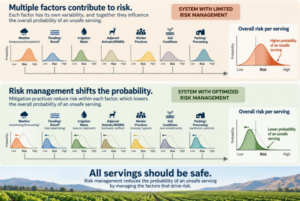
We often talk about food safety as binary: a serving is safe or it isn’t. But the system that produces that serving is much more complex than that.

Weather has variability. Water quality has variability. Wildlife activity, flooding, adjacent land use, worker practices, soil conditions, processing. The risks associated with each change across time and space.  

Think of each factor as having its own probability distribution. 

Good risk management doesn’t pretend we can eliminate variability. It asks: What can we do to shift those distributions? 

Better monitoring. Better information. Strategic buffers. Water treatment. Sanitation. Training. Process controls. Earlier detection of changing conditions. 

Risk management changes the distribution of possible outcomes. And when those changes are integrated across the production system, they can reduce the overall probability of producing an unsafe serving. That is a critically important distinction.  

Two servings of fresh produce can both be perfectly safe today, while having been produced by systems with very different probabilities of producing an unsafe serving tomorrow. 

All servings should be safe. Optimized risk management increases the probability that they will be.  

FDA Concludes Cyclospora Outbreak Investigation and Outlines Prevention Plans

October 7th, 2026

The U.S. Food and Drug Administration (FDA) announced on October 2, 2026, that it had concluded its investigation into the Cyclospora outbreak linked to iceberg lettuce sourced from Central Mexico.  

Investigation Update 

In the Oct 2nd announcement, the FDA shared that they had conducted an onsite inspection and sample collection (water, soil, sediment, and lettuce) at several farms and facilities in Mexico. The FDA reported that two positive environmental samples collected during inspections in Mexico: one from a tank holding outgoing wastewater at the processing facility and another from a drainage ditch at a lettuce grower identified through traceback. The total number of samples taken was not shared by the FDA.  

FDA noted that these findings confirm Cyclospora was present in the environment where lettuce was grown and processed. While they do not conclusively establish how contamination occurred, they mention this adds to the strong epidemiological and traceback evidence linking the outbreak to recalled shredded iceberg lettuce. Genotyping of both positive environmental samples has been completed, and FDA is continuing its analysis to determine how those results relate to ongoing genotyping of clinical specimens. 

What Happens Next? 

The FDA’s post-outbreak response page shares what is happening next, they have two types of actions (i) Immediate and (ii) ahead of the 2027 sessions. Immediate actions included that During the week of September 8, FDA met with senior Mexican public health and agricultural officials to discuss recent outbreaks and strengthen prevention efforts. The agency also sent a letter to industry calling for collaboration to address Cyclospora contamination throughout the supply chain. Work to understand the outbreak’s root cause continues, and they have committed to sharing those findings and incorporate lessons learned to their cyclospora prevention, response and research action plan.  

Ahead of the 2027 growing season, FDAs also listed 10 activities that reflect their plans to mitigate risk during the 2027 season. These include 

  • Publishing an outbreak investigation report 
  • Expanding surveillance of commodities historically associated with Cyclospora. 
  • Conducting outreach activities, domestically and internationally on PSR, Preventive Controls and the Traceability Rule 
  • Strengthening laboratory capacity in Mexico and aligning genotyping methods with CDC. 
  • Leverage data to monitor environmental and weather factors as potential indicators of contamination risk. 
  • Collaborating with Mexican authorities to expand food safety education and training. 
  • Convening experts on worker health and hygiene, water and wastewater monitoring, and growing and processing practices. 
  • Increasing Foreign Supplier Verification Program inspections to assess how importers address Cyclospora hazards. 
  • Taking lessons learned and incorporating them into the Cyclospora Prevention, Response and Research Plan 

What Are Mexican Authorities Saying? 

Mexican federal and state authorities also addressed FDA’s findings. In an October 3, 2026, informational statement, COFEPRIS responded to the closure of the Cyclospora and Salmonella Javiana investigations. According to reporting reproducing the statement, COFEPRIS acknowledged FDA’s two positive Cyclospora environmental samples but emphasized that those findings alone did not conclusively establish agricultural products as the source of contamination. The agency also cited negative results from Mexican testing of raw material, finished product, and water. The statement also reaffirmed its commitment to continued technical and scientific cooperation with FDA and CDC. 

In a separate release issued the same day, the Government of Guanajuato acknowledged FDA’s investigation closure and outlined continued coordination through its Secretaría del Campo. The state said it remained in communication with SENASICA and the company to review available technical evidence and determine appropriate preventive and follow-up actions. 

Guanajuato also described ongoing collaboration with the Comité Estatal de Sanidad Vegetal de Guanajuato (CESAVEG), producers, and companies to strengthen monitoring, traceability, and food safety practices. The state reaffirmed its commitment to cooperate with authorities in countries receiving its agricultural exports, in coordination with Mexican institutions and based on scientific evidence. 

Additional Information 

For more information, visit Western Growers’ Cyclospora resource page for the fresh produce industry. Additional reading includes: 

For questions or additional support, contact Gustavo Reyes at [email protected], Joelle Mosso at [email protected], or De Ann Davis at [email protected]. 

FDA Releases 2025 Annual Report on Foodborne Outbreak Investigations

October 7th, 2026

The U.S. Food and Drug Administration (FDA) released its 2025 CORE+EP Annual Report on October 6, 2026, summarizing investigations of foodborne illness outbreaks and certain adverse events involving FDA-regulated foods. The report highlights major investigations, public health actions, and new resources for sharing outbreak findings. 

Summary 

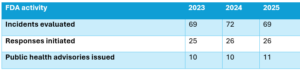
In 2025, FDA evaluated 69 incidents, initiated 26 responses, and issued 11 public health advisories. Overall activity was similar to recent years: 

How much involved Produce? 

Among the 17 responses with an identified food source, six involved produce-vegetables, representing approximately 35%. These included cucumbers, frozen sprouted beans, cilantro, parsley, spring mix, and sprouts. Vegetables remained the largest individual food category, followed by multi-ingredient foods at 29%. 

The vegetable share was lower than in 2024, when vegetables accounted for 11 of 20 responses with an identified food source, or 55%. This is a year-to-year decrease, but it does not establish a sustained decline in vegetable-associated foodborne illness.  

Expanded resources for sharing investigation findings 

In September 2025, FDA introduced two resources to make more information from completed investigations available to industry, researchers, and the public. 

Executive Incident Summary (EIS) Abstracts provide summaries of individual investigations after they close. They describe the evidence gathered during the response, including epidemiological information, laboratory findings, and traceback activities. The collection includes investigations where a food source was identified and those where the source remained unknown, providing visibility into both findings and unresolved questions. 

The abstracts also document coordination among federal, state, and local partners. Information is redacted to comply with disclosure laws and protect confidential commercial information and personally identifiable information. 

Foodborne Outbreak Overview of Data (FOOD) Reports examine food–pathogen combinations associated with repeated outbreaks. They bring together historical epidemiological data, laboratory analyses, traceback findings, and post-response prevention activities across multiple investigations.  

Read the full FDA CORE+EP 2025 Annual Report. 

If you have any questions about the report or would like additional information, please contact Gustavo Reyes at [email protected]. 

New Western Growers Resource Helps Consumers Understand Cadmium in Fresh Produce

October 6th, 2026

Western Growers has created a new consumer-facing resource to help answer questions about cadmium in fresh produce.

The flyer explains what cadmium is, how it occurs naturally in soil and why the presence of small amounts in food does not necessarily mean a food is unsafe. It also reinforces the importance of eating a varied diet that includes fruits and vegetables.

Members can share the resource with consumers, customers or anyone who may have questions about cadmium in fresh produce.

Download the resource here.

Bertie Gregory to Kick Off Western Growers 100th Annual Meeting

October 6th, 2026

Western Growers is excited to welcome National Geographic photographer, wildlife filmmaker and television host Bertie Gregory as the kickoff keynote speaker for the 100th Western Growers Annual Meeting.

Gregory is an award-winning filmmaker who has spent his career traveling to some of the most remote and challenging places on the planet to tell stories about wildlife and the people working to understand and protect it. In 2020, he became BAFTA’s youngest-ever cinematography winner for his work with David Attenborough and the BBC Planet Earth series.

He has hosted and produced 14 television projects for National Geographic, including his latest projects, Sharks Up Close with Bertie Gregory and Secrets of the Penguins, which are streaming on Disney+. He has also been named the National Geographic Rolex Explorer of the Year.

Known for leading teams into extreme environments, Gregory brings a perspective that goes well beyond wildlife filmmaking. Gregory will share stories from his work around the world and offer a look at what it takes to adapt when the unexpected happens. His ability to pivot and turn challenges into opportunities is a fitting message as Western Growers celebrates 100 years of agriculture, innovation and leadership.

For more information about the Western Growers Annual Meeting, including speakers and agenda, please click here.

To learn more about Western Growers Annual Meeting sponsorship opportunities, please contact Rob Steinmann at [email protected].

New California Laws: What Growers Should Know About SB 716 and AB 817

October 6th, 2026

Gov. Gavin Newsom recently signed AB 817 and SB 716 into law, establishing new requirements for certain cold storage facilities and increasing penalties for specified local ordinance violations. These bills were gutted and amended in the last few days of the legislative session in response to the Boyle Heights cold storage facility fire in Los Angeles. These laws carry implications for businesses across the fresh produce supply chain. Below is an overview of the key provisions and what Western Growers members should know.

AB 817 (Gonzalez), Ch. 493 requires certain cold storage facilities to establish a contingency fund of up to $20 million as a condition of building permit approval, to help cover community impacts from emergencies. Western Growers initially opposed the bill because of the costs and uncertainty for facilities looking to build or expand. On August 27, we removed our opposition after amendments narrowed its near-term reach and delayed statewide application until January 2028. We are now working with Assemblymember Gonzalez on amendments for a cleanup bill next year to address our remaining concerns.

SB 716 (Durazo), Ch. 494 allows higher fines for local health and safety ordinance violations at large nonresidential facilities, with enhanced penalties of up to $50,000 per violation in certain circumstances. We remained opposed because its reach extends well beyond cold storage and adds substantial penalty exposure for growers and other businesses already subject to extensive regulation. The bill failed in the Assembly Local Government on August 27 but was later pulled from committee and passed by the Legislature on August 31.  We will also work on addressing amendments to this bill.

If you have any further questions, please reach out to Gail Delihant at [email protected].

Court Sets December 30 Deadline for New H-2A Wage Rule

October 2nd, 2026

A federal court has ordered the U.S. Department of Labor (DOL) to issue a new interim final rule for calculating H-2A Adverse Effect Wage Rates (AEWRs) by December 30, 2026. The existing interim final rule will be vacated effective that same date. 

The October 2 order in United Farm Workers v. U.S. Department of Labor follows the court’s August 26 ruling that DOL’s wage methodology was arbitrary and capricious and procedurally defective under the Administrative Procedure Act. The court initially left the rule in place while directing DOL to promptly develop a replacement. 

DOL subsequently proposed a timeline of up to six months for a new interim rule, then indicated at the October 1 status conference that it would endeavor to finish within four months. The court found that DOL had not justified that much time, pointing out that the agency issued the existing rule just five and a half weeks after the prior rule was vacated. 

The court also directed the parties to submit a joint status report on October 22, with additional reports every three weeks until the new interim rule is issued. 

For H-2A employers, the order establishes a firm deadline but does not specify the replacement wage methodology or announce new wage rates. It also does not resolve backpay questions. The October 2 order does not immediately vacate the existing rule. 

Western Growers will continue monitoring the litigation and DOL’s rulemaking and will provide updates as the new methodology takes shape. 

For questions about the H-2A wage rule or about the H-2A program in general, please contact the Western Growers H-2A Services Team. 

Governor Signs AB 2646 Establishing Near $20 Wage Floor for H-2A and Corresponding Workers

October 2nd, 2026

Governor Gavin Newsom signed AB 2646, authored by Assemblymember Maggy Krell, on September 30, 2026. Effective January 1, 2027, the law establishes a separate California minimum wage for specified agricultural workers, including H-2A workers and qualifying domestic employees. 

The law sets a base hourly wage of $19.75, with annual adjustments tied to the Social Security cost-of-living adjustment beginning January 1, 2027. Employers should therefore account for that adjustment when planning for the 2027 wage requirement. 

Although AB 2646 does not expressly name the H-2A program, it covers nonresident agricultural employees working temporarily or seasonally through an application or job order approved, in whole or in part, by California’s Labor and Workforce Development Agency or Employment Development Department. Such employees are by definition H-2A workers.  

The law also covers California residents who perform the same or substantially similar work for the same employer in the same county during the same period. This coverage is broader than the H-2A regulations’ definition of “domestic worker in corresponding employment,” which limits corresponding workers to the same work locations as H-2A workers. The law does not establish a blanket $19.75 minimum wage for every California agricultural employee. 

Western Growers opposed AB 2646 because of the additional costs it would impose on agricultural employers already operating under intense financial pressure. Western Growers is evaluating next steps, including potential legal action, and will keep members informed as those efforts develop. 

Employers should review which positions fall within the law’s coverage and consider the potential impact on their 2027 labor budgets and job orders. For questions about H-2A planning and compliance, contact Western Growers H-2A Services at [email protected]. 

The Termination Process

October 2nd, 2026

The employment relationship can end for a variety of reasons and in many ways. How a separation occurs has as much to do with limiting an employer’s risk as why separation was necessary in the first place. What follows are a few key steps employers should keep in mind before, during and after a termination has occurred.  

  • Understand applicable laws. Given that ‘at-will’ employment is the default rule for private employers in the U.S., employers may end the employment relationship for any reason—with or without notice—so long as it is not for a wrongful reason (such as discrimination, retaliation or harassment). By the same token, employees protected by these laws are not insulated from termination on legitimate grounds, such as for poor performance. Nevertheless, it’s important to understand state and federal employment laws that might be grounds for a lawsuit.  
  • Determine whether the situation poses risk of litigation. If you are unfamiliar with the process of termination or the circumstances are complex (e.g., issues involving protected or disability leave, claims of harassment, retaliation or discrimination, or union activities) it is worth consulting legal counsel to confirm the decision and next steps.  
  • Develop a termination checklist. Developing a checklist will assist in ensuring that company policies are followed consistently and that the process is carried out in accordance with state/federal laws. Below are five important checklist boxes to tick: 
    • Document the reason for the termination. There is no need to provide a detailed written monologue covering all the reasons why the individual was terminated. However, the relevant key points should be noted including which company policy was violated and how, who was involved in the termination (the decision to terminate and the actual termination), when was the decision made, and what was discussed.  
    • Final paycheck issued. Most states have statutory requirements on when a final paycheck must be provided depending on whether the termination was voluntary or involuntary. An employer who terminates an employee must present the employee with their final paycheck at the time of termination. A note on the check should indicate “Final Check” and pay wages through the date of termination.  
    • Unused Accrued Vacation Paid. Unused accrued vacation time is treated the same as wages in California, Colorado and New Mexico, and must be paid at the time of termination. In Arizona, as of August 6, 2016, the definition of “wages” no longer includes an express reference to vacation pay. 
    • COBRA Eligibility Notice/HIPAA Certification provided. These notices must be provided by the employer if not provided by the plan administrator/carrier. 
    • All legally required notifications provided. Many states require employers to provide terminated employees with specific notices. For example, California requires several including, but not limited to, Employment Development Department “For Your Benefit” and Change of Employment Status Notifications, Department of Health Services “Health Insurance Premium Payment” program notice and written notice of coverage options if not provided by the plan administrator or carrier, and COBRA and Cal-COBRA notices. 
    • File the checklist and accompanying documents, if any, accordingly.    
  • Disable Access to Electronic Resources. It’s crucial for employers to safeguard their sensitive information and deter former employees from potentially misusing company electronic communication systems. To achieve this, it’s imperative to take the following steps: 
    • Deactivate access to company email accounts. 
    • Disable voicemail privileges. 
    • Revoke login credentials. 
    • Terminate remote login capabilities. 
  • Collect Company Equipment: Absent contractual language setting out the terms and conditions for returning company property, the employer should simply request the terminated employee to return or dispose of (if outdated or duplicated) all specified property. Once all company resources have been successfully retrieved, it is prudent to have the departing employee sign an acknowledgment affirming the complete return of all company assets. 

By implementing these measures, organizations can mitigate litigation risk and ensure the protection of valuable data and property. 

Gov. Newsom Signs UFW Minimum Wage Bill for H-2A

October 1st, 2026

Unfortunately, Gov. Newsom has signed AB 2646 (Krell – D). The bill will increase the hourly minimum wage for H-2A and associated corresponding employees in California to $19.75 per hour beginning Jan. 1, 2027. In addition, the hourly wage will continue to be increased each January based on the cost-of-living adjustment for Social Security benefits. This is a massive cost increase to a program that also requires that H-2A employers provide housing and transportation. This wage increase will impose hundreds of millions of dollars in additional annual costs on the agricultural industry and will lead to increased costs of healthy foods. Western Growers voiced strenuous opposition to this bill throughout the entire process.

Every additional mandated cost on agriculture further limits investment, constrains production and contributes to difficult decisions about reducing acreage, scaling back operations or shifting production elsewhere. AB 2646 will add to these existing pressures without addressing the underlying workforce challenges facing agriculture or recognizing the economic realities under which California’s food production system operates.

California is the nation’s leading producer of fresh fruits, vegetables and tree nuts—the very foods that nutrition experts encourage Americans to consume to improve public health and reduce chronic disease. The state’s agricultural diversity, productivity and commitment to high production standards have made California indispensable not only to its own residents, but to consumers across the country. However, net farm income (the key indicator of farm viability) is decreasing in California as operating costs continue to spiral far beyond what farmers in other states and countries experience. Policies that make the production of these foods increasingly difficult deserve particularly careful consideration because their impacts extend well beyond individual farming operations.

While this is not the outcome that we had hoped for, Western Growers has been preparing for this result, including considering legal options. Western Growers staff will be providing regular updates to our membership as we proceed forward.

Registration Open for 34th Annual Nutrient Management Conference

October 1st, 2026

Registration is now open for the 34th Annual FREP/WPH Nutrient Management Conference, taking place October 28-29 at the Hilton Stockton in Stockton, Calif.

Hosted by the California Department of Food and Agriculture’s (CDFA) Fertilizer Research and Education Program (FREP) and Western Plant Health (WPH), the annual conference brings together agricultural researchers, industry professionals, consultants and others to discuss the latest research and practical approaches to nutrient and irrigation management.

This year’s agenda will cover a range of topics relevant to California growers, including nutrient and irrigation management in annual and perennial crops, cover crop adoption, potassium management in almonds, irrigation scheduling, biostimulants and the role of silicon in plant nutrition. Panel discussions will also examine the outcomes of the Second Agricultural Expert Panel and irrigation challenges across different regions and cropping systems.

The conference will also feature a poster session on October 28 showcasing California research, outreach and demonstration projects related to irrigation and nutrient management. Abstracts are due to FREP by October 20.

Early registration is available through October 15 for $225, with a $130 rate for currently enrolled students. Continuing education units will also be available for Certified Crop Advisers and Self-Certified Growers.

Register here.