Western Growers Wins Ninth Circuit Ruling Upholding Block on California’s “Captive Audience” Law 

October 29th, 2026

In a significant victory for Western Growers and California employers, the U.S. Court of Appeals for the Ninth Circuit on October 29 unanimously affirmed a preliminary injunction blocking California from enforcing SB 399, the state’s so-called “captive audience” law. The court concluded that the employer associations challenging the law are likely to prevail on their claim that it violates the First Amendment. 

The California Chamber of Commerce, California Restaurant Association and Western Growers brought the lawsuit, California Chamber of Commerce v. Bonta. Fisher Phillips attorneys Lonnie Giamela and Todd Lyon represent the associations. A link to the association plaintiffs’ statement can be found here. Western Growers thanks CalChamber for leading this litigation and for its partnership in defending California employers’ First Amendment rights.

SB 399, which took effect Jan. 1, 2025, prohibits employers from taking or threatening adverse action against employees who decline to attend employer-sponsored meetings or receive communications conveying the employer’s opinions on political or religious matters. The law defines “political matters” broadly, covering legislation, regulation, elections and decisions about joining or supporting a labor organization. Violations carry potential civil penalties of $500 per employee per violation, along with exposure to employee lawsuits and damages. 

The State Cannot Single Out Employer Speech 

California argued that SB 399 regulates employer conduct rather than speech because it restricts discipline for refusing to attend a meeting. The Ninth Circuit rejected that distinction. Whether an employer violates the law depends on what the employer says at the meeting, bringing the First Amendment directly into play. 

The court found that SB 399 discriminates based on both the subject of the speech and the identity of the speaker. As the opinion explains, “SB 399 is facially content-based because it applies only when the employer has discussed certain topics: politics and religion.” 

Those distinctions subjected the law to strict scrutiny, the most demanding constitutional standard. California’s argument that employees need protection as a “captive audience” did not justify the restrictions. 

Western Growers’ Evidence Helped Establish the Right to Sue 

The court specifically relied on Western Growers’ declaration explaining that members hold all-hands meetings to discuss legislation and legislative reform. That evidence helped establish Western Growers’ standing to challenge the law on its members’ behalf. Having found that Western Growers had standing, the court did not need to decide whether the other associations independently satisfied that requirement. 

What the Decision Means for Employers 

The ruling keeps the preliminary injunction against California’s enforcement of SB 399 in place. It is a substantial appellate victory, although it does not constitute a final judgment permanently invalidating the law. The court resolved the appeal on First Amendment grounds and did not reach the associations’ separate argument that federal labor law preempts SB 399.  

For agricultural employers, the decision protects the ability to discuss legislation, regulation and other issues affecting their businesses with employees. Employers should continue to observe other applicable restrictions on workplace communications, including prohibitions against threats, coercion and unlawful retaliation. 

California Proposes Updates to Pregnancy and Bonding Leave Regulations

October 29th, 2026

California’s Civil Rights Council has proposed significant updates to the regulations governing pregnancy disability leave, workplace accommodations, temporary transfers and bonding leave. The proposal is intended to modernize regulations that have not been updated in more than a decade and, where appropriate, align California protections with the federal Pregnant Workers Fairness Act. The proposal will be considered at a public hearing scheduled for 11:00 a.m. December 8, 2026, with written comments due by 5:00 p.m. that same day. Please note that these changes are only proposed and have not taken effect.

Among other changes, the proposal would expand examples of pregnancy-related medical conditions and reasonable accommodations, including telework and temporary suspension of certain essential job functions. It would also broaden the types of healthcare providers who may support an employee’s need for leave or accommodation and eliminate the current requirement that CFRA bonding leave generally be taken in two-week increments.

What Does It Mean?

For employers, no immediate policy change is required based on the proposal alone. However, the proposed regulations provide an early look at where California may be headed, particularly regarding how employers respond to accommodation requests, the documentation they may request and the flexibility available to employees. For example, the proposal provides that employers should respond to pregnancy-related accommodation requests as soon as practicable and that unnecessary delay could constitute a violation even if the accommodation is ultimately provided.

Written comments may be submitted to the Council at [email protected] by 5:00 p.m. PT on December 8, 2026. For additional information, including meeting location and Zoom link, please review the Notice of Proposed Rulemaking.

An H-2A Worker Is Injured as the Season Ends. What Happens Next?

October 29th, 2026

An H-2A worker is still receiving physical therapy when the harvest ends. Another needs surgery just days before the contract expires. Can the worker remain in the United States? Can treatment continue back home? What happens to housing and return transportation? 

The season’s end does not necessarily end an employer’s responsibilities. Medical care, immigration status and H-2A contract obligations each require attention. 

Medical Care May Continue After Employment Ends 

H-2A employers must provide workers’ compensation coverage at no cost to the worker. For a covered work injury, necessary medical treatment may continue after the seasonal job ends. In California, for example, treatment can continue for as long as medically necessary, subject to applicable treatment guidelines and limits. Wage-replacement benefits require a separate assessment under state law. 

Notify the carrier promptly and obtain the treating physician’s assessment of the worker’s restrictions, anticipated treatment and ability to travel. If the worker wants to return home, ask the claims administrator whether treatment can be arranged there, which providers are authorized and how payment and follow-up will work. Do not assume care abroad is automatically covered. 

A non-work-related illness or injury raises different coverage questions. Workers’ compensation generally covers conditions arising from employment, not every medical problem that occurs during an H-2A contract. 

Medical Treatment Does Not Automatically Extend Immigration Status 

A pending workers’ compensation claim, scheduled therapy or hospitalization does not by itself extend the worker’s authorized stay. 

Review the worker’s current Form I-94, petition approval and any pending immigration filing. The expiration date on the visa stamp alone does not establish how long the worker may remain. H-2A rules generally provide a 30-day grace period following petition expiration to prepare for departure or seek qualifying further status, but that period does not authorize continued employment. Counsel should confirm the applicable dates and circumstances. 

If medically necessary treatment will extend beyond the authorized stay, involve immigration counsel before that stay expires. Counsel may evaluate a change to B-2 visitor status for medical treatment or another appropriate option. An H-2A extension should not be treated as a medical extension when qualifying agricultural employment has ended. 

Plan Housing and Return Travel 

Employers generally must provide or pay for return transportation and subsistence when a worker completes the contract and has no immediate subsequent H-2A employment. Coordinate the departure with the treating physician’s advice, including any restrictions on flying or prolonged travel. 

Housing also needs an express plan. Before closing housing or requiring an injured worker to leave, review the job order, applicable state law, medical needs and any accommodation obligations with counsel. A continued right to medical benefits does not, by itself, resolve who must provide or pay for lodging after the contract ends. 

What Employers Should Do Now 

As soon as treatment appears likely to extend beyond the season, coordinate with the worker, treating physician, claims administrator and immigration counsel. Document the treatment plan, travel restrictions, immigration deadlines, housing arrangements and responsibility for transportation. Explain the arrangements in a language the worker understands. 

Do not wait until the crew’s departure day to resolve these questions. Early planning helps protect the worker’s recovery and prevents a medical problem from becoming an immigration or compliance problem. 

For assistance with H-2A compliance questions, contact Western Growers H-2A Services at [email protected]. 

AI Is Growing Up: Employers Shift Their Focus from Adoption to ROI

October 29th, 2026

Artificial Intelligence (AI) has quickly moved from a workplace experiment to everyday business tool. But as employers become more comfortable with AI, a new question is coming into focus: Is it actually delivering measurable business value? 

McKinsey & Company’s latest global survey suggests the answer is both yes and not yet. Nearly nine in ten respondents report regular AI use in at least one business function, and 44% say their organizations are now scaling AI across the enterprise. Employees are seeing benefits too: 80% of respondents who use AI at work say it has improved their productivity. 

Yet those gains have not translated as readily to the bottom line. Only 37% of respondents say AI has contributed positively to their organization’s earnings before interest and taxes (EBIT). The organizations reporting the strongest financial results aren’t simply adding more AI tools. They are more likely to redesign workflows, measure AI’s impact, involve senior leadership and plan for workforce changes. 

The workforce picture is also more nuanced than early predictions suggested. While 39% expect AI to reduce overall head count in the coming year, only 14% report that AI actually contributed to an overall workforce decline during the preceding year. Meanwhile, 60% expect their organizations to increase AI investment over the next year. 

What Does It Mean? 

For employers, the next stage of AI adoption may be less about whether to use AI and more about where it genuinely creates value. Productivity gains are encouraging, but the organizations seeing the strongest results appear to be pairing technology with redesigned workflows, employee AI skills, meaningful human oversight and methods for measuring results. 

As discussed here, the move from experimenting with AI to integrating it more deeply into business operations also brings new legal considerations for employers, particularly when AI intersects with workplace decision-making. 

For employers, the takeaway is straightforward: the competitive advantage may no longer come simply from having AI. It may ultimately come from learning how to use it well.

WG Issues Statement on Ninth Circuit Blocking Enforcement of California Captive Audience Law

October 29th, 2026

SACRAMENTO (Oct. 29, 2026) — Western Growers Association, along with the California Chamber of Commerce and the California Restaurant Association, issued the following statement on Thursday after the U.S. Ninth Circuit Court of Appeals affirmed the lower court ruling blocking the enforcement of Senate Bill 399 that would limit employer communications with workers on a variety of issues, including possible union representation:

The Ninth Circuit got it right: SB 399 violates an employer’s First Amendment rights to free speech by dictating what kinds of meetings can, and cannot, be considered mandatory for employees to attend.

The state cannot limit the speech of any business owner simply because the contents of that speech might differ from the political viewpoint of elected officials or outside interest groups.

By upholding the ruling of the district court, the Ninth Circuit has ensured those in the agriculture and restaurant industries — along with all California businesses — can communicate openly with their employees about any issue that might affect a company.

Today’s ruling serves as a reminder that free speech, unrestrained by government overreach, is an essential part of our American democracy.

AZDA to Hold Annual Regional Stakeholder Meetings

October 28th, 2026

The Arizona Department of Agriculture (AZDA) will hold several Regional Stakeholder Meetings in November. AZDA Director Paul Brierley and his leadership team will provide agency updates, share accomplishments, discuss current challenges and hear input from participants.

Growers, labor contractors, custom applicators and food safety professionals are encouraged to attend. Input shared during the meetings helps shape the future of agriculture in Arizona through open dialogue and collaboration.

Yuma
Date: Wednesday, November 4
Time: 1-3 p.m.
Location: Pivot Point Conference Center
200 N. Madison Ave., Yuma, AZ 85364

Phoenix
Date: Thursday, November 5
Time: 10 a.m.-noon
Location: Maricopa County Cooperative Extension
4341 E. Broadway Road, Phoenix, AZ 85040

Tucson
Date: Wednesday, November 18
Time: 10 a.m.-noon
Location: UA Campus Agricultural Center — Building #2027, Modular Classroom
4101 N. Campbell Ave., Tucson, AZ 85719

The date and location for the Show Low meeting are still being finalized and will be posted here once confirmed.

The Social Wrap: Oct. 22-28

October 28th, 2026

From pumpkins to plant biotechnology, here’s what we’ve been up to on social media this week.

We kicked off our Pumpkin Palooza series, putting our members in the spotlight and giving consumers a behind-the-scenes look at the people, products and processes that bring a seasonal favorite from the field to the front porch.

At Van Groningen & Sons in Manteca, Calif., we explored some of the 40 different pumpkin varieties grown under their Pamper’d Farms label and learned what makes each unique, from their shapes, colors and sizes to their uses for decorating and cooking.

We also headed to Nuss Farms in Lodi, Calif., where fifth-generation farmer Tim Nuss walked us through the pumpkin harvest process, from planting and cutting to sizing and hand-harvesting.

On X, we shared Western Growers’ Jeana Cadby’s visit to Stanford with Rep. Zoe Lofgren to explore plant biotechnology research and its potential applications for agriculture, including crop resilience and improved water and nutrient use efficiency.

With Halloween right around the corner, Pumpkin Palooza gave us a timely opportunity to introduce consumers to our members, show the work behind one of fall’s most recognizable crops and remind them of the important role growers play in making seasonal traditions like Halloween possible.

Watch and share today on all platforms:

FDA Leadership Visits Salinas to Discuss Prevention and Risk Communication 

October 28th, 2026

FDA Human Foods Program leadership visited the Salinas Valley October 20–21 to meet with local fresh produce industry, trade association representatives, USDA and California and Arizona State leaders and partners about this summer’s Cyclospora outbreaks, risk communication and their 10 Planned Activities prior to the 2027 Growing Season for Cyclospora.  

The visit included an industry reception, an agricultural technology tour at Reservoir Farms, and a roundtable at the USDA Sam Farr Research Center. Discussions addressed the outbreaks’ continued effects on California producers, the role and critical aspects of clear communication during crisis events to ensure consumer confidence and a discussion about the details within the FDA’s Cyclospora response plan to help prevent recurrence. 

Industry representatives emphasized the need to learn from these events to improve outbreak communication and its coordination, regulatory oversight, risk prioritization and management regarding production areas known to be historically associated with Cyclospora and improve the system for better consumer-level communication around existing and evolving food safety management controls at the farm. A proactive discussion was held around how to improve communication between industry, state and federal regulators, as well as a collective focus on efforts that could improve speaking to consumers routinely about fresh produce food safety, versus during crisis events alone. A key discussion area focused on building trust in the system recognizing the importance of being able to communicate more clearly how growers assess hazards, implement preventive measures and verify that those measures are working. 

From Baselines to Signals: How Do We Know When Something Has Really Changed?

October 28th, 2026

Last month I wrote about why developing baseline measures is so important. A baseline tells us what normal looks like for a process. But it leaves an obvious follow-up question: once we have a baseline, how do we decide that a new result is different enough to deserve a closer look? 

Today I want to take the next step, moving from baselines to signals. 

So, what is a signal? 

A signal is a pattern in new data that is unlikely to be explained by routine variation alone. That is all. It is not a diagnosis, and it is not a verdict on whether something is safe or unsafe. 

Going back to the commute example, a 38-minute drive on a day you usually take 25 to 35 minutes is just noise. A 65-minute drive is a signal. It does not tell you why it happened, only that the day was different enough to ask questions. In produce safety, that is the job of a signal: to tell us where to look first. 

A simple tool: the control chart 

Last time I mentioned one of the most practical ways to turn a baseline into a signal is the control chart, a tool that came out of manufacturing quality control almost a century ago. The idea is simple. We take results from a stable baseline period, calculate the average and how much the results normally vary, and draw limits around that average (commonly three standard deviations). Then we plot new results against those limits as they come in. NIST has a good overview of control charts and the patterns to look for. Today I want to elaborate a little bit more.

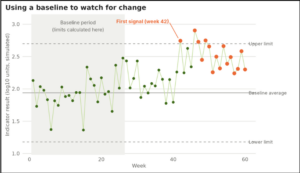
Figure 1 below shows what this looks like using simulated weekly results. The first 26 weeks are the baseline. Later in the series the process shifts upward by a modest amount. Most of the new results still look ordinary, and none of them is dramatic. Yet the chart first flagged a result at week 42, and then kept flagging the weeks that followed, because eight or more results in a row were sitting above the baseline average. That is the pattern of a process that has moved, not of one unlucky week.  

A signal is more than one extreme result 

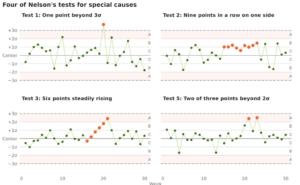
This is the part I think we most often miss. We tend to look for the one big number. But a meaningful change can also show up as a run of results sitting on one side of the average, several results steadily moving in the same direction, or a couple of results hovering close to the limits. 

Figure 2 shows four of the tests that Lloyd Nelson described in his 1984 paper, “The Shewhart Control Chart: Tests for Special Causes,” which I accessed here. Nelson divides the space around the average into zones one standard deviation (sigma = σ) wide (C is closest to the average, A is the outer band between two and three standard deviations) and defines each test in terms of those zones. He suggests applying Tests 1 through 4 routinely and adding Tests 5 and 6 when earlier warning is worth a few more follow-ups. The four I picked for the figure are, however in the paper there are 8 total tests that could be applied for us: 

Seasonality May Also Matter 

Many of the processes we study follow a seasonal pattern. A study of agricultural water on Kansas and Missouri agricultural farms, for example, reported seasonal effects on generic E. coli levels (Haley et al., 2022).  Similarly, we know that external factors such as temperature, precipitation, humidity all follow somewhat predictable seasonal trends. 

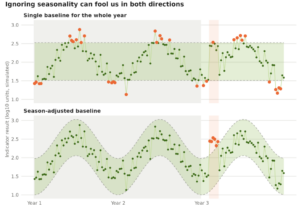
If we build a single baseline across the whole year, the seasonal swing gets mixed into what we call “normal.” In Figure 3 Below, I simulated three years of weekly results with a seasonal pattern. With one baseline for the whole year, the summer highs and winter lows are flagged 17 times in the two baseline years, even though nothing unusual happened. At the same time, a real increase during the seasonal low in year 3 goes unnoticed: only 1 of the 6 affected weeks was flagged. A season-adjusted baseline flagged 0 weeks in the baseline years and 5 of the 6 affected weeks. Same data (different adjustments for a baseline).

What are some limitations 

Control charts work best when the baseline comes from a stable period, the samples are representative, and the data behave reasonably well. Microbial data are often skewed, so they usually need a transformation (such as a log) before limits make sense; NIST notes that skewed distributions change the false alarm risk of the usual three-standard-deviation limits. Results below the detection limit need careful handling, and a baseline built from too few samples will give unreliable limits. As I mentioned in my last article a baseline is also only as good as the process it describes, so if past performance was poor, the baseline will reflect that. 

And, as with baselines, a signal is not a diagnosis. It tells us that something may have changed, not why, and not that food is necessarily unsafe. The next step is always to verify the data, review the surrounding conditions, and determine whether the result is isolated or part of a larger pattern. 

Interested in reading more, here are some resources 
Control charts and signal rules 
From Western Growers 

CAA Webinar Provides Overview of SB 54 Producer Fee-Setting

October 23rd, 2026

Circular Action Alliance (CAA) hosted a webinar this week to provide an overview of its fee-setting approach for California’s packaging Extended Producer Responsibility (EPR) law, SB 54. The webinar covered how program costs are developed, allocated across materials and used to calculate producer fees, as well as the key principles, processes and investments supported through producer funding.

View the recording here.

The webinar comes after CAA submitted its revised program plan to CalRecycle. The revised plan reflects feedback received during the 60-day public comment period and includes updates aimed at improving transparency, strengthening implementation and providing greater clarity around proposed program investments and costs.

CalRecycle is reviewing the revised plan and will determine whether to approve, disapprove or conditionally approve it by Dec. 28, 2026.

USDA and FBI to Host Webinar on Produce Industry Fraud Prevention

October 22nd, 2026

The U.S. Department of Agriculture (USDA) Agricultural Marketing Service (AMS) is partnering with the Federal Bureau of Investigation (FBI) to host a free webinar on fraud prevention for produce‑industry members.

The webinar comes amid reports of sophisticated imposter fraud schemes targeting buyers, sellers and transporters across fruit and vegetable supply chains. Recent allegations reported to USDA’s Perishable Agricultural Commodities Act (PACA) Division point to fraudulent procurement attempts involving spoofed identities, falsified credentials, altered email domains and deceptive trust-building tactics.

The presentation is part of ongoing USDA and FBI efforts to strengthen industry awareness and fraud prevention through outreach and information sharing.

The webinar will be held on Thursday, Nov. 5, 2026, at 10:30 a.m. PST. No registration is required.

Meeting ID: 279 834 785 666 187

Passcode: wM6LK3aD

Reports of Immigration Enforcement Underscore Need for Preparedness

October 23rd, 2026

Western Growers has received reports of immigration enforcement activity in the Fresno and Madera areas, as well as on the Central Coast, including requests to enter agricultural property and encounters involving farmworkers traveling to work. 

One account described agents making repeated requests to a landowner for access to a farm. A labor contractor reported that three workers were detained following a vehicle stop in Fresno. The contractor also described an encounter at a Madera ranch where workers remained inside locked vehicles while agents questioned them through the windows about their immigration status. According to that account, the agents eventually departed. 

Western Growers has not independently verified these accounts, and the circumstances surrounding the reported stops, detentions and requests for access remain unclear. They nevertheless highlight the need for agricultural employers to prepare before agents arrive. 

An enforcement encounter can unfold quickly. Receptionists, field supervisors, crew leaders and farm labor contractors should know whom to contact and how to respond. 

What Employers Should Do Now 

  • Designate a response team. Identify a primary contact and backup authorized to communicate with agents. Keep legal counsel’s contact information readily available and coordinate the plan with labor contractors. 
  • Ask for identification and review the paperwork. Request agents’ names, agency identification and copies of any warrant, subpoena or inspection notice. An ICE administrative warrant is different from a judicial warrant and generally does not authorize nonconsensual entry into private workplace areas. Have counsel promptly review the document and its scope. 
  • Address property access in advance. Train staff to refer access requests to the designated contact rather than casually inviting agents into restricted areas. Review your operation’s offices, packing facilities, fields and access roads with counsel. Private ownership alone does not resolve every access question, and federal law provides specific authority to enter certain private lands near the border for border patrol purposes. 
  • Stay calm and document the encounter. Do not physically obstruct agents, conceal workers, provide false information or destroy records. Record what agents request, what documents they present and what actions they take. Preserve relevant security footage. 
  • Know the deadlines for an I-9 inspection. A Notice of Inspection generally gives employers at least three business days to produce requested Forms I-9. California employers must also provide the required employee and union notices within 72 hours of receiving the inspection notice. Additional notification duties apply to inspection results affecting employees. Contact counsel immediately so neither deadline is missed. 
  • Review records and employee communications now. Conduct a counsel-guided I-9 review, correct errors properly and train supervisors to share verified information.  

Employers should rehearse their response before an encounter occurs. A written plan is useful only if the people answering the door or supervising the crew know how to follow it. 

Best Practices: Performance Reviews Formats

October 23rd, 2026

Performance reviews, or employee evaluations, are an important tool for supervisors and managers to strengthen employees’ performance and acknowledge high achievers. For effective performance reviews we provide the following tips on performance review formats.   

The two major styles in writing reviews are a narrative style and a rating system. The narrative requires the manager or supervisor to write out comments about the employee and the job performance in response to a broad question. The rating system “grades” the employee on various factors. Many companies find a combination of narrative and ratings to be effective. How much of each kind will be used is a decision left up to management. Each has advantages and disadvantages. For example, narratives such as “describe employee’s performance in regard to quality” provokes the supervisor or manager to write their own thoughts about the performance. If periodic discussions are conducted throughout the year with the employee are documented and specific, this will be easier for the supervisor to do. These thoughts tend to be job specific, obviously, and relate to the company’s performance standards. 

The downside is that many supervisors will feel unsure about how to express themselves or what to write about. In the ratings section, the supervisor may find it easier to check a box or circle a number; but the information tends to be generic and less specific. The employee must be able to relate to the information in a review, to correct behavior or continue doing a good job.  

Oftentimes a company will utilize a format that asks for a rating and then provides space for a written explanation or substantiation of the rating. It is essential that the rationalization be specific and factual, so the employee understands what is being discussed. Typically, employee review forms end with an overall rating of theemployee’s performance. This can be extremely helpful in summarizing the other aspects of the review to a conclusion. The employee then leaves the review process with a clear understanding of their overall performance regarding the standards of the job. Managers and supervisors must be aware, though, that the entire review should point logically to this conclusion. If the overall rating does not make sense when compared to other ratings and comments, confusion results. This is to be avoided as it may lead to the employee finding other reasons for the rating (e.g., discrimination, favoritism, etc.). 

It is important to keep in mind, however, that even though both the supervisor and employee expect a review to include a “rating” of the employee, this is not the only purpose for an employee evaluation. Another key component is to engage in a dialogue with the employee to assist the employee in improving performance and developing their skills. 

The evaluation form and procedure can also incorporate the “team” concept. Since very few employees work entirely independent of others, the supervisor may want to include a rating or narrative on the team as a whole. This also fosters an incentive for everyone in the work group to do their part so that the “team” is successful. 

Any form used should be provided to the employee. Sometimes employees are asked to do a “self-evaluation” which can identify whether the supervisor and employee are focusing on the same issues. In any event, the employee should know the criteria for the review so that they can engage in a discussion with the supervisor.

Cal/OSHA Moves to Define Egregious and Enterprise-Wide Violations

October 23rd, 2026

When California enacted SB 606 in 2021, it created two powerful new Cal/OSHA enforcement tools: Egregious Violations and Enterprise-Wide Violations. While those provisions have been on the books for several years, Cal/OSHA is only now proposing regulations that would establish how the agency intends to classify these violations and calculate penalties under the law.

To that end, Cal/OSHA has commenced formal rulemaking to incorporate these classifications into California’s occupational safety and health regulations and establish procedures for citation and penalty calculations. The proposal will be considered at a public hearing scheduled for December 3, 2026, with written comments due by November 30, 2026. 

What Do the Regulations Propose? 

The proposed regulations provide additional detail regarding when Cal/OSHA may characterize a violation as “enterprise-wide.” Generally, the classification may apply when an employer maintains a written policy or procedure that violates a safety requirement or when there is evidence of a pattern or practice of the same violation occurring at more than one worksite. 

For many employers, the significance lies in the reality of operating across multiple worksites and affiliated entities. Where safety programs, management practices, or operational procedures are shared across locations, a deficiency identified at one worksite could potentially prompt broader scrutiny elsewhere within the organization. 

In other words, the issue may not be limited to whether a violation occurred at one ranch, packinghouse, shop, or facility. Cal/OSHA may also examine whether the same deficiency reflects a broader policy, practice, or failure appearing across multiple locations. This makes it especially important to communicate and implement corrective actions throughout the organization when the same issue could exist elsewhere. 

The proposal also sheds additional light on how Cal/OSHA intends to apply the Egregious Violation classification. Under the proposed regulations, a violation generally must first qualify as willful before it may be classified as egregious. Factors that may support an egregious classification include an employer’s prior history of serious, repeat, willful, or egregious violations; conduct demonstrating intentional disregard of employee safety; conduct amounting to clear bad faith; and violations associated with particularly serious outcomes, including fatalities, catastrophes, or multiple injuries or illnesses. 

In practical terms, the proposed criteria focus on conduct suggesting repeated noncompliance, intentional disregard, bad faith, or a failure to address known safety concerns, rather than treating every safety violation as egregious. 

Perhaps most importantly, the proposed regulations illustrate how penalties may be assessed. An egregious violation could result in separate citations and penalties for each employee exposed to the violative condition. Likewise, enterprise-wide violations could allow penalties to be assessed across multiple locations where the same deficient practice exists. For employers with numerous California worksites, the difference between an isolated citation and an enterprise-wide citation could be significant. 

As discussed here, California law already authorizes Cal/OSHA to pursue enterprise-wide citations and, in certain circumstances, count affected employees separately for penalty purposes. The current rulemaking does not expand that authority, but it does provide the clearest picture yet of how Cal/OSHA intends to exercise it. 

What Does It Mean? 

While the proposal does not impose new statutory obligations, it serves as a timely reminder to evaluate whether safety programs are not only uniformly written, but effective, current, and consistently implemented across all locations. Most importantly, employers should keep in mind that a standardized policy can create broader risk if the same flaw is repeated throughout the organization. 

For businesses operating multiple locations, the message behind the proposed regulations is straightforward: Cal/OSHA is increasingly focused on patterns, practices, and systemic safety failures rather than viewing each worksite in isolation. As the agency moves forward in developing regulations clarifying how it will enforce SB 606, employers should take the opportunity to review enterprise-wide safety practices before an inspection raises those questions for them. 

Additional information, including public hearing details and a videoconference link for the hearing, can be found by visiting Cal-OSHA’s website.  

E-Verify Records Scheduled for Deletion: What Employers Should Do Now

October 23rd, 2026

For employers that have participated in E-Verify for many years, the start of 2027 brings an important record-retention deadline. USCIS recently announced that employers have until January 8, 2027, to download E-Verify records for cases last updated on or before December 31, 2016. After that date, USCIS will permanently dispose of those records as part of its records retention schedule. 

While the announcement does not change employers’ Form I-9 obligations, it does create a limited opportunity to preserve historical E-Verify information that may no longer be available once the records are deleted. 

According to USCIS, employers have until January 8, 2027, to download records associated with E-Verify cases last updated on or before December 31, 2016. USCIS will dispose of those records on January 11, 2027. Employers can preserve the information by downloading the Historical Records Report from E-Verify before the deadline. The Historical Records Report contains company information, case identifiers, and case resolution information for the affected E-Verify cases. USCIS also reminds employers that they should record the E-Verify case verification number on the corresponding Form I-9 or attach a copy of the case details page to the Form I-9 and that the Historical Records Report should be retained with the Forms I-9. 

What Does it Mean? 

For employers with long hiring histories, records may be spread across multiple worksites, HR teams, payroll providers, recruiters, or legacy systems. In some cases, the employees who originally managed E-Verify accounts may no longer be with the organization. 

The disposal deadline provides an opportunity to confirm that historical E-Verify information is properly retained and that older records are not lost simply because they were overlooked. Employers that have been enrolled in E-Verify since 2016 or earlier may be particularly affected. 

A few key steps to consider before the deadline, include: 

  • Identify E-Verify accounts that were active before 2017. 
  • Confirm who has administrator access to those accounts. 
  • Download any available Historical Records Reports before January 8, 2027. 
  • Determine where the records should be maintained within the organization’s I-9 retention system. 
  • Document the preservation effort as part of broader immigration compliance and audit-preparedness practices. 

The January 8, 2027 deadline is not a new compliance requirement, but it is an important housekeeping reminder for long-time E-Verify users. Employers that participated in E-Verify before 2017 should review their records now, confirm access to historical accounts, and download any needed reports before USCIS permanently disposes of the affected records. 

California’s War on the Driverless Tractor

October 22nd, 2026

A Rule Written for Another Age

A Cal/OSHA regulation rooted in the 1970s requires self-propelled agricultural equipment moving under its own power to have an operator stationed at the controls. The rule made sense when autonomous farm equipment belonged to science fiction and a driverless tractor meant someone had fallen off.

Nearly 50 years later, tractors can follow mapped routes, remain within geofenced boundaries, detect people and obstacles and stop automatically. But California still generally requires a human being at the controls whenever employees could enter the area.

The tractor has changed. The regulation has not.

Sacramento’s Innovation Paradox

This might be merely another example of government moving slowly if the consequences were not so serious. California growers face a persistent labor shortage, rising wages, agricultural overtime, increasingly expensive H-2A requirements and fierce competition from foreign producers that operate under very different labor and regulatory standards. Sacramento’s answer to nearly every agricultural problem is that growers must become more efficient, adopt new technology and do more with less.

Then, when the technology arrives, the state tells growers to put someone in the driver’s seat.

The Elevator Operator Problem

History has seen this before. Push-button elevators were commercially viable by the early 20th century, but elevator operators remained common for decades. Municipal codes continued to require attendants, the public distrusted the idea of riding alone and unions negotiated agreements protecting operator positions even in buildings equipped for automatic service. Safety was the stated concern, and early elevators certainly presented real hazards. But as automatic door-reopening sensors, floor-leveling systems, emergency interlocks, communications equipment and braking systems became standard, the safety rationale steadily weakened.

The 1945 New York City elevator strike helped expose the absurdity of having an entire city depend on people performing a function that machines could reliably perform themselves. Today, requiring a licensed operator to stand inside every elevator and press the button would seem ridiculous.

California is repeating that history in the fields.

Regulate the Risk, Not the Seat

The justification, of course, is safety. Tractors and other heavy equipment can cause serious injuries and fatalities. No responsible grower or equipment manufacturer disputes that reality. Autonomous equipment should not receive a free pass, and no one is asking for one.

But safety rules should measure whether equipment operates safely. They should not assume that the presence of a human operator is the only way to make it safe.

Modern autonomous equipment can incorporate obstacle-detection systems, cameras, radar, geofencing, audible warnings, emergency-stop controls, speed limitations and automatic shutdown features. International standards now address the design and testing of partially automated and autonomous agricultural machinery. The technology can record operating data and document near misses in ways a conventional tractor cannot.

A rule that simply requires a person at the controls does not account for any of this. It regulates the seating arrangement rather than the risk.

It can also produce the opposite of its intended result. An autonomous tractor can perform repetitive tasks in extreme heat, operate in areas recently treated with crop-protection products and remove employees from rollover and equipment-strike hazards. Requiring a person to remain on or immediately beside the machine may put a worker back into the very environment the technology was designed to avoid.

Studying the Future While Blocking the Present

Cal/OSHA itself has recognized that the old rule needs attention. After previously opposing petitions to allow autonomous agricultural vehicles, the agency acknowledged in 2024 that it had learned more about the technology and rescinded its general opposition. An advisory committee followed, bringing together regulators, growers, manufacturers, unions, worker advocates and researchers.

That was progress. But studying the future is not the same as permitting it.

California’s regulatory process can take years. Technology companies do not have years to wait while their capital dries up and their competitors establish themselves elsewhere. Growers cannot make long-term investments in equipment when the legal right to use it depends on a variance, an empty field or the hope that regulators will eventually rewrite a rule adopted before the personal computer.

A Field Is Not a Freeway

The state also should resist importing the debate over driverless trucks and robotaxis into agriculture. An autonomous tractor moving slowly within a defined field is not an 80,000-pound truck traveling on Interstate 5. It is not a Waymo navigating pedestrians, bicycles, traffic signals and public intersections. Agricultural equipment operates in controlled environments where access, routes, speed and work zones can be carefully managed by the employer.

Different risks call for different rules.

Protecting Jobs by Losing Them

Some opponents are less concerned about how autonomous tractors operate than about whether they operate at all. Beneath many of the safety arguments is a more basic fear that automation will displace workers.

That concern deserves an honest response. Technology changes jobs, and some tasks will require fewer people. Pretending otherwise would undermine the case for reform.

But refusing to automate will not preserve agricultural jobs if the farm itself becomes uncompetitive. California growers do not sell into a protected market. Buyers can obtain produce from other states: Mexico, South America and elsewhere. When labor and regulatory costs make California production uneconomic, acreage moves or disappears. The jobs follow it.

Automation also does not eliminate the need for people. It changes the work. Autonomous equipment must be programmed, monitored, maintained, repaired, transported and integrated into complex farming operations. These are safer and often better-paying jobs than many of the repetitive tasks the equipment replaces. The right policy is to help agricultural employees develop those skills, not to preserve every existing task indefinitely by law.

California can authorize autonomous agricultural equipment while adopting reasonable protections. Training and upskilling can help affected employees move into new positions. Equipment can be required to satisfy recognized safety standards, operate within designated zones, maintain incident data and include effective emergency controls.

Those protections would address legitimate worker concerns without making autonomous agriculture practically impossible.

Lead or Get Out of the Field

California prides itself on being the home of innovation. That claim rings hollow when the state welcomes agricultural technology at conferences, funds research at its universities and then bars growers from using the finished product in their fields.

The question is not whether autonomous agricultural equipment is coming. It is whether California farms will be allowed to use it before their competitors do.

Lawmakers should expressly authorize autonomous tractors and direct Cal/OSHA to establish clear, performance-based safety standards. The rules should protect workers, allow responsible deployment and give manufacturers and growers enough certainty to invest.

California can lead the next agricultural revolution, or it can regulate that revolution into another state or country. It cannot do both.

The greatest threat to California farm jobs is not an empty tractor seat. It’s an empty field.

A Tale of Two Trade Regions

October 22nd, 2026

For President Donald Trump’s second administration, international trade realignment is again one of his primary crusades. Driven by his inherent view that the country has long been taken advantage of by others, he has made the goal to “rebuild the U.S. industrial base, rebalance trade relationships, enforce reciprocity… and use America’s market power to secure better terms with trading partners.” For the fresh produce sector, the prospects for real trade gains or losses aren’t taken lightly.

As we approach the third year of this trade agenda in action, let’s compare the regional market landscapes of North America and Southeast Asia. The former obviously encompasses Canada and Mexico, the top two export markets for fresh produce collectively (fruits, vegetables and tree nuts). For the latter I highlight Vietnam and Thailand, as I had the great opportunity to travel to both countries earlier this year as part of a specialty crop technical trade mission.

Vietnam and Thailand

Southeast Asia market development is of high interest, especially as the China market dims (more on that later). Of the 11 nations that comprise the Association of Southeast Asian Nations (ASEAN) bloc, Vietnam and Thailand respectively have the third- and fourth-largest populations and similar nominal GDP levels of roughly $500 billion. While Vietnam is still dominated by traditional and smaller outlets, last year supermarkets grew 13 percent and food e-commerce grew 29 percent. Consumers are becoming more selective of food sources and ingredients, and key sectors are getting better at accommodating high-value products, including more sophisticated retail, tourism and food processing. While Thailand’s food market is farther along and more developed in all these aspects, it is still projected to grow at an average annual rate of nearly 5 percent over the next four years. Over the past decade, U.S. fresh produce exports to both countries have increased nearly 60 percent, reaching $795.7 million in 2025.

This June, a small group of industry representatives, technical experts and U.S. Department of Agriculture staff traveled overseas to meet with counterparts in the governments and private sectors. This trip was far more technical in nature than promotional and was organized and supported through the USDA Assisting Specialty Crop Exports (ASCE) Program. ASCE is a $65 million multi-year undertaking to comprehensively tackle non-tariff barriers into markets, especially missing or challenging maximum residue levels (MRL). Nearly three years in, it has arguably been one of the most effective USDA-driven efforts in some time, elevating several crop-chemistry combinations into several countries in one big swing.

We came at a time when Vietnam has been weathering public pressures to tackle corruption in government. The result has been substantial bureaucratic changes and shifting agency responsibilities, so for us there was an immediate need to understand ‘who’s on first’ now with ag import, food safety and crop protection oversight. In Thailand, there is palpable activism against pesticides domestically, including calls for the country to mirror European Union standards. As a result, the consideration of new products has stalled for years and now there could very likely be reforms to the overall registration and regulation process. Given how domestic policy changes can often impact channels for our exports, it was a timely discussion.

From our on-the-ground observations and conversations in both countries, recent U.S. policies and politics fortunately haven’t tarnished the reputation of U.S. ag products being among the safest and highest-quality in the world. From the regulatory and political officials, they were generally open to explaining how their systems work and what their goals for successful ag trade are. Conversely, they asked many questions about how the U.S. manages food, including FDA’s handling of imports and EPA’s oversight of chemicals.

The grocery stores we visited rivaled American ones in terms of quantity, variety, cleanliness and marketing, including displays and aisles dedicated exclusively to U.S.-origin products. Value-added products, tree nuts and premium fruits are overwhelmingly driving the demand. For vegetables not nearly as much, given how much is already grown domestically or is sourced much more closely from neighbors like China. While geography is possibly the greatest disadvantage, the confidence in U.S. foods’ safety is still the key advantage, and a couple off-hand remarks and presentations made mention of certain specific vegetable categories of interest that left me with some (perhaps naïve) optimism that a narrow opening for some U.S. vegetables could be possible in the future.

There were several takeaways from our six-day venture. Both countries are emboldened to strengthen their own domestic policies and economic output. Real changes have and will continue to come for the mechanisms that manage food safety, pesticides and even packaging. At the same time, there is still a constructive attitude toward current U.S. diplomacy and a desire for U.S. products. There is also active interest in multilateral trade dealings, not just bilaterals. The participation from these countries is crucial toward another ASCE initiative: creating a regional import MRL approval process within the ASEAN region.

Mexico and Canada

For all the energy and interest into Southeast Asia, it and practically every other market region in the world are still eclipsed by the sheer volume and value of the Mexican and Canadian markets combined. For 2024 and 2025, the U.S. exported $12.4 billion in fresh produce and nuts, and WG’s four home states were responsible for over 44 percent of that. For U.S. vegetables alone, 87 percent of all exports are destined for Canada and Mexico annually.

As such, we immediately took notice that these countries were among the first targeted by President Trump for higher tariffs and national security demands. All things considered, the relationship with Mexico has continued to be relatively stable and collaborative. With our neighbor to the north, it is a different story and arguably the story of the past two years.

President Trump’s words and actions toward Canada have been especially pointed, frequent and personal. The effect is that it has stirred up anti-American sentiment to a degree we are not seeing anywhere else, nor have probably seen in our lifetime. In a private conversation between California ag stakeholders and U.S.-based diplomatic officials this July, the message was clear: “It cannot be overstated just how [upset] Canadians are.” Franker language was used. Every day there is another media report interviewing Canadian retailers, describing customer demand to stock more Canadian-grown, or at least stock less of U.S.-grown. From direct talks with several WG exporting members, they have been on the receiving end of this ire directly with cancelled or reduced orders, demands that they share in added financial costs and pressure to source product grown in other countries.

Will this all blow over once this administration has moved on in two years? For comparison, January 2018 saw the first shots fired in the U.S.-China trade conflict, and two years later the Phase One deal was signed. Further focus and tariffs on China continued under the Biden Administration, and this second Trump term has again had flare-ups, cool downs and another truce since last year. All told, since 2017 the average tariff rate into China for all U.S. goods has increased from 8 percent to 31 percent. For some fresh fruits and tree nuts that previously had major inroads into China, exports have dropped 20 percent or more since 2016.

Other tree nuts had marked recoveries after the first trade war, but exports collapsed again last year when tariffs came back in the spotlight. As for the systemic non-tariff barriers that hinder greater access to China—barriers the first Trump Administration made so central to its trade agenda—the needle has simply not moved. Today, U.S. ag exports still face an additional 10 percent baseline retaliatory tariff into China that has been kept since 2018.

If history repeats itself, our industry stands to lose a lot in an unresolved U.S.-Canada conflict with little to gain. In response to initial U.S. tariff actions last year, Canada imposed a 25 percent retaliatory tariff on many U.S. products, including 12 fresh produce items. The tariff was in place only from March to July last year, but for those targeted categories there was a collective 33 percent decline when compared to the same period in 2024. If this snapshot gives us any indication as to how a broader and longer imposition of tariffs could go, it’s clear the impact would be substantial.

Even if or when the verbal sparring cools and deals are ostensibly reached, some actions and shifts will likely stay the course. In Canada there are proposals for greater self-sufficiency and moving away from the U.S. as a primary source. Its recently announced National Food Security Strategy proposes $750 million toward controlled environment agriculture to “grow more vegetables and fruits in more places, making Canada less dependent on imports of these products.” Producers understand the time and effort it takes to build relationships with buyers and consumers, and what it means to rebuild. The value of diversifying markets notwithstanding, there is simply no replacing Canada or Mexico.

We recognize the fluidity and politics surrounding international trade right now is especially heightened and sensitive. Nonetheless, WG has been vocal since day one that foreign competition is already tough in many markets, and further ruptures and lingering uncertainty give them more opportunities to keep displacing us. For these reasons we must capitalize on opportunities for new footholds in developing markets overseas, and we must diligently preserve—and build upon—what has long been established here in North America.

[Author’s Note: Cited statistics are generated from USDA and Congressional Research Service databases and sources.]

Going Beyond Lobbying: Passionate Advocacy

October 22nd, 2026

I am writing this article in the middle of September. The California Legislature has concluded their session, and we are now awaiting the Gov. Gavin Newsom’s final action on bills that made it to his desk. It has been a challenging year across the board on a range of topics, but we have had some great victories, including stopping a bill that would have further limited nitrogen applications and successfully stripping language from another bill that would have prohibited an entire class of pesticides in California. There are numerous other wins as well. Of course, many challenges are likely to be ongoing. Our team continues the work on single-use packaging, Proposition 65 regulations, numerous labor-related initiatives and a host of other regulatory proposals.

A common denominator within all of this is the dedication that our entire team brings to work every day, to do everything that we can to ensure your continued success in agriculture. If we don’t end with a successful resolution, we conduct an after-action review to see what tactics and strategies worked and which didn’t. It’s not about meeting the bare minimum to say that we lobbied a specific piece of legislation or regulation; it’s about caring for each of your businesses as if we are one of the owners. That is not something that you can train for; that is someone who naturally brings forward the passion to work hard for your success. I am proud to say that Western Growers has those colleagues, and I am blessed to work with them. We are also grateful to work alongside a group of lobbyists from other agricultural and business associations that have that same natural drive for your success.

This was quite tangible at the end of the session, as hundreds of lobbyists were swarming the Capitol rotunda in Sacramento to grab the ear of legislators and their staff to answer questions about a bill or to negotiate final amendments to protect their stakeholders’ interests. There is a difference between a lobbyist who just “shows up” to work on an issue versus a passionate advocate. I stood at the rotunda railing between meetings, watching the frenzied activity of passionate advocates working to keep your business operations running as smoothly, effectively and efficiently as possible.

It may often seem that Sacramento is a passionless place, devoid of common sense, deaf to the plight of agriculture. That is true in some corners but definitely not all. It remains our job and our calling to ensure that those who have gone deaf to agriculture’s concerns begin to truly listen again. We will not ever give up on protecting this industry that goes above and beyond every single day to feed our nation and the world. Please don’t ever believe that you are operating alone when it comes to handling legislative and regulatory issues. There is a small but mighty army of passionate advocates in Sacramento that considers themselves part of your company and your team.

Beyond Traceability: Why Solving Foodborne Outbreaks Requires a Systems Approach

October 22nd, 2026

As the familiar saying goes, “Insanity is doing the same thing over and over again and expecting different results.”

This is one of my favorite quotes, particularly when specific outcomes are not what we desire. It may seem self-evident not to repeat mistakes, and yet, we’re all guilty of doing this very thing on more occasions than we’d like to admit. Similar to habitual behavior in our personal lives, this maxim also captures an important challenge in how we think about foodborne illness investigations today.

The food-production landscape is continually changing, including the risks we face and the tools available to identify and manage them. Global supply chains are increasingly complex, environmental conditions are shifting, pathogens and hazards are evolving and detection tools are becoming more advanced. Outbreak investigations must evolve as well so we can prevent, detect and contain foodborne illness more quickly and effectively.

Much of today’s conversation around outbreak investigations understandably focuses on traceability and how quickly can we identify a potential source or point of contamination. More rapid and detailed traceability is essential to outbreak intervention. But we must assess the broader system that encompasses outbreak investigations. The broader system, as defined by the U.S. Food and Drug Administration (FDA) and the Centers for Disease Control and Prevention (CDC), recognizes that foodborne outbreak investigations comprise three interconnected, fundamental streams of evidence: epidemiology, laboratory testing and traceability—components that must not only be robust on their own but also collectively.

The system is not sustainable if we only focus on strengthening one component and neglecting the others. Like a three-legged stool, the system depends on the strength and stability of all three.

Start with epidemiology. Before investigators can trace a product, they first need to determine which product they are looking for. That sounds simple enough, but it often is not. It begins with reconstructing what infected people who report their illness ate over a specified time period, including where they purchased it and what other exposures they may have had. As time passes, memories fade, receipts disappear, packaging is discarded and seemingly simple questions—What brand was it? Where did you buy it? When did you eat it?— become more difficult to answer. Collecting detailed, structured exposure information closer to the time of illness can improve patient recall, strengthen hypothesis generation and ultimately support more effective outbreak investigations. The CDC itself recognizes that investigators sometimes lack enough detail about exposures to even begin traceback.

That should prompt us to ask whether improvements in traceability need to be accompanied by improvements in how—and how quickly—we collect epidemiological information. Can standardized questionnaires be used sooner (e.g., in the doctor/clinic office)? How often are questionnaires evaluated for improvement or expansion (e.g., other possible exposure pathways)? Can technology help capture information before memories fade or disappear (e.g., streamline access to electronic purchase data from retail/food service)? Can local and state entities play a more active role in capturing relevant information earlier (e.g., use of standardized surveillance system or database)? These questions relate to the broader information-gathering system and deserve the same level of attention as traceability.

Laboratory testing brings a different set of challenges. While extremely valuable, laboratory testing has limitations in its application and relevancy. Testing is more than generating a positive or negative result. A recent paper on food safety testing highlights the importance of understanding the capabilities and limitations of sampling and testing systems so results can be appropriately interpreted and used to inform food safety decisions. First, contamination in food and the production environment is typically unevenly distributed. Second, products infected people report consuming may no longer be available when an investigation begins. Because of its relatively short shelf life, this is especially pertinent to fresh produce. In addition, only a small portion of a food, if it’s available, or the production environment can realistically be sampled. Also, as FDA has noted, a negative result does not necessarily mean contamination was absent.

Aside from testing challenges, but relevant to testing programs, research also indicates that a changing environment brings new challenges. For example, pathogen occurrence and persistence are influenced by slow, permanent changes in climate over time and transient changes such as extreme weather events (e.g., flooding, drought, wildfires, high winds). Weather-related climate changes may vary season to season or change gradually over time. Innovation in microbial detection methods and other emerging technologies can offer opportunities for sensitive and faster detection, but new technologies also require substantial research, capital investment and validation, prior to integration into surveillance systems.

So perhaps the testing conversation also needs to evolve—from simply asking, “Are we testing enough?” to asking, “Are we testing effectively and developing the science, technologies and surveillance capabilities necessary to anticipate and detect the emerging hazards we will face tomorrow?”

And then there is traceability. With the publishing of FDA’s FSMA Rule 204 on traceability, the promise of enhanced, more efficient traceability is significant. However, no grower, shipper, processor, distributor, broker, retailer or restaurant can create an effective traceback system independently. Information must remain consistent and connected to food as it moves through the supply chain. This need for continuity marks traceability as a shared supply-chain responsibility and not simply a regulatory obligation assigned to individual businesses or sectors of a supply chain.

Traceability, too, presents its own systems challenges. Companies are at different stages of implementation and have invested in different technological solutions and approaches to comply with FSMA Rule 204. As companies make decisions about which system to use and service providers build various tools, the focus, as a whole, should be on system interoperability, data quality and best practices that allow information to move safely and efficiently across the supply chain. Ultimately, no single supply chain segment can make traceability successful on its own; its value depends on shared responsibility and a coordinated farm-to-fork effort.

The real opportunity before us is to strengthen all three legs of the stool and how they work together.

After every outbreak, rather than focusing on traceability improvements or immediately looking for someone to blame, we should be asking where information was lost, where time was lost, if investigations were driven by the data or by assumptions and how the connections among epidemiology, laboratory testing and traceability can be strengthened.

Finding the source of an implicated food is not the same as solving an outbreak. Traceability may help investigators follow the trail, and recalls may help contain the risk, but neither can stand alone. Effective outbreak investigations require epidemiology, laboratory evidence and traceability to work together—not only to identify the problem, but also to understand it, contain it and prevent similar issues in the future.

Earlier and more consistent exposure-data collection could improve the accuracy and completeness of the information available to investigators, helping them develop stronger hypotheses. At the same time, the testing conversation must evolve and focus on advancing the science, knowledge, technologies and surveillance capabilities needed to maximize its value. Combined with better traceability, these efforts could accelerate source identification and improve outbreak response.

The goal for both industry and regulators should not simply be faster traceback. Traceback speed matters, but the larger goal should be a faster-learning, more efficient and effective food safety system—one capable of detecting potential signals sooner, forming better hypotheses and testing them with the best available science; tracing products rapidly through an interconnected and often complex supply chain; taking proportionate action to protect consumers; and, most importantly, using what is learned to prevent future foodborne illness outbreaks.

A Century of Innovation in the Field

October 22nd, 2026

How growers have used mechanization, automation and robotics to keep agriculture productive, resilient and sustainable

For 100 years, Western Growers members have faced the same fundamental challenge: produce more food of higher quality, with limited land, water, labor and time. The tools have changed dramatically, but the grower’s mindset has not. Growers observe a problem, test a solution, measure the result and improve the system. Long before anyone used the term “agtech,” growers were already innovators.

That history matters. Agriculture’s technological progress is sometimes described as though innovation arrived recently from outside the farm. In reality, many of the industry’s most important advances succeeded because growers adapted them to commercial conditions. Tractors, precision planters, mechanical harvesters, refrigerated transportation, drip irrigation and improved genetics all became valuable only after growers proved where they fit, changed their operations and accepted the risk of doing something differently.

Innovation Across Crops

Consider the evolution of California almonds. Shakers, sweepers and pickup machines transformed harvest from a labor-intensive process into a coordinated mechanical system. Microirrigation, soil-moisture monitoring and pressure-compensating emitters later gave growers far greater control over when and where water and nutrients were applied. In table grapes, trellis design, canopy management, field packing and cold-chain improvements increased quality and helped fruit travel farther while arriving in better condition.

The lettuce industry tells an equally powerful story. A century ago, lettuce was packed in wooden crates, top-iced and shipped east by rail. Better railcars, refrigeration, vacuum cooling, packaging and logistics expanded markets and changed what consumers could expect from fresh produce. None of those advances was a novelty for its own sake. Each solved a grower problem: shelf life, quality, labor, distance or cost.

Genetics has been just as important as steel and electronics. Plant breeders have improved yield, uniformity, shelf life, flavor and resistance to pests and disease. In apples and stone fruit, genetics combined with dwarfing rootstocks and two-dimensional trellis systems is creating narrower, more uniform canopies. Those systems improve light distribution and worker access while making precision spraying, mechanical pruning and future robotic harvesting more achievable.

Doing More with Water Inputs and Information

Irrigation may be the clearest example of technology becoming a management system. Permanent-crop growers moved from broad applications toward drip and micro-sprinklers, then added weather data, soil and plant sensors, remote valves, telemetry and variable-rate control. The objective is not simply to use less water. It is to place the right amount in the right location at the right time to protect yield, quality and long-term orchard or vineyard health.

That capability has become more important as regulation has grown more complex. Under requirements such as the Sustainable Groundwater Management Act (SGMA), growers need better information about pumping, allocation and crop demand. Digital records also support nutrient management, pesticide applications, traceability and compliance reporting. Technology cannot remove regulation, but it can reduce the time and uncertainty required to manage it—and help growers document responsible practices with defensible data.

From Hand Crews to Plant Level Decisions

In bedded vegetable production, innovation begins before the crop emerges. Growers choose between direct seeding and transplants based on crop, season, cost, stand establishment and harvest goals. Precision planters and improved transplanters have increased uniformity, which matters because nearly every downstream operation works better when plants are consistently spaced.

Thinning and weeding show how quickly field work can change. Hand crews once made nearly every plant-selection decision with a hoe. Today, automated thinners use cameras and targeted treatments to establish the desired spacing. Automated weeders combine mechanical tools, precision sprays, lasers or other energy sources with vision systems that distinguish crop from weed. These machines do more than replace a task. They can reduce crop injury, target inputs and create a repeatable record of field performance while helping growers manage rising labor costs and limited crew availability.

Crop protection is expanding beyond conventional application methods as well. Ultraviolet-C systems are being evaluated and deployed in selected crops to suppress powdery mildew, offering another tool alongside synthetic chemistry, biological products and cultural practices. Drones now scout fields, map variability, identify stressed areas and, where the crop and rules allow, apply inputs to targeted locations. Handheld and in-line instruments measure Brix, firmness, color and other quality attributes, turning experience into data that can guide harvest timing, packing and marketing decisions.

The Digital Turning Point

The mid-2010s marked a new chapter. Mechanization traditionally performed the same physical action across a row. Computer vision and machine learning allowed a machine to see individual plants, classify what it saw and respond in real time. Blue River Technology helped demonstrate this transition through LettuceBot and the technology that became See & Spray. The significance was larger than one machine: agriculture was moving from field-level averages toward plant-level decisions.

The Next Frontier

That progress should make us optimistic, but not complacent. Some of agriculture’s most valuable crops still depend on people for the most difficult and physically demanding work. Strawberries, table grapes, avocados and citrus remain challenging because fruit can be hidden, delicate, variable in maturity and difficult to reach. A successful harvester must recognize the right fruit, remove it without damage, maintain quality, move through commercial fields and deliver an economic return during a short harvest window.

The next century of innovation will not be defined by robots alone. It will be defined by how well technology fits the biology of the crop and the economics of the farm. Growers will continue to be the proving ground. We will ask whether a tool performs reliably, protects quality, reduces risk and produces a measurable return. That is the same practical standard growers applied to iced railcars, mechanical almond harvest and drip irrigation—and it is why agriculture will continue to innovate.

Western Growers’ first 100 years show that technology does not transform farming by itself. Growers transform farming by putting technology to work.