Diamondback Moth Management Field Day 

October 15th, 2026

Thursday, October 22 

 9:30-11:00 AM  

Huntington Farms – Soledad, CA 

Diamondback moth (DBM) continues to be one of the most challenging pests facing California cole crop production.  

Join UC Davis and UCCE researchers (Ian Grettenberger/Fi-Ve Bug IPM lab and Dylan Beal) and industry (Abby Taylor-Silva, Pest & Disease Task Force) representatives for a field day focused on the latest research and practical management strategies for this increasingly difficult pest. 

The program will cover current insecticide resistance issues, updates from various insecticide efficacy trials, and alternative management tools including virus-based products, vacuums, and mating disruption. Attendees will also learn about the role of non-crop hosts, sprayer technology and spray coverage, and regulatory updates impacting DBM management.  

This event will provide an opportunity to hear about new approaches and discuss potential IPM frameworks for DBM. This is an excellent opportunity for PCAs, growers, industry professionals, and other stakeholders to stay informed on the latest developments and collaborate on solutions to one of California agriculture’s most significant insect management challenges. 

Please contact Dr. Ian Grettenberger  

Registration: https://forms.gle/5JRvirwy4kN9AAdZ6 

Update to Monarch Butterfly ESA Listing Settlement

October 14th, 2026

The U.S. Fish and Wildlife Service and the Center for Biological Diversity, Center for Food Safety reached a settlement that will require the agency to issue a final listing determination for the Monarch butterfly. While the settlement does not automatically grant Endangered Species Act (ESA) protections to monarchs, it ensures that the federal government will ultimately make a final decision on the proposal by June 2030.

Timeline:

2014

  • Center for Biological Diversity, Center for Food Safety, the Xerces Society for Invertebrate Conservation, and monarch researcher Lincoln Brower petitioned the U.S. Fish and Wildlife Service to list the monarch butterfly under the ESA.

2020

  • The monarch butterfly was designated as a candidate species for ESA protection, acknowledging that listing was warranted but precluded by higher-priority actions.

2024

  • The U.S. Fish and Wildlife Service published a proposed rule to list the monarch butterfly as a ‘threatened’ under the ESA, accompanied by a species-specific Section 4(d) rule and proposed critical habitat in coastal California.

2025

  • The statutory one-year deadline for a final listing decision passed without a final rule being issued. Instead, the monarch rule was moved to the agency’s “long-term actions” category, which could push the decision indefinitely.

2026

  • Following the suit filed by the Center for Biological Diversity and Center for Food Safety in Feb 2026, a settlement agreement was reached between the parties where the U.S. Fish and Wildlife Service committed to issuing a final listing determination for the monarch butterfly by June 6, 2030. The final determination could be to list the species as threatened, endangered, or find that listing is not warranted. The settlement does not currently impose new ESA restrictions.

Detection Is Not Risk: What Data Sharing Could Do for Pesticide Exposure Modeling

October 14th, 2026

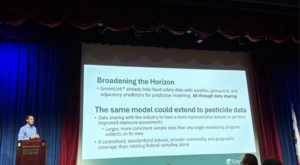
Last Sunday I presented at the 52nd CAPCA Annual Conference on a  communication problem our industry keeps running into: finding a pesticide residue is not the same as finding risk. Here is what I shared, and why I believe data sharing is the way forward. 

Presence is not risk 

A detection answers one question: is something there, and at what level? Risk answers the question that matters: does it affect health? Risk requires both a hazard and an exposure. If either is absent, there is no adverse effect. 

The distinction is easiest to see side by side:

Hazard Exposure Risk
What it is An agent with the potential to cause harm Contact with the hazard (route, frequency, dose) Requires both a hazard and an exposure
Focus Inherent properties of the agent How and how much contact occurs The likelihood of harm under realistic conditions
If absent No potential for harm No risk No adverse effect


A residue detection is a hazard-side input. It is an ingredient of a risk assessment, not a conclusion about safety. Risk is also dynamic: it depends on multiple factors and varies with them, so no single factor, presence included, equals risk. 

Regulators already work this way. Dietary exposure estimates combine what people eat (NHANES/WWEIA) with how much residue is in it (USDA PDP). The result is compared with a health-based reference value (RfD/PAD) and expressed as % of PAD and Margin of Exposure. 

Public messaging often skips all of this. “Dirty Dozen”-style lists rank by detection frequency, with no toxicology and no dose. Growers then absorb reputational and market consequences that are disconnected from the underlying science. 

Even good assessments rest on limited data 

The national datasets are valuable, but each tells only part of the story, and none includes actual grower data. 

  • Scale: USDA PDP tested 9,872 samples across 19 commodities in 2024. 
  • Rotating coverage: not every crop is tested every year. 
  • “As tested,” not “as consumed”: potatoes, for example, are washed but not cooked before analysis. 
  • Dietary data: two-day recalls can miss variability in episodic foods, and self-reported intake carries recall and portion-size bias. 
  • Uneven geography: monitoring is not a designed census of every region, season, or combination. 

If these are the inputs, how representative are the resulting assessments? 

What GreenLink® already does 

GreenLink® is Western Growers’ private, industry-built data-sharing platform. It is designed to move data up a value ladder: collect raw data, clean and aggregate it, see patterns, learn and recommend, and finally take risk-based action in the field. 

Trust is built into the design: 

  • Company name, exact location are anonymized. 
  • Data is aggregated, and when visualized results appear only when a minimum group size is met (for example, three or more participants). 
  • Role-based access keeps individual data individual. 
  • A Data Governance Committee lets participants shape platform development and use cases. 

Today GreenLink® links food safety data with weather, season and time, EPA nearby operations, USDA Cropland Data Layer land cover, and hydrology, all to build predictive models that forecast signals from industry data enriched with public datasets. However, the focus has been mostly on preharvest testing microbiological testing data.  

The opportunity: pesticide data 

The same model could extend to pesticide data. Sharing residue data across the industry would give us: 

  • A more representative dataset for improved exposure assessments. 
  • Larger, more consistent sample sizes than any single monitoring program collects on its own. 
  • A centralized, standardized dataset with broader commodity and geographic coverage than rotating federal sampling alone. 

What this could enable: 

  • A stronger industry voice. Data-driven participation in cumulative risk and MRL discussions, and better-grounded communication with the public. 
  • Better exposure assessments. More representative residue inputs to the models regulators and researchers already use. 
  • Earlier signal detection. Emerging residue patterns and shifts spotted before they become compliance issues. 

To be clear, this complements regulatory monitoring and never replaces it. PDP, FDA, and EPA remain the system of record. Industry data adds depth and context to what those assessments already show. 

Where the industry fits in 

Growers, shippers, processors, and industry partners all hold pieces of this picture. Defining what useful, trustworthy pesticide data sharing looks like will take input from across the supply chain. 

The data we already collect, the models we can already build, and the governance we have already tested give us a foundation. The next step is deciding, together, whether pesticide data belongs on it. 

If you would be interested in developing this further, please reach out to me at [email protected].  


The Messy Middle of Risk-Based Management 

October 14th, 2026

Everyone wants risk-based management, but fewer of us seem comfortable sitting with what it takes to get there. 

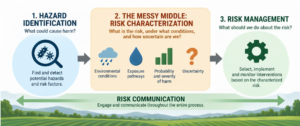
Risk analysis technically encompasses the following steps:  

(1) Hazard Identification – what will cause harm? Examples: bacteria, toxins, metals 

(2) Hazard Characterization – What happens if exposure occurs, and how severe is it (dose-response)? 

(3) Exposure Assessment – How likely and how much exposure is likely to occur? 

(4) Risk Characterization – Use the above information to estimate the probability and severity of harm. 

(5) Risk Management – What can be done to address the risk (monitor, manage, mitigate, etc.)? 

(6) Risk Communication – How do we understand and communicate the risk? 

As a food industry, we seem to really like the beginning of risk-based management. Step 1 is our go to – we like to identify a hazard. In fact, we are getting increasingly good at finding things. Better diagnostics, sequencing, environmental monitoring, remote sensing and massive datasets allow us to detect hazards and potential risk factors at levels we could not have imagined a generation ago. 

We also like to embrace the appearance of step 5. Build a control. Change a practice. Establish a standard. Write a regulation. Find a root cause. Measure compliance. 

But, what about that messy middle? It seems the steps in there make us increasingly uncomfortable. 

Sitting right between hazard identification and risk management sits risk characterization. Risk characterization is all about determining how the presence of a hazard, combined with exposure, environmental conditions, pathways and uncertainty, translates into actual risk. 

That step reads simple but is extremely difficult because it rarely produces a simple answer. Beyond not giving simple answers, those answers are often highly situational and may not apply to related scenarios or systems.  

Let’s start breaking the middle apart so that we can get better in our risk-based efforts.  

Finding a hazard does not automatically tell us the probability of harm. Finding a pathogen in water does not tell us whether it reaches a crop, nor that it will survive once there. Identifying an animal near a field does not tell us whether it creates a meaningful exposure pathway. Rainfall, flooding, irrigation practices, hydrology, temperature, agricultural activities and adjacent land uses can all matter—but they do not necessarily matter equally, everywhere, or all the time. 

Risk exists in the relationships among these factors, and that is where risk characterization gets messy. It requires us to ask questions that are harder than: Did we detect something? 

How much is there? How often does it occur? Under what conditions? Is there a plausible pathway to exposure? How does that pathway change over time? How much uncertainty remains? And, ultimately, how much does this change the probability of an adverse outcome? 

Those questions can be uncomfortable because sometimes the answer is: we don’t know yet. They are also uncomfortable since they have a habit of identifying our vulnerabilities and uncertainties clearly and documented on paper – that is uncomfortable and scary for what it can force us to face.  

But uncertainty and vulnerability are not reasons to skip risk characterization. Uncertainty and vulnerability are what risk characterization is supposed to address. 

Without the important middle steps in the process, precautionary assumptions and efforts can easily become disconnected from risk. When we begin treating every detection, every hazard and every theoretical pathway as though they represent equivalent probabilities of harm, we will logically see resources flowing towards what we can detect, regulate or measure. Unfortunately, that means resources are not spent toward what reduces risk the most.  

That isn’t risk-based management. It is hazard-based management. 

True risk management requires characterization and differentiation (aka, the messy middle). 

Some hazards deserve extraordinary resources and controls because the probability and consequence justify them. Some pathways deserve intensive monitoring only under particular environmental conditions. Some detections may be useful early-warning indicators without representing an immediate food-safety threat. And some factors that appear concerning individually may become meaningful only when several conditions converge. 

Making those distinctions is not minimizing or ignoring risk. Making those distinctions is the actual real work of understanding risk. 

Agriculture particularly needs this distinction because biological systems are variable by definition. I write about this a lot, but a field is not a factory. We know that weather will change, water will move, animals interact within the system, microbial populations will fluctuate, and agricultural practices vary across commodities, regions and seasons. 

If our response to that complexity is to eliminate or shy away from the characterization step and simply demand that every conceivable hazard be prevented, we have not created a more sophisticated risk-management system. We have avoided the hardest part of building one and traded it for a system that feels more comfortable (we aren’t addressing the scary unknown bits). Doing so often costs us far more in consumer, business, and legal risk. That trade off doesn’t make sense. 

The future should look different. 

We should be building systems capable of continuously collecting information about hazards, pathways and environmental conditions; identifying combinations associated with increased risk; evaluating whether interventions shift those probabilities; and updating decisions as new information arrives. 

That means moving beyond asking whether something was detected. 

The better question is: What did this detection teach us about risk? 

And then: What should we do differently because of it? 

There will always be pressure to move directly from hazard identification to action. Sometimes, when consequences are severe or information is limited, precautionary action may be entirely appropriate. But even in those scenarios, the hard work of characterization should continue. Emergency action and scientific understanding are not mutually exclusive.  

Ultimately, the objective is not simply to eliminate everything we can identify as hazardous. It is to continuously understand risk well enough to know that we can exist within it and reduce it. That requires accepting the messy middle and facing it head on. 

If we are unwilling to characterize risk because the answer is complicated, uncertain or inconvenient, we should also stop calling what comes next risk-based management.  

Our food safety system and regulatory structure have heavily invested in training and funding the two ends of the risk analysis process (hazard identification and concept of risk management) but we have largely ignored the challenges of building the analytical and social infrastructure that bridges between them.   

To truly improve risk-based management and communication, it’s time we address the messy middle. 


The Social Wrap: Oct. 8-14

October 14th, 2026

This week on social media, we highlighted the people and technology behind agriculture, from supporting the workforce to recognizing farmers and showcasing the latest innovations in the field.

Luis Barrera of Empire Farm Labor Contractor gave us a tour of the company’s H-2A employee housing facilities, offering a look at how they support their employees beyond the field.

In recognition of National Farmers Day, we shared photos of farmers doing what they do best and thanked them for their work providing families with fresh, healthy produce year-round.

We also gave our followers a look at the Vulcan, FarmWise’s AI-powered precision weeder, continuing to showcase the agtech innovations that consistently capture our audience’s attention.

It was another opportunity to use our social channels to amplify our members’ stories and give consumers a better understanding of the people, work and innovation behind agriculture.

Watch and share today on all platforms:

SB 54 Update: CAA Publishes 2027 Producer Fees Schedule

October 14th, 2026

Circular Action Alliance (CAA) has published the 2027 Producer Fees Schedule for California, to support implementation of the state’s Extended Producer Responsibility (EPR) program and help producers prepare for program participation.

This schedule, along with the 2027 Incentive Mechanism Schedule, provides producers with the information they need to understand and plan for their obligations under the state’s EPR program. Producer fees fund the collection, transportation and processing of recyclable materials, as well as the administration and oversight activities required to operate each program. Additionally, California fees will fund the deployment of reuse and refill infrastructure, along with innovation in reusable packaging and food service ware.

You can find more information here.

Additionally, an upcoming webinar will be held on Wednesday, Oct. 21, 2026, from 12:30 p.m. to 1:30 p.m. PT to give an overview of CAA’s fee-setting approach, including how program costs are developed, allocated across materials and used to calculate producer fees. It also explains the principles and process that guide fee-setting, and how producer fees support program implementation, recycling system improvements, education, outreach and other program requirements.

Gov. Katie Hobbs Eases Trucking Restrictions to Help Farmers Cut Costs

October 14th, 2026

Arizona Gov. Katie Hobbs issued an executive order to help farmers and ranchers save money as fuel prices rise. From Oct. 16 through Dec. 31, 2026, the state will ease certain restrictions, allowing eligible agricultural vehicles to use lower-cost diesel and trucks carrying agricultural products on non-interstate highways to haul heavier loads, up to 90,800 pounds instead of the usual 80,000 pounds. The changes are intended to lower transportation costs for farmers and help ease pressure on food prices.

Western Growers President and CEO Dave Puglia welcomed the decision: “Fresh produce growers operate on tight margins and an even tighter harvest schedule. Allowing heavier truck loads and the use of red-dyed diesel between harvest and processing or distribution will help mitigate high transportation costs, improve efficiency, and protect the quality of perishable crops. We appreciate the Governor’s fast action to help Arizona growers get through this stressful situation.”

Read the full executive order here.

Why Food Is Left in the Field—and What It Takes to Reduce Food Loss

October 14th, 2026

Edible food left unharvested is rarely the result of a single failure, and growers cannot solve the problem alone. Leigh Prezkop, Senior Program Officer on World Wildlife Fund’s food loss and waste team, explains in a recent Voices of the Valley conversation with Western Growers the causes of food loss and waste as well as opportunities to address this important issue.

Reducing food loss depends on stronger demand signals and more flexible market channels. One model is to create planned uses for secondary-grade product before harvest. In a recent WWF pilot project, strawberries that did not meet the primary fresh-market specification were directed into a value-added product. By establishing the outlet and workable price in advance, the partners reduced loss while creating additional value from the crop. “It’s not a farmer issue at all. It’s a whole supply chain issue, and it’s all about those demand signals and creating market opportunities,” said Prezkop.

That approach reflects a broader set of solutions: whole-crop or multi-grade purchasing programs; wider size and appearance bands where function is not compromised; fresh-cut, frozen, pureed, juiced or prepared-food channels; and regional cooling, processing and aggregation capacity that can respond quickly. Buyers can also help by sharing forecasts earlier, reviewing rejection data, committing to secondary-grade volumes and adopting fair terms when orders or specifications change.

Better measurement is another essential step. Crop loss varies widely by commodity, region, season and market channel, so broad estimates cannot replace field-level information. Measuring planted versus harvested volume, packout by grade and size, unharvested edible product, rejection reasons and recovery destinations can help identify where interventions will have the greatest effect. WWF’s Global Farm Loss Tool is designed to support that work by helping users categorize what remains in the field and assess the associated resource and emissions footprint. “If the revenue is not there, if it doesn’t make economic sense for the growers, then it’s always going to be better to leave it in the field,” said Prezkop.

Food left in the field should not be treated as a grower failure and the full supply chain is responsible for ensuring food loss and waste is minimized. As the first link in the long journey from field to fork, growers are often held responsible for decisions and constraints that extend across the entire supply chain. Measurable and necessary progress will come from preventing loss before it occurs, creating reliable outlets for natural crop variation and sharing the costs and risks among those who influence specifications, forecasts, markets and logistics. When growers, buyers, recovery organizations and consumers each play their part, more of agriculture’s investment can reach its intended destination: people’s plates.

Listen to the full episode on Spotify or YouTube, as well as Apple Podcasts.

Finalists and Judges Announced for 2026 AgSharks® Pitch Competition

October 13th, 2026

IRVINE, CALIF. (Oct. 13, 2026) – Western Growers and Plug and Play have announced the four finalists that will compete in the 2026 AgSharks® Competition. AgSharks® is a unique event where startup companies pitch their innovations in front of a live audience of the world’s largest specialty crop producers to win the chance for an investment.

The finalists are:

  • BioScout, an Australian startup developing an AI-powered early warning system that alerts farmers to fungal pathogens. Pitch presenter: Charles Simons, Chief Sales Officer.
  • Phiex Technologies, a company developing interactive packaging for safety and shelf-life extension in food, healthcare and defense. Pitch presenter: CL Tian, CEO and Co-Founder.
  • Sami Robotics, a multifunctional robotics platform for modern agriculture, autonomous harvest and data analytics. Pitch presenter: Pascal Labrecque, CEO and Co-Founder.
  • Soiltech Wireless, a company that gives growers real-time field data to make confident decisions, reduce risk and get more value from every acre. Pitch presenter: Ehsan Soltan, Founder and CEO.

These startups will pitch their inventions to three industry judges and an audience of more than 600 fresh produce farmers and industry leaders during the 100th Western Growers Annual Meeting in Maui on Nov. 8-11, 2026.

The competition will be hosted by Neill Callis from Turlock Fruit Company and judged by Danny Bernstein, Founder and CEO of Reservoir; Matthew Claxton, Partner and Global Head of Sustainability at Plug and Play; and Nick Schroer, Partner at Trailhead Capital.

AgSharks® was first held in 2017; past winners to receive funding have included Hazel Technologies, Burro, Nutjobs and Applied Carbon.

Meet the Entrepreneurs Training 70,000-Pound Robots to Pick Your Broccoli

October 14th, 2026

How do robots become a vital part of the $222 billion farming business? Practice, practice, practice.

It is always nice when a journalist from a general business (i.e. non-AgTech) magazine comes by Reservoir Farms to see what is going on with the world’s first on-farm robotics incubator. It is even better when they stay for a few hours, talk to a few growers, talk to a few startups, ask a lot of questions, and then come out with the great article in this link. When you get journalists who aren’t AgTech focused, you get a chance to slow things down and walk through all of the key elements that make Reservoir what it is – the best option for startups to get shared workspace, shared John Deere tractors, shared acreage commercially grown by WG members, and a real AgTech community rolling around the shop and acreage daily.

In this case, full marks to Lisa Bonos, who spent the time at Reservoir, asked the great questions, and put together a great article with a great title that summarizes the key elements so well. First, it is about the entrepreneurs – they are doing the heavy lifting of the R&D, the fund raising, the sales, the team recruiting and building, the field trials, and the live field demonstrations. All of that is ideally a prelude to a conversation with growers, but then the real work begins – all of the above is just table stakes to get growers interested enough to have a conversation. Well done Pascal and Eric to get SAMI Robotics this far down the path towards automating broccoli harvesting, which is a lot harder than many entrepreneurs think. Second, yes on the “practice practice practice” which is one of the things Reservoir is so good at providing. Startups do not have to drive their machine for miles or hours to test it – they can work on R&D in the Reservoir shop and then move it literally feet away to professionally grown acreage. Cheaper and faster to get to their first product – that’s a value proposition AgTech startups should (and do) like. Added bonus – you can follow growers to the desert and move from Salinas to Yuma for another full season of working in fields down there.

I continue to believe that specialty crop robotics will out-perform a lot of AgTech segments the next 10 years because they are solving the top problem for many growers – the increasing costs created by the ever-growing number of H-2A farm workers California growers need (up to 10% of CA farm workers last year). The percentage of venture capital coming into automation is up from just over 1% to over 5% in the past 5 years and I expect that to continue or even increase further. That does not mean that all robotics startups will get an exit (which would likely be M&A, not IPO). It does mean robotics startups that solve problems and do it in a way that matches grower economics will be able to engage growers in quality conversations and ideally field trials and a sales motion if it works as advertised. Reservoir does not guarantee outcomes for startups, but it increases the odds of creating more of those conversations with growers by giving startups real world testing and feedback from growers.

Link to article

https://www.inc.com/lisa-bonos/meet-the-entrepreneurs-training-70000-pound-robots-to-pick-your-broccoli-reservoir-farms/91413600

Congratulations to Gail Delihant for making the Packer 25 for 2026!

October 14th, 2026

Big congratulations to my WG colleague Gail Delihant for making the Packer 25 for 2026. The Packer does a great job covering the key topics and movers and shakers in agriculture, and Christina Herrick does a great job covering both really complex issues (like some of the automation topics we’ve walked through) and articles like this celebrating the people doing a lot of the key work in support of the agricultural industry. Here is all you need to know about Gail –

1) The growers in Salinas Valley know Gail and appreciate the job she does. Talk to the growers all over the valley, and growers across the state, and Gail is acknowledged as one of the most knowledgeable and effective water experts and advocates.

2) She brings the fire. Water advocacy for agriculture in California is sometimes a tough job. You have to try and hold the line against a lot of forces that are often not that interested in collaborating and often times can be pretty challenging to work with to get things done.

3) My family and I (and some of our consultants) have been working on water issues for decades. Gail is up to speed on both statewide issues like Sites Reservoir and regional issues like the Salinas River.

As Gail mentions in the article so perfectly, the industry needs to adopt innovation and help define what worksable and economically sustainable policies look like or those policies will be defined for them. I could not say it any better than that!

Gail being in this year’s Packer 25 is recognition of all the good work she’s done and keeps doing for 18 years (and counting!) Thanks for all the work Gail – it’s noticed and appreciated!

Link to article – Packer 25: Gail Delihant – The Packer

Top 10 Specialty Crop Automation Stories of 2026 (so far!)

October 14th, 2026

I am working with ChatGPT to help me track the latest news and activities in specialty crop automation. A couple of weeks back I asked it to compile a list of the top 10 automation headlines for the year to date (so January through September). Here are the topics it came up with, and a few thoughts from me on the significance of each.

Carbon Robotics crosses $100M in revenue

There’s no doubt this is the top story in automation – we have our first $100M revenue startup and that’s a large piece of support for the $325M in automation revenue for the category in 2025. We are on pace for a 20-25% annual growth rate in 2026 and if we continue at that pace we get to $1B in automation revenue by 2030, which is a huge milestone to reach. Having $100M in revenue from a single company and being on track for $1B in 5 years are both signs that the automation category is reaching early commercial scale.

Verdant Robotics: ~$500K savings and ~7-month payback

Verdant’s key points indicate a clear transition from “does the tech work” to “how quickly does it pay back?” This is a huge milestone for an automation startup – moving from proving it works to proving it works with grower’s economics supported is a key transition area as startups start and try to scale commercialization. In this case, what is working is precision application and what is being identified is a payback period that under some circumstances can be less than a year. Automation startups should target this type of information to share with growers and media interested in how your product is doing.

Bonsai Robotics + farm-ng ecosystem reaches 400+ machines / ~1M acres

Bonsai’s acquisition of Farm-NG creates an ecosystem that has now reached 400+ machines. In addition, as I’ve written previously, their ability to turn the Amiga (and Amiga Max) machines into platforms that can integrate with third party machines is creating significant new and follow-on business opportunities. One of the most interesting integrations is the spraying integration with both electro-static (OnTarget) and conventional spray modules that are being sold to Gary Omori. Watch this space for as-a-service progress, which helps growers by removing utilization and equipment risks and putting them on the OEM side of the cost ledger so the grower buys results instead of equipment. Bonsai CEO Tyler Niday has convinced me this is one of the most high-potential segments in automation.

TRIC Robotics reaches ~1,500 strawberry acres with 15 robots

Adam Stager and the TRIC Robotics team have done a great job of commercializing their UV-C machines on an as-a-service basis for strawberry growers on the Central Coast. Growers can purchase UV-C treatment for $25/acre and can add bug vacuum capabilities for an additional $25/hour. Just like above with Bonsai/Farm-NG, this business model is getting some traction with growers who are increasingly feeling less need to own every piece of equipment the farm uses. The disease-control-as-a-service category should grow as growers and TRIC validate the economics. TRIC reached coverage of 1,500 strawberry acres with 15 operating robots and are on a solid revenue growth trajectory.

Saga Robotics: 100+ robots operating across ~2,600 vineyard acres

Right behind Farm-NG and TRIC is another as-a-service solution involving a potential platform play from Saga Robotics. They reached the 100 robots milestone, and those robots are operating on 2,600 vineyard acres. The WG Innovation team (and John Deere and Reservoir Farms teams) visited Saga in a Paso Robles vineyard a few weeks back. It’s impressive technology and (as with the others on this list) growers are confirming the economics work for growers. The machines are autonomous and 100 robots signals a large fleet milestone.

John Deere commits $10M to Reservoir / specialty-crop innovation

In one of the clearest signals that OEMs see specialty crops as strategically important, John Deere followed up Western Grower’s $1.5M capital commitment and strategic partnership with Reservoir with their own $10M investment of equipment and capital. This is a huge milestone to validate the Reservoir Farms model and team’s work to date, which has been tremendous to participate in and watch. The 3-way partnership continues to grow in strength and the results suggest that we are just getting started and have lots of opportunity ahead.

GUSS + Deere push autonomous spraying further

John Deere’s acquisition of GUSS as both an autonomous and spray equipment provider is a clear indication that Deere is treating the spray space as one worth additional investment, including in high value crops. The deal moved GUSS from joint venture to acquisition and broadened Deere’s spray solutions portfolio. One key milestone is that fractional machine operators have emerged and in some cases GUSS machines are operating in an 8:1 ration (one operator for 8 GUSS machines), which has a large, positive impact on spraying economics.

USDA backs a $7.5M orchard robotics center

This was for an SCRI grant that Manoj Karkee at Cornell was awarded with several partners (including WG) participating in various portions. The grant was kicked off a few weeks ago and there are wins to be found on both the R&D side and in specifics like end effector improvements that can work across tree crops of all types (apples, cherries, stone fruit). Harvest remains the most elusive of solutions and represents 2/3 of farm worker hours so automation solutions to harvest have a large impact when they are able to commercialize. These federal dollars help accelerate that process for orchards.

Bluewhite acquired after logging 100,000+ autonomous hours

This is a mixed set of news. On the one hand, this 100,000+ autonomous hour milestone demonstrates genuine grower adoption in fields, but the acquisition also shows how difficult it remains for AgTech companies to build durable standalone businesses. This is particularly true as AgriFoodTech VC has dropped 70% ($54B in 2021 to $16B in 2025) and pushed some startups into positions where they need to get acquired because they cannot successfully fund raise.

Mixing Bowl market map: 400+ companies, ~$600M raised — but ~20% churn

The latest Crop Robotics Landscape from Mixing Bowl identifies 400+ companies that have raised $600M. This is clearly a large and active market segment that is solving real problems while undergoing significant consolidation. 20% of the startups from the prior list are gone, and a new 20%+ have come along to take their spot on the Landscape.

My key takeaways: (1) we are moving increasingly from demos and R&D to acres, revenue, and ROI; (2) commercial metrics are finally becoming the story. Both of these are wins for automation startups and growers.

CalRecycle Releases New SB 54 Online Resources

October 9th, 2026

The Department of Resources Recycling and Recovery (CalRecycle) has published new web resources to assist entities in implementing the Plastic Pollution Prevention and Packaging Producer Responsibility Act (SB 54, Allen, Chapter 75, Statutes of 2022).

This site provides step-by-step guidance and application pathways for local jurisdictions and recycling service providers seeking extensions or exemptions from collection requirements under Public Resources Code section 42060.5. It consolidates process information and portals for electronic submission and will include future guidance, including FAQs.

Local Jurisdictions are also encouraged to provide a contact for an authorized local jurisdiction representative using the Packaging EPR Contact Request form.

This database lists components of small (de minimis) size or weight that are excluded from the definition of “covered material” for SB 54 compliance. CalRecycle’s exclusions list posted on this page helps interested parties understand which specific components do not have reporting or fee obligations.

Western Growers Files Amicus Brief in Appeal Over Seasonal Workers’ Final Pay

October 9th, 2026

Western Growers has filed an amicus brief in The Wildwood Group, Inc., et al. v. Vista Santa Rosa, Inc., et al., now before California’s Fourth District Court of Appeal, Division Two. Drafted by Senior Vice President and General Counsel Jason Resnick, the brief urges the court to uphold a Riverside County Superior Court judgment in favor of agricultural employers.  

The dispute involves the Division of Labor Standards Enforcement (DLSE), farm labor contractor Vista Santa Rosa, Inc., and several growers. It concerns whether intermittent breaks in agricultural work constitute a discharge requiring immediate payment of final wages and potentially triggering waiting-time penalties. 

Vista’s employees performed various agricultural tasks, and many returned season after season. Following trial, the superior court found that DLSE had failed to prove the workers were hired solely for a particular grape harvest. Instead, they were hired for an indefinite period to perform agricultural work as needed. The court rejected DLSE’s position and entered judgment for the employers. 

On appeal, DLSE argues that a seasonal layoff constitutes a discharge unless workers receive a definite return date within the same weekly pay period. Western Growers’ brief challenges that approach, explaining that Labor Code section 205 requires weekly pay during ongoing farm labor contractor employment, while sections 201 and 202 govern final pay when employment ends. 

Growers cannot always predict when the next field will be ready or when weather will allow crews to return. Treating each break as a termination could expose contractors and growers to penalties even when employees remain part of an ongoing seasonal workforce and receive their wages on the regular weekly payday. The brief asks the court to preserve the distinction between a pause in work and the end of employment.

The brief warns that growers “cannot operate under a rule that retroactively converts ordinary agricultural pauses into discharges whenever the next assignment was not scheduled within one week.” 


Attorneys for the employer parties include Bruce Carroll; Howard A. Sagaser, Michael J. Conway II and Ian B. Wieland of Sagaser, Watkins & Wieland, PC; and Michael I. Kim of CKB Vienna LLP.

AB 2321 Expands Criminal Exposure in Cal/OSHA Investigations

October 9th, 2026

Governor Gavin Newsom signed AB 2321, authored by Assembly Member Liz Ortega, on September 30, 2026. Effective January 1, 2027, the law strengthens Cal/OSHA enforcement and expands criminal liability for workplace safety violations and interference with inspectors. 

The law makes willfully obstructing Cal/OSHA inspectors in the performance of specified duties a misdemeanor, punishable by up to six months in county jail, a $5,000 fine, or both. It also covers willful violations of related court orders. 

AB 2321 broadens existing criminal liability for employers and managers whose willful safety violations cause harm. Previously, Labor Code Section 6425 applied to violations causing death or permanent or prolonged bodily impairment. It now also covers serious injury, illness or exposure. 

The law also requires Cal/OSHA’s Bureau of Investigations to investigate serious incidents resulting in willful citations and strengthens notification and referral requirements involving prosecutors. These changes increase the likelihood that a serious workplace incident will receive early scrutiny for potential criminal charges. 

What Employers Should Do Now 

Agricultural employers should review their Injury and Illness Prevention Plans (IIPPs) and inspection and incident-response procedures before January. Designate who will respond when an inspector arrives, train supervisors to contact that person promptly, and make sure safety records are organized and accessible. Following a serious incident, preserve relevant evidence and involve counsel early. 

The law retains the inspection-warrant procedure when permission to inspect is refused. Employers should seek legal guidance on access disputes and train supervisors to avoid conduct that could be viewed as willful obstruction.

Webinar October 13: Washington Moved. California Answered. AB 2646: What Agricultural Employers Need to Know

October 9th, 2026

Join Western Growers, Fisher Phillips, and the National Council of Agricultural Employers on Tuesday, October 13, 2026, from 12:15–1:15 p.m. PDT for a webinar on AB 2646 and what it means for agricultural employers. 

Despite substantial opposition from agricultural industry groups, Governor Newsom signed AB 2646, establishing a new minimum wage for certain agricultural employees beginning January 1, 2027. For growers and farm labor contractors, its reach may extend beyond H-2A workers to other employees who qualify as “corresponding employees” under California’s new definition—a standard that differs from the federal H-2A concept of corresponding employment. 

The webinar will open with introductions from Jason Resnick of Western Growers and John Hollay of the National Council of Agricultural Employers. Fisher Phillips attorneys Chris Schulte and Rebecca Hause-Schultz will then unpack AB 2646, examine which workers may be covered, discuss its practical implications, and consider potential challenges to the law. 

Fisher Phillips is submitting this webinar for HRCI/SHRM credit. 

Register here. 

Questions? Contact [email protected]. 

By registering, attendees acknowledge that registration information will be shared with the co-hosting organizations, which may follow up directly. 

Western Growers Joins Federal Court Challenge to California’s SB 54

October 9th, 2026

Western Growers and 20 other organizations have filed a federal court challenge to California’s SB 54 packaging law, seeking to add constitutional claims to their existing lawsuit over the state’s recycling labeling requirements. 

On October 8, the coalition, led by the California League of Food Producers, filed a motion for leave to amend and a proposed Second Amended Complaint in the U.S. District Court for the Southern District of California. The court must approve the motion before the SB 54 claims become part of the case. 

The proposed complaint challenges provisions that prohibit businesses from separately disclosing SB 54 fees to customers and rely on the same definition of “recyclable” used in SB 343. In July, the court granted a preliminary injunction blocking enforcement of SB 343, finding that challenged recyclability provisions were likely unconstitutionally vague and its speech restrictions likely violated the First Amendment. The proposed SB 54 claims allege violations of free speech, due process and equal protection. 

SB 54 requires producers to fund California’s recycling system and meet packaging and recycling targets by 2032. For fresh produce operations, changing packaging requires testing to ensure replacement materials can protect food throughout shipping and storage. 

“Fresh produce packaging is an essential part of the food-safety system,” Western Growers said in its statement supporting the challenge. “It must protect against contamination, manage moisture and airflow, and keep fruits and vegetables fresh through refrigerated shipping and storage.” 

Western Growers emphasized that support for reducing packaging waste must be accompanied by workable rules that protect food safety and recognize the practical limits of available alternatives. 

“Reducing packaging waste should not mean creating more food waste.” 

Western Growers members are encouraged to refer to Western Growers’ SB 54 Resources and Updates page for additional compliance resources and ongoing updates. 

Western Growers Announces Results of 2027-2028 Board of Directors Election

October 8th, 2026

IRVINE, CALIF. (Oct. 8, 2026) – Western Growers is pleased to announce the results of the 2027-2028 Western Growers Board of Directors elections. The following members have been elected by the membership to serve a two-year term starting in November 2026 at the 100th Western Growers Annual Meeting:

D-1 All Arizona except Yuma County

Steve Martori III, Martori Farms

D-2 Yuma County (Arizona)

Toby Jones, GreenGate Fresh

Alex Muller, Pasquinelli Produce

D-4 Imperial County and Blythe

Lawrence Cox, Coastline Family Farms

Ryan Rothfleisch, Rothfleisch Ranches

D-5 Los Angeles, Orange, San Diego Counties

Steve Brazeel, SunTerra Produce

D-6 Santa Maria, Santa Barbara, San Luis Obispo

George Adam, Innovative Produce

Scott Cruciger, Bonipak

John Jackson, Beachside Produce

Ryan Talley, Talley Farms

D-7 North San Joaquin and Northern California

Stephen Danna, Jr., Danna Farms

Ron Ratto, Ratto Bros.

D-8 Ventura County

Keith Barnard, Mission Produce

George Boskovich III, Boskovich Farms

Thomas Deardorff II, Deardorff Family Farms

D-9 Kern County

Kevin Andrew, Vista Vineyards

Catherine Fanucchi, Tri-Fanucchi Farms

Brandon Grimm, Grimmway Enterprises

Kyle Richardson, Garry Richardson Farms

Rob Yraceburu, Wonderful Orchards

D-10 Watsonville, Gilroy, Hollister, Santa Cruz

Joe Barsi, California Giant Berry Farms

D-11 Monterey County

Chad Amaral, D’Arrigo Bros of California

Bardin Bengard, Bengard Ranch

David Gill, Rio Farms

Tom Nunes V, The Nunes Company

Colby Pereira, TheogCompanies

Bruce Taylor, Taylor Farms California

D-12 East San Joaquin Valley

John Chandler, Chandler Farms

Tracy Jones, Booth Ranches

Harold McClarty, The HMC Group Marketing

Heather Mulholland, Mulholland Citrus

D-13 Riverside and San Bernardino

Albert Keck, Hadley Date Gardens

John Powell Jr., Peter Rabbit Farms

D-14 West San Joaquin Valley

Garrett Patricio, Westside Produce

Stuart Woolf, Woolf Enterprises

Affiliated Directors

Joe Petrocco, Petrocco Farms

Sonny Rodriguez, The Growers Company

Directors at Large

Rodney Braga, Braga Ranch

Kristen Smith Eshaya, JV Smith Companies

A.G. Kawamura, Orange County Produce

J.P. LaBrucherie, LaBrucherie Produce

Cannon Michael, Bowles Farming Co.

Executive Committee 

Chair: Rob Yraceburu, Wonderful Orchards

Vice Chair: Neill Callis, Turlock Fruit Company

Treasurer: Don Cameron, Terranova Ranch

Exec. Secretary: Catherine Fanucchi, Tri-Fanucchi Farms

Past Chair: Stuart Woolf, Woolf Farming & Processing

E.C. Member-at-Large: Albert Keck, Hadley Date Gardens

E.C. Member-at-Large: John Jackson, Beachside Produce

President & CEO: Dave Puglia, Western Growers


Trump Administration Takes Action to Lower Diesel Fuel Costs

October 8th, 2026

On October 5, President Trump signed an executive order to reduce diesel fuel costs for American farmers, truckers and businesses. The order temporarily allows the use of red-dyed diesel fuel in highway vehicles. The action responds to sharply rising diesel prices driven by global supply disruptions and international conflicts.

Under the executive order, the administration directs the U.S. Treasury to defer the 24.4-cent-per-gallon federal diesel excise tax on qualifying dyed fuel used on highways through Dec. 31, 2026, without interest or penalties. This would provide about $24 in federal tax relief on a 100-gallon fill-up. The administration is also exploring options to permanently forgive the deferred taxes. The Departments of Agriculture and Transportation have been directed to coordinate with states, fuel distributors and industry stakeholders to facilitate implementation and ensure adequate supplies for agricultural operations.

Western Growers, in partnership with other agricultural groups across the West, sent letters to the Governors of California, Arizona and New Mexico, urging them to issue an executive order in their respective states. Specifically, each Governor was asked to temporarily allow the agricultural industry to use red-dyed diesel fuel on highways through the end of the year to transport products and equipment between farms, and commodities from the field to the point of processing.

The Social Media Wrap: Oct. 1-7

October 7th, 2026

It was another busy week on social media, with posts covering everything from rising labor costs and the realities of farming today to food safety and some common misconceptions about agriculture.

Jordan Long of Western Growers H-2A Services broke down the implications of AB 2646 and what rising labor costs can mean beyond the farm. He explained how labor costs can influence production decisions, the competitiveness of California-grown food and ultimately what consumers pay at the grocery store.

We also heard from Western Growers VP of External Affairs Cory Lunde, who addressed the misconception of “Big Ag” and explained how many of America’s largest and most sophisticated farms are still family businesses.

On Facebook, we shared a consumer-oriented guide to help parents better understand cadmium in fresh produce, including why its presence doesn’t necessarily mean food is unsafe and the importance of offering young ones a variety of fresh fruits and vegetables.

As always, our goal is to use social media to give our members a voice, help clear up misconceptions about agriculture and explain how the issues facing growers can have an impact beyond the farm.

Watch and share today on all platforms: